A Brave Writer's Life in Brief - Page 560 of 779 - Thoughts from my home to yours A Brave Writer's Life in Brief
  • Start Here
    • For Families
      Multiple Ages
    • Ages 5-7
      Beginning Writers
    • Ages 8-10
      Emerging Writers
    • Ages 11-12
      Middle School Writers
    • Ages 13-14
      High School Writers
    • Ages 15-18
      College Prep Writers
  • Shop
    • Product Collections
    • Bundles
    • Writing Instruction Manuals
    • Literature & Grammar/Punctuation
    • Composition Formats
    • Literature Singles
    • Homeschool Help
    • Book Shop
  • Online Classes
    • Class Descriptions
    • Class Schedule
    • Classroom
    • How Our Classes Work
    • Our Writing Coaches
    • Classes FAQ
  • Community
    • Brave Learner Home
    • What’s Happening
    • Blog
    • Podcast
    • Calendar
  • Cart
  • My Account
    • My Online Classes
    • My Account
  • My Account
    • My Online Classes
    • My Account
  • Start Here

    If you’re new to Brave Writer, or are looking for the best products for your child or family, choose from below:

    • For Families
      Multiple Ages
    • Ages 5-7
      Beginning Writers
    • Ages 8-10
      Emerging Writers
    • Ages 11-12
      Middle School Writers
    • Ages 13-14
      High School Writers
    • Ages 15-18
      College Prep Writers
  • Shop

    If you’re already familiar with Brave Writer products, go directly to what you’re looking for:

    • Product Collections Browse the full catalog in our shop
    • Bundles Everything you need to get started
    • Writing Instruction Manuals Foundational Writing Programs
    • Literature & Grammar/Punctuation Grammar, Punctuation, Spelling & Literary Devices
    • Composition Formats Writing Assignments for Every Age
    • Literature Singles Individual Literature Handbooks
    • Homeschool Help Homeschooling Tools and Resources
    • Book Shop Books associated with Brave Writer Programs
  • Online Classes
    • Class Descriptions
    • Class Schedule
    • Classroom
    • How Our Classes Work
    • Our Writing Coaches
    • Classes FAQ
  • Community
    • Brave Learner Home
    • What’s Happening
    • Blog
    • Podcast
    • Calendar
  • Search
  • Cart

Search Bravewriter.com

  • Home
  • Blog

A Brave Writer's Life in Brief

Thoughts from my home to yours

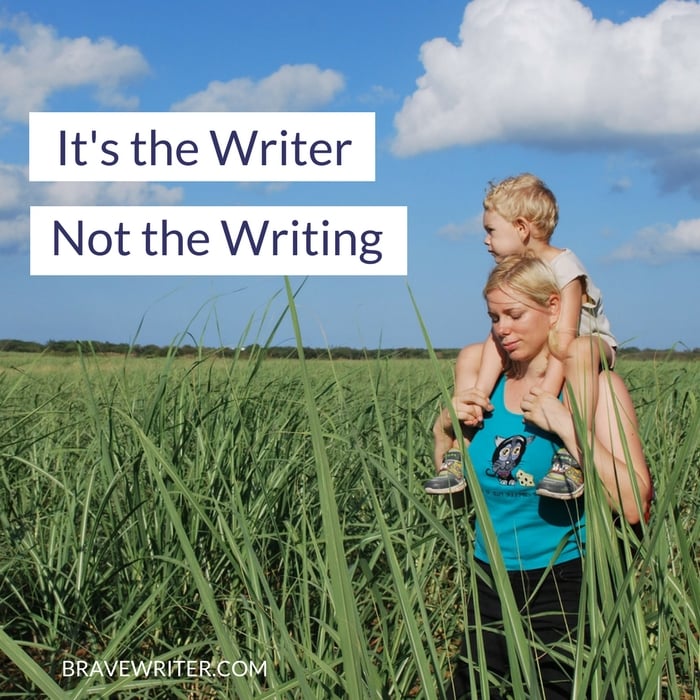
It’s the Writer, Not the Writing

It's the Writer, Not the Writing

It’s tempting to see writing as something a person does, as assignments to complete, as skills to acquire for an academic or career purpose.

It’s tempting to evaluate the writing a person does as though it is a set of math problems—measurable, impersonal, external.

It’s tempting to push for completion, because the assignment or project has a due date or has to be done for the end-of-the-year evaluation.

The paradigm shift is this:

Writing is not like other subjects. Writing is closely related to the self, no matter what the content. Even mothers sending me email get nervous thinking I will read their questions, and wonder what I will make of them, because they are undressing their minds right in front of me. What will I see? How will I react?

How much more kids feel that way?

  • Take the “school definition” out of writing (beware of the ghost of public school past).
  • Focus on the “writer” more than the “writing.”
  • Tears mean the lesson is over for the day.
  • Partial work is valuable.
  • Progress happens through a series of attempts, not through wrestling a single project to the perfected finish.
  • Self-expression is a risk and needs you to treat it gently.
  • Support helps—and help is helpful (not damaging, not cheating, not short-cutting).

Academic formats require as much “soul investment” as fan fiction and diaries. You must be just as gentle and curious with an expository essay as you were with the story about your child’s pet gerbil.

Writers express what lives inside them. Writing is the form it is put in. Expression deserves respectful care. Mechanics deserve minimal care. Expression matters the most. Mechanics are marginally important.

Work on the two components (mechanics and expression) separately and teach your writer to take responsibility for editing mechanics and getting someone to help him or her see what he or she can’t see without a second set of eyes.

That’s it. That’s all the attention mechanics deserve. They do not make or break the essence of the writing. They merely punctuate it, so someone else can approximate the tone and meaning the writer intends.

Brave Writer not brave writing.

Learn More: The Difference Between Brave Writer and Other Programs
Posted in Brave Writer Philosophy, Homeschool Advice, Writing about Writing | Comments Off on It’s the Writer, Not the Writing


Partnership Writing is here!

PartnershipWritingYou wanted:

Developmentally appropriate writing projects for your middlers.

Step-by-step instructions with models.

A weekly and monthly plan that puts it all together.

You got it!


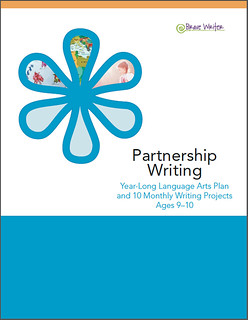
Partnership Writing
The Year-Long Language Arts Plan
and 10 Monthly Writing Projects
(9-10 year olds)

Partnership Writing is the second in our series of products that gives you developmentally appropriate writing projects for your kids in the partnership writing stage of development. Jot It Down! is the first.

Have you wondered why your writing assignments stall? Do you wonder why your kids give you a blank stare after you ask them to fill a blank page? Do you have a tough time creating writing assignments that are both creative (interesting) and academically sound (preparatory for essay writing)?

And just how do you put together a program that includes copywork and dictation, as well as the language rich environment you hope to foster in your home, while still teaching original writing?

Partnership Writing tackles it all!

It can work alone (as a tool you use to boost the power of your writing efforts with your kids) and it can work in tandem with other Brave Writer products: The Writer’s Jungle (the manual that teaches YOU how to teach writing), and The Arrow (the tool that provides you with great literature to read, grammar, spelling and punctuation help, and copywork/dictation passages).

Plus we have special bundles on the website for Partnership Writing + The Writer’s Jungle and/or The Arrow.

To learn more about the Partnership Writing stage of development (usually 9-10 year olds, but also good for younger advanced writers and older kids who struggle), you can check out our Getting Started with Brave Writer page. You can also listen to a podcast by me where I explain what Partnership Writing is.

This is the perfect product for you if you need help thinking of writing projects and want to know how to plan them for a month at a time.

Partnership Writing gives you the
practical,
step-by-step implementation of
what to write,
not just how to write.

DOWNLOAD A FREE SAMPLE!

Posted in BW products, Natural Stages of Growth in Writing, Young Writers | Comments Off on Partnership Writing is here!


Friday Freewrite: Up, Up, and Away!

Dreamin' - Hot Air Balloon RidesImage by Jesse Millan

If you soared over your neighborhood or town, what would you see?

New to freewriting? Check out our online guide.

Posted in Friday Freewrite | Comments Off on Friday Freewrite: Up, Up, and Away!


Let’s do some math

Try again

There are 180 days in the school year.

There are 36 weeks.

You have X number of children at writing age.

If you were to do one passage of copywork per week per child, you would have this equation:

36 x X = ______

So if you have 3 children at writing age, the answer is:

36 x 3 = 108 passages of copywork that you have supervised, corrected, and supported.

If you have a child who works to complete a single passage in a week by writing parts of it 2 or 3 times a week, that child is now working on handwriting and copying:

1 child x 3 days of handwriting (1 copywork passage) x 36 weeks = 108 days of writing 36 passages

3 kids x 2 days of handwriting (1 copywork passage) x 36 weeks = 216 days of supervising 36 passages (per child) of copywork

Can you see why you fall short sometimes? Can you see why adding a day of dictation or phonics worksheets or one more day of copywork can feel impossible, even though the actual daily practice is only 5-15 minutes at a time?

The hardest thing to do in homeschool is to sustain a routine without giving up when you don’t feel you’ve “hit the optimal practice.” Just like you wouldn’t abandon your daily math work just because you missed a week or a few days, you can take a similar approach to copywork and dictation. Get to it, as often as you can, within the weekly framework. When you miss, don’t let that derail you into *not* doing it at all.

Come back to the routine and try again. It’s better to have supervised 20 copywork attempts than 5. It’s better to have returned to the practice after being away from it, than to abandon it all together. Over years of time, you’ll see fruit from copywork and dictation, even if there are some (many) weeks you don’t get to it.

Posted in Dictation and copywork, Homeschool Advice | Comments Off on Let’s do some math


Love who you are

Love who you are

Have you noticed how easy it is to wish away your chief personality features? Do you think to yourself, “I’m the wrong personality for my temperament”? You might wish for a clean, orderly home in your heart, but your personality style is relaxed Bohemian. Or you are the sort who keeps a ship-shape house, but wish you could relax when your kids make big creative messes.

Layered on top of the structured versus unstructured selves we bring to homeschool are our memories of school. We compare what we do at home (even when we don’t want to) to what we experienced as children. We react against it (“I’m not doing that!) or we we suffer because of it (“I’m not teaching my kids anything”).

The temptation to overhaul our essential selves is powerful. Advertising everywhere tells us we are one tweak away from being the fantasy person in our heads. We may be able to resist Botox or Coach purses, but the seductress for home educators is any “method” that results in effortless, joyful learning where parents and kids get along all the time.

We hop from one program to the next like frogs on lily pads forgetting to consider which personality is implementing the philosophy!

Let me let you in on a little secret.

There’s no one personality type that is better for homeschooling than another.

Let me drill down further.

There’s no one personality type that is better for parenting, loving, nurturing than another.

Every type has its marvelous strengths, and (darn it all) each type has its blind spots and liabilities.

What you and I need to do is to become self aware people—able to recognize when our personalities are creating the hum of happiness and productivity, and when they are sapping the energy from the room and causing pain.

It isn’t always better to have a messy or a neat house.

Sometimes waking up to a clear kitchen table, fluffed pillows, books easy to access, and a freshly vacuumed carpet is the most nurturing way to start the day. If, however, the process of getting there ended an art project or removed a Robin Hood fort still lingering in the minds of your kids as they went to bed, the same cleared space in the morning may now feel like robbery:

“Where did you put my art project?”

“Do I really have to get out all the blankets again for my fort?”

The question to ask yourself as you move through the day isn’t “How can I be more relaxed?” or “How can I be more productive?”

You want to ask yourself a single question:

“How can I best serve this moment?”

I remember when I went to graduate school, I had just begun our unschooling experiment. It was a study in contrasts. I was being educated by highly trained academics with lectures, a syllabus, reading schedule, essay assignments, and tests. My kids were free to explore the world without any hindrance.

Or so I thought.

Love who you are

What became apparent to me after a semester surprised me. I loved graduate school. It felt nurturing to have someone care enough to create lessons, to show me what I should read to get a full view of the subject, to dialog with me from a position of investment and knowledge. I liked having a plan and a schedule. I felt relief. I had studied the subject area for five years on my own, and now I felt this surge of strength that came from guidance and support.

Meanwhile, the structures I had used in homeschool were on hold. I wanted my kids to feel free to learn what they wanted, to investigate any topic to their hearts’ content. A couple of them took off! But two floundered. They felt (strangely enough) unloved. They wouldn’t have used that language but in hindsight that’s what it was. They felt connected to me when I took the time to plan their lessons and guide their education. They lost that connection when I gave them “freedom.”

I spent hours on unschooling lists learning how to create the context, how to support an unschooling lifestyle, how to foster and nurture a rich learning environment. I didn’t “abandon” my kids to doing whatever they wanted unsupervised. Nevertheless, two of my children missed planned lessons and a structure for learning. I understood this because I was having a parallel experience in grad school.

What becomes so difficult to tease apart as a home educator is the idealized vision of learning that dances in our heads like sugar plums and the very real home and family we have. Our job isn’t to be more organized or more relaxed, more structured or completely free of structure.

Our job is to serve the moment—to serve the needs of our families from within the framework of our delightful personalities.

We can do that best when we lean into our strengths.

If you’re an orderly person, create happy order. Avoid the temptation to require everyone to be like you. Resist your tendency to nag or to have your feelings hurt when the rest of your gang is unenthusiastic for kitchen duty or keeping tables cleared. Straighten, file, assemble check lists, keep the sink empty, make the beds, plan the day. Enthusiastically offer your talent for creating a clean, peaceful, orderly, neat space to the family as a gift.

If you’re a relaxed, go-with-the-flow mom, stop pummeling your personality. Your home is cozy, it’s alive with activity, and it supports messes without stress. Keep big containers nearby for quick clean-ups, make a loose routine to follow each day (rather than a schedule), allow your kids who need order to create systems to support you and the family. Smile.

Do not worry that you aren’t getting enough done in either system or style. Focus on this moment. What is happening right now? How can I help it become a good moment? Shall I ease up and let the mess grow? Shall I hunker down and clear the space so something new can be born? Are we getting along and growing?

Above all: no system saves you. You will eventually go back to being who you are. Your job is to be the best you, you can be. Be the you that creates love and learning, not the you that worries and frets or ignores and pretends away.

You can even say to your kids in a moment of frazzledness:

“You know me! I need everything cleaned up before I can think straight. Anyone willing to help me so we get the day off to a good start? My brain is about to fall out of my head when I see shoes scattered everywhere. Cookies to the helpers!”

Or

“You know me! I can’t put a week-long system together for the life of me. Let’s make a quick list for today of things we want to study and do, and then put them in an order. Who wants to make the list with me? If today feels good, we can do it again tomorrow. Let’s eat cookies while we discuss.”

See? The goal isn’t to “reform” who you are and how you are. The goal is to be the best of yourself that you can be, acknowledging that within your strengths and weaknesses is a real human being doing the best she can. Your kids want to help you and they want to be themselves too.

They’ll learn to love who they are in direct proportion

to how well you love who you are.

Go forth and love yourself.

Posted in Brave Writer Philosophy, Homeschool Advice, Julie's Life, On Being a Mother, Unschooling | 16 Comments »


« Older Entries
Newer Entries »
  • Search the Blog

  • Julie Bogart
  • Welcome, I’m Julie Bogart.

    I’m a homeschooling alum -17 years, five kids. Now I run Brave Writer, the online writing and language arts program for families. More >>

    IMPORTANT: Please read our Privacy Policy.

  • New to Brave Writer? START HERE

  • FREE Resources

    • 7-Day Writing Blitz
    • Brave Writer Lifestyle Program
    • Brave Writer Sampler: Free Sample Products
    • Freewriting Prompts
    • Podcasts
  • Popular Posts

    • You have time
    • How writing is like sewing
    • Best curriculum for a 6 year old
    • Today's little unspoken homeschool secret
    • Do you like to homeschool?
    • Don't trust the schedule
    • You want to do a good job parenting?
    • If you've got a passel of kids
    • You are not a teacher
    • Natural Stages of Growth in Writing podcasts
  • Blog Topics

    • Brave Learner Home
    • Brave Writer Lifestyle
    • Classes
    • Contests/Giveaways
    • Friday Freewrite
    • High School
    • Homeschool Advice
    • Julie's Life
    • Language Arts
    • Movie Wednesday
    • Natural Stages of Growth
    • One Thing Principle
    • Our Team
    • Parenting
    • Philosophy of Education
    • Podcasts
    • Poetry Teatime
    • Products
    • Reviews
    • Speaking Schedule
    • Students
    • Writing about Writing
    • Young Writers
  • Archives

  • Brave Writer is a participant in the Amazon Services LLC Associates Program, an affiliate advertising program designed to provide a means for sites to earn advertising fees (at no extra cost to you) by advertising and linking to amazon.com

    Content © Brave Writer unless otherwise stated.

What is Brave Writer?

  • Welcome to Brave Writer
  • Why Brave Writer Works
  • About Julie
  • Brave Writer Values
  • Frequently Asked Questions
  • Speaking Schedule

Brave Writer Program

  • Getting Started!
  • Stages of Growth in Writing
  • The Brave Writer Program
  • For Families and Students
  • Online Classes
  • Brave Writer Lifestyle

…and More!

  • Blog
  • Classroom
  • Store
  • Books in Brave Writer Programs
  • Contact Us
  • Customer Service
  • Brave Writer Staff
© 2026 Brave Writer
Privacy Policy
Children's Privacy Policy
Help Center