Podcasts Archives - A Brave Writer's Life in Brief A Brave Writer's Life in Brief
  • Start Here
    • For Families
      Multiple Ages
    • Ages 5-7
      Beginning Writers
    • Ages 8-10
      Emerging Writers
    • Ages 11-12
      Middle School Writers
    • Ages 13-14
      High School Writers
    • Ages 15-18
      College Prep Writers
  • Shop
    • Product Collections
    • Bundles
    • Writing Instruction Manuals
    • Literature & Grammar/Punctuation
    • Composition Formats
    • Literature Singles
    • Homeschool Help
    • Book Shop
    • Special Offers
  • Online Classes
    • Class Descriptions
    • Class Schedule
    • Classroom
    • How Our Classes Work
    • Our Writing Coaches
    • Classes FAQ
  • Community
    • Brave Learner Home
    • What’s Happening
    • Blog
    • Podcast
    • Calendar
  • Cart
  • My Account
    • My Online Classes
    • My Account
  • My Account
    • My Online Classes
    • My Account
  • Start Here

    If you’re new to Brave Writer, or are looking for the best products for your child or family, choose from below:

    • For Families
      Multiple Ages
    • Ages 5-7
      Beginning Writers
    • Ages 8-10
      Emerging Writers
    • Ages 11-12
      Middle School Writers
    • Ages 13-14
      High School Writers
    • Ages 15-18
      College Prep Writers
  • Shop

    If you’re already familiar with Brave Writer products, go directly to what you’re looking for:

    • Product Collections Browse the full catalog in our shop
    • Bundles Everything you need to get started
    • Writing Instruction Manuals Foundational Writing Programs
    • Literature & Grammar/Punctuation Grammar, Punctuation, Spelling & Literary Devices
    • Composition Formats Writing Assignments for Every Age
    • Literature Singles Individual Literature Handbooks
    • Homeschool Help Homeschooling Tools and Resources
    • Book Shop Books associated with Brave Writer Programs
    • Special Offers
  • Online Classes
    • Class Descriptions
    • Class Schedule
    • Classroom
    • How Our Classes Work
    • Our Writing Coaches
    • Classes FAQ
  • Community
    • Brave Learner Home
    • What’s Happening
    • Blog
    • Podcast
    • Calendar
  • Search
  • Cart

Search Bravewriter.com

  • Home
  • Blog

A Brave Writer's Life in Brief

Thoughts from my home to yours

Archive for the ‘Podcasts’ Category

« Older Entries

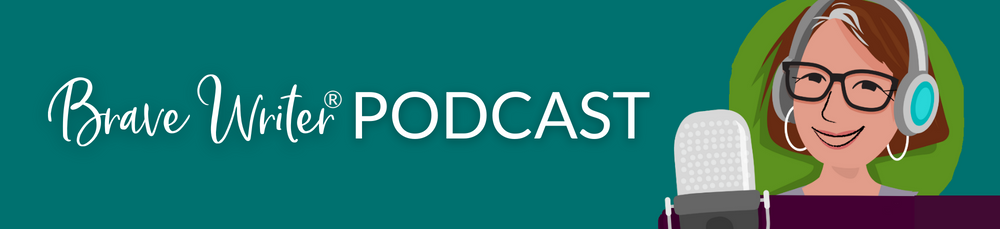
[Podcast #347] Part Two: ADHD and Homeschooling

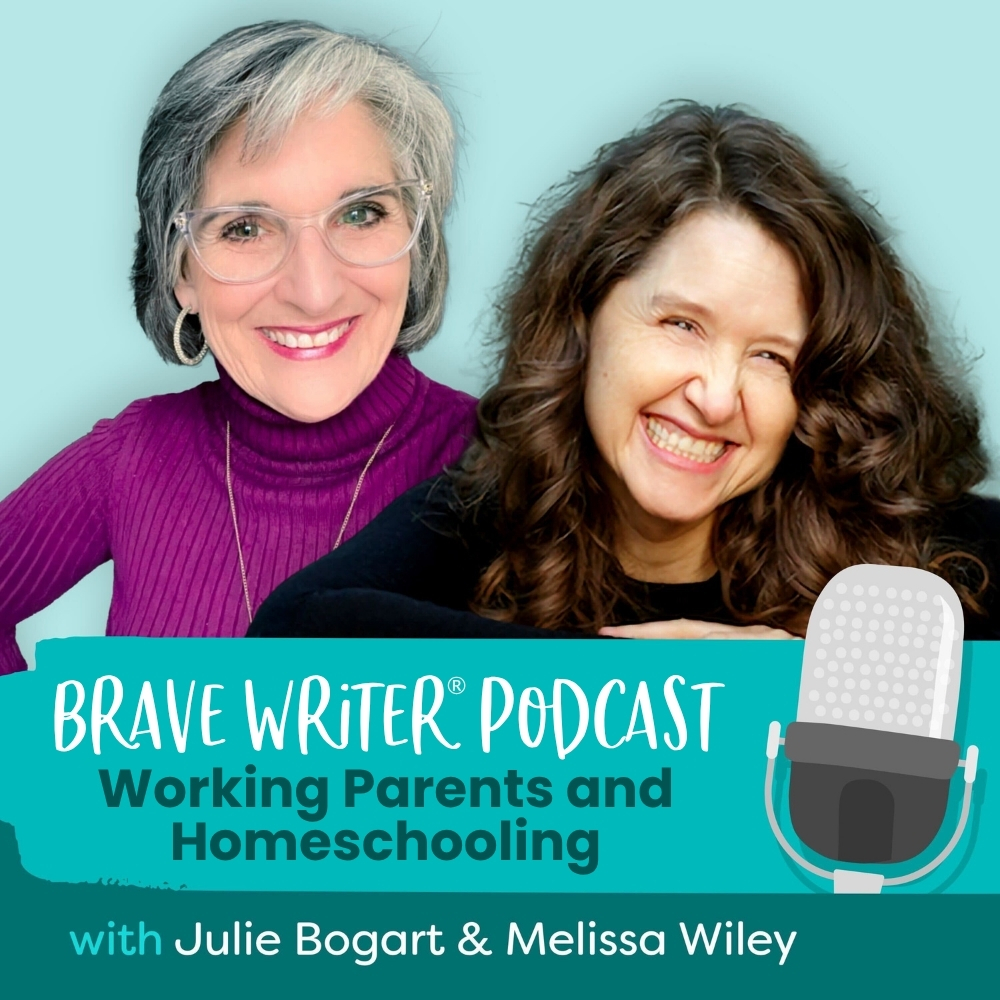
Brave Writer Podcast

Have you ever wondered whether your scattered systems, duplicate scissors, or frozen to-do list are actually character flaws, or clues to how your brain works? 

In this second conversation about ADHD in the homeschooling parent (here’s Part One), we look at the inattentive traits that can hide behind daydreaming, over-planning, lost objects, and task paralysis. We talk about accommodations, body doubling, medication, the ADHD tax, and why evaluations can miss neurodivergent homeschooled kids whose lives are already beautifully adapted to their needs. 

Most of all, we name the relief that comes when shame gives way to information. Tune in and let’s make room for every brain in the homeschool.

Show Notes

When Your Brain Has Its Own Homeschool Rhythm

Have you ever stood in the middle of your kitchen, surrounded by half-finished tasks, and wondered why everything feels harder than it should?

The laundry is waiting. The math book is open. Someone needs lunch. There is an email you meant to answer three days ago. You know what to do, at least in theory. Yet starting the next thing feels impossible.

For many homeschooling parents with ADHD or ADHD-like traits, this experience can become tangled with shame. We tell ourselves we are lazy, scattered, inconsistent, too much, not enough. We mistake brain wiring for moral failure.

But information changes everything.

When we understand the brain’s needs, we can stop asking, “What is wrong with me?” and begin asking, “What support would help this brain function better?”

That shift matters.

Some of us have been accommodating ourselves for years without knowing it. We keep multiple calendars. We buy scissors for every room because the one pair always disappears. We write better at the library because other people are quietly working. We invite a child to sit nearby while we tackle a project because another body in the room helps us stay present.

Those are not failures. They are strategies.

Accommodations are everywhere. Glasses help eyes focus. Hearing aids help ears receive sound. Quiet testing rooms help certain brains think. Body doubling, visual reminders, duplicate tools, timers, medication, therapy, and external accountability can all be ways of meeting a brain with what it needs.

Homeschooling can be beautifully forgiving for neurodivergent families because home education is flexible by nature. We can let the child move. We can follow interests. We can pause for snacks, read on the couch, or turn a hard day into a poetry teatime with store-bought cookies on a napkin.

That flexibility is a gift.

It can also hide needs.

A child who would struggle in a classroom may thrive at home because we have already adapted the environment. A child who never has homework cannot forget to turn it in. A child who keeps all the books in the house cannot forget to bring them home from school. A child who hyperfocuses on a beloved activity may not look “distractible” at all.

This is why curiosity matters.

Not panic. Not labels as verdicts. Curiosity.

We can pay attention to the child who cannot play alone unless a costume unlocks the imagination. We can notice the child who invites a friend over and then plays beside them rather than with them. We can check vision, hearing, speech, attention, sensory needs, and development. We can seek evaluations when our instincts tug at us.

A diagnosis does not reduce a child to a problem. It can give us a map.

The same is true for parents. Your limits are not an interruption to the homeschool. They are part of the homeschool. Every parent brings strengths and constraints. Some of us bring magic to language, conversation, and ideas. Some of us bring beauty to logistics, presentation, and order. Most of us bring a mix.

The goal is not to become a different person. The goal is to build a life where the real people in the room can learn, love, and grow with less shame.

Information helps with strategy. And strategy helps peace return.

Resources

  • DIVA questionnaire for ADHD: Advancedassessments.co.uk
  • Sign up for our free Brave Writer Summer Camp!
  • Check out the special offer at Talkbox.MOM/brave and start speaking a new language with your kids from day one!
  • Find our favorite readalouds and nonfiction in the Brave Writer Book Shop
  • Brave Writer class registration is open! 
  • Visit Julie’s Substack to find her special podcast for kids (and a lot more!) 
  • Purchase Julie’s new book, Help! My Kid Hates Writing
  • Find community at the Brave Learner Home 
  • Learn more about the Brave Writer Literature & Mechanics programs
  • Start a free trial of CTCmath.com to try the math program that’s sure to grab and keep your child’s attention
  • Subscribe to Julie’s Substack newsletters, Brave Learning with Julie Bogart and Julie Off Topic, and Melissa’s Catalog of Enthusiasms
  • Sign up for our Text Message Pod Ring to get podcast updates and more!
  • Send us podcast topic ideas by texting us: +1 (833) 947-3684
  • Interested in advertising with us? Reach out to media@bravewriter.com

Connect with Julie

  • Instagram: @juliebogartwriter
  • Threads: @juliebogartwriter
  • Bluesky: @bravewriter.com
  • Facebook: facebook.com/bravewriter

Connect with Melissa

  • Website: melissawiley.com
  • Substack: melissawiley.substack.com
  • Instagram: @melissawileybooks
  • Bluesky: @melissawiley.bsky.social

Produced by NOVA
Brave Writer Podcast

Posted in Podcasts | Comments Off on [Podcast #347] Part Two: ADHD and Homeschooling

[Podcast #346] Part One: ADHD and Homeschooling

Brave Writer Podcast

Join us for today’s Brave Writer podcast episode!

In this honest and eye-opening conversation, we explore what happens when the home educator begins to recognize ADHD traits in themselves. From task initiation and time blindness to hyperfocus, novelty, shame, doom boxes, and the relief of a diagnosis, we talk about how our wiring shapes the homeschool experience.

We also name the gifts:

  • enthusiasm,
  • curiosity,
  • side quests,
  • deep dives,
  • and the ability to turn education itself into a living adventure.

Tune in for Part One of a conversation many of us didn’t know we needed.

Show Notes

What If the Home Educator Has ADHD?

We spend a lot of time talking about how to support neurodivergent children. We look for the right strategies, the right accommodations, the right rhythm, the right language. We read the books. We consult the experts. We adjust the environment.

But what happens when we begin to recognize that some of those same traits live in us?

Many homeschooling parents are exquisitely attentive to their children’s needs while remaining strangely unaware of their own wiring. We notice the child who needs movement, fewer transitions, more time, less pressure, or a different path into learning. Meanwhile, we are the ones losing track of appointments, switching curriculum because the new thing feels alive, creating elaborate planner systems, avoiding the calendar because it triggers shame, or wondering why a simple task feels separated from us by an invisible wall.

That wall has a name for many people: task initiation.

Task initiation is not laziness. It is the experience of knowing what needs doing and still struggling to begin. The laundry is there. The email is there. The homeschool plan is there. Even the enjoyable activity is there. And yet, beginning can feel impossible until pressure, novelty, accountability, or hyperfocus finally kicks in.

For some of us, homeschooling works beautifully because it feeds the very traits we once thought were liabilities. Curiosity? That’s a homeschool superpower. Hyperfocus? Welcome to the deep dive. Love of novelty? Every library stack, unit study, poetry teatime, science experiment, rabbit trail, and historical obsession benefits from a parent who can become fascinated on demand.

The ADHD-style brain can bring enormous energy to home education. It can turn a child’s passing interest into a full-family immersion. It can learn alongside the child with sincerity. It can say yes to side quests. It can transform education from a checklist into a feast.

And it can also create stress.

A parent who loves novelty may change course too often. A parent who resists schedules may have a child who longs for one. A parent who underestimates time may turn every departure into a crisis. A parent who avoids the calendar may miss the appointment, double-book the day, or live under a cloud of dread.

This is where self-knowledge becomes a gift to the whole family.

We do not need shame to become better supported. We need information. A diagnosis, a pattern, a vocabulary word, or even a moment of recognition can help us stop moralizing our struggles and start building meaningful strategies.

Maybe that means alarms on the calendar. Maybe it means protected days when nothing gets scheduled. Maybe it means routines instead of rigid schedules. Maybe it means keeping snacks, water, and backup clothes in the car because “prepared” does not come naturally. Maybe it means apologizing when our wiring creates stress for someone else.

Homeschooling is not built by perfect parents.

It is built by human parents who keep learning.

When we understand our own brains, we are better able to create homes where everyone’s needs matter: the child who craves structure, the child who needs freedom, the parent who comes alive through novelty, and the family system that needs enough steadiness to hold it all.

The goal is not to become someone else. The goal is to know who we are well enough to build supports that let love, learning, and connection flourish.

Resources

  • DIVA questionnaire for ADHD: advancedassessments.co.uk
  • Sign up for our free Brave Writer Summer Camp!
  • Find our favorite readalouds and nonfiction in the Brave Writer Book Shop
  • Brave Writer class registration is open! 
  • Visit Julie’s Substack to find her special podcast for kids (and a lot more!) 
  • Purchase Julie’s new book, Help! My Kid Hates Writing
  • Find community at the Brave Learner Home 
  • Learn more about the Brave Writer Literature & Mechanics programs
  • Start a free trial of CTCmath.com to try the math program that’s sure to grab and keep your child’s attention
  • Subscribe to Julie’s Substack newsletters, Brave Learning with Julie Bogart and Julie Off Topic, and Melissa’s Catalog of Enthusiasms
  • Sign up for our Text Message Pod Ring to get podcast updates and more!
  • Send us podcast topic ideas by texting us: +1 (833) 947-3684
  • Interested in advertising with us? Reach out to media@bravewriter.com

Connect with Julie

  • Instagram: @juliebogartwriter
  • Threads: @juliebogartwriter
  • Bluesky: @bravewriter.com
  • Facebook: facebook.com/bravewriter

Connect with Melissa

  • Website: melissawiley.com
  • Substack: melissawiley.substack.com
  • Instagram: @melissawileybooks
  • Bluesky: @melissawiley.bsky.social

Produced by NOVA
Brave Writer Podcast

Posted in Podcasts | Comments Off on [Podcast #346] Part One: ADHD and Homeschooling

[Podcast #345] DIY Writing Retreats for Kids

Brave Writer Podcast

What if a writing retreat didn’t require a plane ticket to Ireland?

This week on the Brave Writer podcast, we explore what makes writing feel spacious, playful, and alive. From Julie’s memoir retreat on the Irish Sea to Melissa’s fiction experiments with point of view, we talk about how atmosphere, community, sensory detail, and low-stakes exploration can help writers of every age drop beneath the noise of daily life.

We also share practical ways to create a mini writing retreat at home for your kids, complete with snacks, freedom, feedback, and delight.

Join us as we reimagine writing as nourishment for the intellect and the spirit.

Show Notes

Create a Writing Retreat at Home

A writing retreat sounds luxurious, doesn’t it?

A lodge on the Irish Sea. Waves rolling in all night. Tea, notebooks, quiet mornings, and a room full of writers listening deeply to one another’s words.

Most of us are not packing for Ireland this summer. We have laundry to fold, meals to make, camps to drive to, toddlers to supervise, teens to text, and a dog who needs to go out again.

Still, the heart of a writing retreat is available to us.

A retreat is not magic because of the location. The location helps, of course. Beauty and quiet give the nervous system a chance to settle. But the real gift of a retreat is that it creates permission. Permission to slow down. Permission to notice. Permission to write without producing anything useful right away.

That kind of permission can happen at your kitchen table.

Start with safety.

Tell your kids that this is not a grammar day. No red pens. No grades. No “fixing.” Writing retreat writing is exploratory writing. We are playing with language the way we play with Legos. Dump the pieces out. Build something strange. Take it apart. Try again.

Then make it feel different from school. Light a candle. Put out snacks. Make tea or lemonade. Invite a few friends. Write outside under a tree. Bring clipboards to the porch. Let someone write under the table if that helps. Change the atmosphere, and you change the body’s expectations.

Instead of assigning a finished piece, offer experiments.

  • Write a memory in past tense. Then, the next day, write the same memory in present tense. Notice what changes. Does the scene feel more immediate? More chaotic? More visual?
  • Write a story from the hero’s point of view. Then write it from the villain’s. What does the “bad guy” notice that the hero missed?
  • Choose one object, like a baseball glove, a mixing bowl, a shell, a button, a pinecone. Look at it longer than seems necessary. Smell it. Touch it. Turn it over. Let the object reveal its personality. The physical world is often where metaphor begins.
  • Try a proverb prompt. Gather a handful of familiar sayings: “The early bird catches the worm,” “A watched pot never boils,” “Many hands make light work.” Ask your child to choose one and freewrite a real-life memory that somehow brushes against its meaning.

Most importantly, make sharing optional.

Writing is vulnerable. Even experienced writers can shake when reading personal work aloud. Children may cry, freeze, get silly, or collapse into giggles. Those responses are not misbehavior. They are the body’s way of handling the strange power of seeing private experience turned into words.

When kids do share, ask listeners to notice what they loved. A funny phrase. A surprising image. A sound pattern. A moment that made them lean in. Let feedback begin with delight.

A writing retreat at home does not need to last a week. It can be one morning. One afternoon. One picnic blanket and a notebook.

What matters is the shift: writing is not always a performance. Sometimes writing is a place to enter. A place to discover what we think, what we remember, what we feel, and what we have to say.

That is nourishment. That is the writing life.

Resources

  • Catch the replays of our free Brave Writer training webinars
  • Shop our June sale!
  • Find our favorite readalouds and nonfiction in the Brave Writer Book Shop
  • Brave Writer class registration is open! 
  • Visit Julie’s Substack to find her special podcast for kids (and a lot more!) 
  • Purchase Julie’s new book, Help! My Kid Hates Writing
  • Find community at the Brave Learner Home 
  • Learn more about the Brave Writer Literature & Mechanics programs
  • Start a free trial of CTCmath.com to try the math program that’s sure to grab and keep your child’s attention
  • Subscribe to Julie’s Substack newsletters, Brave Learning with Julie Bogart and Julie Off Topic, and Melissa’s Catalog of Enthusiasms
  • Sign up for our Text Message Pod Ring to get podcast updates and more!
  • Send us podcast topic ideas by texting us: +1 (833) 947-3684
  • Interested in advertising with us? Reach out to media@bravewriter.com

Connect with Julie

  • Instagram: @juliebogartwriter
  • Threads: @juliebogartwriter
  • Bluesky: @bravewriter.com
  • Facebook: facebook.com/bravewriter

Connect with Melissa

  • Website: melissawiley.com
  • Substack: melissawiley.substack.com
  • Instagram: @melissawileybooks
  • Bluesky: @melissawiley.bsky.social

Produced by NOVA
Brave Writer Podcast

Posted in Podcasts | Comments Off on [Podcast #345] DIY Writing Retreats for Kids

« Older Entries
  • Search the Blog

  • Julie Bogart
  • Welcome, I’m Julie Bogart.

    I’m a homeschooling alum -17 years, five kids. Now I run Brave Writer, the online writing and language arts program for families. More >>

    IMPORTANT: Please read our Privacy Policy.

  • New to Brave Writer? START HERE

  • FREE Resources

    • 7-Day Writing Blitz
    • Brave Writer Lifestyle Program
    • Brave Writer Sampler: Free Sample Products
    • Freewriting Prompts
    • Podcasts
  • Popular Posts

    • You have time
    • How writing is like sewing
    • Best curriculum for a 6 year old
    • Today's little unspoken homeschool secret
    • Do you like to homeschool?
    • Don't trust the schedule
    • You want to do a good job parenting?
    • If you've got a passel of kids
    • You are not a teacher
    • Natural Stages of Growth in Writing podcasts
  • Blog Topics

    • Brave Learner Home
    • Brave Writer Lifestyle
    • Classes
    • Contests/Giveaways
    • Friday Freewrite
    • High School
    • Homeschool Advice
    • Julie's Life
    • Language Arts
    • Movie Wednesday
    • Natural Stages of Growth
    • One Thing Principle
    • Our Team
    • Parenting
    • Philosophy of Education
    • Podcasts
    • Poetry Teatime
    • Products
    • Reviews
    • Speaking Schedule
    • Students
    • Writing about Writing
    • Young Writers
  • Archives

  • Brave Writer is a participant in the Amazon Services LLC Associates Program, an affiliate advertising program designed to provide a means for sites to earn advertising fees (at no extra cost to you) by advertising and linking to amazon.com

    Content © Brave Writer unless otherwise stated.

What is Brave Writer?

  • Welcome to Brave Writer
  • Why Brave Writer Works
  • About Julie
  • Brave Writer Values
  • Frequently Asked Questions
  • Speaking Schedule

Brave Writer Program

  • Getting Started!
  • Stages of Growth in Writing
  • The Brave Writer Program
  • For Families and Students
  • Online Classes
  • Brave Writer Lifestyle

…and More!

  • Blog
  • Classroom
  • Store
  • Books in Brave Writer Programs
  • Contact Us
  • Customer Service
  • Brave Writer Staff
© 2026 Brave Writer
Privacy Policy
Children's Privacy Policy
Help Center