Archive for the ‘One Thing’ Category

Pick one thing

Thursday, May 16th, 2013

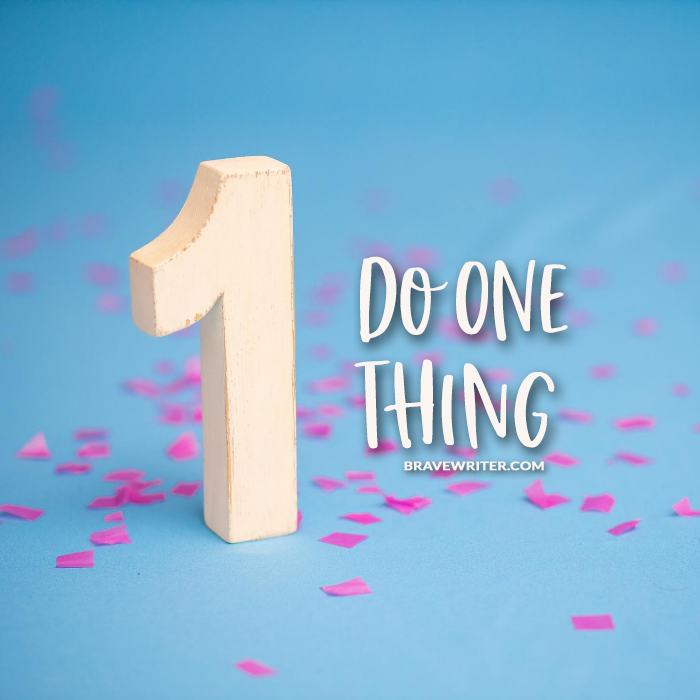
oneImage by andrechinn

You can’t do ten things, and your homeschool won’t transform itself over night.

What you want and what creates momentum is a series of deliberate, prepared choices that lead to a sense of accomplishment and satisfaction. You get there one thing at a time.

Pick the subject, practice, habit, or attitude you wish were more present in your home and “do it” or “have it” or “develop it.”

Identify the One Thing that is top of mind—that keeps coming back to you as the one thing you wish you were living.

Then follow the One Thing principles:

1. Prepare (ahead of time). Plan a date, purchase, make copies, organize, think about, read literature related to your one thing choice. Gather materials.

2. Execute (day of). Follow through with enough time to invest deeply without distraction. Turn off your phone, shut down your computer, don’t answer the door. Be fully present.

3. Enjoy (kids and you). Let yourself forget everything else but that experience/lesson. Be here now. Don’t do other things simultaneously, don’t think ahead to what you will do next. Engage.

4. Reminisce (later that day or the next or next week). Talk about what was fun, remember humor, honor connections, recollect what went well. Talk about when you might do it again.

I gave a podcast about this topic a few months ago. Check it out.

11 One Thing Principle

Tuesday, January 22nd, 2013

One Thing! I’ve written about the One Thing Principle many times on the blog. Today, though, I wanted to share with you in more detail about how to get that fantasy homeschool you imagine into the real world of your routine family practice. Noah shares about our family and what we did that he remembers and I am hoping that my comments will ease some of the frustration and doubt that get in the way of enjoying your time at home with your kids.

And forgive the silly picture. My business photo shoot included these shots of me with the numbers 1, 2, and 3 for possible inclusion in marketing materials. They turned out really silly… but then, maybe silly is a little bit what’s missing for all of us in this serious business of raising, nurturing, and educating our kids.

Please feel free to post questions about your unique family situation below or to share some successes. We don’t have a forum any more and I know your input does help those who are learning this brave new way of living.

5 tips to get you back in gear

Wednesday, January 2nd, 2013

DSCN3023.JPG Happy New Year, Brave Writer families!

Too bad we can’t settle into a “long winter’s nap” right about now. January insists that you be productive, so let’s look at 5 ways to do it that I hope are relatively painfree.

If you live down under: You just finished your big holiday and it’s summer vacation. Rock it! Have a great time. We in the north envy you, but we know it’s well deserved.

  1. Coziness first
    It’s winter in the northern hemisphere. Everyone is nicer to each other under cuddly blankets or with fires roaring or with tea and candles. Don’t “hit the workbooks” so much as invite everyone back to the routine with a little attention to snuggling and pleasing natural light. Remember that winter can create a sinking feeling—moodiness, depression, pessimism, loneliness—all due to loss of sunlight. So bring some inside and warm up the space. Keeping tables and counters clear seems to matter more in winter too.

  2. Read alouds second
    Nothing says “gentle return to education” like a new novel to read together. Pick something you loved as a child (not a new novel). This is “comfort food” time. Find the joy in the novels of your youth (pair it with The Arrow, if we have an issue created for it). This month’s issue (Jan 2013) is for Little Town on the Prairie (my favorite children’s book series of all time). You might also love reading Wind in the Willows to help foster the coziness you need (how can you resist Mole’s home?). Check out the Already Published Issues of The Arrow for more ideas.

    For older kids, you might simply designate a time that everyone reads to themselves at the same time. Shared reading time, with a fire, is amazingly intimate. It creates a dynamic of valuing literature and private reading experience, while also giving the home a moment of silence (akin to when a newborn baby is sleeping and a hush comes over the space). The Boomerang Already Published Issues is a great place to find titles to read.

  3. Make one plan
    Plan ahead and execute the One Thing you’ve been meaning to do all fall but never got to it. Check out our blog entry on how to focus on one thing at a time.
  4. Go on a field trip to…
    A nature center, a ski lodge, the library, an art museum, the movie theater, the zoo, a restaurant from another culture, your best friend’s house, McDonald’s playland (yes, sometimes that’s even a good idea in January), a shopping trip to China Town, or Little Saigon, or the Italian Quarter. Pick one. Plan it. Do it. Get OUT of the house.
  5. Add one novelty item to your homeschool
    This could be a new set of watercolors with an easel. You might purchase a whole set of dinosaur cookie cutters to go with your dinosaur unit and you will make playdoh and do cut outs. Maybe you add a bird feeder to the nearby tree and spend some time each day noting which birds show up. Get a new strategy board game or several decks of cards and teach everyone Solitaire. Even a new sled (for outside) or a mini trampoline (for the garage or basement) can inject some lively activity when you start to feel trapped indoors.

The main thing to remember is that January is the middle of the year. You can actually plug along nicely in your traditional education work (math, science, grammar work, reading, writing) because the quieter, slower months are conducive to all of that. Just remember to not let cabin fever take over. In those moments, remind yourself of this list and pick ONE to do!

The One Thing Principle

Tuesday, March 16th, 2010

I haven’t posted this for awhile, but it’s critical to good home education, good writing practice, good living! Before you read, take a deep breath. Take another. Maybe pour a second cup of tea. Did you know that you are more likely to feel successful in homeschooling if you do one thing really well today (invest in it, spend energy on it)? If you let other things go and are fully present for one thing, you’ll feel like you got a lot done. Conversely, if you do a whole bunch of things in a hurry, covering all the material, you will feel discouraged like you didn’t get enough done.

Depth, not breadth, creates momentum in the homeschool. Here’s how you can shift gears to doing one thing at a time… well.

The discussion of how to create a flexible routine as well as how to create a home context conducive to nurturing relationships prompts me to revisit a plank of the Brave Writer philosophy: The One Thing Principle. Some of you already know it well. Others of you are new to Brave Writer so this will help you begin to shift the paradigm from which you teach and guide your kids. Remember: we are home educators. We are not recreating school. One of the biggest advantages to being at home is the ability to go in-depth when studying or pursuing an interest. This is the key principle to help you do just that guilt free. Enjoy!

When was the last time you really tasted the food you ate? If you’re like me and millions of moms, you wolf down your meals in an attempt to clean your plate before someone in the family needs seconds, needs a face-wiped, needs to be breastfed, needs you on the phone.

It’s easy to run through the homeschool day the same way – Everyone’s doing math. Good. In just ten minutes I’ll get the older two started on spelling. While they’re spelling, I’ll read with the eight-year-old and nurse the baby. Then I’ll make lunch and think about which creative project will go with the history novel.

As you race along, you might even have the strange feeling of not having done anything worthwhile, even though you are exhausted and have been pushing the family at breakneck speed. There’s a sense in which we “hover” above our lives rather than living right inside them when we’re filled with obligations, good ideas, lots of children and the endless demands of email and phone calls that intrude on our best plans.

(more…)

It’s the Little Things…

Monday, October 26th, 2009

A reminder to do the little things that make for pleasantness in your home:

Have you….

    hugged your kids?
    surprised someone with a treat?
    tickled someone?
    made a joke?
    pointed out beauty to someone else?
    stopped to listen to laughter?
    looked out the window and saw, really saw, a bird?
    had an unhurried cup of tea?
    been thankful for good health?
    read something worth reading?
    smiled?
    jumped up and down to get your heart pumping?
    put on lipstick?
    read a poem?
    looked into your child’s eyes while she was telling you something?
    ate tasty food?
    gone for a walk?
    asked for a hug?
    admired a child’s good attitude?
    forgave yourself?
    wrote a few sentences?
    cleared the coffee table and put out something new to read or look at?
    lit a candle, put a flower in a vase, arranged the fruit in a bowl?
    inhaled deeply, exhaled slowly?

Hope so. Do any one of these and let your day unfold.

It’s the little things….

Finding a Rhythm

Thursday, October 22nd, 2009

The Brave Writer Lifestyle may be in danger of becoming a group of words that lose meaning. When I first chose the word “lifestyle” to express the kind of language arts and writing environment that I hope families can create, I did so because I wanted to undercut the negative associations with the word “curriculum.”

“Lifestyle” is a routine or habit of being that relishes good books, writing, poetry, language, talking, movie viewing, and listening. These habits of being will foster better spelling, deeper readings, insight into stories and plots, an appreciation for good writing, an ability to translate one’s thoughts into written expression, a sophisticated vocabulary, interest in languages, (especially one’s own), openness to all kinds of writing genres (including poetry, plays, fiction and non-fiction), and a general love for the language arts.

Because we use the term “lifestyle” so much around here, it might become just the third word in the trio that substitutes for what others might see as a curriculum.

A writing curriculum or a language arts program is geared toward mastering skills. They may, as a by-product, help you to deconstruct difficult grammar, discover a wonderful book or teach helpful writing techiniques. Additionally, a program offers structure and a linear step-by-step measurement of movement forward. This is why curricula and programs will never completely fall out of fashion and have their place! But they are not a lifestyle.

Brave Writer offers a different vision. We have certain practices we recommend that have proven beneficial for grammar and spelling, for writing and narrating. But they are simply that: habits or practices. They can be used to advantage or skipped for a time while a child investigates some other aspect of language or writing. You can use programs and curricula to support you in a targeted area of language arts or writing instruction (like an online class, or programs like the Arrow or Boomerang). But these are supports to the lifestyle, not substitutes for it.

A lifestyle implies habit and fluidity, routine and flexibility. You get to decide what is working and what is not.

For those who are “‘tweens” – between curricula and the vision of a lifestyle – let me offer you a single suggestion for how to embrace the lifestyle as you reorient yourselves.

Start with ONE thing.
Pick one activity or habit or practice or idea that sounds fun to you and do that first. Do it well. Don’t add to it.

So if you want to read poetry with your kids, go to the library and find a good poetry book. Just get a poetry book. Don’t get sixteen other books to read.

Share the book with your kids. Leave it on the coffee table. Read it at bedtime or with tea or during dinner. Let your kids read and hold it. Mark your favorite poems with bookmarks and reread them. Memorize a poem. Write one each morning on the white board. Write a poem in a notecard and keep it in your pocket all day, then reread it in the morning, in the grocery line and before you make dinner. Enjoy poetry.

Too often we rush through the ideas on our list of good ideas and then wonder why nothing is taking hold. Stop. Read the ONE book and see how much you can get out of it for a week.

Maybe you’ll illustrate poems, or copy them over, or read them at the dentist’s office, or memorize one to share with visiting relatives. Maybe you’ll want to write a poem yourself. Maybe your kids will. Maybe this book will lead you to another book of poems or to one single poet. Let it do its work. Don’t force it.

The point is that if you make poetry just one of the many things you must do this week to achieve the “Brave Writer Lifestyle,” you may not enjoy the poetry. You might find yourself thinking about how after you read the poetry book, you ought to be copying quotes into copy books. And what about freewriting? And will that subscription to the Arrow turn out to be worth it? Suddenly your mind is off of the poem and on “curriculum planning.”

Don’t fall for that trap.

Slow down. Start with one thing. You can build on one good experience. You’ll find that one positive language arts experience enriches the whole. Perhaps the poem you read will naturally lend itself to a discussion of theme (Gerard Manley Hopkins), or grammar (Lewis Carroll), or word choice (Jack Prelutsky), or even a historical moment that gives context to the poet’s writing (Langston Hughes).

When you have exhausted the poetry book, pick the next enticing idea. (Don’t pick the one you think you should pick – I give you permission to follow your enthusiasm.) Enjoy it. Live it.

Follow these steps:

  1. Prepare for the experience (get the book, buy the ingredients for a recipe for teatime, read ahead in the novel, order the film from Netflix – whatever the activity is).
  2. Set up the experience for success by picking a date and planning to execute it that day. Clear your day of other burdens. Focus.
  3. BE HERE NOW – while you are in the experience, don’t let your mind wander to math or orthodontist appointments or bills. Unplug the phone, turn the ringer off your cell, close the laptop. Enjoy what you are doing and do it fully, without guilt.
  4. Reminisce. When the experience ends, a few days later, talk about it. Remember what was enjoyable. Say it out loud, to your kids, to your friends. Write it up in a blog or email your mother. Be sure to validate the positive experience so that it becomes a memory to treasure and share.

You might notice that these steps work great for teatimes or trips to the art museum. What about something more philosophical like, listening attentively to your children? Start by thinking of all the ways you can be a better listener. Can you take one child out for coffee, another on a walk, swim with one at the Y, see a movie and then chat about it on the way home with yet another?

Do it! It counts. See where it leads.

Can you choose to sit on the couch for a minute today with one child? Might it work to put one child to bed and to lie on that bed for fifteen minutes to cuddle and converse? Do it! Plan it, set it up for success, be fully in the moment and then remember the good that came from it.

You can’t plan time for listening and then fill up your days with lots of busy work. Focus on listening and let that be the frame of reference for everything you do that week.

Allow this year to be the one where you taste-test all the great ideas. Some will stick. Some will bomb. The ones that energize you and your kids will become natural habits because they make you and your kids happy, and you see fruit in their lives.

After many months, you will find that you have a lifestyle all your own.

Taking time for you

Wednesday, June 24th, 2009

I know it’s tough to carve out time for you when you’ve got children who need lunch, rides, help and sleep. I have a few tricks up my sleeve for how to recharge even with kidlets at your feet. Let’s break these down into time allotments. So, for instance, if all you’ve got is 30 seconds, you can still take time for you.

30 Second Time Out

  • Splash water on your face
  • Steep a cup of tea
  • Look out a window and SEE a bird (name it if you can)
  • Put on lipstick
  • Look in the mirror and smile at yourself
  • Get a child to massage your shoulders
  • Stretch your body (arms over head, up on tip toes; or, sideways bends in each direction, feet apart)

5 Minute Time Out

  • Drink that cup of tea in one chair (don’t move – sit all the way through it)
  • Clear one annoying surface (couch, coffee table, kitchen counter)
  • Page through a new magazine (just page – you don’t have to read it)
  • Send a text to a friend
  • Put on make-up (quick version – mascara, blush, lip gloss) and earrings
  • Prop up your feet and lean head back; close your eyes
  • Take a brisk walk around your house (outside if possible)

15 Minute Break

  • Turn on music you pick (iPod, radio, speakers for your iPod)
  • Read poetry (get that book out and sit with a couple of poems)
  • Close your eyes and lie on the couch (eye pillow is really great if you have one)
  • Email someone
  • Walk down the block (alone if possible, or with baby in sling or backpack – keep house in sight)
  • Read one chapter of the book you want to read
  • Make your bed and straighten your bedroom

30 Minute Break

  • Combine some of the ideas above: tea with poetry and music, for instance
  • Take a run, do yoga, stretch, go for a bike ride, take a long walk
  • Focus on a project (for instance, put in 30 minutes toward playing piano or working on an art collage or planning a new kitchen)
  • Study something YOU want to study (design, art history, growing herbs, theology, nutrition, quilting)
  • Call a girlfriend
  • Take a nap (set the timer)
  • Take a shower

3 Hour Break

  • Get out of the house (that means, this break is planned so childcare is handled)
  • Go to a coffee shop, library or a natural setting like a park (rejuvenate)
  • See a movie with a girlfriend (or alone)
  • Eat out (choose some place tasty)
  • Visit an art museum without your kids
  • Go to a botanical garden
  • See a play
  • Write (if you write); Paint (if you paint); Craft (if you craft); Play music (if you play something)

If you can contrive a longer break, by all means take half a day or a full day. I used to take Monday nights (three hours) to go to the library. My husband would look after the kids (they were little!) and I’d reserve one of the library’s private conference rooms. I’d go in the room and either write (I was working on a book), write songs (I was learning guitar at the time and loved writing lyrics), pray (some weeks were like that) or cry (other weeks were like that). It was my time to use as I wished. I liked the library because no one could get to me, it was blissfully quiet and I would not be interrupted by anyone or anything.

Even tiny breaks are good. Put a flower in a vase, light a candle, eat one square of chocolate that you’ve hidden in your cupboard, straighten the photos on your refrigerator, brush your hair (feel the bristles on your scalp), make yourself smile, notice a reflection and see it… Be in the moment for a moment today. It helps.

The lens matters

Monday, June 1st, 2009

Caitrin has told me for years that she doesn’t like history. Her sister before her didn’t like it either. And naturally, I was a history major, totally happy to overdose on historical fiction. They, however, were not.

We tried the Story of the World books and the Brown Paper School ones. Caitrin was compliant, just not engaged. What really interested her, however, has been everything related to being female: fashion to abortion, women’s rights to make-up. Her appetite for these topics drove her out of the juvenile book section and smack into adult reading. Last week she found a book that completely captured her imagination: Women’s Letters (edited by Lisa Grunwald and Stephen J. Adler). This volume is enormous: nearly 800 pages of letters. They span our entire history from the Revolutionary War to nearly the present (Iraq War 2005). They are written to husbands, sons, daughters, sisters. Each letter has some kind of note to contextualize the circumstances or to explain idiomatic expressions current to that era.

Caitrin is enthralled. Suddenly her ability to retain information related to our country’s founding is effortless. The connections support the information. She’s able to retain the facts because they are related to something she cares about.

Last night as we were driving to deliver cookies to her customers (she has a cookie business, taken over from her older brother), she mentioned in the car, “I’d like to keep writing over the summer along with math. I’m realizing that I want to keep my routine going and to prepare for the day when I go to school.” I said I thought that was a brilliant plan. So we brainstormed some writing ideas and quickly found ourselves talking about letter writing. Could she write letters that reflect various eras? She liked that idea and then went on to discuss how our era has letter writing, but it’s electronic. She wondered how these letters would be preserved. She mused about the way letter writing had changed (was more informal, not so literate and beautiful to read; yet still so entertaining and compelling). We looked at what kind of women could have written letters in the 1700′s (highly educated, women of means) versus today (where nearly every girl in America can read and write and type).

It was a rich, interesting, interest-generated conversation. Her resistance to history had crumbled. As we pulled into the driveway, she said, “It’s so funny. I thought I didn’t like history. But I really do.” All I could think was, she hadn’t had the right lens for viewing it. I’m glad that she was our fifth child. It made it easier to trust the process and to “get out of the way.”

How do you get it all in, one thing at a time?

Friday, May 22nd, 2009

One of the most frequent questions I get about the “one thing” philosophy or the “flexible routine” is wondering how to get everything done. If we focus deeply on, say, art for several weeks, what happens to math? If we take our time planning a vegetable garden and then put in hours of planting and tending, are we neglecting reading aloud and history? The idea that you could get an education focusing on one thing at a time feels risky to most of us, particularly if we are being haunted by that familiar ghost of public school past. She’s the one that nags reminds you: There are seven subjects to cover in a day by 2:30 p.m., Missy!

The hardest part of adopting any philosophy is the emotional hurdle (letting go of the familiar to take on the new). One way to lower the anxiety associated with trying something new is to understand the philosophy a bit better first. So let’s tackle that now.

Think about life as an adult versus life as a student. Remember leaving high school or college? How did you feel about reading books? Did you want to dive right into medieval lit or tackle another business theory? Probably not. Exhaustion from juggling so many class lectures, ideas, tests, papers leads to a complete break from “studies” in any kind of formal sense. After a period of recovery (sometimes as long as a decade for some people), you found yourself curious about… something. Maybe it was quilting or photography, perhaps it was politics or business, or maybe you joined an adult soccer league or pilates class. The point is, when you found yourself attracted to an area of interest, you pursued it because… you were attracted to it.

Over time, these areas of interest led you into others. The freedom to think and do and be what you want are intoxicating and produce the best conditions for learning. You find yourself motivated by your own hunger, not by someone controlling what you do. And in fact, there is brain research that supports your adult style of learning. Apparently our brains do best when we have the opportunity to focus intently, allowing the greatest interconnection of ideas to occur simultaneously (what you already know relating to what you are now learning) and sequentially (how one thing leads to another).

As we look at our depth of learning as adults, the model doesn’t have to be so different for children. The biggest difference between us and them can be boiled down to several things:

1) Kids need to gather the skills to learn (reading, writing, computer literacy and basic math do provide the right foundation). That’s worth working on.

2) Kids need to know what’s out there that might interest them. They don’t have as much life experience as you do so they don’t know what could interest them without exposure to a wide array of activities, ideas and resources. Your primary job is to enhance their exposure to the wonderful feast that life is.

3) Kids need money. You are the adult with money. Their newly cultivated interests require lessons or museum visits or books or art supplies or tutors or DVDs or binoculars or cameras or musical instruments or ballet shoes or Vogue magazine subscriptions. Be sure to provide these. If you don’t have money, barter, swap, trade. Do what it takes to make it happen. (Two of my kids have run cookie businesses that have paid for Space Camp, all Apple products, wardrobes and music lessons.)

4) Kids need time. They learn best when they have time. That means creating space in your life for uninterrupted work. If that means investing hours in practicing soccer dribbling, then it does mean that some days. Think about how you learn. You can’t master quilting by working at it in 45 minute chunks. Too much work setting up the sewing machine, ironing board, etc. Kids need to know they have the morning to build the huge Lego castle or to rehearse a scene they want to perform or to hike to see birds in the canyon.

5) Kids need chauffeurs. You can provide rides. So do that for them.

6) Kids need your help and enthusiasm. When they work hard, they hit snags. They will need you to reread the instructions or find out a softer reed for the woodwind or to get a different coach or to help them stick with something when it gets hard. They need your praise, support, happiness and pride in their efforts. They also need partners (someone to play pokemon cards or to help direct the scene or to practice throwing the frisbee with).

If you support depth learning (while also facilitating their growth in the basics – writing, reading, computing and math skills), they will gradually gain momentum and will discover a fascinating web of relationships between what they care about and what they develop a taste for because of the way the two overlap. So, for instance, my 17 year old loves music (passionate about classical music of all kinds). That love has led the way to care about historical, philosophical and theological issues that were related to his classical music interest. Likewise, my son who is passionate about Warcraft online has learned typing, spelling and map reading/creating through that game.

Not any one subject has to teach it all, either. A passionate period of devotion to World War 2 will eventually give way to another area of interest (Greek mythology or bread baking). Mine the interest while it’s compelling, notice the interconnections, foster them. Then allow the next one to emerge.

I’ll talk more about the idea of requirements and particularly high school expectations in the coming week.

The One Thing Principle Redux

Sunday, May 10th, 2009

The discussion of how to create a flexible routine as well as how to create a home context conducive to nurturing relationships prompts me to revisit a plank of the Brave Writer philosophy: The One Thing Principle. Some of you already know it well. Others of you are new to Brave Writer so this will help you begin to shift the paradigm from which you teach and guide your kids. Remember: we are home educators. We are not recreating school. One of the biggest advantages to being at home is the ability to go in-depth when studying or pursuing an interest. This is the key principle to help you do just that guilt free. Enjoy!

When was the last time you really tasted the food you ate? If you’re like me and millions of moms, you wolf down your meals in an attempt to clean your plate before someone in the family needs seconds, needs a face-wiped, needs to be breastfed, needs you on the phone.

It’s easy to run through the homeschool day the same way – Everyone’s doing math. Good. In just ten minutes I’ll get the older two started on spelling. While they’re spelling, I’ll read with the eight-year-old and nurse the baby. Then I’ll make lunch and think about which creative project will go with the history novel.

As you race along, you might even have the strange feeling of not having done anything worthwhile, even though you are exhausted and have been pushing the family at breakneck speed. There’s a sense in which we “hover” above our lives rather than living right inside them when we’re filled with obligations, good ideas, lots of children and the endless demands of email and phone calls that intrude on our best plans.

(more…)