Podcasts Archives - Page 8 of 75 - A Brave Writer's Life in Brief A Brave Writer's Life in Brief
  • Start Here
    • For Families
      Multiple Ages
    • Ages 5-7
      Beginning Writers
    • Ages 8-10
      Emerging Writers
    • Ages 11-12
      Middle School Writers
    • Ages 13-14
      High School Writers
    • Ages 15-18
      College Prep Writers
  • Shop
    • Product Collections
    • Bundles
    • Writing Instruction Manuals
    • Literature & Grammar/Punctuation
    • Composition Formats
    • Literature Singles
    • Homeschool Help
    • Book Shop
  • Online Classes
    • Class Descriptions
    • Class Schedule
    • Classroom
    • How Our Classes Work
    • Our Writing Coaches
    • Classes FAQ
  • Community
    • Brave Learner Home
    • What’s Happening
    • Blog
    • Podcast
    • Calendar
  • Cart
  • My Account
    • My Online Classes
    • My Account
  • My Account
    • My Online Classes
    • My Account
  • Start Here

    If you’re new to Brave Writer, or are looking for the best products for your child or family, choose from below:

    • For Families
      Multiple Ages
    • Ages 5-7
      Beginning Writers
    • Ages 8-10
      Emerging Writers
    • Ages 11-12
      Middle School Writers
    • Ages 13-14
      High School Writers
    • Ages 15-18
      College Prep Writers
  • Shop

    If you’re already familiar with Brave Writer products, go directly to what you’re looking for:

    • Product Collections Browse the full catalog in our shop
    • Bundles Everything you need to get started
    • Writing Instruction Manuals Foundational Writing Programs
    • Literature & Grammar/Punctuation Grammar, Punctuation, Spelling & Literary Devices
    • Composition Formats Writing Assignments for Every Age
    • Literature Singles Individual Literature Handbooks
    • Homeschool Help Homeschooling Tools and Resources
    • Book Shop Books associated with Brave Writer Programs
  • Online Classes
    • Class Descriptions
    • Class Schedule
    • Classroom
    • How Our Classes Work
    • Our Writing Coaches
    • Classes FAQ
  • Community
    • Brave Learner Home
    • What’s Happening
    • Blog
    • Podcast
    • Calendar
  • Search
  • Cart

Search Bravewriter.com

  • Home
  • Blog

A Brave Writer's Life in Brief

Thoughts from my home to yours

Archive for the ‘Podcasts’ Category

« Older Entries
Newer Entries »

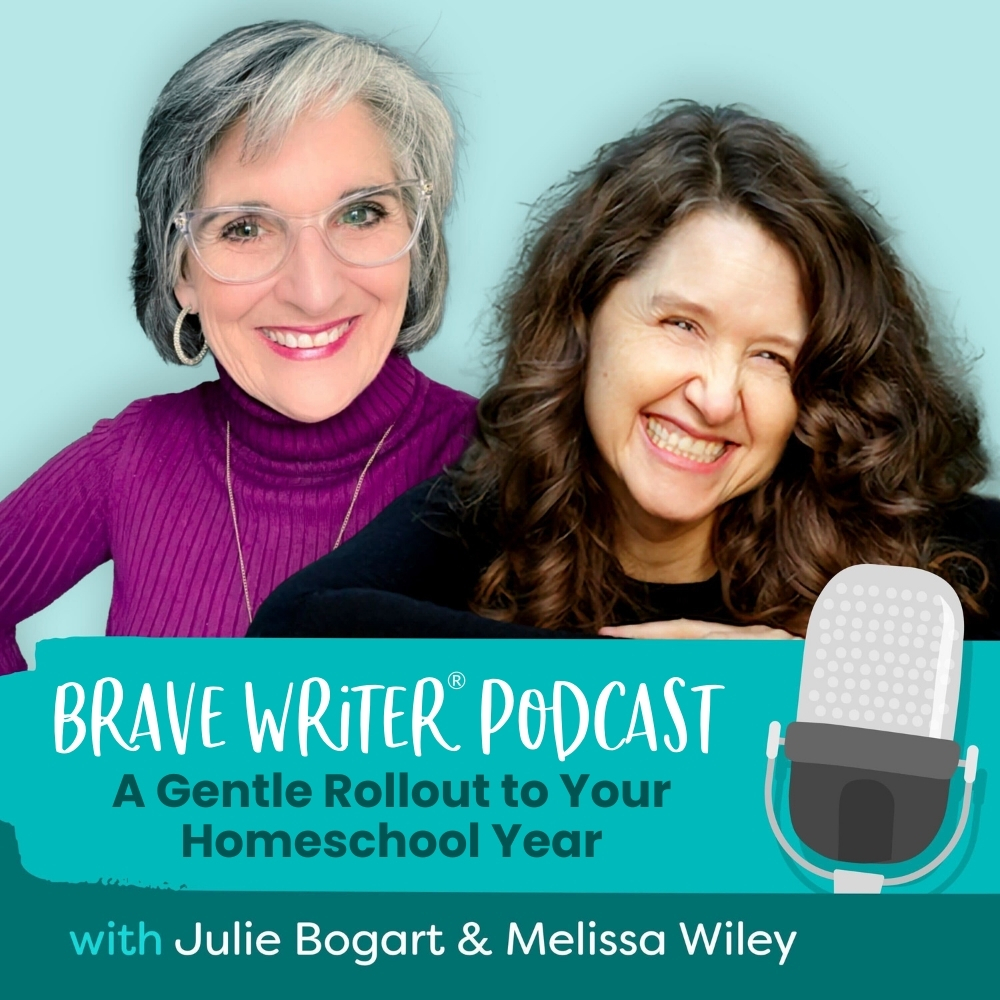
[Podcast #301] A Gentle Rollout to Your Homeschool Year

Brave Writer Podcast

One of the best parts of homeschooling is the freedom to start the year in a way that works for your family. Instead of overwhelming everyone with a full schedule on day one, you can begin with connection and fun—like a “Not Back to School” outing, a day of games, or a creative project.

Personal notes to each child, wish lists of activities, and a few well-chosen dates on the calendar can keep momentum going all year. By adding subjects gradually, stocking up on creative supplies, and valuing the experience of learning, you set the tone for a joyful, sustainable year.

In this Brave Writer podcast episode, we share practical tips, creative ideas, and mindset shifts to help you roll out your homeschool year gently while building:

  • curiosity,
  • creativity,
  • and connection.

Listen in for ways to make your start feel exciting and doable—for both you and your kids.

Show Notes

Personal notes to spark connection

Write a short, personalized note to each child, sharing what you’re looking forward to learning together this year. Mention both academic goals and personal interests—maybe learning fractions, teaching you a favorite card game, or visiting the zoo. These little notes communicate that you see and value your child as a whole person.

Invite your kids to share their own “wish list” for the year. By scheduling a few of these special activities on the calendar—like an apple-picking trip or skipping math for a day—you give them something to look forward to and break up routine fatigue.

Feather in academics

Instead of starting with a full schedule, introduce one subject at a time over several days. Begin with a beloved read-aloud, then add math the next day, history the day after, and so on. This approach prevents burnout and allows everyone to ease into new materials and routines.

For subjects like math, spark interest by letting kids flip through the year’s book and choose a page they find intriguing. Use that as a goal to work toward, identifying the skills needed to get there. This gives learning a sense of purpose and progression.

Stock up on supplies for creativity

A well-stocked supply cabinet is the secret weapon of a smooth homeschool start. Overfill it with markers, scissors, glue sticks, manipulatives, art paper, modeling clay, dress-up clothes, and other open-ended materials. Having resources on hand means you can follow inspiration without a midday store run.

For younger children, prioritize large paper for big movements; for older ones, consider giving them more control over their tools—perhaps a favorite mug, notebook, or even a backpack if they want one. And remember: quality paper can make even the cheapest watercolors look beautiful.

Value the experience of learning

A gentle rollout isn’t just about pacing—it’s about atmosphere. Do fairy wings make math more fun? Does a glue gun help bring a story to life? These touches make learning feel good, which keeps kids engaged.

There’s no need to stand up your whole homeschool in the first week—or even the first month. Start small, layer in new elements, and focus on building an environment that fosters creativity, curiosity, and connection. Over time, the routines will form naturally, and your homeschool year will be off to a joyful, sustainable start.

Resources

  • Find Prang watercolors, Prismacolor pencils, and other irresistible art supplies in the Brave Writer Book Shop
  • Fall class registration is open! 
  • Visit Julie’s Substack to find her special podcast for kids (and a lot more!) 
  • Purchase Julie’s new book, Help! My Kid Hates Writing
  • Brave Learner Home: https://bravewriter.com/brave-learner-home
  • Learn more about the Brave Writer Literature & Mechanics programs
  • Start a free trial of CTCmath.com to try the math program that’s sure to grab and keep your child’s attention
  • Give your child the gift of music! Sign up for a free month of private lessons with Maestro Music and let your child discover their own musical voice: www.maestromusic.online/brave
  • Subscribe to Julie’s Substack newsletters, Brave Learning with Julie Bogart and Julie Off Topic, and Melissa’s Catalog of Enthusiasms
  • Sign up for our Text Message Pod Ring to get podcast updates and more!
  • Send us podcast topic ideas by texting us: +1 (833) 947-3684

Connect with Julie

  • Instagram: @juliebogartwriter
  • Threads: @juliebogartwriter
  • Bluesky: @bravewriter.com
  • Facebook: facebook.com/bravewriter

Connect with Melissa

  • Website: melissawiley.com
  • Substack: melissawiley.substack.com
  • Instagram: @melissawileybooks
  • Bluesky: @melissawiley.bsky.social

Produced by NOVA

Brave Writer Podcast

Posted in Podcasts | Comments Off on [Podcast #301] A Gentle Rollout to Your Homeschool Year

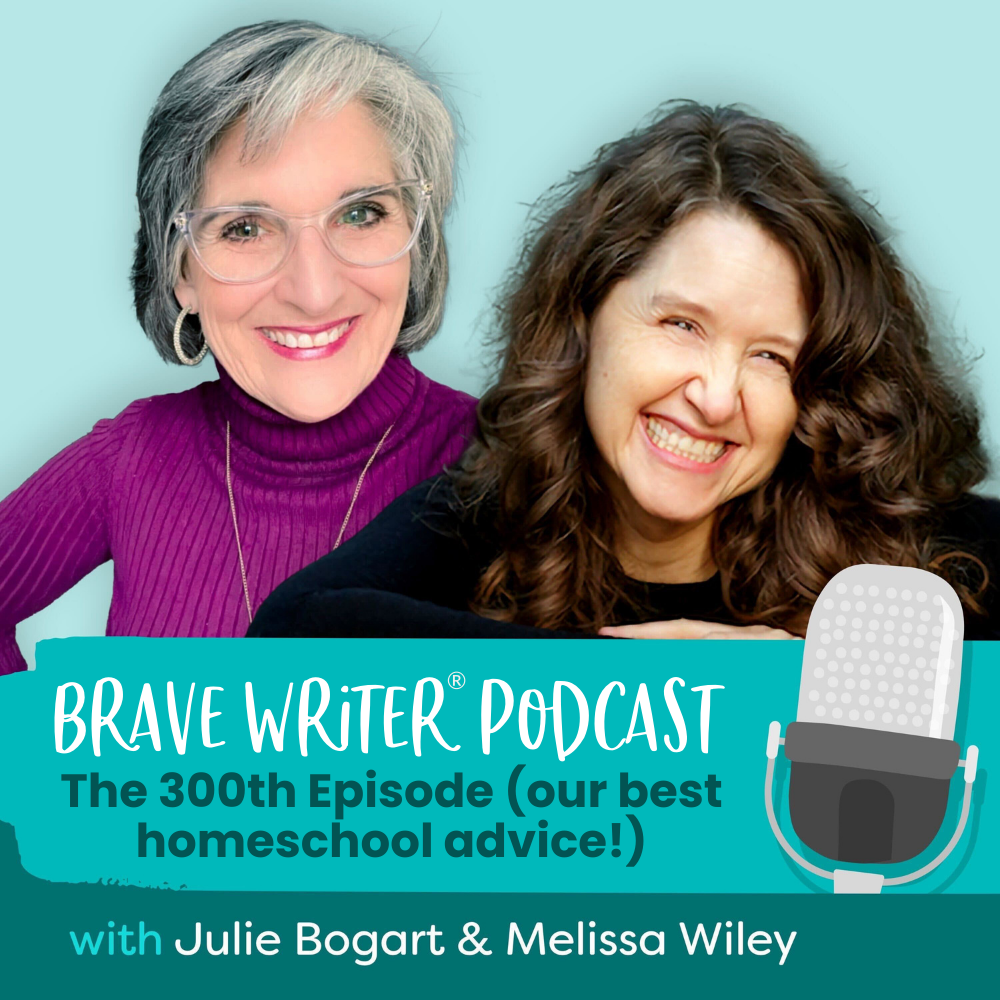
[Podcast #300] The 300th Episode (our best homeschool advice!)

Brave Writer Podcast

Homeschooling isn’t about perfection—it’s about connection, curiosity, and adapting to your family’s needs.

In this Brave Writer podcast episode (our 300th!), we revisit three core principles that have guided our approach through the years:

  1. honoring spontaneous self-expression by jotting down our children’s words,
  2. remembering there are no educational emergencies (kids learn at their own pace),
  3. and staying flexible by changing the topic or the context when resistance pops up.

When we let go of pressure and focus on our children’s interests, we create an environment where learning truly thrives.

Show Notes

If there’s one thing we’ve learned over years of supporting homeschooling families, it’s this: the secret to a thriving homeschool isn’t about having the perfect curriculum or checking every box. It’s about connection, curiosity, and adapting to the ever-changing landscape of family life and learning. With each season, we return again and again to a set of core principles that make home education both joyful and sustainable.

Jot It Down: The Power of Capturing Spontaneous Self-Expression

One of the most transformative practices we’ve seen in home education is what we call “jot it down.” At its heart, this practice is about catching your child in the act of spontaneous self-expression—those magical moments when a child shares an observation, tells a story, or explains an idea bubbling up from their world.

Rather than treating these outbursts as distractions or fleeting moments, we honor them by writing them down, word for word, as close as we can recall. We might use a notebook, a slip of paper, or even a whiteboard on the fridge. When we capture our children’s words, we’re telling them, “Your ideas matter. Your words are worth remembering.” This simple act validates their voice and allows them to see themselves as writers, long before they master penmanship or spelling. Over time, these little jottings become cherished keepsakes and a powerful tool for building confidence and literacy.

There Are No Educational Emergencies

Homeschooling can feel urgent. The pressure to keep up with school standards, meet testing requirements, or compare our children’s progress with others can create anxiety. But we stand by the principle that there are no educational emergencies. Children learn at different rates in different subjects, and our job isn’t to keep pace with anyone else’s timeline. Instead, we meet our kids exactly where they are—whether they’re racing ahead in one area or taking their time in another.

If a child struggles, it’s not a crisis; it’s information. It’s an invitation to adapt, to slow down, or to seek extra help if needed. Testing and evaluations can be helpful for insight, but they’re not a referendum on your child or your abilities as a home educator. When we lower the pressure, we make room for genuine growth, mastery, and the joy of learning.

Change the Topic, Change the Context

When we hit resistance—a child refusing to write, dreading math worksheets, or tuning out during history—it’s time to change something. Sometimes the answer is to change the context: make math a game, act out grammar concepts, or take learning outside. Other times, we change the topic: instead of writing about a history lesson, maybe your child writes about dinosaurs or video games. The skill—whether it’s writing, reading, or critical thinking—matters more than the specific subject. By honoring our children’s interests and experimenting with new approaches, we keep learning alive and meaningful.

The Homeschool Journey Is Ours to Create

At the end of the day, homeschooling is about creating a life of learning together. When we listen, adapt, and celebrate our children’s unique paths, we set the stage for not just academic achievement, but family connection and lifelong curiosity. Let’s give ourselves permission to slow down, change course, and delight in the little victories. That’s where the magic happens.

Resources

  • Check out what Maestro Music is doing for homeschool families (and they’re offering a full month of free private lessons!)
  • Brave Learner Home: https://bravewriter.com/brave-learner-home
  • Fall class registration is open! 
  • Purchase Julie’s new book, Help! My Kid Hates Writing!
  • Julie’s new author website: juliebogartwriter.com
  • Subscribe to Julie’s Substack newsletters: Brave Learning with Julie Bogart and Julie Off Topic
  • Try out our Brave Writer Practice Pages
  • Learn more about the Brave Writer Literature & Mechanics programs
  • Read all Brave Writer class descriptions
  • Start a free trial of CTCmath.com to try the math program that’s sure to grab and keep your child’s attention
  • Sign up for our Text Message Pod Ring to get podcast updates and more!
  • Send us podcast topic ideas by texting us: +1 (833) 947-3684

Connect with Julie

  • Instagram: @juliebogartwriter
  • Threads: @juliebogartwriter
  • Bluesky: @bravewriter.com
  • Facebook: facebook.com/bravewriter

Connect with Melissa

  • Website: melissawiley.com
  • Substack: melissawiley.substack.com
  • Instagram: @melissawileybooks
  • Bluesky: @melissawiley.bsky.social

Produced by NOVA
Brave Writer Podcast

Posted in Podcasts | Comments Off on [Podcast #300] The 300th Episode (our best homeschool advice!)

[Podcast #299] Would You Let a Chatbot Homeschool Your Child?

Brave Writer Podcast

Do you ever wonder what’s at stake when we hand over our children’s education to automation and AI?

In this Brave Writer podcast episode, we explore how the rise of influencer-driven resources and tech-powered learning tools is reshaping homeschooling—and what we risk losing when we outsource the most human parts of education.

We discuss:

  • why real learning thrives on meaningful connection,
  • hands-on experiences,
  • and the expertise of educators and parents who care deeply about kids, not just content.

As homeschooling changes, let’s remember to center our children’s education on relationships, shared adventures, and the joy of learning together.

Show Notes

Recently, the homeschooling landscape has been transforming at a dizzying pace. Gone are the days when the core of home education was built on the vision, commitment, and daily involvement of parents. Instead, we see a new wave of influencer-driven, affiliate-marketed resources—and now, the encroachment of AI-powered learning tools promising to teach our children for us.

The Shift from Community to Commodity

Not so long ago, homeschooling meant seeking out the wisdom of real educators and passionate parents. We read thoughtful blog reviews, weighed the merits of various curricula, and engaged in robust debates about educational philosophy. The focus was always on our children’s unique personalities and the adventure of learning together.

Today, much of that has been eclipsed by a rapid, influencer-fueled affiliate culture. Homeschooling resources are promoted in quick, soundbite formats, and the lines between thoughtful review and advertising have blurred. Social media is awash with sponsored content and programs designed to sell—not necessarily to educate.

This commodification of home education has left some parents feeling lost. We see families looking for shortcuts—solutions that require less direct involvement. The rise of AI tutors and automated programs seems to answer that call, promising personalized, tireless instruction without demanding much from the parent. But is that really what we want for our children?

What We Lose When We Hand Off the Human Element

The true heart of homeschooling is relational, not transactional. The greatest educational gains don’t come from outsourcing to an algorithm, but from the day-to-day adventure of learning together as a family. It’s the shared jokes, spontaneous science lessons at the kitchen sink, reading aloud on the couch, or the comfort of a parent’s encouragement after a tough day. These are the memories and connections that shape not just a child’s education, but their sense of self and belonging.

AI can be a useful tool—it can drill math facts, organize schedules, or help find resources quickly. But it cannot replicate the irreplaceable magic of human connection: a parent noticing the spark in a child’s eye, adapting a lesson on the fly, or celebrating small wins with a hug. We believe that education is a life, not just a checklist of subjects completed.

The Value of Expert Voices and Shared Wisdom

When we support resources created by experienced educators and passionate parents, we invest in the richness of our children’s learning experience. These small businesses may not have the marketing muscle of tech giants, but their offerings are shaped by real-world experience and a genuine love of learning. Let’s continue to champion companies whose expertise and values align with our own.

A Call to Meaningful Connection

As homeschooling continues to evolve, let’s not lose sight of what drew many of us to it in the first place: the joy of learning together, the freedom to explore, and the deep bonds we build with our children. AI and automation will never replace the life-giving, relationship-driven heart of home education.

Resources

  • Brave Learner Home: https://bravewriter.com/brave-learner-home
  • Fall class registration is open! 
  • Purchase Julie’s new book, Help! My Kid Hates Writing!
  • Check out Julie’s new author website: juliebogartwriter.com
  • Subscribe to Julie’s Substack newsletters: Brave Learning with Julie Bogart and Julie Off Topic
  • Try out our Brave Writer Practice Pages
  • Learn more about the Brave Writer Literature & Mechanics programs
  • Read all Brave Writer class descriptions
  • Start a free trial of CTCmath.com to try the math program that’s sure to grab and keep your child’s attention
  • Sign up for our Text Message Pod Ring to get podcast updates and more!
  • Send us podcast topic ideas by texting us: +1 (833) 947-3684

Connect with Julie

  • Instagram: @juliebogartwriter
  • Threads: @juliebogartwriter
  • Bluesky: @bravewriter.com
  • Facebook: facebook.com/bravewriter

Connect with Melissa

  • Website: melissawiley.com
  • Substack: melissawiley.substack.com
  • Instagram: @melissawileybooks
  • Bluesky: @melissawiley.bsky.social

Produced by NOVA
Brave Writer Podcast

Posted in Podcasts | Comments Off on [Podcast #299] Would You Let a Chatbot Homeschool Your Child?

[Podcast #298] Wise Effort with Diana Hill  

Brave Writer Podcast

Have you ever felt exhausted from giving your all, yet still worried you aren’t doing enough?

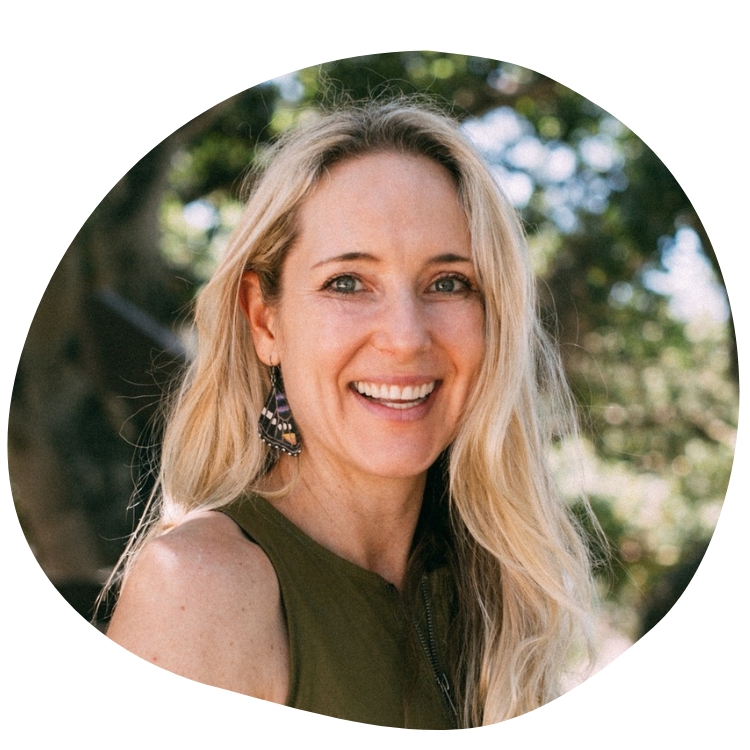
In this Brave Writer podcast episode, we’re joined by Dr. Diana Hill, clinical psychologist, podcast host, and author of Wise Effort: How to Focus Your Genius Energy on What Matters Most. Diana shares her refreshing, science-based approach to reclaiming our natural strengths and using our “genius energy” wisely, rather than trying to fix ourselves or do more.

Dr. Diana Hill
Dr. Diana Hill

We explore:

  • how our gifts can sometimes get off track,
  • why honoring paradox and values leads to better solutions,
  • and how building wise habits starts with small moments of self-awareness.

Diana’s wisdom encourages us to embrace interdependence and resilience, transforming not just ourselves but our communities.

Listen to the full episode for more practical strategies and inspiration from Diana Hill on how to bring wise effort—and more joy—into your family and life.

Show Notes

A New Approach to Genius Energy

Diana Hill challenges the cultural obsession with self-improvement. Rather than suggesting we “fix” ourselves, she encourages us to notice and honor the unique “genius energy” already present in each of us—those qualities and strengths that come naturally, whether it’s emotional sensitivity, persistence, idea generation, or being a calming presence. Her approach blends psychological science with a touch of the mystical, encouraging us to see our personalities not as problems to be solved but as gifts to be directed with wisdom.

When Our Gifts Go Off Track

One of Diana’s key insights is that our greatest strengths are often double-edged swords. That genius quality—be it creativity, responsibility, or drive—can help us flourish, but when we overuse or misuse it, we risk burnout and disconnection. Diana outlines how our genius can go off track: when we get stuck in old stories about ourselves, when we use our strengths to avoid discomfort, or when we cling too tightly to familiar roles and routines. The solution is not to abandon these gifts but to become more skillful and flexible in their use.

Embracing Paradox, Prioritizing Values

Through her Wise Effort podcast and writing, Diana encourages us to welcome the paradoxes of life. We can hold multiple values at once—creativity and order, solitude and connection, responsibility and rest. Instead of treating these as conflicts to be resolved, she guides us to experiment and reflect, finding creative solutions that align with our values and our family’s needs. Sometimes, as Diana shares from her own homeschooling experience, that means brainstorming ways to honor both a child’s creative messiness and a parent’s need for calm, perhaps by moving the activity outside or creating new routines together.

Building Wise Habits, Moment by Moment

Diana’s “wise habits” framework is a refreshing alternative to traditional habit advice. Rather than rigid routines, she focuses on “choice points”—those moments when we notice ourselves drifting from our values. By pausing and checking in with our inner awareness (what Diana calls the “heart-mind”), we can make small, compassionate shifts that lead to more meaningful, regenerative effort.

The Beauty of Interdependence

Perhaps Diana’s most powerful message is the importance of interdependence. Drawing on ideas from Buddhist teacher Thich Nhat Hanh, she reminds us that resilience and growth come from our connections with friends, family, and community. When we seek help, offer support, and allow others to shine in their genius, we all thrive.

Through Diana Hill’s lens of wise effort, we’re invited to move beyond exhaustion and perfectionism, discovering more joy, creativity, and connection in our daily lives. Her work is a timely reminder that our energy is precious, and when directed with wisdom, it can transform both ourselves and those we love.

Resources

  • Learn more on Diana’s website: https://drdianahill.com/
  • Check out Diane’s books: https://drdianahill.com/books/
  • Find Wise Effort and How to Love the World at the Brave Writer Bookshop
  • Brave Learner Home: https://bravewriter.com/brave-learner-home
  • Fall class registration is open! 
  • Purchase Julie’s new book, Help! My Kid Hates Writing!
  • Check out Julie’s new author website: juliebogartwriter.com
  • Subscribe to Julie’s Substack newsletters: Brave Learning with Julie Bogart and Julie Off Topic
  • Try out our Brave Writer Practice Pages
  • Learn more about the Brave Writer Literature & Mechanics programs
  • Read all Brave Writer class descriptions
  • Start a free trial of CTCmath.com to try the math program that’s sure to grab and keep your child’s attention
  • Sign up for our Text Message Pod Ring to get podcast updates and more!
  • Send us podcast topic ideas by texting us: +1 (833) 947-3684

Connect with Julie

  • Instagram: @juliebogartwriter
  • Threads: @juliebogartwriter
  • Bluesky: @bravewriter.com
  • Facebook: facebook.com/bravewriter

Connect with Melissa

  • Website: melissawiley.com
  • Substack: melissawiley.substack.com
  • Instagram: @melissawileybooks
  • Bluesky: @melissawiley.bsky.social

Produced by NOVA
Brave Writer Podcast

Posted in Podcasts | Comments Off on [Podcast #298] Wise Effort with Diana Hill  

[Podcast #297] Chronicle Your Homeschool Adventure

Brave Writer Podcast

Do you ever find yourself wondering what you’ve truly accomplished in your homeschool? Chronicling—through blogs, scatterbooks, journals, quick notes, or even voice memos—offers families a way to:

  • celebrate growth,
  • capture memories,
  • and gain confidence in the learning journey.

In this Brave Writer podcast episode, we discuss the many forms of chronicling, how it transforms our outlook from focusing on what’s missing to noticing the richness of what’s already happened, and why the tools you choose should fit your style and life.

Whether it’s a scatterbook, a five-year diary, or a few lines in your phone, recording your days can turn fleeting moments into lasting meaning.

Show Notes

Turning Memories into Meaningful Records

When we take time to record our days—whether through a blog, journal, calendar, or even voice notes—we create a rich archive of experiences. This archive isn’t just for nostalgia; it’s a living resource our families can return to, sparking memories and insights that would otherwise be lost. What may have seemed like ordinary days become treasured stories, reminding us of moments we’d likely have forgotten: a funny comment on the way to the grocery store, a spontaneous science lesson in the backyard, or the first time a child read aloud on video.

The act of chronicling is more than just keeping records—it helps us see the depth and variety in our homeschool lives. Looking back, we’re often surprised by how much we’ve truly done, even when it didn’t feel like much at the time.

Choosing Your Tools, Honoring Your Style

Chronicling doesn’t require a perfect system or daily commitment. The best approach is the one that feels natural to you and your family. Some parents love to write blogs or keep detailed journals; others prefer quick notes on a phone calendar, voice memos, or even scatterbooks filled with lists, ticket stubs, and little observations. For some, a five-year diary or a private digital archive can provide structure and a sense of continuity. The important thing is to choose tools that invite you to participate, not ones that feel like another chore.

Today’s technology also makes chronicling more accessible than ever. Searchable blogs, note-taking apps, and even AI-powered tools can help us organize, reflect, and rediscover recurring themes in our homeschool journey. It’s easier than ever to trace a thread of learning, see which interests keep resurfacing, and adjust our plans accordingly.

The Transformative Power of Looking Back

One of the most powerful outcomes of chronicling is the shift from focusing on deficits—what hasn’t happened yet—to celebrating what has happened. Especially in homeschooling, it’s tempting to zero in on gaps, unfinished curriculum, or developmental timelines. But when we look back through our records, we see real growth, creativity, and resilience. We’re reminded of challenges overcome, joyful moments shared, and how our children—and we ourselves—have grown in ways that don’t always fit into neat checkboxes.

Regular reflection also primes us to notice more beauty and meaning as it happens. By cultivating a habit of jotting down stories, conversations, or little victories, we become more present and attentive to the richness of ordinary days.

Start Small, Celebrate Often

Chronicling your homeschool adventure doesn’t need to be overwhelming. Start small: a weekly note, a funny quote, a photo, or a single sentence. With time, these fragments build a mosaic that tells the story of your unique family journey. The practice isn’t about perfection or completeness; it’s about creating touchstones that encourage, affirm, and inspire you.

In the end, chronicling is a gift to yourself and your children—a tangible way to honor the life you’re building together, one day at a time.

Resources

  • Read Melissa’s blog, Here in the Bonny Glen
  • Julie’s Amazing Day post
  • Google’s NotebookLM
  • Check out the Wild Simplicity digital planner: https://www.etsy.com/shop/smallmeadow/
  • Brave Learner Home: https://bravewriter.com/brave-learner-home
  • Fall class registration is open! 
  • Purchase Julie’s new book, Help! My Kid Hates Writing!
  • Check out Julie’s new author website: juliebogartwriter.com
  • Subscribe to Julie’s Substack newsletters: Brave Learning with Julie Bogart and Julie Off Topic
  • Try out our Brave Writer Practice Pages
  • Learn more about the Brave Writer Literature & Mechanics programs
  • Read all Brave Writer class descriptions
  • Start a free trial of CTCmath.com to try the math program that’s sure to grab and keep your child’s attention
  • Sign up for our Text Message Pod Ring to get podcast updates and more!
  • Send us podcast topic ideas by texting us: +1 (833) 947-3684

Connect with Julie

  • Instagram: @juliebogartwriter
  • Threads: @juliebogartwriter
  • Bluesky: @bravewriter.com
  • Facebook: facebook.com/bravewriter

Connect with Melissa

  • Website: melissawiley.com
  • Substack: melissawiley.substack.com
  • Instagram: @melissawileybooks
  • Bluesky: @melissawiley.bsky.social

Produced by NOVA
Brave Writer Podcast

Posted in Podcasts | Comments Off on [Podcast #297] Chronicle Your Homeschool Adventure

« Older Entries
Newer Entries »
  • Search the Blog

  • Julie Bogart
  • Welcome, I’m Julie Bogart.

    I’m a homeschooling alum -17 years, five kids. Now I run Brave Writer, the online writing and language arts program for families. More >>

    IMPORTANT: Please read our Privacy Policy.

  • New to Brave Writer? START HERE

  • FREE Resources

    • 7-Day Writing Blitz
    • Brave Writer Lifestyle Program
    • Brave Writer Sampler: Free Sample Products
    • Freewriting Prompts
    • Podcasts
  • Popular Posts

    • You have time
    • How writing is like sewing
    • Best curriculum for a 6 year old
    • Today's little unspoken homeschool secret
    • Do you like to homeschool?
    • Don't trust the schedule
    • You want to do a good job parenting?
    • If you've got a passel of kids
    • You are not a teacher
    • Natural Stages of Growth in Writing podcasts
  • Blog Topics

    • Brave Learner Home
    • Brave Writer Lifestyle
    • Classes
    • Contests/Giveaways
    • Friday Freewrite
    • High School
    • Homeschool Advice
    • Julie's Life
    • Language Arts
    • Movie Wednesday
    • Natural Stages of Growth
    • One Thing Principle
    • Our Team
    • Parenting
    • Philosophy of Education
    • Podcasts
    • Poetry Teatime
    • Products
    • Reviews
    • Speaking Schedule
    • Students
    • Writing about Writing
    • Young Writers
  • Archives

  • Brave Writer is a participant in the Amazon Services LLC Associates Program, an affiliate advertising program designed to provide a means for sites to earn advertising fees (at no extra cost to you) by advertising and linking to amazon.com

    Content © Brave Writer unless otherwise stated.

What is Brave Writer?

  • Welcome to Brave Writer
  • Why Brave Writer Works
  • About Julie
  • Brave Writer Values
  • Frequently Asked Questions
  • Speaking Schedule

Brave Writer Program

  • Getting Started!
  • Stages of Growth in Writing
  • The Brave Writer Program
  • For Families and Students
  • Online Classes
  • Brave Writer Lifestyle

…and More!

  • Blog
  • Classroom
  • Store
  • Books in Brave Writer Programs
  • Contact Us
  • Customer Service
  • Brave Writer Staff
© 2026 Brave Writer
Privacy Policy
Children's Privacy Policy
Help Center