Podcasts Archives - Page 7 of 126 - A Brave Writer's Life in Brief A Brave Writer's Life in Brief
  • Start Here
    • For Families
      Multiple Ages
    • Ages 5-7
      Beginning Writers
    • Ages 8-10
      Emerging Writers
    • Ages 11-12
      Middle School Writers
    • Ages 13-14
      High School Writers
    • Ages 15-18
      College Prep Writers
  • Shop
    • Product Collections
    • Bundles
    • Writing Instruction Manuals
    • Literature & Grammar/Punctuation
    • Composition Formats
    • Literature Singles
    • Homeschool Help
    • Book Shop
    • Special Offers
  • Online Classes
    • Class Descriptions
    • Class Schedule
    • Classroom
    • How Our Classes Work
    • Our Writing Coaches
    • Classes FAQ
  • Community
    • Brave Learner Home
    • What’s Happening
    • Blog
    • Podcast
    • Calendar
  • Cart
  • My Account
    • My Online Classes
    • My Account
  • My Account
    • My Online Classes
    • My Account
  • Start Here

    If you’re new to Brave Writer, or are looking for the best products for your child or family, choose from below:

    • For Families
      Multiple Ages
    • Ages 5-7
      Beginning Writers
    • Ages 8-10
      Emerging Writers
    • Ages 11-12
      Middle School Writers
    • Ages 13-14
      High School Writers
    • Ages 15-18
      College Prep Writers
  • Shop

    If you’re already familiar with Brave Writer products, go directly to what you’re looking for:

    • Product Collections Browse the full catalog in our shop
    • Bundles Everything you need to get started
    • Writing Instruction Manuals Foundational Writing Programs
    • Literature & Grammar/Punctuation Grammar, Punctuation, Spelling & Literary Devices
    • Composition Formats Writing Assignments for Every Age
    • Literature Singles Individual Literature Handbooks
    • Homeschool Help Homeschooling Tools and Resources
    • Book Shop Books associated with Brave Writer Programs
    • Special Offers
  • Online Classes
    • Class Descriptions
    • Class Schedule
    • Classroom
    • How Our Classes Work
    • Our Writing Coaches
    • Classes FAQ
  • Community
    • Brave Learner Home
    • What’s Happening
    • Blog
    • Podcast
    • Calendar
  • Search
  • Cart

Search Bravewriter.com

  • Home
  • Blog

A Brave Writer's Life in Brief

Thoughts from my home to yours

Archive for the ‘Podcasts’ Category

« Older Entries
Newer Entries »

[Podcast #327] Becoming a Critical Thinker

Brave Writer Podcast

What does it really mean to think critically in a world that never stops shouting at us?

In this Brave Writer podcast episode, we slow things down and explore how to stay grounded when information, emotion, and opinion collide.

We talk about:

  • noticing our own reactions,
  • asking better questions,
  • and learning how to separate facts from the stories wrapped around them.

Along the way, we share practical tools you can use with your kids—and yourself—to build clarity, curiosity, and courage. If you’ve ever felt overwhelmed by the noise or unsure how to model thoughtful engagement, this conversation offers a steady place to begin. Join us, and keep thinking well.

Show Notes

We live in an age of information overload. News arrives faster than we can process it, opinions stack on top of opinions, and emotional reactions often outrun thoughtful reflection. It’s no wonder so many parents feel unsure about how to help their kids make sense of it all. Critical thinking, though often treated as an academic skill, begins much closer to home—in our own habits of mind.

One of the most important shifts we can make is recognizing that critical thinking doesn’t start with evaluating someone else’s argument. It starts with noticing ourselves. Before reading an article, opening an email, or responding to a post, we can ask a deceptively simple question: What do I hope will be true? That single moment of awareness reveals how much emotion, identity, and desire shape the way we receive information.

Right-Sizing Our Reactions

Not every piece of information deserves the same level of alarm or passion. Learning to match our emotional response to the actual stakes of a situation is a core critical thinking skill. Overreacting to minor issues leaves us exhausted. Underreacting to serious ones can be dangerous. When kids see us calmly assess what matters—and why—they learn that thinking isn’t about panic or dismissal. It’s about proportion.

Turning the Lens Inward

An “academic selfie” invites us to examine assumptions we’ve stopped questioning. Why do we label some schools as “good” and others as “bad”? Why do we accept uneven teaching quality in institutions that promise excellence? When we turn the lens inward, we model humility and curiosity. We show kids that growth begins by examining what we take for granted.

Facts, Stories, and the Space Between

Facts never arrive alone. They’re always embedded in stories shaped by word choice, order, and tone. Separating verifiable details from narrative framing helps remove some of the emotional charge. Dates, names, actions, locations, and data give us something solid to hold onto when everything else feels slippery.

At home, this can look like reading two articles on the same topic—without knowing the source—and noticing what feels persuasive, irritating, or comforting. Those reactions are data too.

Curiosity Over Combat

When disagreements arise, curiosity opens doors that confrontation slams shut. Asking someone how their view makes the world better invites explanation rather than defensiveness. It also gives us insight into values, fears, and priorities we might otherwise miss. That same posture helps our kids feel safe bringing us questions that don’t yet have neat answers.

Critical thinking isn’t about winning arguments or proving ourselves right. It’s about developing the courage to look honestly at information, beliefs, and emotions—our own included. When we create homes where curiosity is welcomed and thinking is allowed to evolve, we give our children something far more lasting than answers. We give them the tools to think well.

Resources

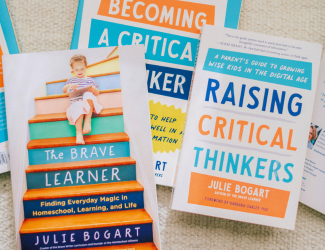
  • Find Raising Critical Thinkers and Becoming a Critical Thinker on Julie’s website at juliebogartwriter.com
  • Brave Writer class registration is open! 
  • Visit Julie’s Substack to find her special podcast for kids (and a lot more!) 
  • Purchase Julie’s new book, Help! My Kid Hates Writing
  • Find community at the Brave Learner Home 
  • Learn more about the Brave Writer Literature & Mechanics programs
  • Start a free trial of CTCmath.com to try the math program that’s sure to grab and keep your child’s attention
  • Subscribe to Julie’s Substack newsletters, Brave Learning with Julie Bogart and Julie Off Topic, and Melissa’s Catalog of Enthusiasms
  • Sign up for our Text Message Pod Ring to get podcast updates and more!
  • Send us podcast topic ideas by texting us: +1 (833) 947-3684
  • Interested in advertising with us? Reach out to media@bravewriter.com

Connect with Julie

  • Instagram: @juliebogartwriter
  • Threads: @juliebogartwriter
  • Bluesky: @bravewriter.com
  • Facebook: facebook.com/bravewriter

Connect with Melissa

  • Website: melissawiley.com
  • Substack: melissawiley.substack.com
  • Instagram: @melissawileybooks
  • Bluesky: @melissawiley.bsky.social

Produced by NOVA

Brave Writer Podcast

Posted in Podcasts | Comments Off on [Podcast #327] Becoming a Critical Thinker

[Podcast #326] Big and Little Families

Brave Writer Podcast

Homeschooling looks different depending on how many kids you’re teaching—and that’s exactly the point.

In this Brave Writer podcast episode, we explore the real-life rhythms of homeschooling in both big families and small ones, offering practical strategies for group learning, one-on-one time, and everything in between.

We talk about:

  • releasing guilt,
  • using creative resources to keep kids engaged,
  • and recognizing the unique opportunities that come with each family size.

Whether you’re juggling many ages or navigating the intensity of homeschooling an only child, this conversation is full of reassurance, ideas, and perspective. Join us—and let’s rethink what “doing enough” really means.

Show Notes

Homeschooling doesn’t come in one standard size. The daily rhythms of a home with six children look very different from those of a home with one—and yet both can offer rich, meaningful learning when expectations are aligned with reality.

Let go of equal time

One of the biggest myths in homeschooling, especially for large families, is the idea that every child must receive equal time, equal attention, and equal subjects every single day. That model simply doesn’t reflect how learning actually works. Instead, homeschooling thrives when we allow learning to happen in shifting configurations: whole-group discussions, small clusters, pairs, and occasional one-on-one moments. These groupings evolve as children grow, and that flexibility is a strength, not a flaw.

Design for real life

In homes with many children, one-on-one instruction often happens outside traditional “school hours.” Early mornings, nap times, evenings, and weekends all count. Learning doesn’t disappear when the clock hits 3:00. Creating space for focused instruction sometimes means letting other children watch a show, work independently, or dive into open-ended creative activities. That isn’t a failure of discipline—it’s a thoughtful accommodation to reality.

The power of open-ended play

Creative stations stocked with materials like clay, watercolors, beeswax, pipe cleaners, and building supplies allow children of many ages to engage meaningfully at the same time. These activities aren’t just distractions. They support fine motor skills, imagination, problem-solving, and sustained attention, while freeing the parent to work closely with a child who needs it.

Small families bring their own intensity

Homeschooling one child or two can feel surprisingly demanding. Without siblings to diffuse attention, the spotlight can feel intense for both parent and child. That’s why parallel learning—working side by side rather than face to face—can be so powerful. Reading together, writing together, or pursuing shared interests lowers pressure and keeps learning relational instead of performative.

Go wide and deep

Only children, in particular, benefit from group experiences beyond the home. Theater groups, clubs, volunteer work, and classes with mixed ages provide collaboration and perspective. At the same time, small families have a unique advantage: the ability to go deep. When a child’s interests drive learning, parents can follow those threads confidently, knowing depth is not the enemy of progress.

Protect emotional space

Sibling comparisons can be especially sharp in families with just two children. Offering different assignments, honoring developmental timelines, and resisting side-by-side comparisons protects each child’s dignity. Learning isn’t a race, and progress doesn’t need to look the same.

Homeschooling succeeds when we stop forcing our families into rigid frameworks and instead build systems that reflect who we actually are. Big or small, every family can create a learning life that is humane, responsive, and full of curiosity.

Resources

  • Find great read alouds and read-alones in the Brave Writer Book Shop
  • Brave Writer class registration is open! 
  • Visit Julie’s Substack to find her special podcast for kids (and a lot more!) 
  • Purchase Julie’s new book, Help! My Kid Hates Writing
  • Find community at the Brave Learner Home 
  • Learn more about the Brave Writer Literature & Mechanics programs
  • Start a free trial of CTCmath.com to try the math program that’s sure to grab and keep your child’s attention
  • Subscribe to Julie’s Substack newsletters, Brave Learning with Julie Bogart and Julie Off Topic, and Melissa’s Catalog of Enthusiasms
  • Sign up for our Text Message Pod Ring to get podcast updates and more!
  • Send us podcast topic ideas by texting us: +1 (833) 947-3684
  • Interested in advertising with us? Reach out to media@bravewriter.com

Connect with Julie

  • Instagram: @juliebogartwriter
  • Threads: @juliebogartwriter
  • Bluesky: @bravewriter.com
  • Facebook: facebook.com/bravewriter

Connect with Melissa

  • Website: melissawiley.com
  • Substack: melissawiley.substack.com
  • Instagram: @melissawileybooks
  • Bluesky: @melissawiley.bsky.social

Produced by NOVA
Brave Writer Podcast

Posted in Podcasts | Comments Off on [Podcast #326] Big and Little Families

[Podcast #325] The Myth of Magicmaking

Brave Writer Podcast

What if enchanting learning didn’t require themed parties, elaborate prep, or constant performance?

In this Brave Writer podcast episode, we unpack the myth of “magicmaking” and show why real enchantment is rooted in connection, not production. We share simple, practical ways to revive lessons that feel stuck, from eye contact and movement to snacks, forts, music, and letting kids take the lead.

Along the way, we explore how curiosity, comfort, and collaboration create learning that actually sticks. If you’ve been feeling burned out or pressured to “make school magical,” this conversation offers a deep exhale and a fresh way forward. Join us and rediscover how easy magic can be.

Show Notes

Many homeschooling parents quietly carry the belief that learning should feel magical all the time—and that if it doesn’t, something has gone wrong. When lessons fall flat, the instinct is often to add more: more prep, more creativity, more performance. But what if the problem isn’t a lack of magic at all?

What we’ve discovered is that the real myth lies in thinking enchantment comes from production. True magic in learning doesn’t grow out of themed parties or elaborate setups. It grows out of connection.

Connection Before Curriculum

When learning starts to feel sour, our first move isn’t to decorate the room or invent a clever hook. It’s to reconnect. Something as simple as making eye contact, sitting at the same level, and asking a genuine question can shift everything. That moment of being seen changes the tone from compliance to collaboration.

This is the heart of the magic described in The Brave Learner: learning thrives when relationship comes first. Without that relational foundation, even the most creative activity can feel hollow.

Learning Lives in the Body

One of the most overlooked tools in homeschooling is the body itself. Children learn with their whole selves, not just their minds. Chewing something crunchy, stretching before math, rolling on the floor, or jumping while memorizing facts can restore focus far more effectively than insisting on stillness.

These aren’t distractions. They are supports. Movement, touch, and sensory input help regulate attention and make learning feel possible again.

Changing the Space Without the Pressure

Environment matters too—but not in the way we often imagine. Rearranging furniture, building a fort, moving to the couch, or taking schoolwork to a coffee shop introduces novelty without pressure. Kids respond to surprise and ownership. When they help create the space, they’re far more willing to enter the work.

None of this has to be permanent. These shifts are seasoning, not structure. A little novelty can revive energy without becoming a new obligation.

Change the Tools, Not the Task

We also underestimate how powerful it is to change the materials instead of the lesson. Glitter pens, whiteboards, clipboards, oversized paper, or tiny notebooks can make familiar work feel new again.

The learning hasn’t been diluted. It’s been invited back in.

Let Your Child Be the Expert

One of the most effective enchantment tools is letting children teach. When kids become experts—on panda bears, base-12 math, a video game, or a favorite book—their confidence blooms. Our role shifts from referee to curious listener.

Children love being taken seriously. Leading with curiosity instead of correction often opens doors into subjects they previously resisted.

Permission Is Powerful

Not every subject needs to happen every day. Skipping handwriting occasionally, doing math orally, or declaring a “no worksheets” day can release tension instantly. Pressure rarely produces understanding. Relief often does.

Sometimes the most enchanting thing we can offer is permission: permission to trace, to play quietly, to think invisibly. Learning doesn’t always look productive from the outside, but thinking is still happening.

What Kids Are Really Learning

When kids are bored, angry, or shut down, they’re learning something—just not what we intended. They may be learning that math is miserable, that learning requires obedience, or that their experience doesn’t matter.

Connection Changes the Lesson Entirely

Enchantment, in the end, is simply forming a relationship: with a subject, with an idea, and with each other. That kind of magic doesn’t require a party. It just asks us to show up—curious, present, and willing to listen.

Resources

  • Listen to our episode with Emily Glankler on “Not Boring History”
  • Find Julie’s favorite book on improv in the Brave Writer Book Shop
  • Brave Writer class registration is open! 
  • Visit Julie’s Substack to find her special podcast for kids (and a lot more!) 
  • Purchase Julie’s new book, Help! My Kid Hates Writing
  • Find community at the Brave Learner Home 
  • Learn more about the Brave Writer Literature & Mechanics programs
  • Start a free trial of CTCmath.com to try the math program that’s sure to grab and keep your child’s attention
  • Subscribe to Julie’s Substack newsletters, Brave Learning with Julie Bogart and Julie Off Topic, and Melissa’s Catalog of Enthusiasms
  • Sign up for our Text Message Pod Ring to get podcast updates and more!
  • Send us podcast topic ideas by texting us: +1 (833) 947-3684
  • Interested in advertising with us? Reach out to media@bravewriter.com

Connect with Julie

  • Instagram: @juliebogartwriter
  • Threads: @juliebogartwriter
  • Bluesky: @bravewriter.com
  • Facebook: facebook.com/bravewriter

Connect with Melissa

  • Website: melissawiley.com
  • Substack: melissawiley.substack.com
  • Instagram: @melissawileybooks
  • Bluesky: @melissawiley.bsky.social

Produced by NOVA
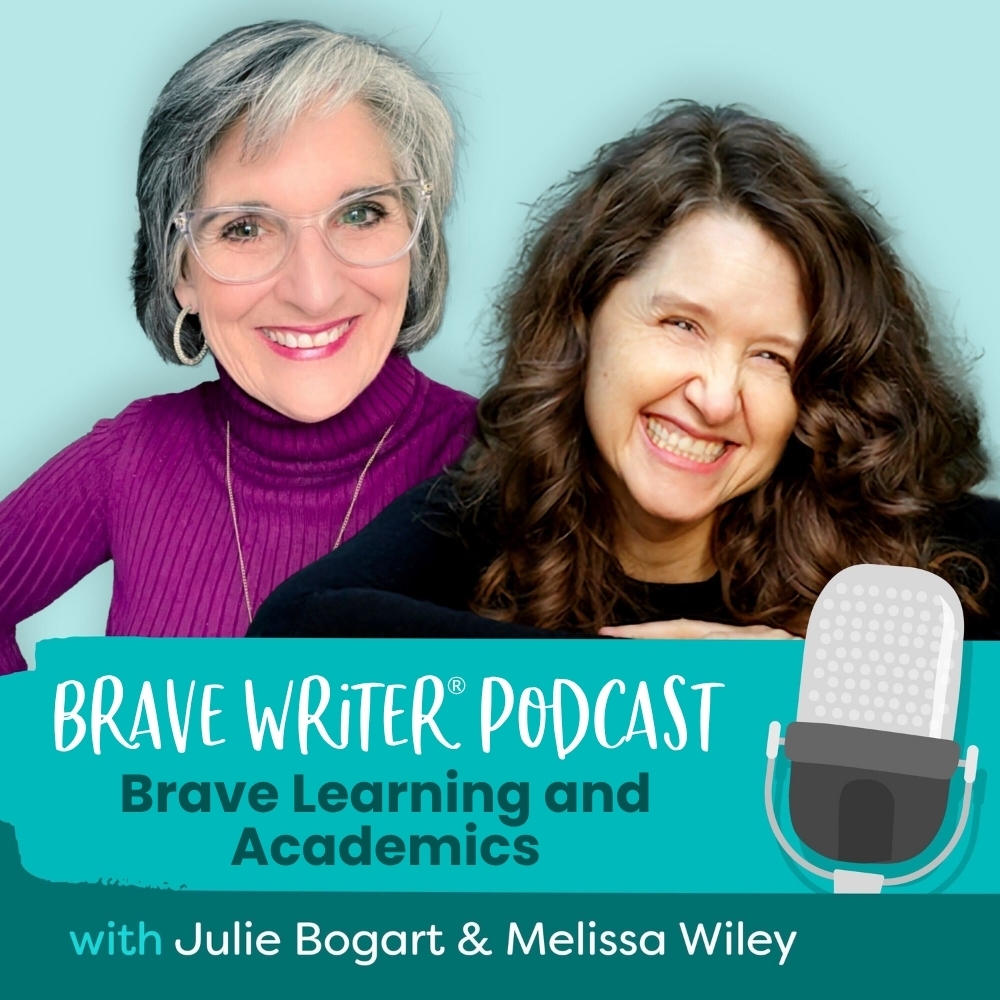
Brave Writer Podcast

Posted in Podcasts | Comments Off on [Podcast #325] The Myth of Magicmaking

« Older Entries
Newer Entries »
  • Search the Blog

  • Julie Bogart
  • Welcome, I’m Julie Bogart.

    I’m a homeschooling alum -17 years, five kids. Now I run Brave Writer, the online writing and language arts program for families. More >>

    IMPORTANT: Please read our Privacy Policy.

  • New to Brave Writer? START HERE

  • FREE Resources

    • 7-Day Writing Blitz
    • Brave Writer Lifestyle Program
    • Brave Writer Sampler: Free Sample Products
    • Freewriting Prompts
    • Podcasts
  • Popular Posts

    • You have time
    • How writing is like sewing
    • Best curriculum for a 6 year old
    • Today's little unspoken homeschool secret
    • Do you like to homeschool?
    • Don't trust the schedule
    • You want to do a good job parenting?
    • If you've got a passel of kids
    • You are not a teacher
    • Natural Stages of Growth in Writing podcasts
  • Blog Topics

    • Brave Learner Home
    • Brave Writer Lifestyle
    • Classes
    • Contests/Giveaways
    • Friday Freewrite
    • High School
    • Homeschool Advice
    • Julie's Life
    • Language Arts
    • Movie Wednesday
    • Natural Stages of Growth
    • One Thing Principle
    • Our Team
    • Parenting
    • Philosophy of Education
    • Podcasts
    • Poetry Teatime
    • Products
    • Reviews
    • Speaking Schedule
    • Students
    • Writing about Writing
    • Young Writers
  • Archives

  • Brave Writer is a participant in the Amazon Services LLC Associates Program, an affiliate advertising program designed to provide a means for sites to earn advertising fees (at no extra cost to you) by advertising and linking to amazon.com

    Content © Brave Writer unless otherwise stated.

What is Brave Writer?

  • Welcome to Brave Writer
  • Why Brave Writer Works
  • About Julie
  • Brave Writer Values
  • Frequently Asked Questions
  • Speaking Schedule

Brave Writer Program

  • Getting Started!
  • Stages of Growth in Writing
  • The Brave Writer Program
  • For Families and Students
  • Online Classes
  • Brave Writer Lifestyle

…and More!

  • Blog
  • Classroom
  • Store
  • Books in Brave Writer Programs
  • Contact Us
  • Customer Service
  • Brave Writer Staff
© 2026 Brave Writer
Privacy Policy
Children's Privacy Policy
Help Center