Brave Writer Philosophy Archives - Page 4 of 84 - A Brave Writer's Life in Brief A Brave Writer's Life in Brief
  • Start Here
    • For Families
      Multiple Ages
    • Ages 5-7
      Beginning Writers
    • Ages 8-10
      Emerging Writers
    • Ages 11-12
      Middle School Writers
    • Ages 13-14
      High School Writers
    • Ages 15-18
      College Prep Writers
  • Shop
    • Product Collections
    • Bundles
    • Writing Instruction Manuals
    • Literature & Grammar/Punctuation
    • Composition Formats
    • Literature Singles
    • Homeschool Help
    • Book Shop
  • Online Classes
    • Class Descriptions
    • Class Schedule
    • Classroom
    • How Our Classes Work
    • Our Writing Coaches
    • Classes FAQ
  • Community
    • Brave Learner Home
    • What’s Happening
    • Blog
    • Podcast
    • Calendar
  • Cart
  • My Account
    • My Online Classes
    • My Account
  • My Account
    • My Online Classes
    • My Account
  • Start Here

    If you’re new to Brave Writer, or are looking for the best products for your child or family, choose from below:

    • For Families
      Multiple Ages
    • Ages 5-7
      Beginning Writers
    • Ages 8-10
      Emerging Writers
    • Ages 11-12
      Middle School Writers
    • Ages 13-14
      High School Writers
    • Ages 15-18
      College Prep Writers
  • Shop

    If you’re already familiar with Brave Writer products, go directly to what you’re looking for:

    • Product Collections Browse the full catalog in our shop
    • Bundles Everything you need to get started
    • Writing Instruction Manuals Foundational Writing Programs
    • Literature & Grammar/Punctuation Grammar, Punctuation, Spelling & Literary Devices
    • Composition Formats Writing Assignments for Every Age
    • Literature Singles Individual Literature Handbooks
    • Homeschool Help Homeschooling Tools and Resources
    • Book Shop Books associated with Brave Writer Programs
  • Online Classes
    • Class Descriptions
    • Class Schedule
    • Classroom
    • How Our Classes Work
    • Our Writing Coaches
    • Classes FAQ
  • Community
    • Brave Learner Home
    • What’s Happening
    • Blog
    • Podcast
    • Calendar
  • Search
  • Cart

Search Bravewriter.com

  • Home
  • Blog

A Brave Writer's Life in Brief

Thoughts from my home to yours

Archive for the ‘Brave Writer Philosophy’ Category

« Older Entries
Newer Entries »

Whole Life Education

Brave Writer Whole Life Education

Homeschooling is more than an education for kids. It’s a life-practice. It’s a path, a way, a philosophy of living that guides, well, everything while you are living a homeschool life.

What would happen if we stopped seeing learning as confined to “school hours”? What if all of a child’s life could be celebrated as the laboratory for learning?

In fact, even if you don’t homeschool or aren’t any longer, education can continue to be a way of life rather than something “done to your kids” six hours a day away from home.

When I call homeschooling a life-practice, a path, a way—I mean that we, the adults, remain curious about who our kids are becoming. We keep bringing our attention to the whole person who is learning EVERYTHING all the time.

We don’t divide how they are doing into:

  • “They’re fine academically, but socially awkward.”
  • “She’s bad at math, but loves writing.”
  • “He’s obsessed with video games so I’m going to put him in soccer.”
  • “Homework always comes first.”
  • “I wish my child would read better books, not comics.”

All of Life Teaches

Education as a whole life means that we’re as curious about a child’s fascination with cooking as we are supportive of their struggle with multiplication. Once we see the struggle and we identify the joy, we look for ways to bring those two together—where is this difficult lesson, concept, idea a part of this child’s real life? How can we bring them together to make meaning, to help connect the dots between abstract lessons and hands-on learning?

  • We see helping a child learn to make friends as valuable—as important as learning to read.
  • We take time off of a difficult subject in order to shore up the child’s confidence in their strengths before returning to it.
  • We notice that tonight, our youngest child is whiny at bedtime—and then recall that this child got the least amount of conversation, eye contact, and attention today. So we come alongside this child to talk, to listen, to connect.

Homeschooling, education as a way of life means: ALL of life teaches. Our only task is to slide into that slipstream, notice where our kids are, and meet them there.


This post is originally from Instagram and @juliebogartwriter is my account there so come follow along for more conversations like this one!

Stages of Growth in Writing

Posted in Brave Writer Philosophy | Comments Off on Whole Life Education

Learning Happens

Brave Writer

What is my child learning? The content of the subject or resentment of the system that teaches it?

Learning happens whether you want it to or not. What the child is learning? That’s up for grabs.

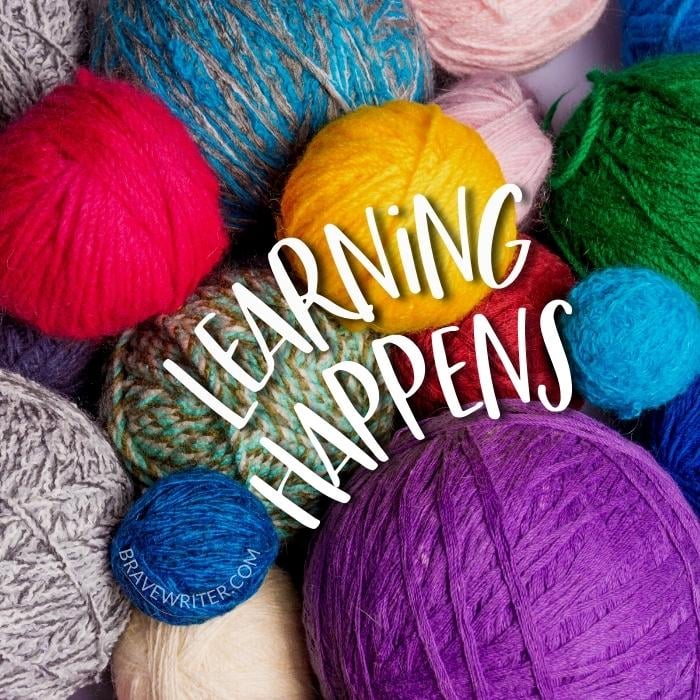
I like to compare the school subjects to learning a hobby. What’s the difference? When I taught Noah to knit, I had tons of patience. We only worked on knitting when he wanted to knit. I used books, I modeled, I didn’t set a time of day called “knitting.”

He knit when I read aloud, he knit during movie time, he knit during afternoon hours or before I got up in the morning. When he got stuck, he asked for help. He taught himself some skills by reading a book about knitting. I bought him yarn and needles for a Christmas gift. He was delighted to receive them because knitting, for Noah, was an experience and activity he valued.

Zero Stress

It’s amazing to think about how easy it was for Noah to learn to knit in part because I felt zero stress over his performance. I didn’t worry that he hadn’t finished X number of rows in an hour or that he lost interest for a week or two or that he needed more help sometimes than others. I didn’t ask myself if he would be a professional knitter or if there was a career path that depended on knitting.

We simply knitted together until he got what he wanted from that experience and moved on.

A great question to ask ourselves: How can learning math or grammar be more like learning to knit? What would we do differently?

If your kids are balking at subjects you consider essential, focus on the how—what is it about the system you are using currently that leads to resentment? Shift the how, and shift the value of the subject for your kids.

Psst: this is how we teach grammar in our program, by the way. We bypass all that stress by making it as easy to learn as knitting.


This post is originally from Instagram and @juliebogartwriter is my account there so come follow along for more conversations like this one!

Posted in Brave Writer Philosophy | Comments Off on Learning Happens

Webinar: Get to Know Brave Writer

Brave Writer
  • Is your Language Arts program not working?
  • Kids bored? Disengaged?
  • Are you worried they will “fall behind” in writing?

Brave Writer offers a totally unique approach to teaching writing.

Engage your kids. Grow confident writers.

We can help!

Join us for a FREE webinar:

Get to Know Brave Writer

Tuesday, November 15, 2022 at 3:00 PM Eastern 

Dawn Smith, Brave Writer’s Director of Publishing, will walk you through the Brave Writer approach to writing and introduce you to Brave Writer products and support. 

Get to know Brave Writer. Learn how we can make a difference in your homeschool!

Sign Up Here!

A replay will be made available.

Brave Writer

Posted in Brave Writer Philosophy | Comments Off on Webinar: Get to Know Brave Writer

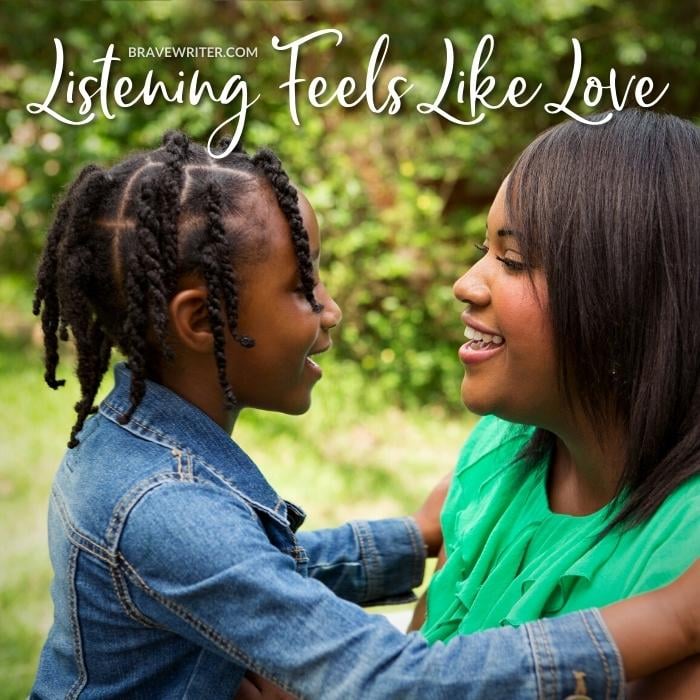
Listening Feels Like Love

Brave Writer

When you listen, it helps to imagine the feelings of your child by attempting to see the world through his or her eyes. That’s empathy and it’s critical to a happy homeschool.

Knowing you’re loved and feeling loved are not identical.

You can know someone loves you, even when they are distant or cruel or hurtful. It won’t feel like love but their love can be cognitively accepted. We go to therapy to understand that the love offered missed the mark emotionally, but we can accept that it was real.

But to feel loved? That’s something else. When you feel loved, you don’t need therapy to tell you that what is being expressed is love. It takes no work to feel it. That kind of love is a balm, a summer rain shower, a bouquet of freshly sharpened pencils in New York in the fall. Feeling loved is a pleasurable experience—it delivers:

  • safety,
  • connection,
  • and trust.

The best news?

To show love is easy. It requires no flowers or candy.

Just listen.

Your child is giving you clues to their inner world all day every day. Sometimes we’re exhausted by the acts of love and service we offer freely. Even as those are loving, for a child to feel loved, they need something else. They want a kind, listening ear—a person who will hold space for their:

  • thoughts,
  • emotions,
  • worries,
  • and wishes.

Kids feel loved when they feel free to be known as themselves.

The challenge, of course, is not running ahead to solutions or worries of your own. It’s a shift to get behind your child’s eyes to see the reasonableness of their point of view. It doesn’t have to be the right point of view—just that given all that the child knows today, this is how they see what they see.

This means sitting on the tendency to have words. You introverts may have an advantage here. Let’s get quieter and kinder and more spacious and more attentive. Let’s work on doing less and loving more.

Let’s listen.


This post is originally from Instagram and @juliebogartwriter is my account there so come follow along for more conversations like this one!

Brave Learner Home

Posted in Brave Writer Philosophy, Homeschool Advice | Comments Off on Listening Feels Like Love

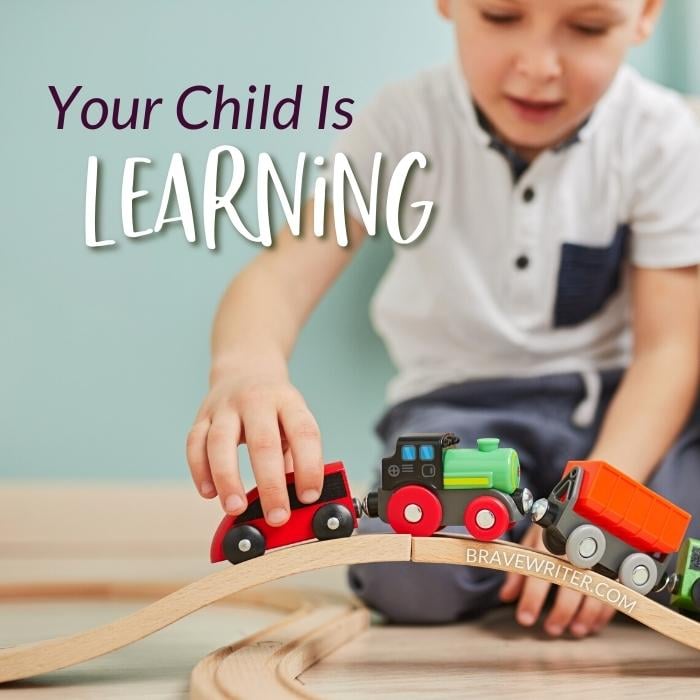
Your Child Is Learning

Brave Writer

The quickest way to kill the atmosphere of learning is to suggest that it’s time to learn!

If you announce “Time to learn” you’re telling the child that without an adult, they aren’t learning. The truth is: learning happens whether or not you intend it. What’s being learned? That’s up for grabs!

The temptation is to say: “Let’s learn how to divide fractions.” What might get learned instead is that math is boring.

The best way to kick the door open for learning? Try this.

  • Tie what you want your child to learn to something they value, like fractions and baking.
  • Notice learning in action: “You divided the recipe in half! Did you know there’s a way to do that on paper, not just with measuring cups?”
  • Learn without words (I know, it’s hard!). Sidle up and do the activity together. Draw the fractions on a page and work them next to your child so they have time to hover and notice, rather than having to hear instructions.

Learning is already going on.

Drawing, building, reading, talking to self (that’s consolidating what they are learning), asking for help, making a snack, playing a game with a friend, completing a puzzle, wandering around the house (that counts too!)—if these are happening, your child is learning.

TUNE IN and take notes. Observe and name what’s going on.

Try these kinds of words to describe what you see:

  • Decoding
  • Writing
  • Narrating
  • Experimenting
  • Collaborating
  • Giving selfcare
  • Gaining vocabulary
  • Constructing
  • Discovering cause and effect
  • Playing independently

…and more!

Yes, your child is learning. No need to make an announcement. It’s already happening without you! Hop on board and ride that train.


Growing Brave Writers

Posted in Brave Writer Philosophy, Homeschool Advice | Comments Off on Your Child Is Learning

« Older Entries
Newer Entries »
  • Search the Blog

  • Julie Bogart
  • Welcome, I’m Julie Bogart.

    I’m a homeschooling alum -17 years, five kids. Now I run Brave Writer, the online writing and language arts program for families. More >>

    IMPORTANT: Please read our Privacy Policy.

  • New to Brave Writer? START HERE

  • FREE Resources

    • 7-Day Writing Blitz
    • Brave Writer Lifestyle Program
    • Brave Writer Sampler: Free Sample Products
    • Freewriting Prompts
    • Podcasts
  • Popular Posts

    • You have time
    • How writing is like sewing
    • Best curriculum for a 6 year old
    • Today's little unspoken homeschool secret
    • Do you like to homeschool?
    • Don't trust the schedule
    • You want to do a good job parenting?
    • If you've got a passel of kids
    • You are not a teacher
    • Natural Stages of Growth in Writing podcasts
  • Blog Topics

    • Brave Learner Home
    • Brave Writer Lifestyle
    • Classes
    • Contests/Giveaways
    • Friday Freewrite
    • High School
    • Homeschool Advice
    • Julie's Life
    • Language Arts
    • Movie Wednesday
    • Natural Stages of Growth
    • One Thing Principle
    • Our Team
    • Parenting
    • Philosophy of Education
    • Podcasts
    • Poetry Teatime
    • Products
    • Reviews
    • Speaking Schedule
    • Students
    • Writing about Writing
    • Young Writers
  • Archives

  • Brave Writer is a participant in the Amazon Services LLC Associates Program, an affiliate advertising program designed to provide a means for sites to earn advertising fees (at no extra cost to you) by advertising and linking to amazon.com

    Content © Brave Writer unless otherwise stated.

What is Brave Writer?

  • Welcome to Brave Writer
  • Why Brave Writer Works
  • About Julie
  • Brave Writer Values
  • Frequently Asked Questions
  • Speaking Schedule

Brave Writer Program

  • Getting Started!
  • Stages of Growth in Writing
  • The Brave Writer Program
  • For Families and Students
  • Online Classes
  • Brave Writer Lifestyle

…and More!

  • Blog
  • Classroom
  • Store
  • Books in Brave Writer Programs
  • Contact Us
  • Customer Service
  • Brave Writer Staff
© 2026 Brave Writer
Privacy Policy
Children's Privacy Policy
Help Center