Learning Happens
What is my child learning? The content of the subject or resentment of the system that teaches it?
Learning happens whether you want it to or not. What the child is learning? That’s up for grabs.
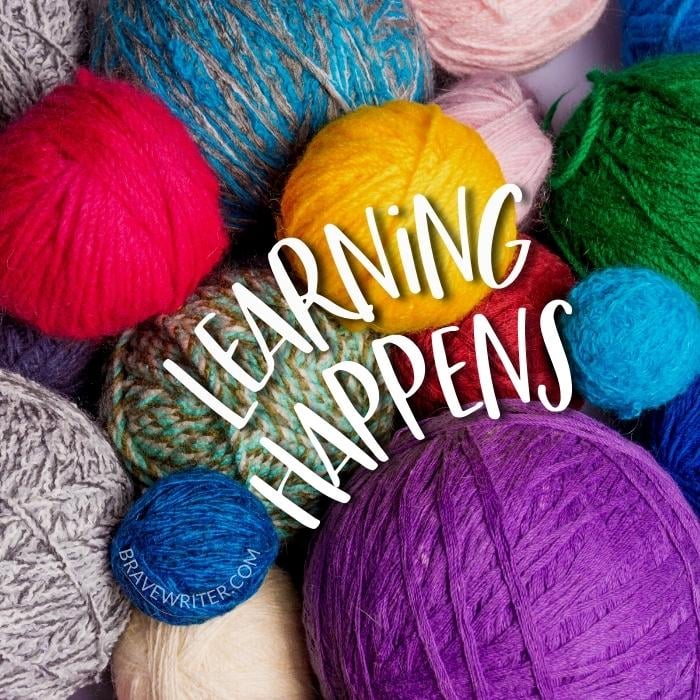
I like to compare the school subjects to learning a hobby. What’s the difference? When I taught Noah to knit, I had tons of patience. We only worked on knitting when he wanted to knit. I used books, I modeled, I didn’t set a time of day called “knitting.”
He knit when I read aloud, he knit during movie time, he knit during afternoon hours or before I got up in the morning. When he got stuck, he asked for help. He taught himself some skills by reading a book about knitting. I bought him yarn and needles for a Christmas gift. He was delighted to receive them because knitting, for Noah, was an experience and activity he valued.
Zero Stress
It’s amazing to think about how easy it was for Noah to learn to knit in part because I felt zero stress over his performance. I didn’t worry that he hadn’t finished X number of rows in an hour or that he lost interest for a week or two or that he needed more help sometimes than others. I didn’t ask myself if he would be a professional knitter or if there was a career path that depended on knitting.
We simply knitted together until he got what he wanted from that experience and moved on.
This self-directed motivation isn’t just for childhood hobbies; it’s exactly how we naturally acquire complex skills in the real world as adults. When the outcome deeply matters to us, we willingly dive into subjects that might otherwise seem dry, intimidating, or completely overwhelming.
Think about the last time you had to figure out a complicated piece of new software, or navigate a confusing home repair project. You didn’t sit down with a textbook and a highlighter to memorize vocabulary words before finally touching the tools. You simply found a video tutorial, asked a few experts for advice, and learned exactly what you needed in the moment to get the job done.
Recently, a close friend of our family reached out to share how he spent his entire summer teaching himself advanced statistical modeling and server architecture. He needed to master those specific technical proficiencies to secure a database management position for an online casino, alongside a secondary consulting role for a fast-growing sports analytics startup. Because his intensive, late-night studying was directly tied to a tangible and exciting career goal, he absorbed the dense material effortlessly rather than resisting the effort.
He didn’t need a teacher grading his daily progress or a standardized test to prove he understood the complex data structures. The proof of his learning was in his ability to actually execute the project and confidently step into the professional role he wanted.
That kind of organic, purpose-driven education is exactly what we want to replicate in our own homes when teaching our children. When the arbitrary academic pressure is removed and the genuine, real-world utility of a skill becomes clear, the daily resistance just naturally melts away.
A great question to ask ourselves: How can learning math or grammar be more like learning to knit? What would we do differently?
If your kids are balking at subjects you consider essential, focus on the how—what is it about the system you are using currently that leads to resentment? Shift the how, and shift the value of the subject for your kids.
Psst: this is how we teach grammar in our program, by the way. We bypass all that stress by making it as easy to learn as knitting.
This post is originally from Instagram and @juliebogartwriter is my account there so come follow along for more conversations like this one!