
Archive for the ‘Help for High School’ Category

Essay-writing, not Lecture-giving

Wednesday, January 23rd, 2013

Today’s writing tip:

As I comment on essay topics in the Brave Writer Classroom, I’m struck by context. It’s easy to get sidetracked into “advice-giving” rather than “essay-writing.” There’s a difference between explaining why you, the reader, should exercise, versus explaining the role of exercise in improved health. Many of our kids are used to lectures, sermons, and mini-lessons designed to urge them to be better people. They internalize this voice and then they mimic it in their essays. But that kind of writing is *not* appropriate for essay writing. Essays are the dispassionate explication of information and how various strands of detail correlate to prove a thesis—a risky proposition, an assertion.

If your student writes about what the reader should do, or directs any comments at the second person, “you,” know that that student has shifted from essay writing to sermon giving. Even without the “you,” if implicit in the writing is a list of “smart practices” or “good ideas,” know that your student is not writing an essay.

We had a question on Facebook:

Any specific tips for redirecting them to essay writing?

My answer:

Yes. Ask them to change the voice of the essay: Move from “you” to third person. Focus on content, not on practice. For instance, in the example of exercise:

Don’t write—

People should work out three to five times per week to get their hearts to beat faster. You won’t be as vulnerable to heart disease if you do cardiovascular exercise on a regular basis.

Write—

Regular cardiovascular exercise has been shown to prevent heart disease. People who work out three to five times per week reduce their chances of heart disease by X%.

See the difference in tone? Feel it? That’s what you’re going for.

Vocabulary development

Wednesday, January 9th, 2013

The fashion plate The quickest way to grow as an educated person is to master the vocabulary of a particular field. That really is what we mean when we say someone is “educated.” They know the verbiage that goes with that field. They know the people who comment and write about it, they know the critical players in the field (whatever field of expertise they are in – inventors or football stars!), and they know especially the language of the specific domain.

For instance, your kids are often expert in a particular video or computer game. When they talk about it, don’t you feel bored and a little out of your depth? That’s because your kids are experts and you are a mere out-of-date novice! On the other hand, your knowledge of a particular area (birth? tennis? art history? literature? gardening?) trumps your kids’ I’m sure!

The point is this—growth as an educated person is all about mastery of language and how it relates to a specific field. The more you read, the more nuances you’ll master. It’s one thing to say: “What a pretty night sky” (a novice’s appraisal) and another to say, “There’s Cassiopeia! It’s a constellation in the northern sky, named after the queen Cassiopeia from Greek mythology. You can recognize it by its unique “W” shape and how it’s formed by five bright stars. See it?”

The tendency in homeschool is to over-value “academic” vocabulary and to under-appreciate the vocabulary your children naturally acquire in their areas of “common” interest. For instance, you want to claim “genius status” for the kid who loves astronomy, but you overlook the child whose enthusiasm for fashion makes her an expert in fabrics, necklines, and designers. Yet the exact same set of skills goes into “expertise” for both. Both of these fields offer your child the opportunity to deepen a vocabulary around a particular field of interest. Knowing the language, the insider-jargon, the methods for evaluation for whatever research is being done, the successes and failures in the field, the “celebrated persons,” the career opportunities that go with that field—all of these lead to a level of competence in that subject domain that empowers your child to be “smart.” The mastery of a particular area of interest leads to the ability to replicate this style of inquiry for other areas later in life (both personal interest and academic).

Not only that, you can use your child’s natural interests now, for spelling, grammar, writing style, and exploration in a way you can’t conjure through bored children being dragged through history or science that doesn’t engage them.

When Caitrin spent several years deeply invested in fashion, we made spelling lists of words that were particular to that field. (See photo above.) Words like couture, stilettos, boutique, sleeveless.

She kept a daily blog for a year writing about fashion and modeling her individual outfits each day.

We watched Project Runway with religious regularity.

We took a trip to Chicago to see the stores of designers she had studied in her magazine subscriptions (Vogue, Elle, etc.).

She acquired a vocabulary far superior to mine in that arena and we used her passion for that field to learn about how you take a subject area deeper. She is less interested in fashion today. Her particular hobbies this last year have ranged from WWI to Korean Pop Music! But as she focuses on what she loves, she finds the names, ideas, and language that go with those subject areas because she knows (instinctively) that that’s how you demonstrate intelligence, and credibility when you talk about any subject.

Try it! You’ll like it.

Funschooling

Tips for the College Application Essay

Monday, October 22nd, 2012

College Essay Notes

From How to Write a Winning College Essay Application
By, Michael James Mason

(Highly recommend buying a copy of this book)

Five elements of a good college essay:

1. Something to grab the reader’s attention
2. Simplicity
3. Realism
4. Sincerity
5. Surprise

As you craft your personal essay, think about the questions and statements below to prompt you. Fit the content to the question your chosen university asks you.

1. Who are the five people who have most influenced you?

2. What do you read?

3. List three virtues that you admire and respect.

4. Discuss three significant lessons you have learned.

5. Tell us about three memorable experiences you have had.

6. Discuss a failure that taught you something.

7. Respond to three quotes that mean something to you.

8. Remember your greatest success.

9. Name five things that you know.

10. Discuss your definition of happiness.

11. What do your parents remember about you?

12. What are your earliest memories?

13. What is an education supposed to provide?

14. List and describe five special things about you.

15. What is your “one sentence philosophy of life”?

16. What is the funniest thing that ever happened to you?

17. What makes the world go round?

18. Picture five places you’ve been that impressed you the most.

19. What is your favorite social activity?

20. What is your favorite intellectual or artistic activity?

21. Describe yourself to a stranger.

22. Tell the story of a fear you conquered.

23. Discuss three goals that you have in life.

24. List ten things you like and ten things you don’t like at all.

25. What do your friends say that they like most about you?

26. What question have you always wanted answered and why?

Guidelines for blogging outside material

Friday, August 3rd, 2012

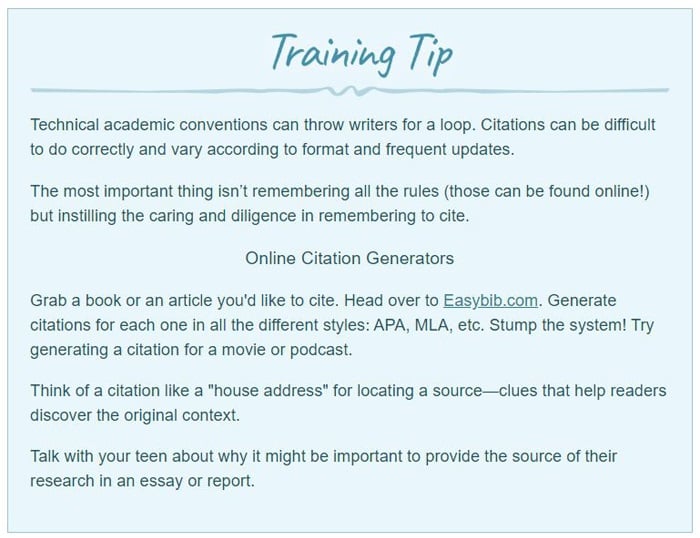
This is a fantastic article about how to cite sources when you blog online. Share with your kids or use it for your own blogging experiences:

How Not To Steal Other People’s Content

Blogs are hotbeds of source attribution issues, probably just due to the sheer volume of content that’s posted there on a daily basis (you awesome inbound marketer, you). So let’s walk through a couple common scenarios bloggers come across when creating their content, and figure out how to address them!


New to Brave Writer

Wednesday, February 24th, 2010

Brave Writer has three components to support your writing and language arts goals:

Home Study Courses

Online Classes

Language Arts Programs

The Home Study Courses are divided into two. The Writer’s Jungle teaches you, the parent, how to be the most effective writing coach in your children’s lives. The principles, exercises, and guidelines apply to every level of writing from beginner to pro. If you like to work at your own pace, need a manual to which you can refer when you get overwhelmed, if you benefit from having your entire philosophy of writing stood on its head and recreated for you, then start with The Writer’s Jungle. It will work for all your kids.

Help for High School is our home study course for teens. It’s written to your student and is intended to be self-teaching. The course is organized around specific modules and in each module, there is an exercise or writing assignment to complete. These can be done multiple times if you swap topics. They are writing processes, not specific assignments geared toward a period in history or a work of literature. Help for High School provides models of how to write expository essays (both open and closed forms) as well as the steps necessary to understand the structure of argument, thesis and points and particulars.

The Online Classes provide moms and kids with instructor support and accountability. They cover a wider range of choices in terms of specific writing genres. If you prefer to be in a classroom style setting with an instructor, other students and the gentle accountability of due dates, start with Kidswrite Basic. This online course transforms your understanding of how to best facilitate writing in your home. It gives you the tools to know how to encourage and foster good writing habits rather than merely editing poor writing for mechanical errors.

Kidswrite Intermediate is the course to consider if you want to make the transition from parent-led writing to student-led. It’s designed for kids just on the cusp of essay writing. The processes in KWI make up the first half of Help for High School. The benefit to taking it as a class is that the online class offers instructor feedback and the opportunity to read other student writing. KWI prepares students for all levels of essay classes, as well.

The other online classes round out writing experiences. We offer fiction, literary analysis, poetry, grammar, freewriting, SAT/ACT preparation, Shakespeare, literary discussion (Boomerang Complete) and more. The courses help you and your kids to widen their writing experiences while giving you the support and modeling that make you a more and more effective writing coach. The courses also prevent a feeling of isolation in the homeschool, putting you in touch with other parents and students from around the world who are embarking on a similar journey.

The language arts portion of Brave Writer supports and enhances the writing programs. The Arrow, the Boomerang and the retired Slingshot are designed to provide you with easy-to-use tools that teach mechanics, spelling, grammar, handwriting and literary elements in the context of great literature. The Arrow works best for kids 3rd – 6th grades. The Boomerang is designed for 7th-9th grades (though some high school students do quite well with the Boomerang). The Slingshot (already published issues) catered to 10th-12th grades. We now offer literary analysis classes for 10th-12th grades instead.

You can either subscribe to the current year’s lists of the Arrow or Boomerang (paying monthly on your credit card), or you can purchase already published issues ala carte and design your own year’s program around books you and your kids want to read. These tools are meant to supplement your writing program, not replace it. When the Arrow or Boomerang are used in tandem with The Writer’s Jungle or Help for High School, or along with Kidswrite Basic or Kidswrite Intermediate, you will be offering your children a complete language arts/writing package.

Jump in. Try not to figure it all out or become overwhelmed at the choices. Pick one thing that you find fascinating. Purchase it or sign up for it. Use it, do it. Experience and enjoy it. See how it goes. Then do the next thing. As you take it one thing at a time, you will build momentum. You’re not in a rush. You don’t have to solve writing and language arts this week, this semester or even this year. You only need to take the next logical step toward the goal of becoming the best writing coach you can be. In turn, your kids will grow into more and more effective writers.