Homeschool Advice Archives - Page 125 of 144 - A Brave Writer's Life in Brief A Brave Writer's Life in Brief
  • Start Here
    • For Families
      Multiple Ages
    • Ages 5-7
      Beginning Writers
    • Ages 8-10
      Emerging Writers
    • Ages 11-12
      Middle School Writers
    • Ages 13-14
      High School Writers
    • Ages 15-18
      College Prep Writers
  • Shop
    • Product Collections
    • Bundles
    • Writing Instruction Manuals
    • Literature & Grammar/Punctuation
    • Composition Formats
    • Literature Singles
    • Homeschool Help
    • Book Shop
  • Online Classes
    • Class Descriptions
    • Class Schedule
    • Classroom
    • How Our Classes Work
    • Our Writing Coaches
    • Classes FAQ
  • Community
    • Brave Learner Home
    • What’s Happening
    • Blog
    • Podcast
    • Calendar
  • Cart
  • My Account
    • My Online Classes
    • My Account
  • My Account
    • My Online Classes
    • My Account
  • Start Here

    If you’re new to Brave Writer, or are looking for the best products for your child or family, choose from below:

    • For Families
      Multiple Ages
    • Ages 5-7
      Beginning Writers
    • Ages 8-10
      Emerging Writers
    • Ages 11-12
      Middle School Writers
    • Ages 13-14
      High School Writers
    • Ages 15-18
      College Prep Writers
  • Shop

    If you’re already familiar with Brave Writer products, go directly to what you’re looking for:

    • Product Collections Browse the full catalog in our shop
    • Bundles Everything you need to get started
    • Writing Instruction Manuals Foundational Writing Programs
    • Literature & Grammar/Punctuation Grammar, Punctuation, Spelling & Literary Devices
    • Composition Formats Writing Assignments for Every Age
    • Literature Singles Individual Literature Handbooks
    • Homeschool Help Homeschooling Tools and Resources
    • Book Shop Books associated with Brave Writer Programs
  • Online Classes
    • Class Descriptions
    • Class Schedule
    • Classroom
    • How Our Classes Work
    • Our Writing Coaches
    • Classes FAQ
  • Community
    • Brave Learner Home
    • What’s Happening
    • Blog
    • Podcast
    • Calendar
  • Search
  • Cart

Search Bravewriter.com

  • Home
  • Blog

A Brave Writer's Life in Brief

Thoughts from my home to yours

Archive for the ‘Homeschool Advice’ Category

« Older Entries
Newer Entries »

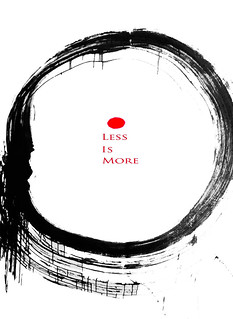
Less is more

Less is moreYou’ll always be tempted to think more is more.

For instance, your child shows interest in planting seeds. You think, “We can create a garden! We can till away part of the yard, start a compost heap, get a variety of seeds, and grow berries while we’re at it. Then my kids can take notes about the rate of growth, they can draw pictures as the plants emerge, they can water the plants and learn which need shade and which need sun, then we can harvest the vegetables and I can teach them to make ratatouille… after they write recipes on notecards, converting the French Metric measurement system to our cups and ounces…”

Right? Or some nutty version of that.

The child wanted to stick a little seed in the ground to see what would happen, and you are imagining starting an organic farm with a restaurant.

Your child asks about one artist, and you envision weekly art lessons combined with study of each period of art, organized by month, with narrations and illustrations, culminating in a trip to Florence! Yes, I did some version of this one and my youngest daughter said at the end of the trip to Italy, “I hate art.”

This was our daughter who could not get enough of the Cincinnati Art Museum before that very expensive trip. But I killed art. I overdid it. I plunged the knife into the chest of art and it bled out.

We did rekindle a love of art years later through fashion and today this 16 year old can say she loves art again and wants to visit the Art Institute in Chicago…. but it took 8 years.

Less is more.

If your child asks to bake cookies, bake cookies with your child. Don’t expect to now go through each cookie recipe one at a time until he hates baking.

If you see a glimpse of interest in computers, don’t assume that means your child wants to be a web designer, developer, or programmer. Most likely your kid wants to be a computer game-player. Understanding a little about how all that works is great and if it leads to genuine interest, offer some resources to look at when she’s ready, when he feels like it! Don’t pile on lessons and requirements, thinking you can turn “computer-love” into a Valuable Lesson.

If you find yourself excited about potting, quilting, the history of music, birding, hiking, bathroom remodeling, even —composting—, you do it! Do what feels good to you (you’ll find that you have a rhythm to your interest and parts of the subject will not interest you at all). That model will help you remember the pace and process of how interests grow. Then you can gently support the interests your kids have without jumping on the bandwagon so heavily, you launch them accidentally over the other side and right out of the wagon!

Trust the process of your passion more than the organization of your lessons.

Less is more.


image by !anaughty!
Posted in Homeschool Advice | 3 Comments »

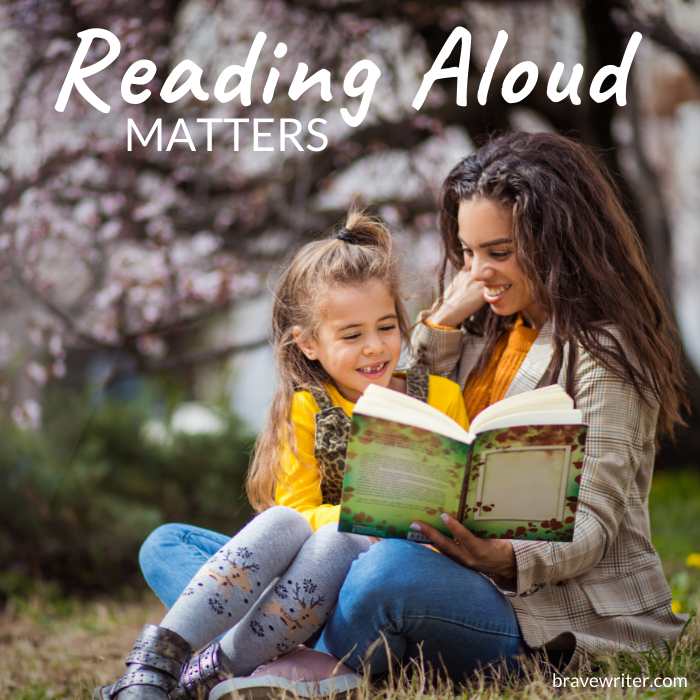
Reading Aloud Matters

Reading Aloud Matters

I spent hours of my adult life nestled in the corner of the sectional, feet tucked under me, with a book in my hands. Sometimes a baby sucked on a bulging breast at the same time, and one of those babies didn’t like to listen to my voice resonating through my chest cavity. Some well-timed nips to the nipples drove home that message. Ouch!

Other times a toddler couldn’t be calmed or a middler would knock over the orange juice onto the carpet and the book would get flung back into the library basket. Reading time over! Waving the white flag.

But those were exceptions.

We made it a daily priority to read together for an hour. Read aloud time signaled the start to our homeschool day. It was the “coming together” of all of us of all the ages in all our stages, and it told us: “Yes, we homeschooled today.”

Over hummus and olives one Friday night in my friend’s kitchen (homeschoolers really rock the social scene), a bunch of my mom friends and I became animated as we swapped titles and our various reactions to the children’s novels we had read over nearly 10 years time. Better than a book club! We drank wine, we got misty over Anne of Green Gables, and had a wide variety of reactions to Moccasin Trail and Across Five Aprils.

We also laughed about the books that bored us but that thrilled our kids. For instance, I have no idea what happens in any Redwall book. I got through (operative phrase there) the first one (not as delighted by the woodland feasts and feisty creatures in chain mail as my kidlets), but then somewhere during the second installment, I discovered I could make a shopping list, consider the benefits of dying my hair, and respond to angry posters online all in my head while reading, without skipping a sentence. So I’d merrily read along and space out, until that one moment that was sure to give me away at the end of any given chapter:

“Mom what do you think is going to happen next?’

Blink. “Um…” I scrambled. “I have a hunch the bad guys are preparing to attack the Abbey.”

Yes! That is what they thought! They knew it!

And that, friends, is the correct answer to any question about plot in Redwall. You’re welcome. You may return to kitchen remodeling in your mind.

While in this vigorous conversation about kids’ lit, one of the moms made a remarkable statement:

“I can’t figure out how you all have time to read aloud. We never have time. That’s the one thing we’ve never done in all our years. I just don’t see how it could be fitted in.”

For a tense moment, you could have heard an olive drop to that tiled floor. We were stunned, because what quickly became clear is that there were even a few us (I plead guilty to this charge) who sometimes got little more done in a day than reading aloud. I couldn’t imagine what homeschool would be if you didn’t read books to your kids.

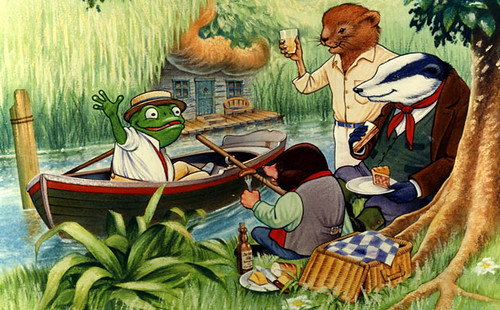
If I had been forced to supervise workbooks all day, every day, for 5 kids, for 17 years without fiction? Without discovering Seamus Heaney’s Beowulf or Robert Peck’s Soup? Not getting to read The Shadow Spinner or become enchanted by Toad and Mole and Badger in The Wind and the Willows?

The-Wind-in-the-Willows-the-wind-in-the-willows-30730319-630-390
The Wind in the Willows

My laundry basket of library books, the wide array of reading lists, the hours spent using my voice to share my emotional reactions in real time to the plights and adventures of heroes and heroines I grew to love as my own possession… This was/is the teaching that is/was homeschool to me… to us.

Homeschoolers rightly think reading to our children is about getting them to hear quality language or to learn about history in a story-format or to become familiar with great literature. It is those.

But it’s also this: When you read aloud, your children discover your values and your humanity. They see tears form in the corners of your eyes. They notice the catch in your throat as you describe a tender scene of connection between two estranged characters. They hear you roar with laughter over an inside joke or a cultural touchstone and they want “in” and expect you to help them “get it.”

Big, Juicy Conversations

And then you talk. About the book! About that awesome story and your surprise at the ending or how glad you are that it did end well. Forget that odious word “narration” for a moment (it has been used to drub tedious recounting out of children when a Big, Juicy Conversation will do so much more).

  • You talk about who you liked and who you believed and who you rooted for to get what he or she wanted.
  • You talk about the evil stoat or the wicked prince or the confusion that goes with a troubled character who has both admirable qualities and also real flaws.
  • You compare today to then, and here to there. But you do it, filled with emotion and connection, and the sense of your own place in history and on the planet, all in front of your children—showing them a way to interact with each other, with their neighbors, with their fellow country-persons, and even with how they perceive other times and places.

Reading aloud is the chief way in the homeschool you show who you are to your children—and they show themselves to you. It’s the core of education.

I can’t think of any more important practice in the homeschool than the sacred read aloud time.

Read to your children every day that you can. You won’t regret it.


Stuff Every Parent Needs to Know About Reading


Stages of Growth in Writing

Posted in Brave Writer Lifestyle, Brave Writer Philosophy, Homeschool Advice, Language Arts, Living Literature, Reading | 7 Comments »

Extra-ordinary kids!

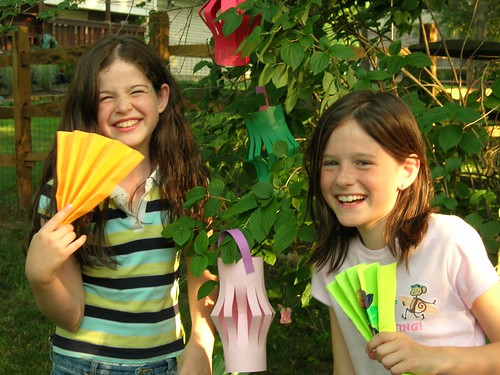
DSCN1199.JPG Caitrin and best friend Sarah with handmade lanterns for their Japanese tea party.

Have you read the book about the homeschooled kids who built a canoe in the basement, whittling the wood from felled trees? Or what about the teens who figured out how to cross breed fish in their creek, or built eco-friendly low-cost dwellings in their backyard as practice for working with Habitat for Humanity?

I remember reading about a kid who played with blocks as a child but then went on to write symphonies in college, after mastering the violin, and learning to conduct a symphony. Somehow these were related.

Then there are the kids who’ve read all of the classics and have taught themselves Latin and/or Greek. Others have performed on a Broadway stage, joined a prestigious ballet company, or have tried out to be Olympic athletes. All homeschooled.

Other impressive homeschoolers got into Harvard, or wrote best selling fiction (The Inheritance Series, anyone?), or worked as interns at the state government house!

Meanwhile, you’ve got runny noses, a daughter whose handwriting resembles scrawl, and a son whose main ambition seems to be punching pixels on a screen by thumping a button on a controller. You can’t imagine that your kids, your garden variety kids, will ever be so extraordinary. You feel mildly guilty about that. (I know I did.)

Perhaps your homeschooled children seem “extra” “ordinary” – as in “more ordinary than usual” – to you!

I found myself inspired and discouraged at the same time when I’d read about successful older homeschooled kids. I couldn’t see how my brood would ever get there.

First of all, we were appallingly bad at science (so scratch cross-breeding and habitat building). We had so many kids, I couldn’t imagine being able to afford supporting a lifetime habit of acting or ballet or singing or violin or lacrosse or gymnastics, let alone accommodating all those rehearsal/practice schedules!

And as far as boat-building in basements—I was lucky if we could find the basement floor, let alone make space to build in it.

Yet I plugged away with our books and our homeschool parties, our math pages and our co-op, committed to what I could do—how I could make my home a place where creativity had a chance to flourish, and where ambitions were accommodated as best as we could.

I couldn’t see the seeds being planted. I couldn’t know how they’d take root.

I wasn’t privy to how my children processed our experiences together, and how these memories became anchors of insight that led my kids to aspire to and achieve some of the amazing things they’ve now done. I never saw most of it coming. Truly.

On this side of homeschooling, I want to encourage you not to worry about the outcomes. The smallest acts of enthusiasm, support, and opportunity lead to big choices down the road. Your job isn’t to think of the great things your kids can do or should be doing some day.

Your job is to make sure that today, they have something interesting:

to read,
think about,
observe,
and enjoy.

Or as Charlotte Mason says, ” “Something to love, something to do, and something to think about.”

Find that sweet spot each day, no matter how briefly visited. These collect into a childhood of impressions that shape how they will choose to spend their teen years and eventually, their adulthood. They don’t have to “change the world” or impress anyone. All they need is the freedom to keep making choices that enhance their enthusiasm for being contributing people—human beings who want to share who they are with others using their unique constellation of gifts and passions.

That’s it.

You can do that.

You already are.

Posted in Brave Writer Lifestyle, Brave Writer Philosophy, Family Notes, Homeschool Advice | 3 Comments »

Email: What other curricula did I use?

Hi Julie,

Thanks to The Writer’s Jungle, I can now relax and teach writing in a more natural and fun way. Your blog has helped inspire our homeschooling and remind us of what really matters. I like your homeschool style and wonder if I could get your recommendations on any particular materials that you used over the years that you found to be valuable.

murderousmaths

I get the idea that you are probably not the type to use a curriculum – but thought I would ask anyway. I’m sort of a curriculum junkie. I have two daughters, 12 and 10.

For the moment we are using the follow…..

  • Math-U-See
  • Singapore Math
  • Apologia Science
  • History Odyssey
  • Writer’s Jungle and The Arrow
  • Worldly Wise

I’ve wasted a lot of money on plenty of other resources.

Thanks so much,

Susie

——

Hi Susie!

I certainly did use a variety of curricula over the years. Some of it I regret (and cringe to think about now). Some of it I loved and would use again. And then for a period of some years, we unschooled (though the definition of that word varies group to group, but from my perspective, that is who we were).

Some of my favorite resources follow, as well as how I “solved” some of the needs we had where I didn’t purchase curricula. I have omitted choices I regretted.

Math:

  • Miquon Math (For elementary school; combined with Cuisinaire rods—I literally didn’t understand multiplication until these books)
  • Family Math (I loved this book – we did everything in it)
  • Math-It (A game to learn multiplication tables quickly)
  • Keys to… (Fractions, Decimals, Percents)
  • Murderous Maths (Hands-down the most fun we’ve ever had with math; lots of volumes)
  • The I Hate Mathematics Book and Math for Smarty Pants by the Brown Paper School company
  • Saxon Math for Algebra and Geometry
  • Tutoring for math in exchange for writing help between homeschool families
  • Paid tutoring for high school math
  • Parttime enrollment at the local high school

History:

  • Sonlight (back when the Instructor’s Guides weren’t so enormous)
  • Well Trained Mind for a reading list, and Story of the World books
  • Personal rabbit trails and my own interests
  • (My regrets are in this category more than any other so the list appears to be short.)

Science:

  • Charter member of HENSE (Home Educators Neglecting Science Education)
  • Kitchen chemistry experiments from books
  • Ring of Fire Rock Study Kits (These are fabulous!!)
  • DK books
  • A telescope
  • Nature journaling 
  • Bird study through the Cornell Lab of Ornithology, including their BIG book and course.
  • Biology through our co-op
  • Chemistry through the local high school

Language arts:

  • Wordly Wise (some of my kids loved these and others thought they were twaddle)
  • Explode the Code
  • Ruth Beechik (everything she wrote)
  • Charlotte Mason
  • My own writing resources
  • Grammar Songs
  • Winston Grammar and Advanced Winston Grammar
  • Word Roots
  • Leon Garfield’s Shakespeare Stories (both volumes)
  • Literature—selected by consulting reading lists for each age bracket and my own memories, the kids’ dad, and online trolling.

Logic:

  • Red Herring Mysteries
  • Traditional Logic

Art:

  • Sister Wendy’s Story of Painting (Oh My Goddess!! I just googled and all of her “videos” are now online for free. Just the music alone sent me wheeling with memories and happiness. Don’t miss these.)
  • Linnea and Monet’s Garden (Then look at the recommended books and you will see all the others we read and enjoyed!)
  • Any museum in driving distance, regularly visited. Bought the books in the museum shop to review at home.

We also had fun with Ancient Greek, Rosetta Stone Chinese (didn’t get far in it, but it was fun to wet our feet), and Power Glide for French. Still, in the end, it was much easier for my kids to learn foreign languages in school (they attended the local high school for language learning, all except Noah who studied Klingon on his own <g>).

Hope that helps! Would love to hear about other favorite resources in the comments below.

Posted in Appreciating Art, Family Notes, Grammar, Homeschool Advice, Language Arts, Unschooling | 2 Comments »

Giving Wishes

If you can't give your child what she wants, you can give it to her in a wish.
 

If you can’t give your child what she wants,
you can give it to her in a wish.

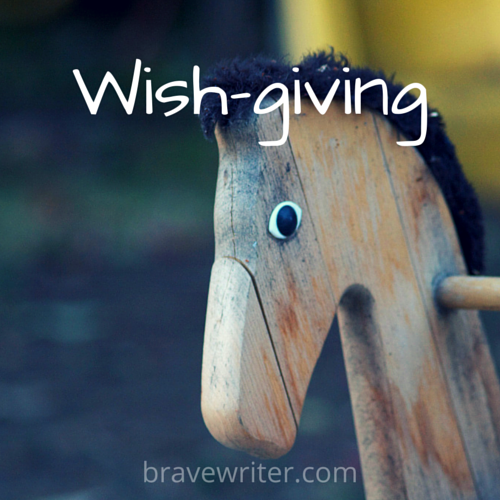
For instance, if she tells you she wants her own horse (yet you live in an apartment and don’t have the funds or lifestyle to support a horse), you don’t need to crush the vision with practicalities. Instead, give it to her in a wishful fantasy.

Wouldn’t it be wonderful to own a horse? What would you name it? Where would you ride it? What would it look like? Do you know what type of horse you’d want to own? Shall we look them up online? Would you want to show the horse in competitions? Ride the horse over jumps? Learn dressage? Or would you prefer to ride bareback over hills alone, looking at the sunset?

Of course you don’t simply shoot questions at her as if pulling the trigger to a BB gun. You want to give her the chance to live her fantasy with you for a little emotional vacation. Let her describe the horse’s mane and color, where she would ride, how she would care for the horse, why a horse would be such a dear companion at this stage in her life.

If possible, assist the fantasy with practical possibilities even if they fall short of the ultimate fantasy:

  • Maybe we can ride horses at the local stable this month.
  • How about we check out some good old films about horses and watch those over the next week?
  • Let’s pick a horse to follow in the upcoming series of horse races and get to know its life story.
  • I know there’s a saddle shop in town. Maybe we can learn how they are made, feel the smooth leather with our hands, and ask about local horseback riding while we’re there.
  • I wonder if we can take a family vacation to a dude ranch one year.
  • Our homeschool group may have a family with a horse we can visit. Let’s ask.

The thing about kids is that they enjoy possibilities far more than we do. They aren’t jaded, haven’t had their dreams dashed, don’t manage the checkbook, aren’t limited in their energy. There’s no need to “smack down a dream” before it has a chance to emerge. Give it some breathing room—allow it to manifest in conversation, illustrations, reading, narration, writing, and play. Then find the little pieces of the fantasy that you can support/provide, and find a way to incorporate these into your child’s life.

Sometimes magic happens and the little bit of wind you blow into those sails leads to the fulfillment of the bigger dream, too. Kids have a way of conjuring wonderfulness from nothing, which is one of the reasons we love having them in our lives.

Wishful thinking is a gift, not a thing to be disparaged.

Image by David Michalczuk (cc cropped, text added)

Posted in Brave Writer Lifestyle, Homeschool Advice | 1 Comment »

« Older Entries
Newer Entries »
  • Search the Blog

  • Julie Bogart
  • Welcome, I’m Julie Bogart.

    I’m a homeschooling alum -17 years, five kids. Now I run Brave Writer, the online writing and language arts program for families. More >>

    IMPORTANT: Please read our Privacy Policy.

  • New to Brave Writer? START HERE

  • FREE Resources

    • 7-Day Writing Blitz
    • Brave Writer Lifestyle Program
    • Brave Writer Sampler: Free Sample Products
    • Freewriting Prompts
    • Podcasts
  • Popular Posts

    • You have time
    • How writing is like sewing
    • Best curriculum for a 6 year old
    • Today's little unspoken homeschool secret
    • Do you like to homeschool?
    • Don't trust the schedule
    • You want to do a good job parenting?
    • If you've got a passel of kids
    • You are not a teacher
    • Natural Stages of Growth in Writing podcasts
  • Blog Topics

    • Brave Learner Home
    • Brave Writer Lifestyle
    • Classes
    • Contests/Giveaways
    • Friday Freewrite
    • High School
    • Homeschool Advice
    • Julie's Life
    • Language Arts
    • Movie Wednesday
    • Natural Stages of Growth
    • One Thing Principle
    • Our Team
    • Parenting
    • Philosophy of Education
    • Podcasts
    • Poetry Teatime
    • Products
    • Reviews
    • Speaking Schedule
    • Students
    • Writing about Writing
    • Young Writers
  • Archives

  • Brave Writer is a participant in the Amazon Services LLC Associates Program, an affiliate advertising program designed to provide a means for sites to earn advertising fees (at no extra cost to you) by advertising and linking to amazon.com

    Content © Brave Writer unless otherwise stated.

What is Brave Writer?

  • Welcome to Brave Writer
  • Why Brave Writer Works
  • About Julie
  • Brave Writer Values
  • Frequently Asked Questions
  • Speaking Schedule

Brave Writer Program

  • Getting Started!
  • Stages of Growth in Writing
  • The Brave Writer Program
  • For Families and Students
  • Online Classes
  • Brave Writer Lifestyle

…and More!

  • Blog
  • Classroom
  • Store
  • Books in Brave Writer Programs
  • Contact Us
  • Customer Service
  • Brave Writer Staff
© 2026 Brave Writer
Privacy Policy
Children's Privacy Policy
Help Center