Homeschool Advice Archives - Page 124 of 144 - A Brave Writer's Life in Brief A Brave Writer's Life in Brief
  • Start Here
    • For Families
      Multiple Ages
    • Ages 5-7
      Beginning Writers
    • Ages 8-10
      Emerging Writers
    • Ages 11-12
      Middle School Writers
    • Ages 13-14
      High School Writers
    • Ages 15-18
      College Prep Writers
  • Shop
    • Product Collections
    • Bundles
    • Writing Instruction Manuals
    • Literature & Grammar/Punctuation
    • Composition Formats
    • Literature Singles
    • Homeschool Help
    • Book Shop
  • Online Classes
    • Class Descriptions
    • Class Schedule
    • Classroom
    • How Our Classes Work
    • Our Writing Coaches
    • Classes FAQ
  • Community
    • Brave Learner Home
    • What’s Happening
    • Blog
    • Podcast
    • Calendar
  • Cart
  • My Account
    • My Online Classes
    • My Account
  • My Account
    • My Online Classes
    • My Account
  • Start Here

    If you’re new to Brave Writer, or are looking for the best products for your child or family, choose from below:

    • For Families
      Multiple Ages
    • Ages 5-7
      Beginning Writers
    • Ages 8-10
      Emerging Writers
    • Ages 11-12
      Middle School Writers
    • Ages 13-14
      High School Writers
    • Ages 15-18
      College Prep Writers
  • Shop

    If you’re already familiar with Brave Writer products, go directly to what you’re looking for:

    • Product Collections Browse the full catalog in our shop
    • Bundles Everything you need to get started
    • Writing Instruction Manuals Foundational Writing Programs
    • Literature & Grammar/Punctuation Grammar, Punctuation, Spelling & Literary Devices
    • Composition Formats Writing Assignments for Every Age
    • Literature Singles Individual Literature Handbooks
    • Homeschool Help Homeschooling Tools and Resources
    • Book Shop Books associated with Brave Writer Programs
  • Online Classes
    • Class Descriptions
    • Class Schedule
    • Classroom
    • How Our Classes Work
    • Our Writing Coaches
    • Classes FAQ
  • Community
    • Brave Learner Home
    • What’s Happening
    • Blog
    • Podcast
    • Calendar
  • Search
  • Cart

Search Bravewriter.com

  • Home
  • Blog

A Brave Writer's Life in Brief

Thoughts from my home to yours

Archive for the ‘Homeschool Advice’ Category

« Older Entries
Newer Entries »

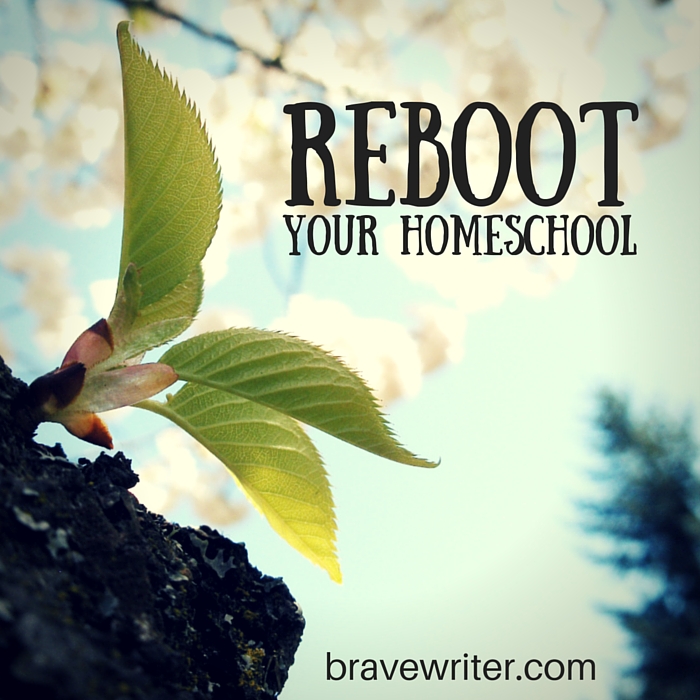
Reboot your homeschool

Reboot your homeschool

If you live in the northern hemisphere, spring is here and your family is increasingly aware that the “school year” is coming to an end. Some years my homeschool dribbled to an inconclusive end, until it was clear that we had given up. My best years, though, were the ones where I seized the spirit of spring and changed the pace/structure/energy of our home education.

How to make spring, springier

  • Play sports. We played soccer in the backyard every single day (that it didn’t rain) for 2 months. I got out there with the kids and the dog and we chased a ball around. We changed the rules, we made up our own games, we exhausted ourselves. Often, we kicked the ball around before we read aloud or worked on math pages. It became the daily “go to” practice and felt so good after a cooped up winter.
  • Visit the zoo. We went to the zoo 2-3 times a week. We’re lucky in Cincinnati to have the second best zoo in the country. I bought passes, and we loaded up the car with snacks and kids… and walked around the zoo until it was our best friend. We did some treasure hunts with clipboards (find the Latin names for Bengal Tiger, Panda, Manatee, and Boa Constrictor, Which weighs more—a cheetah or a lion?, What part of the world does the gazelle live in? etc.). I remember reading the first section of “Life of Pi” to my kids at the zoo to help us all understand how animals feel about being in zoos. Go. Enjoy.
  • Paint, draw, sculpt. Art feels like the natural choice in spring. We followed several books: Drawing on the Right Side of the Brain (Edwards), Drawing with Children (Brooks), and several others (for watercolors, oils, charcoals) that were picked up on sale at Barnes and Noble. I kept polymer clay handy for making jewelry, or little foods for doll houses, and so on. We learned to draw my African violets with charcoal on my deck one year.
  • Take hikes. Go to the places that are bursting with spring-life. Now’s the time to go to the gorge, or the beach, or the cliffs, or the woods. Bring your field guides and binoculars. Rent a kayak or pedal boat. Take a trip to a zip line! Get outside.
  • Make a movie. Turn your kids loose with the digital camcorder. You don’t have to make it a “lesson” by writing scripts. Let them explore how it works—they can make things appear and disappear, they can try to create the image of the warriors coming over the hill, they can record footage of puppets… let them play and explore.

Spring is a great time to get away from the books and out doing the stuff you always say you want to do, but don’t. Remember: no school classroom finishes the text books. They simply stop teaching… because they are exhausted!

You can too! Enjoy the weather, the chance to change pace, and the joy of learning something new.

Psst! Another great way to reboot your day—have a Poetry Teatime! Click the image below to find out more!

Poetry Teatime
Image by Nha Le Hoan (cc cropped, tinted, text added)

Posted in Homeschool Advice | 2 Comments »

Self-care: Part Two

Laying on Grass

Image by RelaxingMusic

Self-care is essential to the happy functioning of your family.

Self-care is not, however, ensuring that everyone in your family is behaving according to your plans and standards so that you can finally have a rest.

Self-care happens in the middle of the muddle, when things are at their most stressful, when you feel the least capable of meeting your own expectations and hopes. That frazzled feeling? A flashing red warning light that you need to take a self-appointed time out.

Check your body:

  • your jaw,
  • your neck,
  • your shoulders,
  • your brow,
  • your temples.

Tense?

Check your energy level:

  • ordinary tasks sound overwhelming,
  • resentment toward those around you for not cooperating with your plan for their lives,
  • bored,
  • frustrated,
  • listless.

Spent?

A few principles will help you get what you need:

1) Stop requiring others to meet your expectations for them. It’s hard to do, but it helps once you get the hang of it. This looks like letting go of your idealized vision of your child or partner, and accepting the person in front of you as that person is.

Today, you can practice by withholding suggestions. Make no behavior suggestions for the whole day. If a toddler or too young child needs some guidance to avoid certain death or vandalism, step in wordlessly and help. Take judgment, nudging, guilting, and shaming out of today’s vocabulary.

2) Stop matching your home to a picture in your head. Focus on the home in front of your eyes. Make one or two adjustments to what you see that bring you pleasure when you see them. Move a sofa, vacuum behind it, change the pillows, add a vase of flowers. In the midst of the mess, make one or two positive changes to the home rather than wishing you had time to overhaul the whole space.

3) Call a spade a spade. Don’t forgive so easily. If you are wounded by words (from a child, from a spouse), say so. Show your hurt or pain, don’t swallow it. Say it with feeling words, “I feel unimportant to you when you say…” or “I feel sad, bad, mad when you say…” or “I feel taken for granted when…”

There are even times when a shout as response is perfectly appropriate: “Hey! Stop that! That hurts!” or “I don’t like that! I feel used/mistreated/taken advantage of when you do/say/yell that!”

The biggest source of “energy drain” in anyone’s life is pretending that things are okay when they really really really are not. Stop pretending.

4) Ask for help. People love to be valuable. Ask for help sincerely, not to guilt anyone. Ask a family member that drives to go get you your favorite drink or to pick up bath salts. Ask your oldest child to run herd on the rest of the kids while you take 15 minutes to read a book in a different room. Ask the youngest children to set the table any way they want so you don’t have to. Ask a spouse to give you 20 minutes so you can take a walk or go for a run.

Don’t steal time—you know you should be with the children but you just want to read one more blog, or one more response to the forum post… We do this when we are bored, stressed, or not attending to our selves. We sneak what we need and then feel badly about it later.

Use that blog or that forum thread as a time out for yourself, deliberately taken, at a time in the day when you can give yourself to it without guilt or the vague sense of shame that you are not quite taking care of the kids, but you are also, darn it, so tired and you deserve a break….

Self-care is intentional. It’s also a great model for your children (and your spouse). When they see that you choose to go out with friends once in a while, or take up a new course of study, or need ten minutes to regroup, or that you are more interested in your own life than in regulating theirs, they become aware that they can live that way too. When you let them know when they hurt you, when you speak up for what you need, when you ask for help, you are teaching the whole family how to care for one another.

You are not the sole designated need-meeter, nor are you responsible to fashion a vision for this family that you single-handedly foist upon or require from everyone.

Your true vocation in the home, in your family, is to be a source of care—for others, but also for self. The symbiosis of these two will create the momentum you need to sustain all kinds of wonderful activities and intimacies for a long time to come.

See Part One here.


Be Good to You: Self Care Practices for the Homeschooling Parent

Posted in Brave Writer Lifestyle, Homeschool Advice, On Being a Mother | 2 Comments »

Self-care: Part One

Meditate

Image by RelaxingMusic

Try not to defend your life to others. It’s tempting to explain your choices, to provide evidence that you did the best you could or that your convictions are pure and your motives are selfless.

We’re all a bundle of needs, making decisions that are both selfless and self-interested. The only criteria that matters in evaluating how you spent today is the one you’ve chosen to live by… today.

That criteria shifts and changes—some years you have more energy for self-sacrifice and understanding; and others, you find you need someone to give you a break, to make up for what you lack, to be the strength you lack. Some years you find resources and help, and others, it seems no one “gets” what you’re going through and it’s entirely up to you to figure out the way forward.

Some years you’re blindsided by facts you never imagined would be the substance of your life, of your family.

We have our ideals (they matter) and we have our limits (they matter too). One person (you, me) can change the entire dynamic in a home by making better, more emotionally supportive, empathetic choices; but it’s also true that one person can wreck the peace, by not cooperating, asserting a will that is unresponsive to the best care and kindness you can give.

A family is an interdependent system—no one person can carry it alone. There must be give and take, support and nurture for each person, even if in uneven doses at times.

All you can do is become the healthiest version of you that you can be—taking care of your welfare so that you don’t wake up one day and “flip out.”

You’ll be given good advice: Be generous. Give. Share. Listen. Pay attention. Make adjustments. Become a partner to your kids, to your spouse. Forgive. Find the good, the true, the pure. Let go of petty resentments and high expectations.

But you also need to take care of you. Be sure that you, the care-giver, are being given care too—by someone, somehow, somewhere. It’s how you keep going.

When you hit your limits, you’ll get advice to give more. You’ll be told what the ideals are. You’ll be reminded of your original goals. You’ll try harder. We women are especially likely to take this advice to heart.

Just remember: in the trying (which is right and noble and good), stand up for you too. You matter as much to the whole system as all the people you love and serve freely every day.

Be good to you, no matter what that looks like. You get one life, too. It needs to be a good, peace-filled, lovely one. No Joan of Abeccas here. No Teresa of Calculadders allowed.

Stay connected to your well-being while you give to the ones you love. That’s it.

See Part Two here.


Be Good to You: Self Care Practices for the Homeschooling Parent

Posted in Brave Writer Lifestyle, Homeschool Advice, On Being a Mother | 1 Comment »

What’s on your child’s mind?

Your kids have been pondering, thinking, and imagining their lives. Some of them spend hours daydreaming about the next level they’ll beat on a video game.

Others wish they could sew costumes or paint with watercolors. You might have a child who wants to be in a play or who wants to play an instrument.

Maybe your daughter wants to become the next soccer star of her local team and your son hopes he can take a cake decorating class.

A teen might want to spend hours a day watching the top 100 films listed by Criterion in order.

How will you know, if you don’t ask? Where will those hours of the day come from if they’re already filled with your agenda or your wishes?

Creating space for the pursuit of your children’s daydreams is one of the greatest joys of homeschool. When you care about their desire to beat the next level on a game, they are more likely to trust you when you say that the math page will only take 15 minutes.

Conversely, what if dread of a specific homeschool task fills their minds?

Find out about that. Create space for complaint or anxiety.

In some cases, your kids will have smart thoughts about how to learn the hard subject area. It’s surprising the amount of insight your kids may have about their struggles if you know how to ask them the right kinds of questions.

You might ask things like:

“I know times tables feel hard to do. Does anything help? Do you prefer to hold things in your hand or draw on a chalk board? Does it help to talk to me as you work on them? What’s the hard part for you? Is it the book? Too busy and colorful? Too plain and tedious? Do the Cuisenaire rods hurt or help?”

Don’t punch the questions at your child like a nail gun. Take them slowly, show curiosity. Sometimes a child will say one thing that unlocks the whole thing:

“I don’t get the point of the rods.”

Suddenly you can see that your child is going through the motions without true understanding! More modeling and support, conversation and suggestions can follow. So pay attention and use your maturity and compassion to help you hear where the frustration comes from.

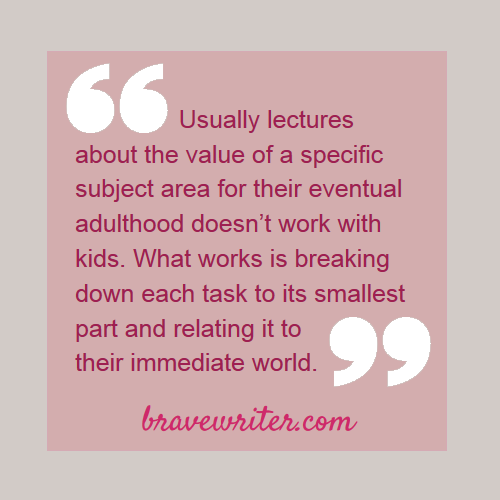
Usually lectures about the value of a specific subject area for their eventual adulthood doesn’t work with kids. What works is breaking down each task to its smallest part and relating it to their immediate world.

If there is no immediate connection, perhaps the work should fall to you to discover one before requiring a child to work that hard on the subject. After all, these are children. They don’t have the same level of fortitude to “do what they should” as you do as an adult. So take time (since you are the grown-up) to find the connection, to uncover the meaning, and to share it with love and support before requiring follow through and effort.

Sandwiched between support for their dreams and help for their struggles are love and trust. Create those through curiosity and care, and you’ll all feel a little happier today.

What works is

Cross-posted on facebook.

Posted in Brave Writer Philosophy, Homeschool Advice | Comments Off on What’s on your child’s mind?

Do it! Taking learning outdoors

Run Run Run
Image by Umair Mohsin

Remember how your 5th grade teacher would take you outside in April or May when the sun was shining to “do school” and you would be so excited to get out of the classroom, you’d become silly, and tug on Charlie’s shirttail and then Missie would steal your pencil, and some class clown would make a wisecrack and Mr. Bernard would shout that if everyone didn’t calm down, he would take you back inside to the Dark Room, where the sun doesn’t shine?

No schooling got done, but it felt so good to be outside. But your teacher vowed to never take that chance again.

Fast forward to your life now.

You live in a house. You are in charge. You can move the math book to any bench, picnic table, blanket, or trampoline outdoors.

Do it! Tickling, shirt-tail pulling, and wisecracks welcome.

Cross posted on facebook.

Posted in Homeschool Advice | Comments Off on Do it! Taking learning outdoors

« Older Entries
Newer Entries »
  • Search the Blog

  • Julie Bogart
  • Welcome, I’m Julie Bogart.

    I’m a homeschooling alum -17 years, five kids. Now I run Brave Writer, the online writing and language arts program for families. More >>

    IMPORTANT: Please read our Privacy Policy.

  • New to Brave Writer? START HERE

  • FREE Resources

    • 7-Day Writing Blitz
    • Brave Writer Lifestyle Program
    • Brave Writer Sampler: Free Sample Products
    • Freewriting Prompts
    • Podcasts
  • Popular Posts

    • You have time
    • How writing is like sewing
    • Best curriculum for a 6 year old
    • Today's little unspoken homeschool secret
    • Do you like to homeschool?
    • Don't trust the schedule
    • You want to do a good job parenting?
    • If you've got a passel of kids
    • You are not a teacher
    • Natural Stages of Growth in Writing podcasts
  • Blog Topics

    • Brave Learner Home
    • Brave Writer Lifestyle
    • Classes
    • Contests/Giveaways
    • Friday Freewrite
    • High School
    • Homeschool Advice
    • Julie's Life
    • Language Arts
    • Movie Wednesday
    • Natural Stages of Growth
    • One Thing Principle
    • Our Team
    • Parenting
    • Philosophy of Education
    • Podcasts
    • Poetry Teatime
    • Products
    • Reviews
    • Speaking Schedule
    • Students
    • Writing about Writing
    • Young Writers
  • Archives

  • Brave Writer is a participant in the Amazon Services LLC Associates Program, an affiliate advertising program designed to provide a means for sites to earn advertising fees (at no extra cost to you) by advertising and linking to amazon.com

    Content © Brave Writer unless otherwise stated.

What is Brave Writer?

  • Welcome to Brave Writer
  • Why Brave Writer Works
  • About Julie
  • Brave Writer Values
  • Frequently Asked Questions
  • Speaking Schedule

Brave Writer Program

  • Getting Started!
  • Stages of Growth in Writing
  • The Brave Writer Program
  • For Families and Students
  • Online Classes
  • Brave Writer Lifestyle

…and More!

  • Blog
  • Classroom
  • Store
  • Books in Brave Writer Programs
  • Contact Us
  • Customer Service
  • Brave Writer Staff
© 2026 Brave Writer
Privacy Policy
Children's Privacy Policy
Help Center