A Brave Writer's Life in Brief - Page 561 of 779 - Thoughts from my home to yours A Brave Writer's Life in Brief
  • Start Here
    • For Families
      Multiple Ages
    • Ages 5-7
      Beginning Writers
    • Ages 8-10
      Emerging Writers
    • Ages 11-12
      Middle School Writers
    • Ages 13-14
      High School Writers
    • Ages 15-18
      College Prep Writers
  • Shop
    • Product Collections
    • Bundles
    • Writing Instruction Manuals
    • Literature & Grammar/Punctuation
    • Composition Formats
    • Literature Singles
    • Homeschool Help
    • Book Shop
  • Online Classes
    • Class Descriptions
    • Class Schedule
    • Classroom
    • How Our Classes Work
    • Our Writing Coaches
    • Classes FAQ
  • Community
    • Brave Learner Home
    • What’s Happening
    • Blog
    • Podcast
    • Calendar
  • Cart
  • My Account
    • My Online Classes
    • My Account
  • My Account
    • My Online Classes
    • My Account
  • Start Here

    If you’re new to Brave Writer, or are looking for the best products for your child or family, choose from below:

    • For Families
      Multiple Ages
    • Ages 5-7
      Beginning Writers
    • Ages 8-10
      Emerging Writers
    • Ages 11-12
      Middle School Writers
    • Ages 13-14
      High School Writers
    • Ages 15-18
      College Prep Writers
  • Shop

    If you’re already familiar with Brave Writer products, go directly to what you’re looking for:

    • Product Collections Browse the full catalog in our shop
    • Bundles Everything you need to get started
    • Writing Instruction Manuals Foundational Writing Programs
    • Literature & Grammar/Punctuation Grammar, Punctuation, Spelling & Literary Devices
    • Composition Formats Writing Assignments for Every Age
    • Literature Singles Individual Literature Handbooks
    • Homeschool Help Homeschooling Tools and Resources
    • Book Shop Books associated with Brave Writer Programs
  • Online Classes
    • Class Descriptions
    • Class Schedule
    • Classroom
    • How Our Classes Work
    • Our Writing Coaches
    • Classes FAQ
  • Community
    • Brave Learner Home
    • What’s Happening
    • Blog
    • Podcast
    • Calendar
  • Search
  • Cart

Search Bravewriter.com

  • Home
  • Blog

A Brave Writer's Life in Brief

Thoughts from my home to yours

What are they doing now: Jacob

Jacob to Paris
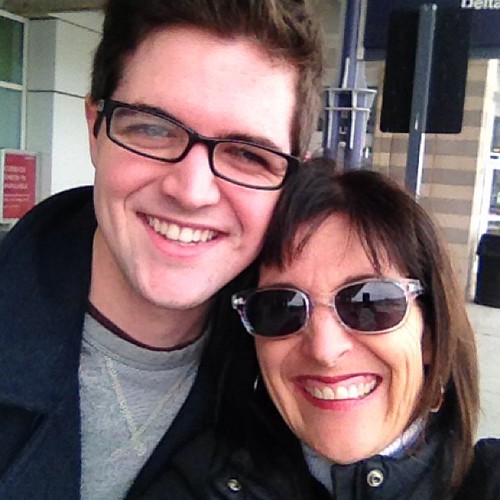
May 22, 2013. It seems the right time to do this expose on Jake as I just got off of Skype with him while he sits in Berlin with his younger brother. He shared some incredible news that I’ll save for the end of this post.

Jacob is our middle child. He came into our lives, the easiest of the five births, and is known for his basic equanimity. For instance, at age 2 when he’d feel a tantrum coming on, he’d excuse himself, scream it out for a few moments alone in the other room, and then return to the family smiling.

By age 3, however, he wasn’t speaking clearly or well. Jacob developed his own sign language to communicate what he wanted from us while trying to get his tongue around all those syllables words required.

At 5-6, we did take him to the local elementary school for speech therapy. He loved it. Thought it was fun. The therapist enjoyed him—her other public schooled students knew that therapy meant there was a problem. For Jacob, the homeschooler, therapy meant he got to go to a special class just for him!

Jacob showed signs of self-starting early on—teaching himself to read by using a program given to me by a California charter school. I literally didn’t have time to teach him (two other kids, pregnant). He didn’t seem to mind and sure enough, by 7, was reading.

Jacob showed a passion for astronomy so much so that inspired by his father’s suggestion, he started a cookie-baking business in our neighborhood in order to pay for Space Camp in Alabama. In two years, at 12, he had earned the $750.00 necessary for the trip and went!

Jacob attended our local public school for two classes his freshman year so he could join the band. Then he attended fulltime high school his last three years and was a member of the high school marching band that even got to perform at the Rose Parade.

He also started the first chapter of Amnesty International at his high school.

Now Jacob is in his junior year at Ohio State. His list of accomplishments is long, as Jacob is quite ambitious and oriented to human rights. It’s easier to list them than to describe them so here they are, as best as I can remember.

  • OSU Honor Student
  • President of Amnesty International at OSU (sophomore year)
  • RA (sophomore year)
  • Member of the Mock UN
  • Intern in Haiti for a summer, combined with research into NGOs and their effectiveness post earthquake
  • Exchange student in Geneva
  • Intern with the Human Rights Watch Commission in Geneva
  • Produced documentation for North Korean HR violations
  • Participant at the International Symposium on Human Rights at the UN (Fall 2012)
  • Presented his research about the NGO’s in Haiti at an Int’l Conference on Sustainability in Hiroshima (Jan 2013)
  • Exchange student in Paris (Now)
  • Recipient of numerous scholarships
  • Member of the Sphinx academic honor society at OSU
  • Student at Woodrow Wilson School of International Affairs at Princeton (This coming summer)

Jacob’s goal is to work in the field of human rights (possibly at the UN), post graduate school. His double major is French and Globalization.

Let me say this. I’m as stunned and amazed as anyone would be by Jacob’s ambition and his success in his chosen field of energy and passion. His heart for what he does and his commitment to the causes he cares about inspire me even more than the “list.” But the list is impressive in a special way. Let me explain.

I homeschooled just like you do, reading about other kids’ accomplishments, and not really believing that one of my kids would go on to do the “impressive stuff” I had read about. I believed in homeschooling (and do!). But I believed in it as an alternative to the standard measures of success. I felt fine with that. I’m proud of each of my children (I look forward to sharing about the last two soon) and the choices they’ve made. They all amaze me in their own ways.

What Jacob’s journey showed me, though, is that home education can be a rock solid foundation for academic advancement and achievement. It’s not a “sub-standard” education nor does it put a child at a disadvantage, if that child is achievement-oriented. Jacob wasn’t always so sure homeschooling had been an advantage (when he got to high school, he was angry, for instance, that I started him on algebra in 9th grade rather than 8th). But I told him he’d be fine. He was… and is. More than.

The foundation he got at home had more to do with his capacity to care and self-educate, than grades. His worldview, his interest in rights, his curiosity about global issues and politics, came from his life at home. He took his natural energy to actualize that caring into active service and achievement. He has a strong work ethic and a lot of motivation, even if he sometimes also loses his shoes. (Which he does.)

Jacob is in Berlin with his brother traveling. Here’s the news he just shared with me:

He was selected as one of two Rhodes Scholar Nominees from Ohio State and found out today.

Jacob will visit Oxford next weekend to check it out before he gets to work on the application this summer. He’ll be in a field of 1500 candidates nationwide. Crossing our fingers!

Posted in Family Notes, Julie's Life | 1 Comment »


An apologetic for teatime

Poetry Teatime

We joke that poetry teatimes are the ‘gateway drug’ to Brave Writer. They’re the lure, the enticement of all we’re about. And they’re free—no product purchase necessary.

You can read the details of how to hold a poetry teatime here.

But let’s look at why it works and what it does in your family, if you’ll just give it a go (even if right now, you think you hate poetry).

Here’s what happens when you take an hour a week to read poetry and drink beverages in tea cups or mugs with a few sweet treats for munchies.

EVERYONE stops.

Everyone. The whole bunch of you gather and every person is equally important to the teatime—baby, toddler, little kidlet, middler, teen, parent. It’s a moment in the day where the whole gang comes together.

Everyone STOPS.

The workbooks, the calculator, the DVD instructions, the playing with toys, the reading to oneself, the “moving a load of laundry from one machine to the other.” It all comes to a halt.

READING begins.

Poetry books are passed around the table. The readers, read. Long poems, short verses, paired-reading poetry, recited tongue twisters and limericks. Everyone reads—at whatever level they can—the exact poems they want to read. This is not “drumming out a few pages to prove you can read” reading, but a joyful dive into material selected by oneself to share with others!

Reading BEGINS.

Even non-readers read. They hunt for clues on the page that tell them that this poem, this verse is worth hearing. They look at fonts, and pictures, and words they recognize and they make good guesses—”Hey! I think I’d like hearing that poem.” They pass the book to a neighboring, willing reader and almost always want to follow along. Their selection is being read! They picked it! Reading is elevated to a goal, to a sacred practice, to being as cool as the big kids, to “I can almost read because I picked that poem!”

POETRY connects.

Poetry is a stealth writing form. It sneaks in through the backdoor and jumps you when you don’t expect it. T. S. Eliot says that poetry is “a raid on the inarticulate.” Rhymes, riddles, verse, ballads, sonnets, villanelles —whether you “get” the poem or not, there are words for pleasure and pondering, tickling and testing in your mouth. Laughter and puzzlement are part of poetry. Poems enrich vocabulary, imagery, and the pairing of unlikely ideas… which gets a writer’s juices going! Poetry says “Come out and play with me.”

Poetry CONNECTS.

A poem in your pocket, or shared over a bagel, or savored later in the day, once you take time to reread it, is like opening a love letter. There’s a little thrill—What will this set of words show me today that I never thought of before? Next week, and the next, you’ll notice favorite poems recycle and certain poetic forms revisited. Slowly, your family creates a shared poetic language that is uniquely yours. It’s different than story—poetry spans the ages more readily, and more quickly.

TEA and TREATS are enjoyed.

Or the beverage of your choice or your kids’ choice. Hydration (we forget to drink enough already, which causes headaches and crankiness), the soothing ritual of tea (blowing the steam off, slowing down to sip, adding milk, sugar, or honey, stirring and tinkling the cup), tipping a teapot and being careful not to spill…. rituals that alter the rush and race of life.

Also, sweet snacks, like brownies or scones or muffins or cookies or sliced cinnamon-sugar oranges or apple crescents or bunches of grapes, equal ‘happy’ smack dab in the middle of the day. The boost of sweet, the chance to munch, the shared pleasure of rare treats guarantees pleasant attitudes.

Poetry teatimes SHIFT your priorities.

When learning shows up as pleasurable and free, undistracted and rich, it’s harder to go back to dead forms of education. Other ideas to enliven the tedious or difficult subjects will dawn on you, as you move toward connection over completion.

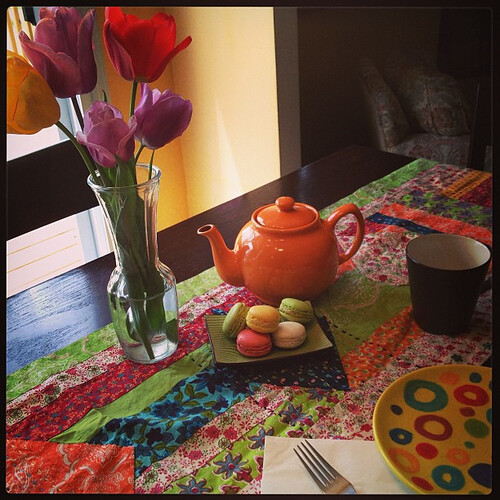
So find a poem, put the kettle on, lay out a few Oreos on a small plate, and get started. You can add a flower arrangement and table cloth next week. Just jump in.

Life gets better with poetry and tea.

Visit our Poetry Teatime website!

Posted in Poetry Teatime | Comments Off on An apologetic for teatime


How you say it is everything

How you say it is everythingWhen I speak at conferences, I like to talk about how to gain the goodwill of your children as you embark on the revision process. Here’s a snippet of what I share.

Remember when you went into labor (or if you adopted kids, remember the stories your mother and friends have told you)? Usually there’s quite a bit of emotion, physical pain, anxiety, and apprehension.

What if your husband or partner joined you during labor and said the following in a “take charge” (perhaps even coercive or condescending voice)?

“Sweetheart, I know this is scary and hard, but you have got to get a grip! Millions of women for thousands of years have given birth to babies. You’re no different. Now you get in there and have that baby. I don’t want to hear another word of complaint from you. I’ve got things to do and when I come back, I expect that baby to be here. Now get going.”

How would you feel? Would you be planning a call to the lawyer? Considering ways to short sheet the bed?

What if, instead, you heard these words, delivered in a sympathetic voice?

“Sweetheart, I know this is scary and hard. I see you are in pain. Millions of women for thousands of years have given birth to babies. They have all felt like you do right now. The baby will come. All you have to do is trust the process. I’ll be here, right by your side, holding your hand when it gets tough, distracting you when it helps. And I promise, at the end of this arduous process, there will be a baby so precious to us we’ll both declare that it was all worth it. No matter what, I’m here to support you.”

Which one do you want at your bedside? Husband A or Husband B?

Which type of parent do you think your children want when they embark on a writing project?

“Kids everywhere have to write and they all complain about it. That’s no excuse. I have things to do. Now you get in there and write three sentences. They had better be written by the time I get back! I don’t care that you hate writing. You just have to do it.”

or

“Kids everywhere have struggled to put pen to paper while thinking of things to write. You are just like them. It’s okay. I’ll be here with you, holding your hand, helping you think about what to say, how to say it, and reminding you of what you want to write so that you can get your wonderful thoughts out onto the page. We’ll do as much as we can today and take it up again tomorrow. I’m here to help. At the end, the writing product will be so worth it. You’ll see.”

Remember: don’t minimize pain or misinterpret it as laziness. Usually, the dawdling and whinging (love that word) is more about a lack of support in the process. Remind your child that the pain they feel is legitimate and natural, and that there are ways through the jungle to the other side. You are their companion for the journey, have tips and tricks to help, and that you don’t mind at all.

That’s a great place to start.

Image by wolfgangfoto

Posted in Brave Writer Lifestyle, Homeschool Advice | Comments Off on How you say it is everything


Friday Freewrite: Gossip

two young girls laughing behind another girls backImage by Inf-Lite Teacher

Has anyone ever talked about you behind your back? Or have you done that to someone else? Write about it.

New to freewriting? Check out our online guide.

Posted in Friday Freewrite | Comments Off on Friday Freewrite: Gossip


Pick one thing

oneImage by andrechinn

You can’t do ten things, and your homeschool won’t transform itself over night.

What you want and what creates momentum is a series of deliberate, prepared choices that lead to a sense of accomplishment and satisfaction. You get there one thing at a time.

Pick the subject, practice, habit, or attitude you wish were more present in your home and “do it” or “have it” or “develop it.”

Identify the One Thing that is top of mind—that keeps coming back to you as the one thing you wish you were living.

Then follow the One Thing principles:

1. Prepare (ahead of time). Plan a date, purchase, make copies, organize, think about, read literature related to your one thing choice. Gather materials.

2. Execute (day of). Follow through with enough time to invest deeply without distraction. Turn off your phone, shut down your computer, don’t answer the door. Be fully present.

3. Enjoy (kids and you). Let yourself forget everything else but that experience/lesson. Be here now. Don’t do other things simultaneously, don’t think ahead to what you will do next. Engage.

4. Reminisce (later that day or the next or next week). Talk about what was fun, remember humor, honor connections, recollect what went well. Talk about when you might do it again.

I gave a podcast about this topic a few months ago. Check it out.

Posted in Homeschool Advice, One Thing | Comments Off on Pick one thing


« Older Entries
Newer Entries »
  • Search the Blog

  • Julie Bogart
  • Welcome, I’m Julie Bogart.

    I’m a homeschooling alum -17 years, five kids. Now I run Brave Writer, the online writing and language arts program for families. More >>

    IMPORTANT: Please read our Privacy Policy.

  • New to Brave Writer? START HERE

  • FREE Resources

    • 7-Day Writing Blitz
    • Brave Writer Lifestyle Program
    • Brave Writer Sampler: Free Sample Products
    • Freewriting Prompts
    • Podcasts
  • Popular Posts

    • You have time
    • How writing is like sewing
    • Best curriculum for a 6 year old
    • Today's little unspoken homeschool secret
    • Do you like to homeschool?
    • Don't trust the schedule
    • You want to do a good job parenting?
    • If you've got a passel of kids
    • You are not a teacher
    • Natural Stages of Growth in Writing podcasts
  • Blog Topics

    • Brave Learner Home
    • Brave Writer Lifestyle
    • Classes
    • Contests/Giveaways
    • Friday Freewrite
    • High School
    • Homeschool Advice
    • Julie's Life
    • Language Arts
    • Movie Wednesday
    • Natural Stages of Growth
    • One Thing Principle
    • Our Team
    • Parenting
    • Philosophy of Education
    • Podcasts
    • Poetry Teatime
    • Products
    • Reviews
    • Speaking Schedule
    • Students
    • Writing about Writing
    • Young Writers
  • Archives

  • Brave Writer is a participant in the Amazon Services LLC Associates Program, an affiliate advertising program designed to provide a means for sites to earn advertising fees (at no extra cost to you) by advertising and linking to amazon.com

    Content © Brave Writer unless otherwise stated.

What is Brave Writer?

  • Welcome to Brave Writer
  • Why Brave Writer Works
  • About Julie
  • Brave Writer Values
  • Frequently Asked Questions
  • Speaking Schedule

Brave Writer Program

  • Getting Started!
  • Stages of Growth in Writing
  • The Brave Writer Program
  • For Families and Students
  • Online Classes
  • Brave Writer Lifestyle

…and More!

  • Blog
  • Classroom
  • Store
  • Books in Brave Writer Programs
  • Contact Us
  • Customer Service
  • Brave Writer Staff
© 2026 Brave Writer
Privacy Policy
Children's Privacy Policy
Help Center