
A Brave Writer's Life in Brief - Page 449 of 781 - Thoughts from my home to yours A Brave Writer's Life in Brief
  • Start Here
    • For Families
      Multiple Ages
    • Ages 5-7
      Beginning Writers
    • Ages 8-10
      Emerging Writers
    • Ages 11-12
      Middle School Writers
    • Ages 13-14
      High School Writers
    • Ages 15-18
      College Prep Writers
  • Shop
    • Product Collections
    • Bundles
    • Writing Instruction Manuals
    • Literature & Grammar/Punctuation
    • Composition Formats
    • Literature Singles
    • Homeschool Help
    • Book Shop
  • Online Classes
    • Class Descriptions
    • Class Schedule
    • Classroom
    • How Our Classes Work
    • Our Writing Coaches
    • Classes FAQ
  • Community
    • Brave Learner Home
    • What’s Happening
    • Blog
    • Podcast
    • Calendar
  • Cart
  • My Account
    • My Online Classes
    • My Account
  • My Account
    • My Online Classes
    • My Account
  • Start Here

    If you’re new to Brave Writer, or are looking for the best products for your child or family, choose from below:

    • For Families
      Multiple Ages
    • Ages 5-7
      Beginning Writers
    • Ages 8-10
      Emerging Writers
    • Ages 11-12
      Middle School Writers
    • Ages 13-14
      High School Writers
    • Ages 15-18
      College Prep Writers
  • Shop

    If you’re already familiar with Brave Writer products, go directly to what you’re looking for:

    • Product Collections Browse the full catalog in our shop
    • Bundles Everything you need to get started
    • Writing Instruction Manuals Foundational Writing Programs
    • Literature & Grammar/Punctuation Grammar, Punctuation, Spelling & Literary Devices
    • Composition Formats Writing Assignments for Every Age
    • Literature Singles Individual Literature Handbooks
    • Homeschool Help Homeschooling Tools and Resources
    • Book Shop Books associated with Brave Writer Programs
  • Online Classes
    • Class Descriptions
    • Class Schedule
    • Classroom
    • How Our Classes Work
    • Our Writing Coaches
    • Classes FAQ
  • Community
    • Brave Learner Home
    • What’s Happening
    • Blog
    • Podcast
    • Calendar
  • Search
  • Cart

Search Bravewriter.com

  • Home
  • Blog

A Brave Writer's Life in Brief

Thoughts from my home to yours

Poetry Teatime: A collective “ahhhh”

The Ultimate Poetry Teatime Post
Brave Writer has been encouraging Poetry Teatimes for well over a decade! Here’s a compilation of tips and inspiration shared throughout the years:

The Original Poetry Teatime Guide

Poetry Teatimes offer you and your children a break from the fast-paced demands of homeschooling, parenting, and household running. Everyone sighs a collective “ahhhh” as they settle into their chairs, tea cups or mugs in hand, poetry books scattered across the table.

How to Make a Pot of Tea

Plus muffin and scone recipes!

7 Teatime Tips

Some fresh advice for your teatimes!

The Value of Poetry

Poetry teaches us the beauty and potential of the English language. The innovative use of language—of diction (word choice), metaphor and simile, other figures of speech, punctuation and capitalization—encourages our fledgling writers to take a chance with language.

34 Poetry Books for Teatime

We share poetry titles on our Poetry Teatime Pinterest board. Suggested books often come from the featured teatimes of Brave Writer families. Here are the poetry books we shared in 2014.

More Poetry Teatime Titles

Features poetry books our family has enjoyed during our teatimes. Also, check out the recommendations from readers in the comments!

How to Read Poetry Aloud

“A poem will live or die depending on how it is read.” ~Billy Collins, former U.S. Poet Laureate

Our First Teatime of the Year

Over and over, they had to read the poems aloud and remember all the times we’ve read them before. At one point, I had to explain why other people didn’t read poetry the way we did: “It’s because a lot of people are intimidated by poetry. They don’t know that you can begin with rhymes and jokes, kids poems and limericks. If they started there, they’d ease into the adult stuff without noticing…like you have!”

No More Fantasy Teatime

Don’t fall victim to “Fantasy Teatime Syndrome.”

What If Your Kids Don’t Like Teatime?

The idea here is to keep experimenting with new venues, new options, trusting the overall thrust of your time with your children to be the good that they need. Remember how critical their own input is to a successful home education.

Sometimes Mom Needs a Teatime Just for Her

Find a private moment to sip, to observe, to take in a little written inspiration, to pause and enjoy the flavor of the hot brew on a cold day.

Then there are the many awesome Brave Writer families who have shared their teatimes with us.

And don’t forget our Poetry Teatime Pinterest board. It’s filled with ideas!
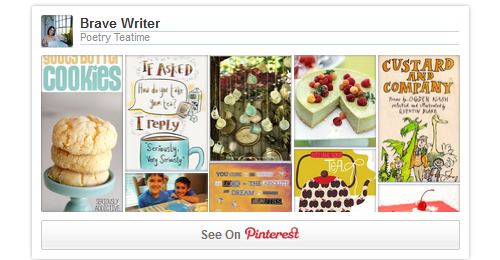
Poetry Teatime Pinterest board
Enjoy!

P.S. Thinking of poetry, our Playing with Poetry online workshop is the most fun you can have with your kids while working on writing. Taught by our own Susanne Barrett (MA in poetry), your family will not just learn to appreciate poetic forms, but will have the satisfying pleasure of writing them!

Also, Brave Writer’s Arrow Poetry Guide is a helpful tool! Four weeks’ worth of poetry lessons that use popular poems for children.

Still life image by cbransto (cc cropped, text added)
Visit our Poetry Teatime website!

Posted in Poetry Teatime | Comments Off on Poetry Teatime: A collective “ahhhh”


Jotting It Down in Action!

Jotting It Down Patty

Dear Julie,

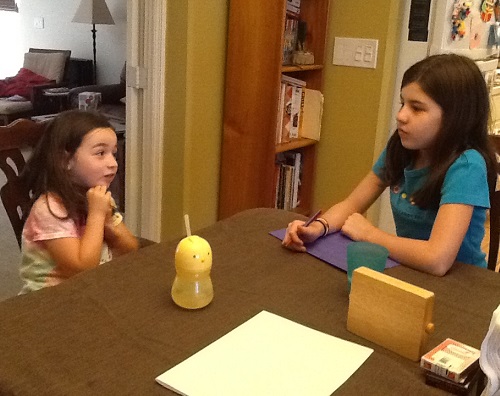
I had to share this with you. My girls were having breakfast and having a nonsense conversation that was starting to wear on me. I suggested they talk about something else, like the books they’re currently reading perhaps. 😉

All on their own, they turned it into a full blown discussion with little sis narrating her story and big sis jotting it down. Big sis can get a little over zealous with her questions, but at least she’s passionate about it…gotta give her that much.

Thanks for continuing to inspire us every day!
Patty

Learn more about Jotting It Down!

Image (cc)

Posted in Email, Natural Stages of Growth in Writing | 1 Comment »


Friday Freewrite: Advice

TITLE

What is the best piece of advice someone has given you? Tell what happened when you followed (or ignored!) his or her wise words.

New to freewriting? Check out our online guide.

Image by shonna1968 (cc cropped)

Posted in Friday Freewrite | Comments Off on Friday Freewrite: Advice


Student Spotlight: Tomy!

http://www.dreamstime.com/stock-image-santa-s-sleigh-image27793471

We love it when Brave Writer students share their writing with us! Tomy (age 8) wrote a holiday poem for an Arrow project. He says:

I would of never write this verse if wasn’t for the book Inside Out and Back Again and the Arrow project. I never read free verse before so Thanhha Lai inspired me to write in free verse, and I thought it was fun!

Thanhha Lai writes about what is important to her, so I wrote something important to me. Christmas is very important to me and I am always wondering how Santa travels since I don’t believe he travels by Reindeer.

I did really enjoy organizing my free verse with lots of one word lines.

Here is Tomy’s poem:

Everything is wrong

I like to hear
bells,
they have a
ringing
sound.

I like to see
decorations,
they are lited up
and
glittering.

But everything is
wrong,
because
Santa
travels every
year
in
something
different.

Image © Waupee | Dreamstime.com

Posted in Poetry, Students | Comments Off on Student Spotlight: Tomy!


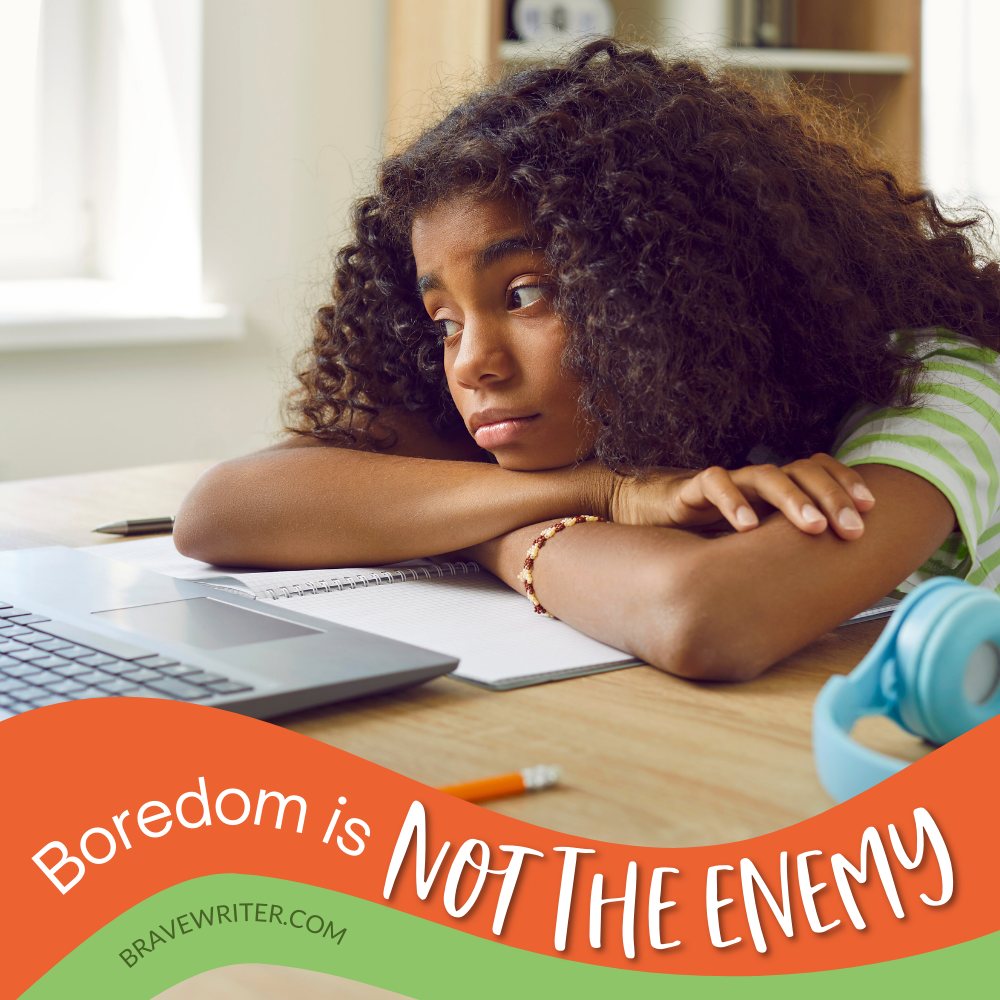
Boredom is Not the Enemy

Brave Writer

The most common advice given to parents when faced with a bored child is to load up that kid with chores. The thinking goes that the child will never utter the words again to avoid mopping, vacuuming, and laundering.

Other advice:

  • Leave the child in it and eventually he or she will come out of it.
  • Remind kids that life isn’t always interesting; that we all have to do things we don’t like.

Less punitive advice:

  • Send bored children outdoors.
  • Post a list of possible activities and hand it to the child.
  • Remind the child of all the toys and supplies at hand.

For me, these responses to the “I’m bored” cry feel inadequate. I know when I express a feeling, I want someone to “get it” at minimum. I want my feeling recognized as legitimate or valid—at least, understandable given my circumstances. Offering me solutions or punishments for being bored, frustrated, lonely, tired, cranky, or sad feels dismissive.

On the other hand, being confronted by a bored gaggle of kids when they have a house overflowing with toys, books, play equipment, video games, movies, and siblings can be utterly exasperating!

4 Ways to Deal with Boredom

(feel free to use, edit, disregard as suits you and your family)

1. Agree with equal amount of emotion in your voice. Like this:

“Mom, I’m bored.”

  • “You’re BORED!? Oh man I HATE that feeling.”
  • “I remember feeling bored when I was a kid. Drove me NUTS!”
  • “Boredom is SOOOO BORING! Ugh. Yuck. I get it.”
  • “Don’t you hate how you can be bored even though you have cool toys and games to play? I get that way sometimes.”

Let that stand. You don’t have to solve it. Sometimes just getting it is enough.

2. Resist the temptation to solve the boredom with practical activities. Instead, offer support in “handling” it, like this:

“How have you solved being bored before? Can you remember? What usually works for you?”

“Sometimes when I’m bored I have to sit for a little bit to think about how I might get to the other side. Want to pull up a chair while I’m in the kitchen and sit here with me while you think about it?”

“I remember the last time you were bored, you took the dog for a walk and you came back with a new idea of what to do. Do you think that would work this time? Or do you have another idea for what to do when you are bored?”

Or ask the question: “Do you mind being bored? Sometimes I like doing nothing—as a change of pace, just sitting around doing absolutely nothing at all. Do you ever like that?”

3. Invite the bored child (the one who is really struggling to find anything to do) to hang out with you until the child has a new idea of what to do.

“I hate being bored. I wish I had time to play a game with you. I’m washing dishes and I would love it if you would create a musical playlist for me to listen to while I do them. Would you mind doing that until you figure out what you want to do instead?”

“I was about to fold laundry. I know that probably doesn’t sound like fun, but until you know what you want to do, I’d love you to come talk to me to keep me company while I fold clothes. Would you mind doing that?”

“I’m on the computer right now. Come here! Look at these photos (story, pinterest images, facebook feed). Sometimes when I’m bored I just scroll through these news feeds endlessly. Not very productive, eh? Want to show me something online that I haven’t seen today?”

The goal here is to recognize that boredom is a condition of experience, but it doesn’t have to be overcome. Companionship is often one way to “heal” it for the moment allowing new ideas to come forward.

4. Suggest (after you may have tried the three ideas above) a project that is messy, that the child has wanted to do but you have put off, that is involving.

The key to overcoming boredom is “surprise.” Boredom is about relentless predictability. All of us get tired of that. Our toys bore us because they are familiar. Our books bore us because the newness has worn off. Our siblings bore us because they are always there. Our parents bore us because they are such adults all the time.

To rise above boredom means upsetting the stability and predictability of routine and familiarity. If your child is truly at the chronically bored place, it’s time to involve new experiences and those usually require time, companionship, and big messes.

  • Painting
  • Brand new board games
  • Hammers and nails
  • Taking apart old radios, bicycles, furniture, computers
  • Modeling clay
  • Baking
  • Sewing
  • Video games
  • A six part movie series
  • Having friends over
  • Planning a party

In other words—boredom may mean that life has become a bit dull, a bit of a drudgery, a bit repetitive.

Even in the academics, this happens. If you have been using the same set of workbooks for the entire fall, it may be time to put them away for a week and do all hands-on activities for math, language arts, and science. Just change the tone and energy of the home.

Alternatively, use them in a new setting: at the local Starbucks, go to the library, hang out at a park, “do school” at a homeschool friend’s house where you all study together for a day.

Boredom is real. It’s not the enemy. It doesn’t mean your child is misbehaving or willful. Boredom is not a sign of lack of gratitude or ingenuity. Boredom simply is—it’s another feeling that human beings have that deserves respect, support, and love. Like all of our feelings.


Flip the Energy in Your Homeschool: 3 Tips


Brave Learner Home

Posted in Homeschool Advice | 5 Comments »


« Older Entries
Newer Entries »
  • Search the Blog

  • Julie Bogart
  • Welcome, I’m Julie Bogart.

    I’m a homeschooling alum -17 years, five kids. Now I run Brave Writer, the online writing and language arts program for families. More >>

    IMPORTANT: Please read our Privacy Policy.

  • New to Brave Writer? START HERE

  • FREE Resources

    • 7-Day Writing Blitz
    • Brave Writer Lifestyle Program
    • Brave Writer Sampler: Free Sample Products
    • Freewriting Prompts
    • Podcasts
  • Popular Posts

    • You have time
    • How writing is like sewing
    • Best curriculum for a 6 year old
    • Today's little unspoken homeschool secret
    • Do you like to homeschool?
    • Don't trust the schedule
    • You want to do a good job parenting?
    • If you've got a passel of kids
    • You are not a teacher
    • Natural Stages of Growth in Writing podcasts
  • Blog Topics

    • Brave Learner Home
    • Brave Writer Lifestyle
    • Classes
    • Contests/Giveaways
    • Friday Freewrite
    • High School
    • Homeschool Advice
    • Julie's Life
    • Language Arts
    • Movie Wednesday
    • Natural Stages of Growth
    • One Thing Principle
    • Our Team
    • Parenting
    • Philosophy of Education
    • Podcasts
    • Poetry Teatime
    • Products
    • Reviews
    • Speaking Schedule
    • Students
    • Writing about Writing
    • Young Writers
  • Archives

  • Brave Writer is a participant in the Amazon Services LLC Associates Program, an affiliate advertising program designed to provide a means for sites to earn advertising fees (at no extra cost to you) by advertising and linking to amazon.com

    Content © Brave Writer unless otherwise stated.

What is Brave Writer?

  • Welcome to Brave Writer
  • Why Brave Writer Works
  • About Julie
  • Brave Writer Values
  • Frequently Asked Questions
  • Speaking Schedule

Brave Writer Program

  • Getting Started!
  • Stages of Growth in Writing
  • The Brave Writer Program
  • For Families and Students
  • Online Classes
  • Brave Writer Lifestyle

…and More!

  • Blog
  • Classroom
  • Store
  • Books in Brave Writer Programs
  • Contact Us
  • Customer Service
  • Brave Writer Staff
© 2026 Brave Writer
Privacy Policy
Children's Privacy Policy
Help Center