Wednesday Movies Archives - Page 15 of 21 - A Brave Writer's Life in Brief A Brave Writer's Life in Brief
  • Start Here
    • For Families
      Multiple Ages
    • Ages 5-7
      Beginning Writers
    • Ages 8-10
      Emerging Writers
    • Ages 11-12
      Middle School Writers
    • Ages 13-14
      High School Writers
    • Ages 15-18
      College Prep Writers
  • Shop
    • Product Collections
    • Bundles
    • Writing Instruction Manuals
    • Literature & Grammar/Punctuation
    • Composition Formats
    • Literature Singles
    • Homeschool Help
    • Book Shop
  • Online Classes
    • Class Descriptions
    • Class Schedule
    • Classroom
    • How Our Classes Work
    • Our Writing Coaches
    • Classes FAQ
  • Community
    • Brave Learner Home
    • What’s Happening
    • Blog
    • Podcast
    • Calendar
  • Cart
  • My Account
    • My Online Classes
    • My Account
  • My Account
    • My Online Classes
    • My Account
  • Start Here

    If you’re new to Brave Writer, or are looking for the best products for your child or family, choose from below:

    • For Families
      Multiple Ages
    • Ages 5-7
      Beginning Writers
    • Ages 8-10
      Emerging Writers
    • Ages 11-12
      Middle School Writers
    • Ages 13-14
      High School Writers
    • Ages 15-18
      College Prep Writers
  • Shop

    If you’re already familiar with Brave Writer products, go directly to what you’re looking for:

    • Product Collections Browse the full catalog in our shop
    • Bundles Everything you need to get started
    • Writing Instruction Manuals Foundational Writing Programs
    • Literature & Grammar/Punctuation Grammar, Punctuation, Spelling & Literary Devices
    • Composition Formats Writing Assignments for Every Age
    • Literature Singles Individual Literature Handbooks
    • Homeschool Help Homeschooling Tools and Resources
    • Book Shop Books associated with Brave Writer Programs
  • Online Classes
    • Class Descriptions
    • Class Schedule
    • Classroom
    • How Our Classes Work
    • Our Writing Coaches
    • Classes FAQ
  • Community
    • Brave Learner Home
    • What’s Happening
    • Blog
    • Podcast
    • Calendar
  • Search
  • Cart

Search Bravewriter.com

  • Home
  • Blog

A Brave Writer's Life in Brief

Thoughts from my home to yours

Archive for the ‘Wednesday Movies’ Category

« Older Entries
Newer Entries »

Wednesday Movie: Willy Wonka & the Chocolate Factory

Movie Wednesday

The 1971 movie, Willy Wonka and the Chocolate Factory, isn’t your run-of-the-mill children’s film. Based on Roald Dahl’s bestselling book, Charlie and the Chocolate Factory, it’s a psychedelic mix of color and chaos, shadow and songs. When Charlie, a boy from a poor family, wins the chance to visit the world’s most famous chocolate factory with four other children, he has no idea what a spellbinding, spooky, and surprising day he’s in for.


[This post contains Amazon affiliate links. When you click on those links to make purchases,
Brave Writer receives compensation at no extra cost to you. Thank you!]


Leading the children throughout the factory is Mr. Willy Wonka, who’s every bit as strange as the rooms on the tour. Magically brought to life by Gene Wilder, he’s got a glint in his eye and a lilt in his voice that are more than a little unnerving.

Willy Wonka’s Chocolate Factory is a doorway into a world where sweets grow on trees, geese lay golden eggs, and gobstoppers last forever. But it’s a dangerous world for the unwary.

Despite the fact that it’s 45 years old this year, the film is every bit as vivid, joyous, and thought-provoking as when it first came out. So give it a go if you haven’t seen it!

Discussion Questions

  • The four children who explore the factory with Charlie are depicted as highly unpleasant, but do you think they deserve what happens to them? Explain your answer.
  • Roald Dahl didn’t like the film at all, partly because he thought it focused too much on Mr. Wonka and not enough on Charlie. Do you think that is true? Why or why not.
  • If you’ve read the book Charlie and the Chocolate Factory, compare the film to the novel. See how many differences you can spot.
  • Was hiding golden tickets in chocolate bars the best way to find a new factory owner? What might you have done differently if you’d been Willy Wonka?

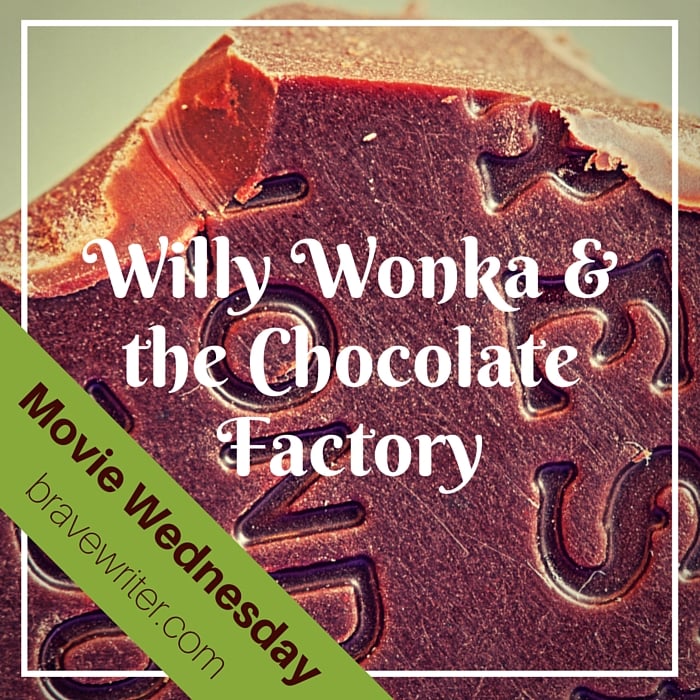
Also, see that bar of chocolate in the graphic above? The photographer notes that Prestat of Piccadilly is one of London’s oldest chocolate shops, and that Roald Dahl referred to Prestat as “the great chocolatiers.” Could that have been the chocolate he had in mind when writing Charlie & The Chocolate Factory?

Image by Martin Cooper (cc cropped, tinted, text added)

Need help commenting meaningfully on plot, characterization, make-up and costumes, acting, setting and even film editing? Check out our eleven page guide, Brave Writer Goes to the Movies. Also, tell us about a film you and your kids watched together (along with a pic if you have one) and if we share it on the blog you’ll receive a free copy!

Movie Discussion Club

Posted in Wednesday Movies | Comments Off on Wednesday Movie: Willy Wonka & the Chocolate Factory

What’s a primary part of any good language arts program? Watching movies!

Watching Movies

Surprisingly enough, watching movies with your kids ought to be a primary part of any good language arts program. There is nothing like listening to language used in the right context by different people (especially actors) for vocabulary training as well as growing in familiarity with proper syntax.

Film teaches kids comic timing, irony, key cultural assumptions, and makes use of a host of well-known story archetypes. Additionally, plot and characterization are both easily identified and understood in movies. Quickly kids learn about what makes a good versus poorly drawn villain, they discover what a climax is without even knowing that that is what it’s called, and they can make predictions based on past story experiences.

Comparing multiple versions of the same story (different film versions and comparisons with the original novel) is an excellent way to point out characterization choices, to focus on setting and costuming, etc.

The key to good movie viewing at home is watching with your kids and talking about what you see. Ask questions. Stop the film at a crucial juncture and ask everyone to predict what will happen next. Replay a scene after the movie is over to see if you understand it differently now that you know the whole story. Watch the same movie once, twice, three times.

Watching films together is a far better way to develop language arts skills than all the typical workbooks that talk about plot and/or vocabulary. Movies put the plot on display in about two hours. Can’t beat that!

Here are helpful resources:

16 Fancy Literary Techniques Explained by Disney by Adam Moerder

“Because why waste money on an English degree when you can just watch Disney movies?”

Read the Book, Watch the Movie by Andrea

“This great list of over 80 wonderful stories that have been made into movies is sure to keep you busy! This is a great way to encourage reluctant readers or bookworms alike! Read them aloud then watch them for a movie night or let confident readers read them alone.”

Note: Not all film suggestions may be right for your child. Check content using review sites like Kids in Mind.

Need help commenting meaningfully on plot, characterization, make-up and costumes, acting, setting and even film editing? Check out our eleven page guide, Brave Writer Goes to the Movies. Also, tell us about a film you and your kids watched together (along with a pic if you have one) and if we share it on the blog you’ll receive a free copy!
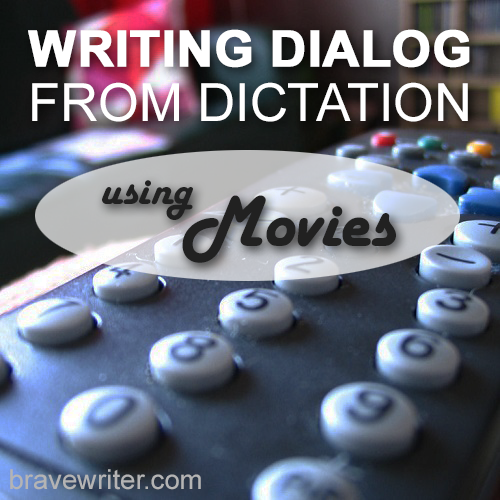
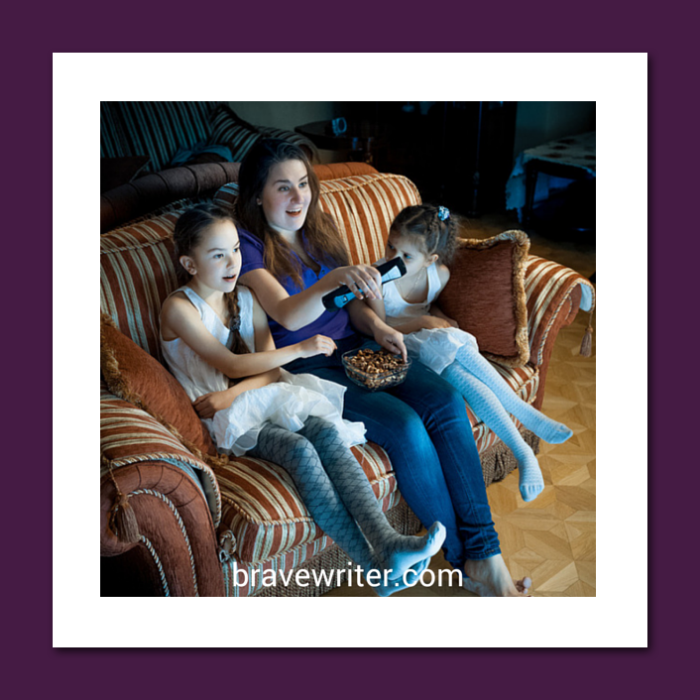
Image by Кирилл Рыжов / Fotolia

Posted in Wednesday Movies | 1 Comment »

How to Use a Movie for Dictation Practice

How to Use a Movie for Dictation Practice

Use a favorite scene from a well-loved film for writing dialog from dictation. You should have kids who are already skilled in copywork of dialog first.

Then, try it like this:

  1. Load the DVD, Blu-ray, or streaming platform.
  2. Cue it up for the dialog scene (no more than 2 characters, only back and forth 4-5 times).
  3. Go over basic punctuation conventions for dialog (remind kids how to use quotation marks, that periods and question marks go inside the quotes, that each new speaker starts on a new line, indented, etc.).
  4. Play the scene through.
  5. Then play it a bit at a time, pausing as your children write. Do this for as long as it takes.
  6. Finally, play the scene all the way through, while the child compares their work to what they hear, making adjustments.

You will be the one to correct the finished product, but do it alongside the child in conversation: “Good job here. I think you need an apostrophe for the possessive here. Oops! Changed speakers. What do you do? That’s right. Indent, new line.”

Have fun!


Brave Writer Movie Discussion Club

Top image by Francis Bijl (cc cropped, tinted, text added)

Posted in Wednesday Movies | Comments Off on How to Use a Movie for Dictation Practice

Movie Wednesday: James and the Giant Peach

007

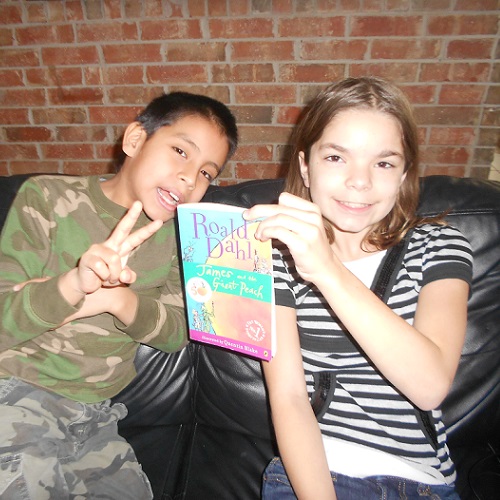
Our family recently started the Brave Writer lifestyle, and we’re all enjoying our new routine. My daughter, 10, is using The Arrow for James and the Giant Peach. My son, 7, was interested in the book, too, so we did it as a read-aloud.

Today, as a conclusion to the study, we watched the movie version on Netflix. We had a good discussion afterward, centering on how different the movie was from the book. The movie started off pretty accurately, but as soon as Aunt Spiker and Aunt Sponge didn’t get squished, they noticed a lot of differences.

My daughter enjoyed the book more, as the personalities of the bugs were more developed, there was a lot more detail, and it made more sense. My son liked the movie version – he liked seeing what we read about and didn’t seem to mind that it didn’t match up.

This was a good exercise for them to watch the movie version of a book they’d just read (or listened to). We talked about how movies can’t include everything in a book and why they might want to change some things.

They can’t wait to tell Daddy about it!

With joy, Andrea

Image (cc)

Need help commenting meaningfully on plot, characterization, make-up and costumes, acting, setting and even film editing? Check out our eleven page guide, Brave Writer Goes to the Movies. Also, tell us about a film you and your kids watched together (along with a pic if you have one) and if we share it on the blog you’ll receive a free copy!

Posted in Wednesday Movies | 1 Comment »

What do we talk about AFTER the movie?

What do we talk about AFTER the movie?

Have you ever experienced this? You added a regular movie night to your Brave Writer Lifestyle. You carefully selected a quality film you believed your child would enjoy. The credits have rolled, and the conversation goes something like this:

“What did you think?”
“I liked it.”
“What are your thoughts about the main character?”
“I liked her.”
“Did you have a favorite part?
“I don’t know. Could I play Minecraft now?”

The exchange feels stilted and forced. Instead of a Big Juicy Conversation, your child wants to bolt. Next time, keep the following tips in mind.

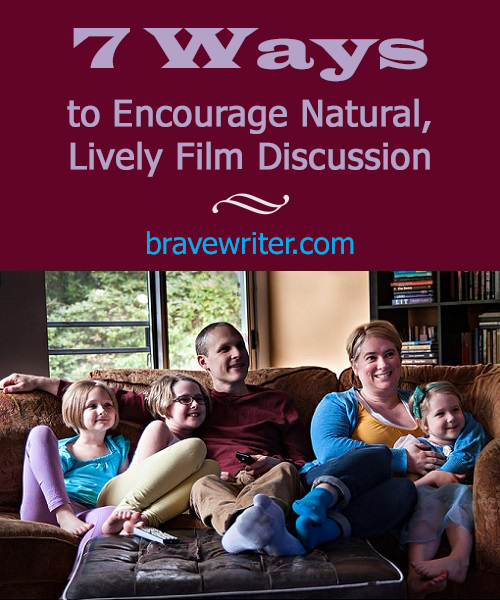
7 Ways to Encourage Natural, Lively Film Discussion

1. Lead the way. If you get, “I don’t know,” for an answer then share your reactions. “It made me angry when…” “I had no idea that X would happen…” “Were you as shocked as I was that Y didn’t win?”

2. Be specific. “What did you think?” is so open that some children aren’t able to pin down reasons. Instead try, “What surprised you the most?” and “Could you predict the ending? How did you know?!”

3. Dig Deeper. When your child responds with a general, “I liked it,” you might say, “That’s cool. What did you like about it? The story? The songs? The animation? I liked…”

4. Ask probing questions. “If a psychologist looked at the actions of Z what do you think he or she would say?”

5. Encourage connection. “Do you relate to anyone in the movie, or do any of the characters remind you of someone you know? And, if so, how are they alike?”

6. Seize the moment for retelling. Oral narrations can feel stiff and artificial when asked for. However, if the child is retelling to someone who hasn’t seen the movie, then the retelling springs from a natural place of wanting to share. So let’s say you watched a movie in the afternoon, when the non-homeschooling parent arrives home, ask over dinner, “We watched a great movie today. Who wants to tell Daddy or Mommy about it?”

7. Don’t push it. Sometimes the best conversations happen a day or two later! Not everyone is prepared to discuss a film the moment the credits roll! Wait for the drive to the dentist or while washing dishes. Bring it up in light conversation and through memories of the film and see how it goes them.

The Bottom Line

Even without a discussion, movie viewing is valuable to your kids as a means of teaching them the structure of plot, characterization, setting, mood, theme, and more. Over time, these are all “going in” and you will find that your children will draw on those memories of movie-viewing to help them as they explore literary analysis in high school and beyond.

Image by Personal Creations (cc cropped and text added)

Need help commenting meaningfully on plot, characterization, make-up and costumes, acting, setting and even film editing? Check out our eleven page guide, Brave Writer Goes to the Movies. Also, tell us about a film you and your kids watched together (along with a pic if you have one) and if we share it on the blog you’ll receive a free copy!
Posted in Wednesday Movies | Comments Off on What do we talk about AFTER the movie?

« Older Entries
Newer Entries »
  • Search the Blog

  • Julie Bogart
  • Welcome, I’m Julie Bogart.

    I’m a homeschooling alum -17 years, five kids. Now I run Brave Writer, the online writing and language arts program for families. More >>

    IMPORTANT: Please read our Privacy Policy.

  • New to Brave Writer? START HERE

  • FREE Resources

    • 7-Day Writing Blitz
    • Brave Writer Lifestyle Program
    • Brave Writer Sampler: Free Sample Products
    • Freewriting Prompts
    • Podcasts
  • Popular Posts

    • You have time
    • How writing is like sewing
    • Best curriculum for a 6 year old
    • Today's little unspoken homeschool secret
    • Do you like to homeschool?
    • Don't trust the schedule
    • You want to do a good job parenting?
    • If you've got a passel of kids
    • You are not a teacher
    • Natural Stages of Growth in Writing podcasts
  • Blog Topics

    • Brave Learner Home
    • Brave Writer Lifestyle
    • Classes
    • Contests/Giveaways
    • Friday Freewrite
    • High School
    • Homeschool Advice
    • Julie's Life
    • Language Arts
    • Movie Wednesday
    • Natural Stages of Growth
    • One Thing Principle
    • Our Team
    • Parenting
    • Philosophy of Education
    • Podcasts
    • Poetry Teatime
    • Products
    • Reviews
    • Speaking Schedule
    • Students
    • Writing about Writing
    • Young Writers
  • Archives

  • Brave Writer is a participant in the Amazon Services LLC Associates Program, an affiliate advertising program designed to provide a means for sites to earn advertising fees (at no extra cost to you) by advertising and linking to amazon.com

    Content © Brave Writer unless otherwise stated.

What is Brave Writer?

  • Welcome to Brave Writer
  • Why Brave Writer Works
  • About Julie
  • Brave Writer Values
  • Frequently Asked Questions
  • Speaking Schedule

Brave Writer Program

  • Getting Started!
  • Stages of Growth in Writing
  • The Brave Writer Program
  • For Families and Students
  • Online Classes
  • Brave Writer Lifestyle

…and More!

  • Blog
  • Classroom
  • Store
  • Books in Brave Writer Programs
  • Contact Us
  • Customer Service
  • Brave Writer Staff
© 2026 Brave Writer
Privacy Policy
Children's Privacy Policy
Help Center