Language Arts Archives - Page 15 of 17 - A Brave Writer's Life in Brief A Brave Writer's Life in Brief
  • Start Here
    • For Families
      Multiple Ages
    • Ages 5-7
      Beginning Writers
    • Ages 8-10
      Emerging Writers
    • Ages 11-12
      Middle School Writers
    • Ages 13-14
      High School Writers
    • Ages 15-18
      College Prep Writers
  • Shop
    • Product Collections
    • Bundles
    • Writing Instruction Manuals
    • Literature & Grammar/Punctuation
    • Composition Formats
    • Literature Singles
    • Homeschool Help
    • Book Shop
  • Online Classes
    • Class Descriptions
    • Class Schedule
    • Classroom
    • How Our Classes Work
    • Our Writing Coaches
    • Classes FAQ
  • Community
    • Brave Learner Home
    • What’s Happening
    • Blog
    • Podcast
    • Calendar
  • Cart
  • My Account
    • My Online Classes
    • My Account
  • My Account
    • My Online Classes
    • My Account
  • Start Here

    If you’re new to Brave Writer, or are looking for the best products for your child or family, choose from below:

    • For Families
      Multiple Ages
    • Ages 5-7
      Beginning Writers
    • Ages 8-10
      Emerging Writers
    • Ages 11-12
      Middle School Writers
    • Ages 13-14
      High School Writers
    • Ages 15-18
      College Prep Writers
  • Shop

    If you’re already familiar with Brave Writer products, go directly to what you’re looking for:

    • Product Collections Browse the full catalog in our shop
    • Bundles Everything you need to get started
    • Writing Instruction Manuals Foundational Writing Programs
    • Literature & Grammar/Punctuation Grammar, Punctuation, Spelling & Literary Devices
    • Composition Formats Writing Assignments for Every Age
    • Literature Singles Individual Literature Handbooks
    • Homeschool Help Homeschooling Tools and Resources
    • Book Shop Books associated with Brave Writer Programs
  • Online Classes
    • Class Descriptions
    • Class Schedule
    • Classroom
    • How Our Classes Work
    • Our Writing Coaches
    • Classes FAQ
  • Community
    • Brave Learner Home
    • What’s Happening
    • Blog
    • Podcast
    • Calendar
  • Search
  • Cart

Search Bravewriter.com

  • Home
  • Blog

A Brave Writer's Life in Brief

Thoughts from my home to yours

Archive for the ‘Language Arts’ Category

« Older Entries
Newer Entries »

Follow up to yesterday’s post

Hi everyone.

I heard from two of our instructors yesterday with excellent feedback related to our post and discussion about writing between parents and children. Here’s what Rita has to say:

Julie,

I think one reason parents freak about spelling is they don’t follow the entire Writer’s Jungle process. They never take a child-selected writing piece once a month and work through the editing process you outline. That is where kids learn about all the picky stuff and they see that they can have a finished piece that people look at and praise.

Without the whole process over the course of months, parents give up on trusting the freewrite and kids don’t understand that a freewrite is about getting ideas on paper for a selected “big finish.” That big finish is where it all comes together and kids have an opportunity to care about how it looks or how it’s spelled–and to show it to someone with pride! The whole process encourages everyone to embrace and trust the freewrite. Parents whose kids are afraid to write are more afraid of that once a month editing process. Then everyone spirals downward again when the freewrite loses its steam. I hear this over and over again in Dynamic Revision (one of Rita’s classes that she teaches for Brave Writer).

Also, introducing kids to electronic dictionaries–now on phones and easier than ever with Siri–can really help the kid who is picky about spelling. They are more willing to just underline words that they don’t know how to spell, while they freewrite, once they can see how easy it is to go back after and electronically “fix” their perceived errors–before anyone else sees it! Their need to be perfect is easily met, so they are able to trust waiting.

Lastly, be aware of this: kids who can’t deal with the misspelled word may have no strategies for spelling. Kids who rely on how words look and don’t attend to phonemes and the default graphemes have no clue how to “just write how you think it’s spelled.” They may have to be taught how to write what they hear. Again, the electronic/on-line dictionaries help here: write what you hear, then check it by inputting those letter choices into the search. Spell-checkers reward those efforts in a way the old tomes never could.

Just some thoughts.

I would add: The Wand (created by Rita) gives parents the tools to teach spelling strategies to your kids. For older kids, The Arrow and The Boomerang give your kids practice with spelling through copywork and dictation. Use someone else’s writing to work on mechanics.

For kids struggling with handwriting, one of our instructors, Susanne Barrett, recommends Dragon Speech-to-Text Software:

Hi Julie,

Keith bought me the Dragon speech-to-text software; he found it at Costco for half price ($40). It’s wonderful; I can speak into the headset, and my words magically appear on the screen; I can even punctuate, capitalize, italicize or bold, even open files all by voice commands. The advantage for me is that it saves my swollen hands from painful typing.

However, I was thinking that because it’s dictation-based, it might be an option to mention for some of our families, either with kids in the partnership stage of writing or for students with dysgraphia or dyslexia.

It took about half an hour to set it up and train it to my voice. And we’re off and running! I’ve had problems with dictating in e-mails (I’m typing this), but I wrote half my new fan fiction chapter in Word with it Saturday within an hour of opening the box, and I can dictate responses to students within Brave Writer after setting the cursor at the right place. Yay!! My hands have really been bothering me lately, so this software is helping immensely.

Just wanted to let you know….

And there you have it! Our instructors have great ideas to keep you and your families writing. You may want to sign up for a class this spring. Just sayin’! 🙂
 

Posted in Brave Writer Philosophy, Dictation and copywork, Homeschool Advice, Language Arts, Learning Disabilities, The Writer's Jungle, Young Writers | Comments Off on Follow up to yesterday’s post

Surprise! No one teaches it.

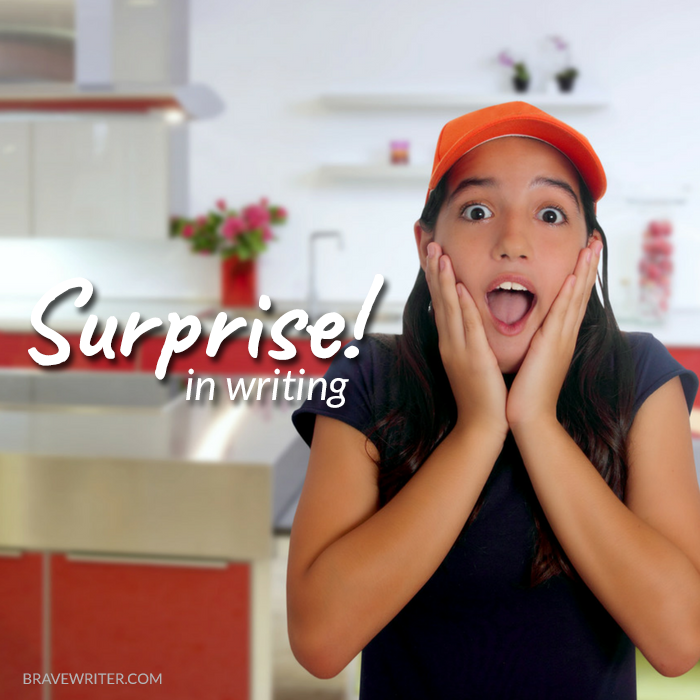
Surprise in Writing

In all the writing literature I have crammed between DVDs on my book cases, the one literary element that gets short shrift is: Surprise. I can’t find it—no chapters devoted to expounding its importance. Exercises for plot, dialog, essay format, poetic structure, yes. Surprise? Well, occasionally it gets a passing mention. But almost always it’s tied to some other element (like, powerful verbs should be surprising, or a thesis statement is best constructed in a “surprise reversal” format). But that’s not what I mean. I mean, writing is absolutely dependent on subverting reader expectations over and over and over again, to be considered powerful.

Surprise means bursting through the door unannounced with cookies and milk, just for the reader, right when energy flags and minds wander. I’m not talking about big plot twists or even hiding information only to reveal it later. I also mean surprising the reader with a fresh metaphor; casting a commonly known term into a new grammatical role; picking unusual proper nouns for characters, street signs, shops; starting the story in the middle of the action; saving your best argument for last in an essay; hooking the reader’s attention at the top of the paper and saving the resolution for the conclusion (hook and return); littering the writing with alliteration, onomatopoeia, rhyme and consonance… and so on.

The best writing is as dependent on generously ladled portions of surprise throughout its lasagna layers of meaning, imagery, cool logic and vivid language as middle-aged readers are on good lighting and corrective lenses!

What’s more, it can be taught! Part of what makes your young writers’ quirky, poorly spelled and punctuated early attempts at written communication so enjoyable is the way their view of the world surprises your jaded, middle-aged one. You “crack up” when they surprise you.

It’s not hard to be surprising, once you know where to hide before you pop out!

Let’s take a look at this mysterious little element and introduce our kids to it. (Psst! They love surprises, so this may be your own subversive way to get them from the couch to the kitchen table, too!)

The “personal experience metaphor” trick

The hardest thing to do is to create fresh comparisons (metaphors, similes, analogies). Readers are sick of the “tried and true,” “old as the hills,” “dry as toast,” cliches that have served since the Spanish-American war! To wake up your readers, take an old cliche and buy it a new outfit. Draw from contemporary experiences that are alive to your kids.

Example: Her body twisted and flipped like Play-Doh in the hands of my baby brother.

Example: He focused his attention like a gamer trying to find the secret passage on level 6 of Mario.

Example: My Mom is older than an Atari play station.

Example: The early bird may catch the worm, but in my house, the early homeschooler catches up on math left unfinished from the day before.

The “grammatical transformation” trick

When I say, “What part of speech is ‘couch’?”; you think ‘noun’.” Right? How about this: “Don’t couch your words in flattery when you talk to me, mister!” Suddenly this ho-hum noun takes charge of the whole sentence (and the offending party!). If you flip the grammatical use of a few words, on a regular basis, you keep your reader vertical and awake! Not only that, habitual meanings can be subverted by using verbs and nouns in unusual pairings. “Dinosaurs marinate in the earth.” Do they? Well, yeah, kinda! It makes you pause and reconsider your internal vision.

Example: Drew lego-ed the sticks together into a kind of backyard fort.

Example: The birds pinwheeled through the autumn sky.

Example: The solution became a schmear of peanut-buttering one side of the argument while jellying the other, until the two competing options were slammed together into a single sticky whole.

The “collecting crazy names” trick

Get a moleskin notebook—the kind that fits in a pocket, or a purse. When you’re driving around, pay attention to signs. Jot down interesting names. Look at billboards, freeway exits, stores and hotels. Record terms that will serve as good choices for your writing. Names of people can be gathered from Greek myths, the Norse Gods, fiction you are reading, TV shows, cartoons, comic books, Shakespeare plays, a directory of your homeschooling community. It really doesn’t matter how you gather them, but pay attention and collect when you are not writing. Then when you need one, pull it out!

An expert in the field of surprising name choices is none other than J.K. Rowling. Whatever you think about her books, her use of creative names is unmatched. She tells her readers she’s been keeping a little notebook for more than a decade where she jots interesting names to be used at a later date. When she’d create a new character, she’d flip through her book looking for the right name.

Example: There’s a reason Rowling has “Hermoine” paired with Harry and Ron. Much more interesting than “Mary” might have been.

Example: Shakespeare has great names like “Hero,” “Benedick,” “Ophelia,” and “Iago.”

Example: The Greek myths include epic names: “Persephone,” “Demeter,” “Agamemnon,” “Xanthe” and “Kallisto.”

This hunt for a good name applies not only to people, but to stores, cities, street signs, organizations, tournaments—all fiction depends on a slew of proper nouns carefully selected.

Example: Diagon Alley (play on words: diagonally)

Example: Island of the Blue Dolphins (using a Native American name)

Example: Camp Kooskooskoos (Trumpet of the Swan: funny to say)

So join the game! Make “naming” a joy, not a chore.


Party School!

Posted in Language Arts, Words!, Writing Exercises, Young Writers | 4 Comments »

From the Forums: When it works, it works!

Last year we took the WONDERFUL copywork/dictation class and now we are slowly working our way through The Writer’s Jungle. Today my children did their first keen observation exercises.

Samuel, age 8, dictated the following to me with just a little bit of help:

Lightsaber
———-
It has a light-blue blade with streaks of white on it. It has a red button that you pull down to open it. It has six grips on it. One has a little, tiny, white streak on it. In the back of it, it has a knob with ridges going all around it with a dot the color of bronze in the middle of it. Right above that there is this thing that looks kind of like a little clothespin but you can not close it. And it has some black on the rim of it.

On each side of the lightsaber, it has two little bumps with a circle going around it. Above the red button I told you about there is a little silver circle. Above that is a black strip that curves in a moon shape, going out to the sides. On the sides, there is a hump that goes up, around the back, and back down on the other side. Then in the middle of the handle, there is more than 55 tiny, pointy studs going around the middle. It feels a little sharpish but it has a good grip.

It tastes like stale crackers.

In the middle of the left side of the lightsaber, there is a rectangle that goes a half-inch off the side of the lightsaber. On the top of that, there is a gold line about half-inch wide and two inches long and it has perpendicular and parallell lines carved on it and it has two little black spots on the top. And on the side of that rectangle, there is this little thing coming off of it that looks like a bed and it has a black spot at one tip. At the bottom of it, near the grip, is a black hook so you could hook it on your pants.

When the blade is coming out, it sounds like a fast-moving river. When it is going back in, it sounds like a brief drum roll.

The smell is like perfume. That’s why I don’t smell it that much.
———————————–

Jane, 10 years old, wrote the following all by herself about a large multi-colored fake gemstone. (I corrected all of her spelling a punctuation errors as I typed this in):

This fake diamond is an amazing mix of colors. When I lean my head to one side, the sun relects on the little, triangular, tinted plates, creating a rose-blended lavendar, while some still remain an emerald green. The diamond-shaped, colored plates surrounding the outer edge can appear gold in some forms of lighting or lavendar, and in other cases emerald color. The inner plate can, too, appear a most majestic gold. Once I turn on the light the colors become deeper and darker like a dark, deep sea.

It feels cold to the touch, like icy metal. But it warms slowly as you keep your hand on it. The back is coated with a light metal surface.

It smells like a clear icy morning, so clear and airy almost like nothing. When I rub it on a wood surface, it sounds rocky and raspy like a not-so-clear voice coming over an old-fashioned radio. Sometimes when I touch it with a warm hand, it feels sweaty, the way it does when you grip a penny too hard and too long.

In the front there is a flat, circular, clearish plate, which is surrounded by the diamond plates I told you about. I think it is very complex and interesting to think about.
——————————-

I’m pleased with their results. We’ve read good books & they’ve done narration for many years. For the past year, we’ve done copywork, dictation & freewriting regularly. We just completed the Farmer Boy Arrow that caused us to discuss and notice descriptive details, especially for my daughter. We also recently played the communication game, which really helped my son notice & describe details. I think all those things helped prepare them for this valuable exercise. I LOVE this approach to language arts! It’s so natural, fun & productive, too.

–Betsy R

Posted in Brave Writer Philosophy, Dictation and copywork, General, Language Arts | 2 Comments »

Email: Reports from the front and a question!


Julie,

I have been reading the Brave Writer Manual (The Writer’s Jungle) and LOVE IT.  I really like the easy approach you give us to teach our kids.  I’m still waiting for the October book to come into my library to start the Arrow program, so I’ll keep you posted on how that goes.

The charter requires everything that the state requires but my rep is also a college Language Arts teacher.  She wants Daniel writing long book reports, essays, and paragraphs when completing school work.  My son, up until Brave Writer “hated” anything that required writing.  He would cringe when constantly reminded that he needed to be able to write an essay for the state tests in April.  Even writing the answers to questions in our history book required my writing the answers he dictated to me and then he would copy them.

Yesterday, we went on a nature walk, in between the rain storms, and collected flowers he wanted to put in a vase and do a writing project on.  We started with using the five senses and listing descriptive words.  When he finished that I asked him to write one sentence (no worries about spelling, grammar, punctuation, etc.) and to my surprise he wrote two very good sentences.  He was so proud reading them to us when his dad came home from work.  When he was done, I congratulated him and let him know that he could be done for the day.  To my surprise he asked if he could write more.  Of course I said yes.

Julie, thank you for this great easy to understand writing program.  We are very blessed to have found you.

Ann

Thanks Ann! It’s always such good news to know that kids discover the power and pride of selecting words to represent their inner experience. You’re doing a great job!

—

Julie,

It’s wonderful to see you up and blogging again. You’re blog has encouraged me greatly these past couple years. I started a blog a couple years ago, because of your encouragement. Writing in it occasionally, my essay like entries reflect upon what I am learning on my journey. Rereading my blog, I notice how much of your philosophy on life (not just writing) has helped me flesh out the things I struggled with through my 19years of home educating. You have also made me realize the importance of example in my life to inspire others. The purpose I have for my blog is to impart to my children as they go through their journey of parenting. Your blog is one of two I come back to, continually. I just want to say thank you for inspiring me to inspire others.  : )

May God shower you with many blessings today!
Diane

Wonderful to hear from you Diane. I’m thrilled that my blog has encouraged you, but even more thrilled to know that you are writing your own! That’s what it’s all about.

—

Hi Julie-

Thanks for sharing at PEACH tonight and for signing your “autograph” on Stefanie’s writing book. 🙂 That will be inspiring for her! I have been using your TWJ (The Writer’s Jungle) electronic since Sept. and we ordered various older electronic Arrows to jive with our TOG readings this year,too.  At any rate, as I told you, it has been going really well. Stef is happier and not as reluctant anymore. She likes the freewriting.   Would you recommend our next step to be just keep doing what we are doing? [buy other Arrows as needed]. I wasn’t sure if doing the Kidswrite Basic would be doing more of the same but with a larger audience and seeing the other kids’ writing with the teacher interaction? Since she is 10, do we just keep going until she gets to middle/high school and use your other essay writing classes, etc? Just wondered your thoughts,

Cindy

Hi Cindy.

You’re doing all the right things. Glad she is growing and relaxing. Your understanding of KWB is accurate. It’s a great place to get feedback, to see other student writing and to ask your in-depth questions about becoming your daughter’s most effective writing coach and ally. If you want an experience that is similar in terms of level, but that uses the tools of TWJ for a different product, I suggest taking a look at the Just So Stories course. It starts on November 2 and gives your daughter a chance to apply her newly found enthusiasm and skills to a specific writing project. This course is not offered again this year and the instructor is our longest-term writing teacher. In other words, she’s fabulous.

In fact, I hope lots of families sign up for JSS as it will close soon. Your kids get to write stories about animals that make use of Rudyard Kipling’s delightful use of language. You’ll love the process and the results.

Posted in Brave Writer Philosophy, BW products, Email, Language Arts, The Writer's Jungle, Young Writers | Comments Off on Email: Reports from the front and a question!

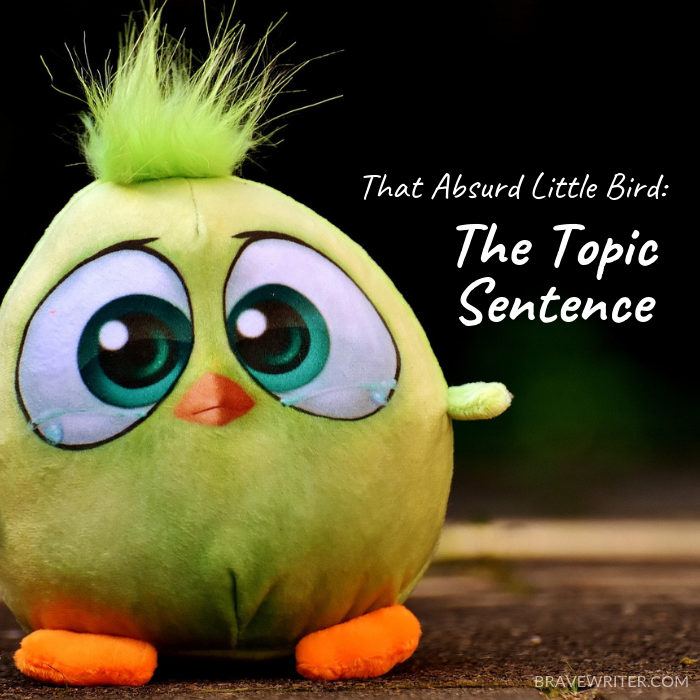
That Absurd Little Bird: The Topic Sentence

The Topic Sentence

If you want to see my dyed gray hair stand on end, talk to me about the importance of the initial topic sentence.

“My left earlobe is very attractive for three reasons.”

“I like anchovy ice cream more than pizza.”

“Captain Diaperpants is an entertaining book and I highly recommend it.”

Need I go on? ::yawn::

Truth is: The topic sentence is to the paragraph what support hose are to varicose veins. We don’t really want to be aware of the work they’re doing. They offer support, yes, but why announce that fact to the world? The best ones are hidden in the compelling-to-read prose.

I was lurking on the Internet and read a whole bunch of sample paragraphs on a writing site for homeschooled students. The curriculum writer stressed the importance of both the topic sentence and structured, orderly writing as hallmarks of correct writing. She then conceded that this kind of writing would be “stiff and stilted and even boring in most cases,” but it didn’t matter. Didn’t matter? In what universe? The point was to learn to write these orderly, cardboard, stiff, spiritless, uninspired, i-n-s-i-p-i-d paragraphs (::grinding teeth::) with duty and diligence no matter how painful to the reader.

Oh break my writerly heart!

Reverse the curse of the initial topic sentence.

Here’s how:

  • Start in the middle.
    Don’t tell me all I need to know in the first sentence. Once I find out that you are a black belt in karate, what interest do I have in reading how you earned the belt? Start with the struggle, facing the board as you prepare to sever it in half as with a cleaver. Leave me hanging out there, flapping in the breeze, worried and curious.
  • Get me involved.
    Use sensory detail to suck me into the scene without revealing your point until I’m hooked: “I sneezed when I leaned over the basket of cumin to examine it for bugs. The spicy fragrance reminded me of kasbahs and Moroccan stews. Unfortunately, I found myself in a modern Farmer’s Market in downtown Cincinnati instead. I miss North Africa.”
  • Put the main idea at the end of the paragraph.
    Most freewriting will start with a typical topic sentence that generalizes about the subject for writing. That’s fine when getting your thoughts together. To help hide the know-it-all sentence when you revise, move it to the end and see what happens. Like in the sample above—the topic sentence is last to appear. It’s so much happier modestly revealing itself at the end.

I know, I know. I didn’t even talk about the all important topic sentence in academic writing or in subsequent paragraphs. We’ll get to that another day.

For now, hook me, seduce me, scare me, move me, grab me by the collar, and don’t let me go. Lure me into your writing by concealing the point. That’s the point! (And that second-to-last sentence you just read, the one pretending not to be a topic sentence, is the topic sentence for this piece, artfully concealed until the end, incidentally…)

Groovy Grammar Workshop

Posted in Language Arts, Writing about Writing, Young Writers | 6 Comments »

« Older Entries
Newer Entries »
  • Search the Blog

  • Julie Bogart
  • Welcome, I’m Julie Bogart.

    I’m a homeschooling alum -17 years, five kids. Now I run Brave Writer, the online writing and language arts program for families. More >>

    IMPORTANT: Please read our Privacy Policy.

  • New to Brave Writer? START HERE

  • FREE Resources

    • 7-Day Writing Blitz
    • Brave Writer Lifestyle Program
    • Brave Writer Sampler: Free Sample Products
    • Freewriting Prompts
    • Podcasts
  • Popular Posts

    • You have time
    • How writing is like sewing
    • Best curriculum for a 6 year old
    • Today's little unspoken homeschool secret
    • Do you like to homeschool?
    • Don't trust the schedule
    • You want to do a good job parenting?
    • If you've got a passel of kids
    • You are not a teacher
    • Natural Stages of Growth in Writing podcasts
  • Blog Topics

    • Brave Learner Home
    • Brave Writer Lifestyle
    • Classes
    • Contests/Giveaways
    • Friday Freewrite
    • High School
    • Homeschool Advice
    • Julie's Life
    • Language Arts
    • Movie Wednesday
    • Natural Stages of Growth
    • One Thing Principle
    • Our Team
    • Parenting
    • Philosophy of Education
    • Podcasts
    • Poetry Teatime
    • Products
    • Reviews
    • Speaking Schedule
    • Students
    • Writing about Writing
    • Young Writers
  • Archives

  • Brave Writer is a participant in the Amazon Services LLC Associates Program, an affiliate advertising program designed to provide a means for sites to earn advertising fees (at no extra cost to you) by advertising and linking to amazon.com

    Content © Brave Writer unless otherwise stated.

What is Brave Writer?

  • Welcome to Brave Writer
  • Why Brave Writer Works
  • About Julie
  • Brave Writer Values
  • Frequently Asked Questions
  • Speaking Schedule

Brave Writer Program

  • Getting Started!
  • Stages of Growth in Writing
  • The Brave Writer Program
  • For Families and Students
  • Online Classes
  • Brave Writer Lifestyle

…and More!

  • Blog
  • Classroom
  • Store
  • Books in Brave Writer Programs
  • Contact Us
  • Customer Service
  • Brave Writer Staff
© 2026 Brave Writer
Privacy Policy
Children's Privacy Policy
Help Center