Julie Bogart, Author at A Brave Writer's Life in Brief - Page 111 of 485 A Brave Writer's Life in Brief
  • Start Here
    • For Families
      Multiple Ages
    • Ages 5-7
      Beginning Writers
    • Ages 8-10
      Emerging Writers
    • Ages 11-12
      Middle School Writers
    • Ages 13-14
      High School Writers
    • Ages 15-18
      College Prep Writers
  • Shop
    • Product Collections
    • Bundles
    • Writing Instruction Manuals
    • Literature & Grammar/Punctuation
    • Composition Formats
    • Literature Singles
    • Homeschool Help
    • Book Shop
    • Special Offers
  • Online Classes
    • Class Descriptions
    • Class Schedule
    • Classroom
    • How Our Classes Work
    • Our Writing Coaches
    • Classes FAQ
  • Community
    • Brave Learner Home
    • What’s Happening
    • Blog
    • Podcast
    • Calendar
  • Cart
  • My Account
    • My Online Classes
    • My Account
  • My Account
    • My Online Classes
    • My Account
  • Start Here

    If you’re new to Brave Writer, or are looking for the best products for your child or family, choose from below:

    • For Families
      Multiple Ages
    • Ages 5-7
      Beginning Writers
    • Ages 8-10
      Emerging Writers
    • Ages 11-12
      Middle School Writers
    • Ages 13-14
      High School Writers
    • Ages 15-18
      College Prep Writers
  • Shop

    If you’re already familiar with Brave Writer products, go directly to what you’re looking for:

    • Product Collections Browse the full catalog in our shop
    • Bundles Everything you need to get started
    • Writing Instruction Manuals Foundational Writing Programs
    • Literature & Grammar/Punctuation Grammar, Punctuation, Spelling & Literary Devices
    • Composition Formats Writing Assignments for Every Age
    • Literature Singles Individual Literature Handbooks
    • Homeschool Help Homeschooling Tools and Resources
    • Book Shop Books associated with Brave Writer Programs
    • Special Offers
  • Online Classes
    • Class Descriptions
    • Class Schedule
    • Classroom
    • How Our Classes Work
    • Our Writing Coaches
    • Classes FAQ
  • Community
    • Brave Learner Home
    • What’s Happening
    • Blog
    • Podcast
    • Calendar
  • Search
  • Cart

Search Bravewriter.com

  • Home
  • Blog

A Brave Writer's Life in Brief

Thoughts from my home to yours

Author Archive

« Older Entries
Newer Entries »

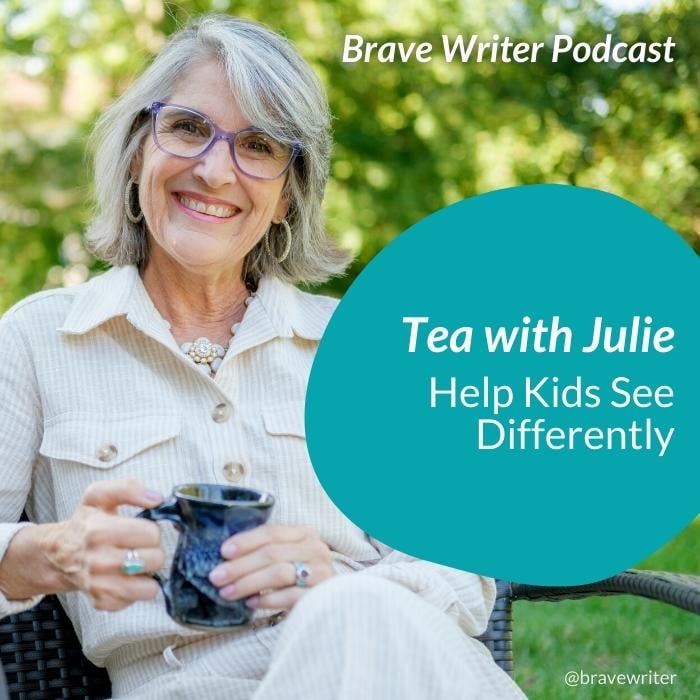
Podcast: Help Kids See Differently

Brave Writer Podcast

I am recording some of my Tea with Julie emails for the podcast for those of you who prefer to listen. These are brief messages of support for parents and educators. If you’d like to receive the weekly emails, they are free. Sign up at bravewriter.com/tea


How did it go thinking about surprise as a force for good?

In our Brave Writer podcast series on the Four Forces of Enchantment, it’s time to look at the second force, which is MYSTERY.

Let’s explore:

  • what mystery is,
  • why it’s a critical tool for developing a sense of enchantment,
  • and the ways you can facilitate a sense of mystery in your kids’ lives.

Show Notes

Complete Tea with Julie notes can be found HERE.

Resources

  • bravewriter.com/tea
  • raisingcriticalthinkers.com
  • thebravelearner.com
  • bravewriter.com
  • Want help getting started with Brave Writer? Head over to bravewriter.com/getting-started
  • Sign up for the Brave Writer newsletter to learn about all of the special offers we’re doing in 2022 and you’ll get a free seven-day Writing Blitz guide just for signing up: https://go.bravewriter.com/writing-blitz

Connect with Julie

  • Instagram: instagram.com/juliebogartwriter
  • Twitter: twitter.com/bravewriter
  • Facebook: facebook.com/bravewriter

Brave Writer Podcast

Tags: Forces of Enchantment, Tea with Julie Podcasts
Posted in Podcasts | Comments Off on Podcast: Help Kids See Differently

What Do I Hope Will Be True?

Brave Writer

Want to clarify your bias? Ask: what do I hope will be true?

It’s easy to identify bias in everyone else: that news show anchor, the brash radio host, your annoying neighbor, the uncle who won’t shut up at the holiday dinner…

Bias lives in all of us, however—even those of us who pride ourselves on being “objective.” What’s harder to detect is the invisible, silent influence bias has on how we think. The method for detecting bias isn’t more studying (you can always find books and articles to confirm your biases). Rather, bias is merely how your mind sorts information to affirm what you hope will be true.

An Example

When you read about homeschooling, don’t you begin hoping that whatever you read will validate that homeschooling is a trustworthy method of education? That “hope” is where your mind starts when it goes to read the article. If you read an article that’s against homeschooling, don’t you find yourself wanting to discredit what you read? You want homeschooling to be seen as effective so you hope that this negative article isn’t accurate or true.

Try this.

  • Go to any news site.
  • Pick an article to read.
  • Read the headline.
  • Now before you start reading, ask yourself, “What do I hope will be true?”

You aren’t asking what IS true. You aren’t asking if the writers are biased. You aren’t even trying to see if you agree or disagree with the writer.

Your task is to detect the little internal voice that is already telling you whether or not to trust this article, and what you hope to find (you may even hope to find that the writer is a loudmouth or that the information is wrong or that the research is flawed). If it’s a headline you like, you may hope to find more data to confirm what you want to be true!

Bias is the unconscious posture you take toward any information. It’s not possible to eliminate it. The best we can do is notice it—bring it to the surface so it can ride sidecar while you read an article, tweet or Instagram caption. It’s also helpful to notice your bias when in conversation.

Ask: what do I hope she’ll say? What do I wish he wouldn’t say?

The crux of bias is: What do I hope will be true?


This post is originally from Instagram and @juliebogartwriter is my account there so come follow along for more conversations like this one!


Raising Critical Thinkers

Posted in Raising Critical Thinkers | Comments Off on What Do I Hope Will Be True?

Podcast: One Thing

Brave Writer Podcast

Let me know if this sounds familiar:

You’re trying to think about all of the things you need to accomplish, not just in a day, but over the course of your child’s life—from birth to adulthood? Eating, walking, reading, writing, riding a bike, instilling good morals… the list goes on! And homeschooling only adds more of that responsibility onto your plate. It can be so overwhelming.

So how do we plan a life that accounts for each child’s personal needs and gets them to the finish line of adulthood well-educated, behaved, kind, and ready to live life on their own?

We do it one thing at a time.

Show Notes

Research shows that multitasking, that thing so many of us love to do—it feels so efficient!—is actually a myth. It isn’t real. What we’re really doing while multitasking is rapidly switching between two tasks, not doing two things at once. The worst part is that each time we switch, we’re losing efficiency and focus. We’re doing two things poorly.

When you want to have success in parenting or homeschooling, you need your deep, attentive focus state.

We want our material to do the instructing for us, and we are just there for supervision. This is called “open and go” curriculum. The problem is that, just like a car, if you’re not paying attention to where you’re steering, you’re going to crash. If you’re not present to the content, you can’t guarantee that your child is going to end up at the right destination. So what do you do? You use The One Thing Principle.

The One Thing Principle says this: Use the deep attention focus state to accomplish your most important goals in parenting and educating.

Remember: we are home educators. We are not recreating school. One of the biggest advantages to being at home is the ability to go in-depth when studying or pursuing an interest. With this principle, we can do so guilt-free.

Resources

  • Read my blog post on The One Thing Principle
  • Join our text messaging service by texting the word POD to 833-947-3684 
  • Want help getting started with Brave Writer? Head over to bravewriter.com/getting-started
  • Sign up for the Brave Writer newsletter to learn about all of the special offers we’re doing in 2022 and you’ll get a free seven-day Writing Blitz guide just for signing up: https://go.bravewriter.com/writing-blitz

Connect with Julie

  • Instagram: instagram.com/juliebogartwriter
  • Twitter: twitter.com/bravewriter
  • Facebook: facebook.com/bravewriter
Brave Writer Podcast

Posted in Podcasts | Comments Off on Podcast: One Thing

Mechanics & Literature: August 2022

Brave Writer

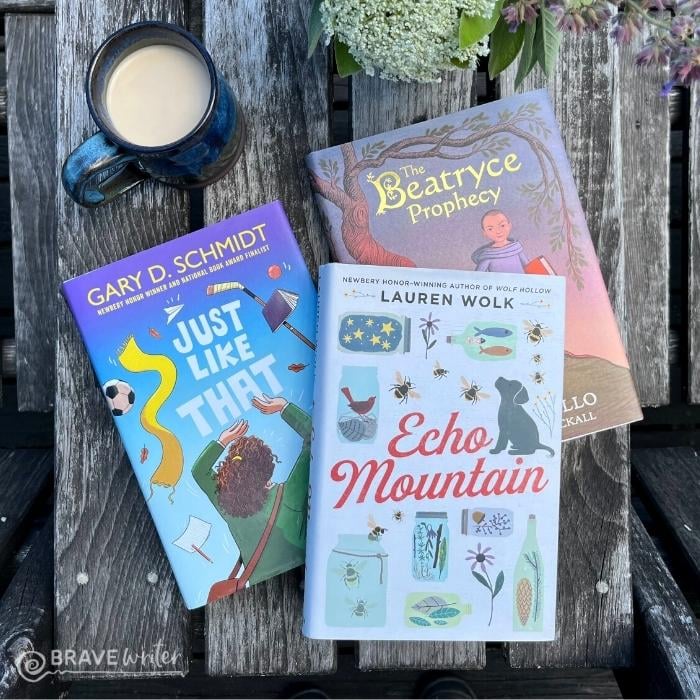
August is ripe with opportunities for adventure, enchantment, and discovery.

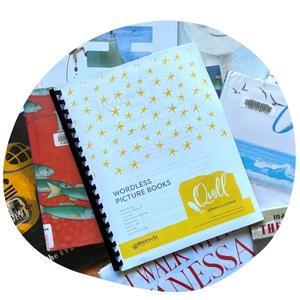
This month’s Quill reveals the wonders of wordless picture books. August’s Dart, Arrow, and Boomerang will transport you back in time.

Take a ride on the pages of this month’s stories to visit:

  • a medieval setting,
  • the mountains of Maine during the Great Depression,
  • and boarding school in 1968.

Read all about it as you and your family explore writing mechanics and literary devices in meaningful new ways.


[This post contains Amazon affiliate links. When you click on those links to make purchases, Brave Writer receives compensation at no extra cost to you. Thank you!]


Brave Writer Quill
Quill (ages 5-7)

Wordless Picture Books

In this Quill we’ll inquire about cover art and discover that books have anatomy; put words into action to develop vocabulary; play with pens and paper to engage with the symbols of writing; wallow in quantities to make numbers meaningful; and go on a shape hunt and have big juicy conversations about the shapes we see and what they mean. 

NOTE: You can use any wordless picture books you have in your stacks or find at your library.

Some suggestions:

  • Brave Molly by Brooke Boynton-Hughes
  • The Farmer and the Clown by Marla Frazee
  • Field Trip to the Moon by John Hare
  • Flashlight by Lizi Boyd
  • The Girl and the Bicycle by Mark Pett
  • Hike by Pete Oswald 
  • I Got it! by David Wiesner
  • I Walk with Vanessa by Kerascoët

Get the Quill.


Brave Writer Dart
Dart (ages 8-10)

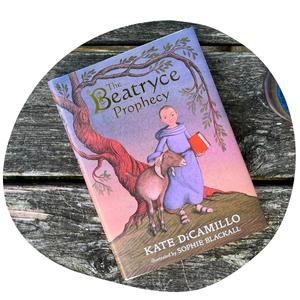
The Beatryce Prophecy by Kate DiCamillo

In a time of war, a mysterious child appears at the monastery of the Order of the Chronicles of Sorrowing. Gentle Brother Edik finds the girl, Beatryce, curled in a stall, wracked with fever, coated in dirt and blood, and holding fast to the ear of Answelica the goat. As the monk nurses Beatryce to health, he uncovers her dangerous secret, one that imperils them all—for the king of the land seeks just such a girl, and Brother Edik, who penned the prophecy himself, knows why.

The Literary Device in this Dart is Foreshadowing. 

We’ll also: 

  • marvel at metaphors,
  • launch an avalanche of adjectives,
  • go on a proper noun scavenger hunt,
  • time-travel with verb tense,
  • imagine a world without nouns, 
  • ponder paragraphs, and so much more! 

Purchase the book.

Get the Dart.


Brave Writer Arrow
Arrow (ages 11-12)

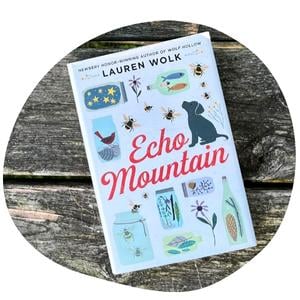
Echo Mountain by Lauren Wolk

A story for dog lovers—and nature lovers. Our protagonist found more freedom, a new strength, and a love of the natural world after her family lost almost everything in the big financial crash, and moved to the mountains. An accident has left her father in a coma, and she is determined to try anything—even sting him with bees—to get him to wake up!

The Literary Device in this Arrow is Suspense.

We’ll also: 

  • announce: colons,
  • cut to the chase with short paragraphs,
  • look up, down, and all around for prepositions,
  • have a good, good time playing with repetition,
  • talk all about dialogue,
  • notice nouns and all that they can do, and so much more!

Purchase the book.

Get the Arrow.


Brave Writer Boomerang
Boomerang (ages 13-14)

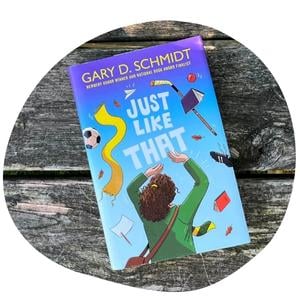
Just Like That by Gary D. Schmidt

Following the death of her closest friend in the summer of 1968, our protagonist goes off to St. Elene’s Preparatory Academy for Girls, where she struggles to navigate the boarding school’s traditions. In a parallel story, a boy has wound up on the Maine coast near St. Elene’s with a pillowcase full of money and a past that has him constantly looking over his shoulder. Both young people gradually dispel their loneliness, finding a way to be hopeful and also finding each other.

In this Boomerang, we’ll: 

  • probe point of view,
  • admire allusions,
  • bask in bold writing choices,
  • dig into dialogue,
  • survey a script,
  • wade into worldbuilding, and so much more!

Purchase the book.

Get the Boomerang.


For ages 15-18, check out the Slingshot.


Brave Writer

Posted in Arrow, Boomerang, BW products, Language Arts | Comments Off on Mechanics & Literature: August 2022

Podcast: Natural Stages of Growth in Writing

Brave Writer Podcast

Are you planning for the upcoming school year? Whether you’re homeschooling or sending kids to a traditional school, writing is that one skill that so many of us find unnerving.

One of the big problems is that your child’s age or grade level doesn’t tell you much about your writer. Writing develops the same way as any other skill: over time, at the writers’ own pace.

Over 22 years of working with tens of thousands of students, I’ve developed what I call the natural stages of growth in writing and my confidence in its accuracy has only solidified over time.

Today on the Brave Writer podcast, we’re going to walk through each of those stages.

Show Notes

  • [04:58] Beginning Writers: Jot it Down (5-7)

This is the stage where a child is too young to write and isn’t quite reading yet, but is so eager to self-express. They are a writer in need of a secretary—someone to jot down their thoughts and read those thoughts back to them so they can experience being authors long before being able to write for themselves. This stage focuses on delight and the joy of writing.

  • [07:51] Emerging Writers: Partnership Writing (8-10)

In this stage, you are a partner with your child in writing. Participating in the writing process with our child is not cheating, but in fact opens them up to the benefits of the adult’s vocabulary, as well as the mental processing of getting words onto the page. The challenge is the gap between a child’s oral fluency and their writing, spelling, and punctuation skills. This is normal—children will continue to grow into the mechanics of writing, and your participation helps.

  • [10:31] Middle School Writers: Building Confidence (11-12)

We tend to see two dichotomies at this stage of writing: Either a child shows a lot of enthusiasm for writing, or they absolutely hate it—often swapping between the two. They may write a lot one day only to refuse to write the next. Their spelling and punctuation may seem strong only to shift into reckless mistakes. They have a lot of competence, but many of their skills are still under construction. Allow them to self-express in the ways they like, and then give them rest from that commitment. The rough edges will smooth themselves out over time.

  • [15:39] High School Writers: Experimenting with Forms (13-14)

Once your child has built confidence and experience in using writing as a tool, they are ready to learn how to put that writing into the formats of academic life. These formats require a level of maturity and rhetorical imagination that doesn’t typically form until puberty. Kids at this stage feel comfortable with writing in general, even if they don’t yet know how to write an essay.

  • [17:29] College Prep Writers: Joining the Conversation (15-18)

Your kids, when they enter academic life, are joining a conversation already in progress. As your kids get an education, they are going to be reading what the experts and others have to say and amassing an understanding of what interests them the most. By the time they graduate, they will be called on to make meaningful contributions to those fields.

  • [19:43] Adult Writers: Fluent and Competent (18 and beyond)

These are adults not afraid to write their words, including professional writers, academics, and confident, competent adults. Once you’ve made it through all of the stages of writing, you should be able to face any writing task without worry or intimidation.

Visit bravewriter.com/stages to learn more about how our products and classes are organized according to these stages and find the ones that are going to help you.

Resources

  • Visit bravewriter.com/stages to find the right products for your child’s current learning stage
  • Want help getting started with Brave Writer? Go to bravewriter.com/getting-started
  • Try us out! Get our FREE seven-day Writing Blitz guide: http://go.bravewriter.com/writing-blitz

Connect with Julie

  • Instagram: instagram.com/juliebogartwriter
  • Twitter: twitter.com/bravewriter
  • Facebook: facebook.com/bravewriter
Brave Writer Podcast

Tags: Natural Stages of Growth in Writing
Posted in Natural Stages of Growth in Writing, Podcasts | Comments Off on Podcast: Natural Stages of Growth in Writing

« Older Entries
Newer Entries »
  • Search the Blog

  • Julie Bogart
  • Welcome, I’m Julie Bogart.

    I’m a homeschooling alum -17 years, five kids. Now I run Brave Writer, the online writing and language arts program for families. More >>

    IMPORTANT: Please read our Privacy Policy.

  • New to Brave Writer? START HERE

  • FREE Resources

    • 7-Day Writing Blitz
    • Brave Writer Lifestyle Program
    • Brave Writer Sampler: Free Sample Products
    • Freewriting Prompts
    • Podcasts
  • Popular Posts

    • You have time
    • How writing is like sewing
    • Best curriculum for a 6 year old
    • Today's little unspoken homeschool secret
    • Do you like to homeschool?
    • Don't trust the schedule
    • You want to do a good job parenting?
    • If you've got a passel of kids
    • You are not a teacher
    • Natural Stages of Growth in Writing podcasts
  • Blog Topics

    • Brave Learner Home
    • Brave Writer Lifestyle
    • Classes
    • Contests/Giveaways
    • Friday Freewrite
    • High School
    • Homeschool Advice
    • Julie's Life
    • Language Arts
    • Movie Wednesday
    • Natural Stages of Growth
    • One Thing Principle
    • Our Team
    • Parenting
    • Philosophy of Education
    • Podcasts
    • Poetry Teatime
    • Products
    • Reviews
    • Speaking Schedule
    • Students
    • Writing about Writing
    • Young Writers
  • Archives

  • Brave Writer is a participant in the Amazon Services LLC Associates Program, an affiliate advertising program designed to provide a means for sites to earn advertising fees (at no extra cost to you) by advertising and linking to amazon.com

    Content © Brave Writer unless otherwise stated.

What is Brave Writer?

  • Welcome to Brave Writer
  • Why Brave Writer Works
  • About Julie
  • Brave Writer Values
  • Frequently Asked Questions
  • Speaking Schedule

Brave Writer Program

  • Getting Started!
  • Stages of Growth in Writing
  • The Brave Writer Program
  • For Families and Students
  • Online Classes
  • Brave Writer Lifestyle

…and More!

  • Blog
  • Classroom
  • Store
  • Books in Brave Writer Programs
  • Contact Us
  • Customer Service
  • Brave Writer Staff
© 2026 Brave Writer
Privacy Policy
Children's Privacy Policy
Help Center