5 Reasons to Take a Brave Writer Online Class in Summer
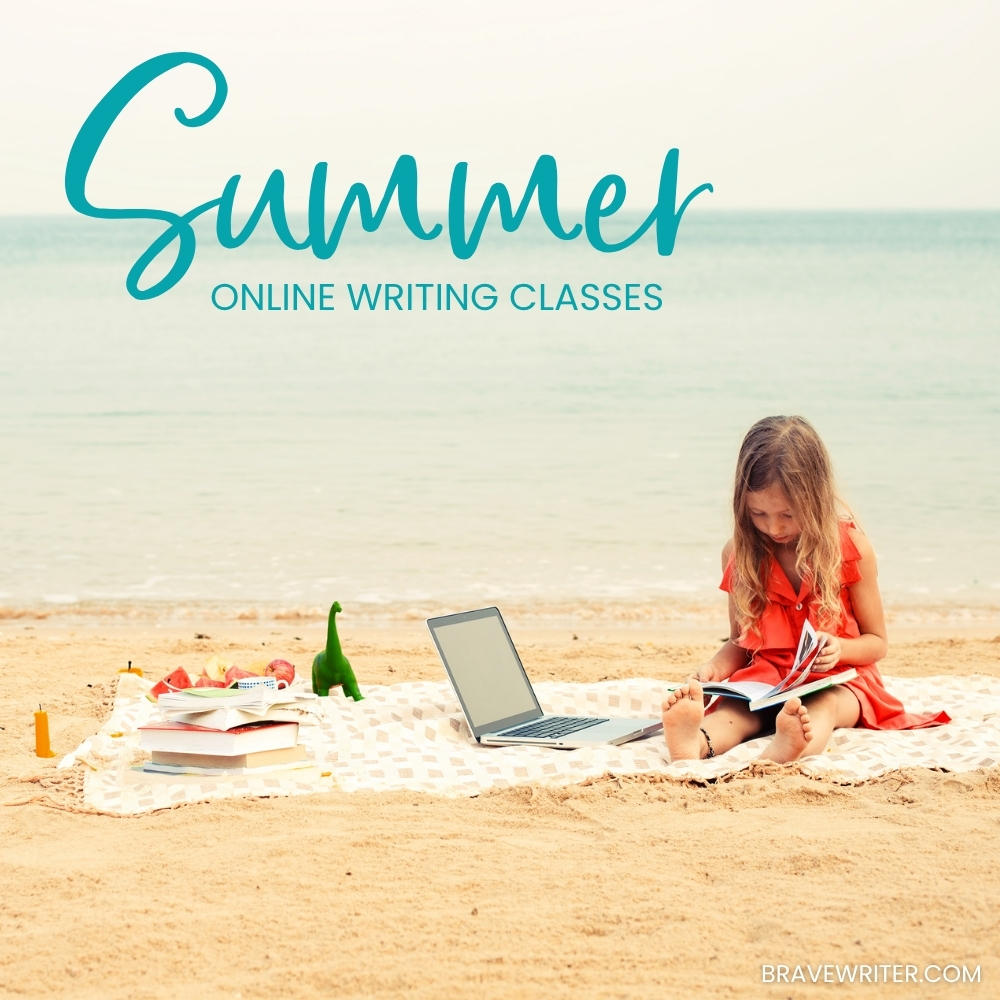
Here are five reasons to sign up for a summertime Brave Writer Online Class:
1. Narrow the focus! Focusing on writing alone allows your child to grow their skills without juggling lots of subjects at once. This is especially helpful for kids who do better when they can go deep on one thing at a time.
2. Short and engaging. Our classes feel more like “Summer Camp” than “Summer School” because young writers choose their topics and get actionable, positive feedback to help them grow their skills. They will want to log on to see their coach’s feedback!
3. Gain new skills that stick. Like Summer Camp, kids come away with new skills they will use for the rest of their lives, increasing their confidence and competence in every writing situation. Instead of learning to start a fire, they will learn to tap into their writing voice!
4. Freedom! Log in any time from anywhere! Our asynchronous classes fit your summer schedule, no matter where you are in the world. Your child gets a live teacher and real interactions with zero required login times.
5. 30+ academic and creative writing classes to choose from on the summer schedule! Whether you have a reluctant writer who needs a gentle on-ramp or a teen ready to stretch, there is a class that fits. Browse and find the right one.
After 26 years of teaching writing online, Brave Writer is not an unknown. We know what works. We have watched thousands of families go from dread to delight, and we can help yours do the same.
Kids grow and change, but one thing stays steady: a Brave Writer online class will meet your child where they are and help them move forward.
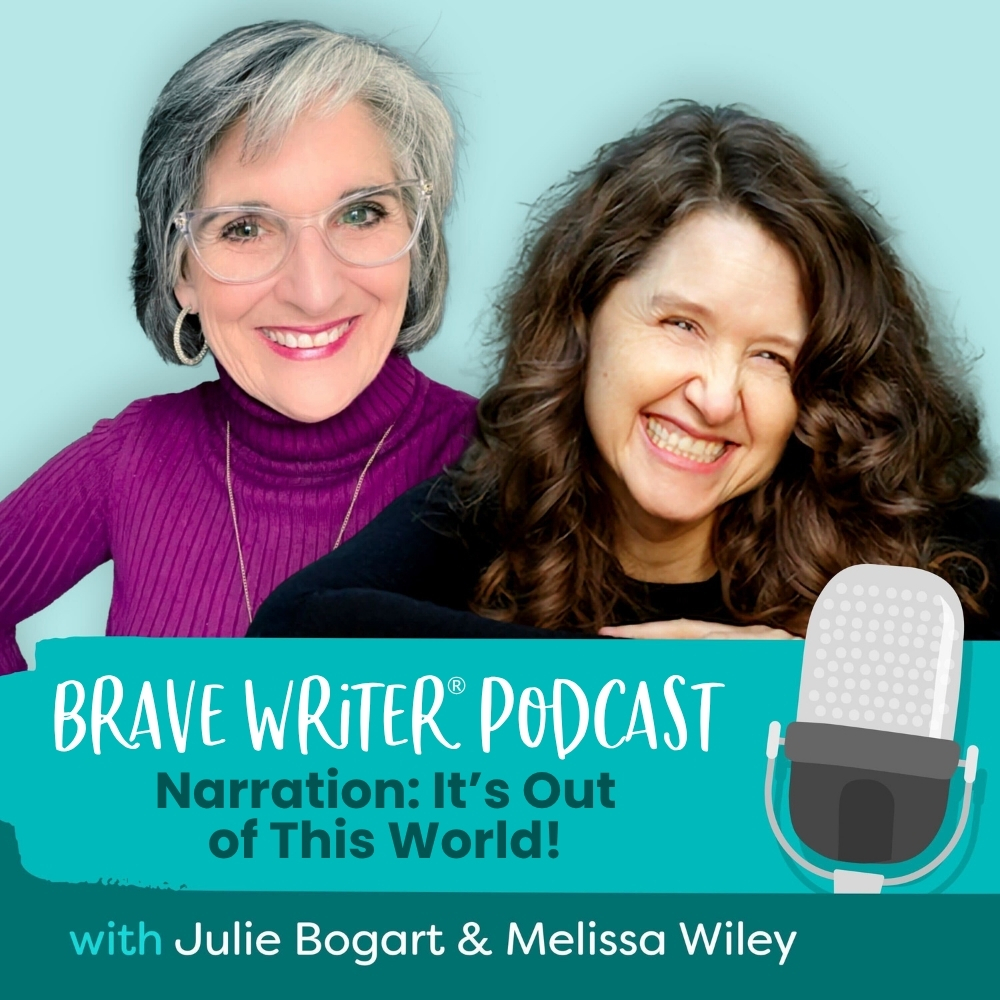
[Podcast #338] Narration: It’s Out of This World!
What if your child’s long, winding stories are not a distraction from learning, but the very foundation of it?
In this Brave Writer podcast episode, we explore the art of narration: the natural ability children have to tell what they:
- notice,
- remember,
- imagine,
- and understand.
Inspired by Charlotte Mason and the astronauts of Artemis 2, we look at how vivid description, precise vocabulary, metaphor, and careful listening help kids turn experience into language.
We also talk about oral narration, written narration, jot-it-down practices, observation, public speaking, and why parents can become a child’s own Mission Control.
Tune in, and let’s learn how to say: Copy kid joy!
Show Notes
The Art of Narration: How Telling What We Notice Becomes Real Learning
Children are natural narrators.
Before they can write essays, before they can summarize chapters, before they can produce tidy paragraphs, they are already telling us the world as they see it. They describe the dog racing across the yard. They explain the video game level in elaborate detail. They tell us exactly what happened when the toddler climbed too high or why the moon looked strange through the window.
Sometimes, as parents, we hear too many words.
We want the point. We want the summary. We want the assignment completed. But what if all those words are not a detour from education? What if they are the ground plan for it?
Narration begins with attention
Narration is the act of telling back what we have seen, heard, read, imagined, or experienced. It is not limited to a formal report. It can happen in the car, at the kitchen table, during a walk, after a read-aloud, while looking at a painting, or while watching the moon.
When children narrate, they show us what captured their attention. They may not summarize the whole chapter. They may remember one vivid scene. They may not offer a tidy beginning, middle, and end. They may linger over a single funny moment, a color, a sound, or a surprising detail.
That is not failure. That is learning taking shape.
Summary is an advanced skill. Young children often need years of rich, detailed language before they can compress an experience into its main idea. First, they need permission to notice. They need to practice saying what they see.
The more we look, the more we see
Observation grows vocabulary.
A child may begin with “blue,” but after comparing shades to crayons, colored pencils, paint chips, or the sky at different times of day, “blue” becomes turquoise, cornflower, navy, slate, or periwinkle. A round shape becomes a circle, dome, sphere, oval, crater, or ring.
This is why narration belongs in every subject. Science depends on it. Art depends on it. History depends on it. Writing depends on it.
Even astronauts need narration.
When the Artemis II crew observed the moon, their work was not only technical. They had to describe what they saw so the rest of us could come close to experiencing it too. Their language carried us there. They noticed color, shadow, terrain, shape, and metaphor. They helped us imagine a place we could not see with our own eyes.
That is what our children are doing too. They are looking out the window of their own spaceship and telling us what is there.
Narration does not have to start in handwriting
Many children can speak far more freely than they can write. That matters.
If we ask a young child to write a narration too soon, the richness of their thought may shrink to match the limits of their handwriting, spelling, and punctuation. A full oral narration becomes two stiff sentences on the page.
So we can jot it down for them.
We can let them speak while we transcribe. We can invite them to copy one sentence afterward. We can ask them to draw first, then tell. We can let narration take the form of a diagram, a labeled sketch, a dramatic reenactment, a video for Grandma, or a conversation over hot chocolate.
All of it counts.
Narration prepares children for real life
A child who practices telling what they know is preparing for more than school.
They are preparing to speak in an interview, explain a medical history to a doctor, give a toast, comfort a friend, teach a skill, advocate for themselves, or tell a story that makes someone laugh at exactly the right moment.
Public speaking begins in ordinary conversation. Writing begins in spoken language. Confidence grows when a child discovers, again and again, “My words can carry my experience to another person.”
That is why listening matters so much.
We can be Mission Control for our kids. We do not have to correct every tangent or demand a perfect summary. We can receive the joy underneath the narration.
- Copy moon joy.
- Copy video game joy.
- Copy soccer joy.
- Copy kid joy!
When we listen with that kind of welcome, we teach children that their observations matter. Their words matter. Their minds matter.
And that is where education begins.
Resources
- Learn more about Brave Writer’s Worldbuilding class and other enthusiasm-sparking online classes!
- Explore NASA’s “Observe the Moon Like an Astronaut” activity
- Find our favorite readalouds and nonfiction in the Brave Writer Book Shop
- Brave Writer class registration is open!
- Visit Julie’s Substack to find her special podcast for kids (and a lot more!)
- Purchase Julie’s new book, Help! My Kid Hates Writing
- Find community at the Brave Learner Home
- Learn more about the Brave Writer Literature & Mechanics programs
- Start a free trial of CTCmath.com to try the math program that’s sure to grab and keep your child’s attention
- Subscribe to Julie’s Substack newsletters, Brave Learning with Julie Bogart and Julie Off Topic, and Melissa’s Catalog of Enthusiasms
- Sign up for our Text Message Pod Ring to get podcast updates and more!
- Send us podcast topic ideas by texting us: +1 (833) 947-3684
- Interested in advertising with us? Reach out to media@bravewriter.com
Connect with Julie
- Instagram: @juliebogartwriter
- Threads: @juliebogartwriter
- Bluesky: @bravewriter.com
- Facebook: facebook.com/bravewriter
Connect with Melissa
- Website: melissawiley.com
- Substack: melissawiley.substack.com
- Instagram: @melissawileybooks
- Bluesky: @melissawiley.bsky.social
Produced by NOVA
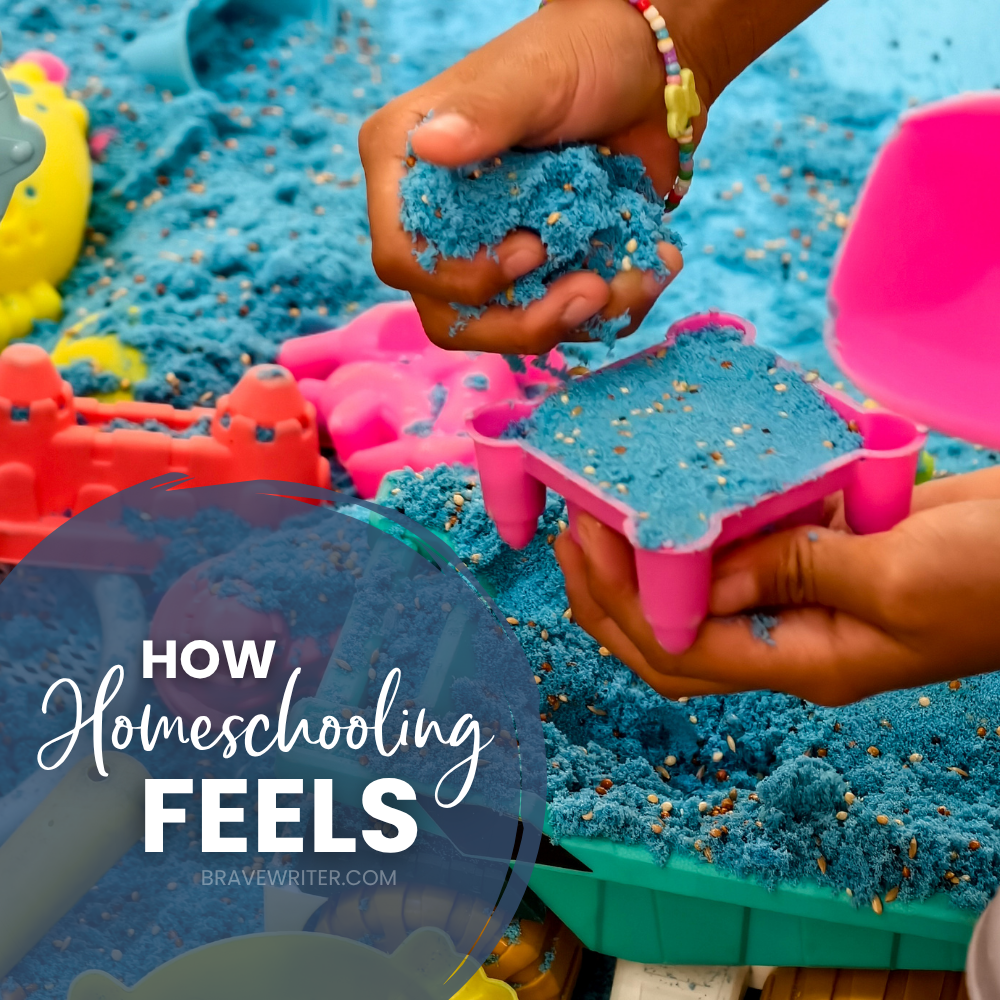
How Homeschooling Feels
Are you sick of trying to do a better job of homeschooling? Good!
That means you are closer to trusting yourself instead of comparing yourself to everyone else.
The biggest missing ingredient in today’s homeschools is confidence. Confidence comes from risk—try something! Put joy or curiosity at the center. If you don’t see those happening, pivot! You deserve to have a good life! That matters the most—way more than “hitting a bunch of standards.”
Experience Ahead of Image
Evaluate your homeschool by how it feels, rather than how it looks. Put your energy into creating an experience rather than an image. Every day we are shown pictures of smiling children, learning effortlessly in clean, trauma-free homes. Yet homeschooling thrives in lived-in homes, with caring adults who are growing and adapting.
You’re doing better than you realize every time you put experience ahead of image.
Need more support?
If that sounds impossible, read my book The Brave Learner. I spell it out for you. It provides handholds to make life a learning adventure rather than a carefully curated “school at home” that looks beautiful but feels rigid.
Get Ready to FLEX!
Summer is a great time to:
- Wander down a learning rabbit trail
- Sharpen skills ahead of fall
- Learn at a leisurely pace with our FLEX classes. (Keep reading!)
FLEX Online Writing Classes!
Back by popular demand: our Brave Writer FLEX classes, which help you flex your schedule around the rest of life …or just let you slow down the pace of our regular courses.
The details:
- Take five weeks to complete your four-week class, scheduling around vacations, camps, and other summer fun.
- Or just go “slo-mo,” giving your student more time with the material.
- Decide on the due dates that work best for you and your family. Your coach is ready when you are.
- Grab this option while you can: FLEX classes are only offered in summer!
Our students have been enthusiastic about this!
“I liked this course better than the classes that I’ve taken in the past because of the amount of freedom I had. The way I was able to submit my work in my own time was great for me.” – Justin
Grab that free and easy feeling for yourself and make your schooling work for you.
We’ve got four FLEX options:
- Essay Prep: Reading the Essay
- Essay Prep: Dynamic Thinking
- Essay Prep: Research and Citation
- Essay Writing 101: Analytic Essay
[Podcast #337] Life Skills
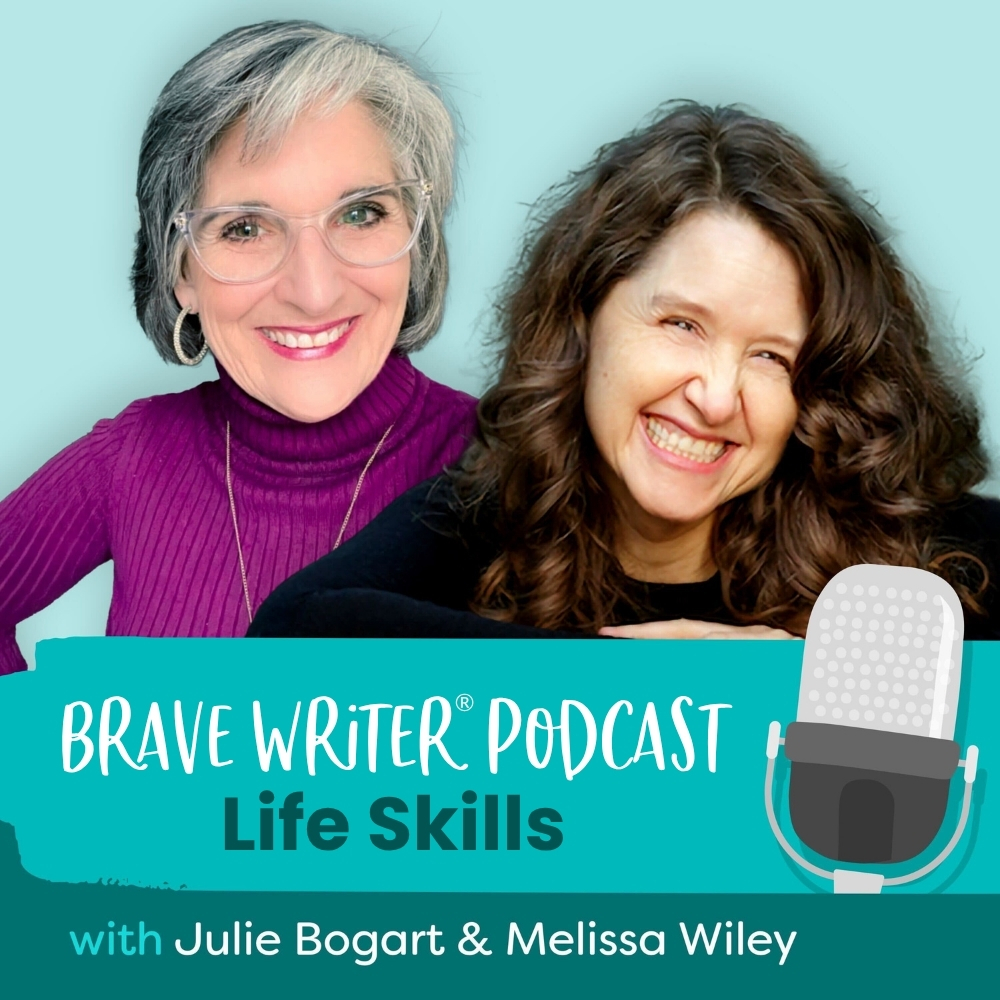
What do our kids actually need to know before they leave home?
In this Brave Writer podcast episode, we explore the everyday life skills that often get overlooked, from tying shoes and folding laundry to handling money, filling out forms, speaking with customer service, hosting guests, managing time, and learning how to do what life requires next.
We talk about why practical competence is part of education, not separate from it, and why homeschooling gives us a beautiful chance to teach these skills in real life, at the right moment.
Join us for a conversation about raising capable, confident kids who know how to participate fully in the world.
Show Notes
Why Life Skills Matter in Homeschooling
For many of us, education was shaped by categories: academic subjects belonged in school, while the practical parts of life were picked up somewhere else, somehow, later. We learned to think of reading, writing, and math as the real work, and everything else as secondary.
But that division has never made much sense.
Children do not live in separate compartments. They live one whole life. They need to know how to read, yes, but also how to button a shirt, fold a towel, speak to a receptionist, make a snack, write a thank-you note, and solve the small daily problems that make up ordinary human life.
That kind of competence matters more than we sometimes realize.
Life skills are already part of learning
One of the gifts of homeschooling is that we are not limited to a narrow definition of education. Learning can happen while sorting socks, setting the table, addressing an envelope, measuring flour, filling out a form, or checking the air in a tire.
A child learning to zip a coat is learning. A child folding laundry is learning. A child comparing prices at the grocery store, helping cancel a subscription, or practicing how to order food in a restaurant is learning too.
These moments may not look like formal lessons, but they are full of attention, memory, coordination, and judgment. They build familiarity with the world. They help children feel less intimidated by daily life because they have already had a chance to participate in it.
When we notice that, we begin to see practical competence not as a distraction from education, but as one of the ways education becomes real.
Start with what children can actually do
Life skills do not have to wait until children are older. In fact, many of them are easiest to teach when children are young and eager to imitate the grown-ups around them.
A young child can learn to tie bows, use scissors, snap buttons, sort clothing, fold napkins, wipe a table, or help set out plates and cups. These are small tasks, but they carry real weight. They strengthen dexterity, coordination, and confidence. They let a child feel useful.
As children grow, the skills can grow with them. Typing, baking, laundry, handling tools, filling out forms, learning phone etiquette, managing money, reading a calendar, and breaking large assignments into smaller pieces all become part of that wider education.
The point is not to hand children adult responsibility all at once. It is to let them grow into capability, one meaningful task at a time.
Practical competence builds confidence
Children feel more secure when they know how to do things.
That does not mean they need to do everything perfectly. It means they need experience. They need chances to try, to fumble, to ask questions, and to try again. They need to see that mistakes are part of learning, not proof that they are incapable.
This is one reason life skills matter so deeply. A child who knows how to speak to a cashier, write a check, use a screwdriver, make toast, or organize a school deadline begins to trust that unfamiliar tasks can be learned too.
That trust is the deeper lesson.
We are not only teaching children how to complete household tasks. We are teaching them that they are able to meet life as it comes.
The goal is not just knowledge, but participation
It is easy to let modern life become too abstract. We can watch videos about how to do something, save ideas for later, admire the finished result, and still never actually begin. Children can drift into the same pattern, especially when so much of life now happens on screens.
Homeschooling gives us a chance to move in a different direction.
We can invite children to participate. To stir the batter, make the call, address the envelope, greet the guest, clean the table, plant the flower, read the instructions, and solve the problem in front of them. We can let them experience learning as something lived, not merely observed.
What we want is bigger than independence for its own sake. We want children who feel at home in the world. Children who know that learning is not only about mastering subjects, but also about becoming capable, generous, attentive human beings.
Homeschooling does not only prepare children for life later.
It lets them begin living it now.
Resources
- Find our favorite read alouds and nonfiction in the Brave Writer Book Shop
- Brave Writer class registration is open!
- Visit Julie’s Substack to find her special podcast for kids (and a lot more!)
- Purchase Julie’s new book, Help! My Kid Hates Writing
- Find community at the Brave Learner Home
- Learn more about the Brave Writer Literature & Mechanics programs
- Start a free trial of CTCmath.com to try the math program that’s sure to grab and keep your child’s attention
- Subscribe to Julie’s Substack newsletters, Brave Learning with Julie Bogart and Julie Off Topic, and Melissa’s Catalog of Enthusiasms
- Sign up for our Text Message Pod Ring to get podcast updates and more!
- Send us podcast topic ideas by texting us: +1 (833) 947-3684
- Interested in advertising with us? Reach out to media@bravewriter.com
Connect with Julie
- Instagram: @juliebogartwriter
- Threads: @juliebogartwriter
- Bluesky: @bravewriter.com
- Facebook: facebook.com/bravewriter
Connect with Melissa
- Website: melissawiley.com
- Substack: melissawiley.substack.com
- Instagram: @melissawileybooks
- Bluesky: @melissawiley.bsky.social
Produced by NOVA