…because sometimes you just have to write about it. 🙂
Who is your favorite Star Wars character (or other movie/book/t.v. show, etc.)?

…because sometimes you just have to write about it. 🙂
Who is your favorite Star Wars character (or other movie/book/t.v. show, etc.)?
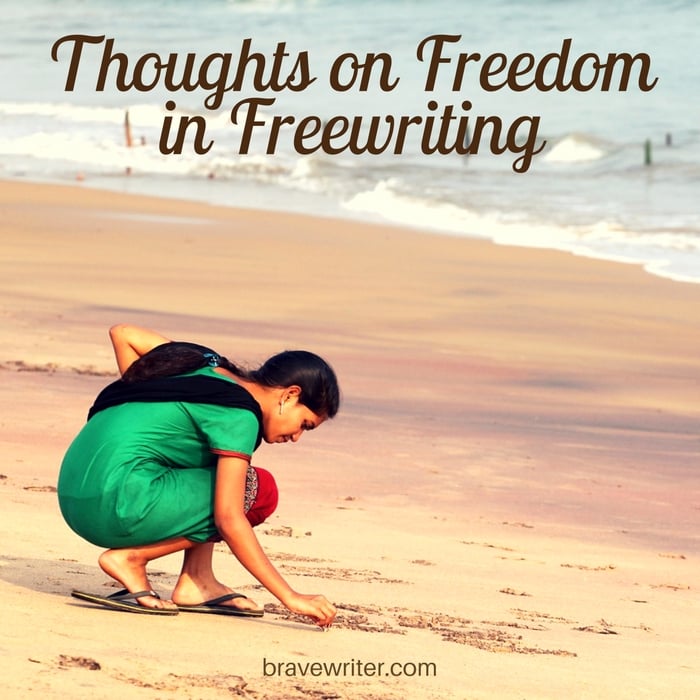
Freewriting is not easy or natural for everyone. Freedom can sometimes feel overwhelming, or too spacious, or simply uninviting. Sometimes we prefer that someone else prepare a beautiful experience for us, not have to create it for ourselves (for instance, the enjoyment of reading over writing). Yet to create does require a kind of freedom from anxiety that supports the process. Freewriting aims to give kids the chance to explore their inner life (words, images, thoughts, fantasies, desires, insights, stored facts, values, beliefs, opinions) in written language. They do this in their heads already (that’s what thoughts are – utterly free to come and go, to wax and wane, to make sense or not, to justify, rationalize, solidify, comfort and empower). Kids are learning how to do it in spoken language every day. Some days are better than others: fluency and self-expression develop over time. The “you” of age five (fluent in English in terms of vocabulary, grammatical accuracy and intonation to convey meaning) is less nuanced and effective in conveying information or conforming to ettitquette or articulating a point of view than the you of 20, and the you of 20 is most certainly more fluent than 5 yet less fluent than you at 45!
So your success in thinking without restriction is magical in how free it is (due to the lack of scrutiny coming from outside voices). We do (at times) collect some outside voices to control our thought life (whether deliberately – a religious text or pyschological self-help profile; or accidentally – the voices of a nurturing parent or the words of a cruel teacher or the harsh reprimands of a coach). Still our thoughts have the most freedom to roam.
Spoken language comes second in the degree of freedom we feel. Yet we get daily opportunities to explore spoken language and we maximize those in conversations that are unscheduled, without pre-determined topics. We generally follow the words around based on outside stimulation (It’s thundering outside, we exclaim “Did you hear that?”; The television broadcasts a new episode of a favorite reality show, we say, “Do you think Jamie will get voted off?” launching us into a discussion about pros and cons). There are risks, there is growth, there is freedom. Occasionally we must conform to spoken conventions (please, thank you, after you, or even more rigidly, giving a speech, making a sales pitch).
What’s tricky about writing is that we are involving that many more parts of the brain. We have to include hand-eye coordination, we have to manage the sonic impact of the words on how we form them in letters, we translate pauses and emphasis into puctuation, we have to think about structure in ways that don’t occur to us orally… all while thinking about what we want to say. Writing takes longer to master. Too often, writing tactics skip all the necessary development in written self-expression and go straight to control – how to control what you want to say in a given shape – none of this playful freedom of thinking, none of this casual risking as in talking. Writing expects neatness, proper shape and clarity of thought all at once.
So to get past that tendency to “straight jacket” self-expression in writing, we have to mimic the same process that nurtured a “free” thinker (free to think what one wants to think), the same process that developed a “free” speaker (someone who can meaningfully interact with another speaker without anxiety for how to do/say it). We need to create “free” writers – people who can risk their original selves in writing without worry that scrutiny or judgment or formats will impede their thought processes. Freewriting enables kids to move beyond the worry that their words will be judged. If they resist freewriting, it’s often because they’ve either had too many bad experiences with writing (therefore having a hard time believing that they have the freedom they are being told they have), or they simply haven’t worked that muscle yet. In either case, the key is to shorten the time length (even just a minute of passionate, scrawling across the page until the ringer dings is enough to start with). Remind them that ALL words count (even “I hate writing” and “Why am I doing this?” and “I wish I could throw my math book out the window”).
Be sure to register after 12:00 p.m. today.
Here’s all you need to know:
What does “You can’t take it with you” mean?
Seems like I’ve had a spate (what a great word!) of emails asking about reading and writing, and the connection between these subject areas. So let’s tackle it.
It matters not if your children read or you read to them. What matters more than anything is that they are repeatedly immersed in written language. (I’ll talk about learning to read in a moment.) Written language has its own cadence. It differs from conversation. Conversational language is stacatto, is inflected by facial movements and vocal intonations, is accompanied by body language and is contextual (often replying to words, ideas known to both speakers).
Written language can’t see your face, can’t hear your reactions. It takes nothing for granted. The whole world it seeks to share must be conjured by magic – the magic of words. Reading to your kids, ensuring that they read every day, does more to shape how they will write than any workbook, writing course, or curricula. I will repeat that because no one believes it on the first pass:
So now we can talk about how and why it works. Language acquisition is largely intuitive. It comes from “hearing” and “mimicking.” When your kids learn to speak their native tongue, they are incorporating sounds, movements, intonations and facial expressions into their spoken words. We crack up as much at their surprising use of volume, deadpan humor, commands and sophistication at ages 2-3 as we do at their word choices. They combine so many different aspects of communication into their words that we hardly notice (they are hitting all the right intuitive strokes, and even risking a few that are beyond their maturity or grasp).
Written language functions in a similar way. The more you read, the more you become conditioned to detailed description, to housing your dialog in attributive tags, to building suspense, to attaching meaning to an idea through the use of metaphor. These “habits” are the intonation patterns of written language. They are as natural to natural writers as raising an eyebrow to convey suspicion is to native speakers.
However, you don’t see all the fruit of that reading in year one. Just like speaking takes at least five years to master sufficiently to be considered “fluent,” writing requires at least that long and then some, due to its unique delivery method (learning to manage a pencil and all the mechanics of writing is more challenging than syncing your tongue, teeth and vocal chords). So I say: give it ten years instead. Signs of mimicry will erupt sooner than that (and for those, be grateful!). Still, to become a fluent, competent writer takes ten years. Reading is essential for shaping the intuitive inner ear that tells the writer that he or she is speaking the right language.
So what if your child isn’t reading? We have three kids who read late: 8 1/2, nearly 9, and 10+. We had two early readers: 6 1/2 and 7. All five of them are avid, fluent readers now. In fact, I noticed that the reading of lengthy chapter books started at around age 11 with all five kids, no matter when they began reading. Our youngest read latest! Go figure.
Regardless of when they began reading for themselves, though, I have always read aloud to them. We’ve read novels, non-fiction books, the Bible, poetry, Shakespeare, comic books and picture books, websites, and instruction manuals. I used to read about an hour a day to them from a variety of sources. It’s the one thing we never failed to do.
So today, carve out that time. Put aside writing, spelling, even that essential math book. Read aloud today and every day.
Tell yourself that if you read to your children, you did homeschool them today.