
A Brave Writer's Life in Brief - Page 622 of 780 - Thoughts from my home to yours A Brave Writer's Life in Brief
  • Start Here
    • For Families
      Multiple Ages
    • Ages 5-7
      Beginning Writers
    • Ages 8-10
      Emerging Writers
    • Ages 11-12
      Middle School Writers
    • Ages 13-14
      High School Writers
    • Ages 15-18
      College Prep Writers
  • Shop
    • Product Collections
    • Bundles
    • Writing Instruction Manuals
    • Literature & Grammar/Punctuation
    • Composition Formats
    • Literature Singles
    • Homeschool Help
    • Book Shop
  • Online Classes
    • Class Descriptions
    • Class Schedule
    • Classroom
    • How Our Classes Work
    • Our Writing Coaches
    • Classes FAQ
  • Community
    • Brave Learner Home
    • What’s Happening
    • Blog
    • Podcast
    • Calendar
  • Cart
  • My Account
    • My Online Classes
    • My Account
  • My Account
    • My Online Classes
    • My Account
  • Start Here

    If you’re new to Brave Writer, or are looking for the best products for your child or family, choose from below:

    • For Families
      Multiple Ages
    • Ages 5-7
      Beginning Writers
    • Ages 8-10
      Emerging Writers
    • Ages 11-12
      Middle School Writers
    • Ages 13-14
      High School Writers
    • Ages 15-18
      College Prep Writers
  • Shop

    If you’re already familiar with Brave Writer products, go directly to what you’re looking for:

    • Product Collections Browse the full catalog in our shop
    • Bundles Everything you need to get started
    • Writing Instruction Manuals Foundational Writing Programs
    • Literature & Grammar/Punctuation Grammar, Punctuation, Spelling & Literary Devices
    • Composition Formats Writing Assignments for Every Age
    • Literature Singles Individual Literature Handbooks
    • Homeschool Help Homeschooling Tools and Resources
    • Book Shop Books associated with Brave Writer Programs
  • Online Classes
    • Class Descriptions
    • Class Schedule
    • Classroom
    • How Our Classes Work
    • Our Writing Coaches
    • Classes FAQ
  • Community
    • Brave Learner Home
    • What’s Happening
    • Blog
    • Podcast
    • Calendar
  • Search
  • Cart

Search Bravewriter.com

  • Home
  • Blog

A Brave Writer's Life in Brief

Thoughts from my home to yours

Copywork and Dictation: How Often? (Revisited)

Homework

Julie,

Could you briefly share with us how copywork and dictation look in your home and include the highest grade you’ve had at home? I’ve shared your arrow and boomerang (the concept) with several friends and the common concern is that it doesn’t appear to be enough. Many believe that copywork and dictation should be daily not weekly. I would love your insight on this matter!

Lisa

—

Hi Lisa.

Sure, I can share.

My oldest kids are in college (the oldest two are 21 and 18). I homeschooled both of them through high school, though the second one went part time to our local high school as well. Our third child is a junior in high school and goes full time. He was homeschooled through 9th grade. We have two more kids: 8th and 7th grades – all homeschooled.

Copywork and dictation can be done more frequently than weekly. The Arrow/Boomerang are designed to support the homeschooling parent, not to replace her own good judgment and her skills as a home educator. In fact, when I first designed the Arrow (which came first), I used to always say that the goal was to model how copywork and dictation can be done (how to select passages, how to teach them, how to make them more meaningful). Mothers can learn to do it themselves, if they like.

I included only one passage per week for several reasons:

1) Discouragement: Many mothers set out to do copywork/dictation more than a couple times per week and then when they fail to hit their target, they give up and stop doing it all together. I’ve found that copywork/dictation once per week is way better than not doing it at all while holding the ideal of doing it twice or three times or every day of the week. In fact, I’ve found that once a week adds up to a lot of copywork/dictation if done all year.

2) Length of passage: Some of the passages in the Arrow and particularly the Boomerang are long. They benefit from being broken up into multiple days of work.

3) Personal preference: Kids like to pick their own copywork. Not all copywork has to be selected for them. By offering only one passage per week, your have the freedom of selecting other passages to copy (song lyrics, poetry, passages from a beloved book, refrigerator magnets, a religious text). If I give you more than one per week, you will feel you must impose those passages on your kids to get your money’s worth. But this way, you focus on one passage, really teach it, and then can allow your kids to select the ones that they want.

4) Stress: For reluctant writers, it is a lot to ask them to do handwriting work (in a book, for instance), copywork, dictation, freewriting, and any writing project all in a week. The Arrow and Boomerang allow you to feel that you are covering the material necessary to a good language arts program without putting your child through too much pencil trauma.

Brave Writer is different than other programs. I believe firmly in a parent’s role in the homeschool. We are supports to what you do. We offer products that teach you how to teach. Of course you can do more copywork and dictation if you like. I have a son (14) who copied things every day and did special handwriting therapies for his dysgraphia. Yet two years ago, he could hardly write even one passage a week. I have an 11 year old daughter who doesn’t like the passages I pick who writes in her journal and her Greek notebook every day, even in summer. We talk about grammar over lunch or in the car. She is learning spelling through Facebook status updates!

My older kids credit their years of dictation with their punctuation skills (the ones in college). They feel like they learned mechanics painlessly. My junior in high school has successfully gone straight into Honor’s English without having ever done a formal grammar or spelling program. He’s learned it all through less than once per week dictation over his lifetime.

Pay attention to your kids. Do what you believe nourishes them. Let them tell you what is working and what is not. Kids don’t learn as well when they are numb to the subject matter, when they feel obliged to fulfill your expectations without their buy-in. If once a week copywork/dictation is tolerable (even enjoyable) for you kids, they will learn a lot! There’s no reason to think that more is necessarily better.

Image by Alastair Vance
Posted in Brave Writer Philosophy, Copywork Quotations, Email, Writing about Writing | 3 Comments »


The One Thing Principle Redux

One Thing Principle Redux

The discussion of how to create a flexible routine as well as how to create a home context conducive to nurturing relationships prompts me to revisit a plank of the Brave Writer philosophy:

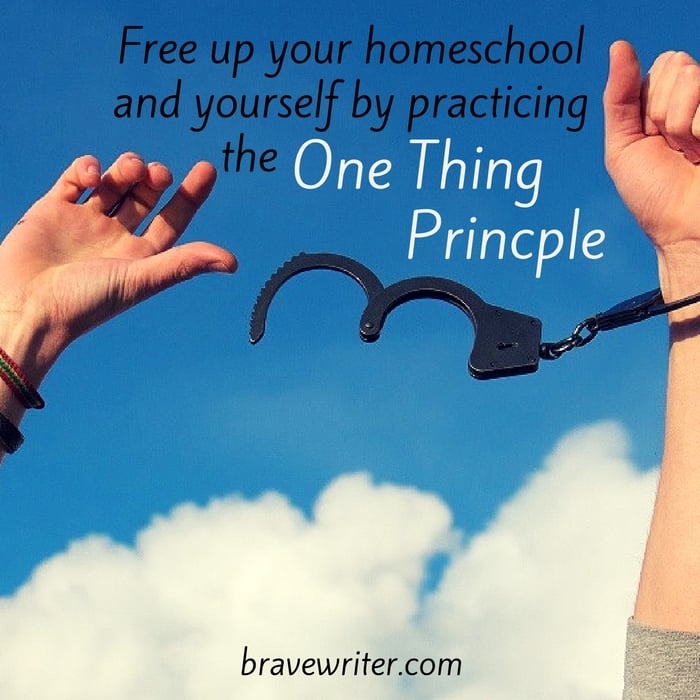
The One Thing Principle.

Some of you already know it well. Others of you are new to Brave Writer so this will help you begin to shift the paradigm from which you teach and guide your kids. Remember: we are home educators. We are not recreating school. One of the biggest advantages to being at home is the ability to go in-depth when studying or pursuing an interest. This is the key principle to help you do just that guilt free. Enjoy!

When was the last time you really tasted the food you ate? If you’re like me and millions of moms, you wolf down your meals in an attempt to clean your plate before someone in the family needs seconds, needs a face-wiped, needs to be breastfed, needs you on the phone.

It’s easy to run through the homeschool day the same way – Everyone’s doing math. Good. In just ten minutes I’ll get the older two started on spelling. While they’re spelling, I’ll read with the eight-year-old and nurse the baby. Then I’ll make lunch and think about which creative project will go with the history novel.

As you race along, you might even have the strange feeling of not having done anything worthwhile, even though you are exhausted and have been pushing the family at breakneck speed. There’s a sense in which we “hover” above our lives rather than living right inside them when we’re filled with obligations, good ideas, lots of children and the endless demands of email and phone calls that intrude on our best plans.

We also feel pressure—pressure to complete assignments, books, courses, and projects, and worry that we won’t have done enough of any of it. So even a completed project or worksheet or novel is not relished because we think about all the things we haven’t done yet instead. What an awful trap!

To stop the madness, you have to change how you see the way you spend time.

I like to tell Brave Writer moms to savor experiences
and learning opportunities rather than rushing through them.

As much as I have emphasized the need to slow down, moms continued to feel they weren’t doing enough. That’s when it dawned on me that we needed to refine what it means to “slow down.”

The solution? The “One Thing Principle.”

Ask yourself: What would happen if you only did one thing well tomorrow? What if you focused all your energy and attention on one important idea/activity/project/math concept or novel?

For instance, what if you set up the conditions to enjoy reading one Shakespeare story by Leon Garfield? You could pick the story the night before. You could look over the difficult to pronounce names and try saying them. You could find a passage for copywork to be used later in the week. You could google a few facts about the Bard and print them out to read over breakfast. You might print out a story synopsis to help you answer questions if your kids get confused while you are reading.

Let’s look at what happens the next day if you really were to focus on One Thing. Here’s what you will do:

The next morning, toast some English muffins, serve with black tea, and set them on the kitchen table. While everyone is slurping their tea and putting in too many teaspoons of sugar, read the story aloud, sharing the gorgeous illustrations as you read. Then ask everyone to pronounce the names after you, and pause to laugh at Shakespeare’s sense of humor. Explain a few of his obscure word choices, and make a little diagram of how the characters are related to each other. At the end, read the interesting fact sheet about old Will and marvel at his accomplishments.

When you’re finished reading, savoring, drinking tea and eating muffins, when you have understood the story and have thought about who Shakespeare is, when each child has had a chance to talk about the story if he or she wants to, you close up shop and turn on the TV for a sitcom. Or perhaps you take a walk or play outside, or do some email while your kids jump on the couch like a trampoline.

Then a little later at lunch time, reminisce about the story and why it was so enjoyable. See what part of the story everyone thought was sad, or funny, or creative. Suggest ordering the film version on Netflix or acting out one scene or comparing this story (orally) to one of Shakespeare’s other plays you’ve read/seen before. Make the most of this rich experience before rushing off to the next one.

As a mother, take time to actually enjoy the story. It’s fine that you enjoy your children’s joy, but it’s even more important that you find yourself focused on the story, its language, the creativity of it, the timelessness of the ideas. You must discipline yourself to not think about the unpaid bills, the dinging bell of new email, the ring of the phone or the tug of unfolded laundry. You must not worry that math is not being studied or that your youngest still can’t read.

It is time for Shakespeare and that’s it. When you have enjoyed and relished Shakespeare, you may then go on to one more thing.

Follow the same process for another homeschool experience you want to have but put off or don’t enjoy or feel you’ve neglected.

Take time to prepare, to execute, to enjoy
and to remember before hurrying off to the next one.

If you build positive experiences around copywork, dictation, Shakespeare, poetry, writing, reading, observing, narrating, conversing, acting, nature, art and more, slowly, over time, one at a time, without feeling you are getting behind, you will naturally build momentum in your homeschool. You’ll discover that you do more things that nourish your family and will revisit the ones that are especially rewarding.

More importantly, your kids will learn to trust you. They’ll believe that you have rich experiences prepared for them that are worth doing. Think about that. Isn’t our biggest struggle “getting our kids to do what they should”? What if they knew that if you said, “Let’s do _______ today” their reaction would be: “That will be fun!” (or interesting or worth doing)? Wouldn’t that make a world of difference?

Here are the One Thing principles to remember:

  1. Prepare (ahead of time). Plan a date, purchase, make copies, organize, think about.
  2. Execute (day of). Follow through with enough time to invest deeply without distraction.
  3. Enjoy (kids and you). Let yourself forget everything else but that experience/lesson. Be here now.
  4. Reminisce (later that day or the next). Talk about what was fun, remember humor, honor connections.

You can follow the one thing principle for any lesson, topic, activity or idea. Overlapping between subject matter happens naturally when you invest this way. Subjects you didn’t even intend to cover are a part of deep investment in any topic. Allow yourself to trust the process. Start with One Thing (the one thing you are dying to do with your kids but keep putting off). Make your plan today!

Brave Writer Online Classes

Posted in Brave Writer Philosophy, One Thing | 9 Comments »


Friday Freewrite: Yummy Food

Name the food item you love to eat whenever you get a chance. Now tell me all about it.

Posted in Friday Freewrite | 2 Comments »


The Importance of a Flexible Routine

Brave Writer Routine

Back when I started having babies, I didn’t know there were two schools of thought about breastfeeding. I lived in a third world country and everyone breastfed. It was free, always available, didn’t need refrigeration or reheating, and everyone around me was “doing it.” You nursed a baby when the baby cried or was hungry or needed to sleep. That’s what I was told; that’s what I did. I didn’t know moms who put babies on a schedule.

Then we came to the states for two years and my friends told me that I should schedule feedings and not let the baby get the upper hand, that babies on schedules slept better and were happier. Except that my baby was happy and we slept together and it went well enough, it seemed to me. While I know plenty of moms and kids who have used a scheduling format and their children have grown up to be healthy, happy young adults, I have never regretted not being a scheduling mom.

Still, there are some moms who are adamant that demand-feeding nearly destroyed their well-being, making them feel like slaves to their children. I didn’t experience that and I’ve thought a lot about why. My conclusions mirror how I see the idea of “flexible routine” in the homeschool.

Schedules appeal because they are predictable. There’s comfort in knowing what comes next in the day, every day. We all need some structure (it’s why meals are morning, noon and evening, not just whenever you feel hungry).

So it isn’t structure per se, that is the enemy.

The Question

So then what kind of structure is most nurturing to:

  • your personality,
  • your kids’ needs,
  • and your family’s lifestyle?

In my home, breastfeeding followed a kind of intuitive pattern that matched each of the five babies (that also shifted and adapted to new routines and patterns as the baby became a nursing toddler and eventually weaned). I could predict with some degree of accuracy when that baby would want to nurse and I’d be able to organize the day knowing that there was the “first thing in the morning” feeding, followed by a mid-morning feeding, followed by the post lunch feed, followed by nursing around dinner time, and so on.

It wasn’t so much that I wrote it all out and checked the clock. It’s that over time, I could see a pattern emerge. When it was between the usual times and the baby was fussy, I didn’t necessarily start with nursing. I tried other distractions and so on. But if baby bumped his head, of course I would nurse the baby, even if he had just been fed a few moments before!

The key term shift for me was from scheduled vs. demand feeding, to flexible routine feedings instead. My breastfeeding relationship with a baby followed a predictable pattern (one I could detect and foster), yet could be altered if circumstances warranted it.

With homeschool, a similar style works well for us. Scheduling our days so that each hour has a specific task didn’t work so well. When I created a daily, hourly schedule, I mostly felt guilty for falling behind. It seemed that if we were supposed to have our read-aloud time at 10:00, but we couldn’t find the book, we were now “off-schedule” and an urgency to get back “on schedule” took over. If a dental appointment slowed our reading pace (so many pages, by a certain date), then we were battling to squeeze in extra reading to “catch up.”

The one time I successfully enforced a schedule for an entire semester (when I really did have five kids under 9), Noah woke up one morning and said, “I hate my life.” It was the wake-up call I needed. We had managed to get our work done, to follow that schedule, to keep up with the demands of reading, workbooks, writing and math problems despite life’s natural intrusions. I felt great, but he was miserable.

The Turning Point

That was a turning point for me. I realized that enforcing a program was less effective than enriching our lives. At about that time, I discovered Charlotte Mason (no “demand-feeding” style instructor was she!). Yet her vision of a full, rich, day-with-free-time lifestyle caught my attention. What if we simply chose to include certain activities and areas of focus in our lives each week, in a flexible, yet predictable pattern? Could we, for instance, read poetry every week? We could pick a day for it but not worry so much about what time of day.

The idea would be: We’ll read poetry once a week on Tuesdays when everyone is calm enough to read together. I discovered early on that drinking tea at the same time brought that calmness to the table.

Could we look at art once a week? I started to bring art books home from the library, left them out, would page through them on my own in the evenings (drawing the attention of the kids). I hung prints and identified the artists over breakfast. I took everyone to an art museum. Then we took a hour a week to draw or read or flip through an art book.

What about math? I’m not so good at intuitive math instruction. So we continued with math books, several pages each day. But I didn’t pick the time. We’d simply be sure that at some point in the day, “math got done.” When they were younger, it worked to have them do it in staggered stages so I could help each kid. Now that they’re older, it’s easier to do it all at the same time (provides morale and support).

Read-aloud time became the centerpiece of every day. It signaled that we had eaten breakfast, had all become clothed, had brushed teeth. Once those tasks were finished, we gathered in a group in the family room. I would read. And often nurse someone (and sometimes a baby wouldn’t nurse if I read, so I would have to have read-aloud time during a nap period instead). Still, each day’s read-aloud time reassured us that we were making progress, that we had been together in a meaningful way, that education had happened. It didn’t matter if it happened at 9:00 a.m. every morning. It mattered that it usually happened, most days, in the morning, after breakfast and brushed teeth.

A flexible routine is slowly cultivated.

It doesn’t spring into existence in a book you keep. It’s the patient adding of “what works,” “what needs to be done,” and “what interests” to your lifestyle over a period of time.


Poetry Teatime

Posted in Brave Writer Philosophy, Homeschool Advice | 16 Comments »


New post up this afternoon

Keep sharing about your family’s practices in the post below. I will get the new post up this afternoon. We’ll tackle “flexible routine” first since it seems to be the one most people are asking me about. 🙂

Posted in General | Comments Off on New post up this afternoon


« Older Entries
Newer Entries »
  • Search the Blog

  • Julie Bogart
  • Welcome, I’m Julie Bogart.

    I’m a homeschooling alum -17 years, five kids. Now I run Brave Writer, the online writing and language arts program for families. More >>

    IMPORTANT: Please read our Privacy Policy.

  • New to Brave Writer? START HERE

  • FREE Resources

    • 7-Day Writing Blitz
    • Brave Writer Lifestyle Program
    • Brave Writer Sampler: Free Sample Products
    • Freewriting Prompts
    • Podcasts
  • Popular Posts

    • You have time
    • How writing is like sewing
    • Best curriculum for a 6 year old
    • Today's little unspoken homeschool secret
    • Do you like to homeschool?
    • Don't trust the schedule
    • You want to do a good job parenting?
    • If you've got a passel of kids
    • You are not a teacher
    • Natural Stages of Growth in Writing podcasts
  • Blog Topics

    • Brave Learner Home
    • Brave Writer Lifestyle
    • Classes
    • Contests/Giveaways
    • Friday Freewrite
    • High School
    • Homeschool Advice
    • Julie's Life
    • Language Arts
    • Movie Wednesday
    • Natural Stages of Growth
    • One Thing Principle
    • Our Team
    • Parenting
    • Philosophy of Education
    • Podcasts
    • Poetry Teatime
    • Products
    • Reviews
    • Speaking Schedule
    • Students
    • Writing about Writing
    • Young Writers
  • Archives

  • Brave Writer is a participant in the Amazon Services LLC Associates Program, an affiliate advertising program designed to provide a means for sites to earn advertising fees (at no extra cost to you) by advertising and linking to amazon.com

    Content © Brave Writer unless otherwise stated.

What is Brave Writer?

  • Welcome to Brave Writer
  • Why Brave Writer Works
  • About Julie
  • Brave Writer Values
  • Frequently Asked Questions
  • Speaking Schedule

Brave Writer Program

  • Getting Started!
  • Stages of Growth in Writing
  • The Brave Writer Program
  • For Families and Students
  • Online Classes
  • Brave Writer Lifestyle

…and More!

  • Blog
  • Classroom
  • Store
  • Books in Brave Writer Programs
  • Contact Us
  • Customer Service
  • Brave Writer Staff
© 2026 Brave Writer
Privacy Policy
Children's Privacy Policy
Help Center