A Brave Writer's Life in Brief - Page 623 of 780 - Thoughts from my home to yours A Brave Writer's Life in Brief
  • Start Here
    • For Families
      Multiple Ages
    • Ages 5-7
      Beginning Writers
    • Ages 8-10
      Emerging Writers
    • Ages 11-12
      Middle School Writers
    • Ages 13-14
      High School Writers
    • Ages 15-18
      College Prep Writers
  • Shop
    • Product Collections
    • Bundles
    • Writing Instruction Manuals
    • Literature & Grammar/Punctuation
    • Composition Formats
    • Literature Singles
    • Homeschool Help
    • Book Shop
  • Online Classes
    • Class Descriptions
    • Class Schedule
    • Classroom
    • How Our Classes Work
    • Our Writing Coaches
    • Classes FAQ
  • Community
    • Brave Learner Home
    • What’s Happening
    • Blog
    • Podcast
    • Calendar
  • Cart
  • My Account
    • My Online Classes
    • My Account
  • My Account
    • My Online Classes
    • My Account
  • Start Here

    If you’re new to Brave Writer, or are looking for the best products for your child or family, choose from below:

    • For Families
      Multiple Ages
    • Ages 5-7
      Beginning Writers
    • Ages 8-10
      Emerging Writers
    • Ages 11-12
      Middle School Writers
    • Ages 13-14
      High School Writers
    • Ages 15-18
      College Prep Writers
  • Shop

    If you’re already familiar with Brave Writer products, go directly to what you’re looking for:

    • Product Collections Browse the full catalog in our shop
    • Bundles Everything you need to get started
    • Writing Instruction Manuals Foundational Writing Programs
    • Literature & Grammar/Punctuation Grammar, Punctuation, Spelling & Literary Devices
    • Composition Formats Writing Assignments for Every Age
    • Literature Singles Individual Literature Handbooks
    • Homeschool Help Homeschooling Tools and Resources
    • Book Shop Books associated with Brave Writer Programs
  • Online Classes
    • Class Descriptions
    • Class Schedule
    • Classroom
    • How Our Classes Work
    • Our Writing Coaches
    • Classes FAQ
  • Community
    • Brave Learner Home
    • What’s Happening
    • Blog
    • Podcast
    • Calendar
  • Search
  • Cart

Search Bravewriter.com

  • Home
  • Blog

A Brave Writer's Life in Brief

Thoughts from my home to yours

Share what works for your family

Hi everyone.

Today has gotten away from me and I still have a dental appointment ahead. Let’s use this entry to share about what is working in your family that relates to the five principles on Monday’s entry. Here they are again:

1. Enjoy them.
2. Take them seriously.
3. Make a flexible routine.
4. Touch them.
5. Have fun.

See if you can share something in as many of these categories as you can. I will share mine later this afternoon. The dialog here has been rich lately! Keep it going.
Posted in General | 8 Comments »


Tuesday Teatime: The Hayes Family

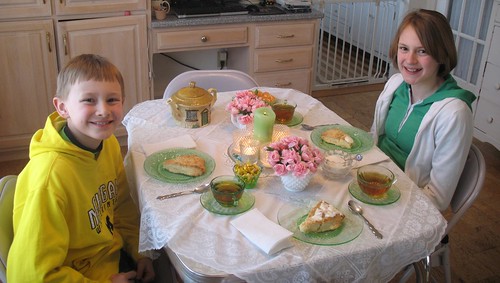
Hayes1.jpg

Dear Julie,

We just got back from a two week vacation to New York, Philadelphia, Baltimore, Washington, D.C., and Cincinnati (The Creation Museum).  My children remembered that Cincinnati is your city, but we didn’t have time to look you up! 😉

Our last tea was a lovely, very proper (albeit in the kitchen vs. the dining room) St. Patrick’s Day Tea on March 17.  We served British scones, green kiwi slices, orange (We’re Protestants! 😉 ) clementine segments, Earl
Grey Tea in my “Irish Cottage” teapot, and leprechauns’ gold pieces (Werther’s caramels in the gold foil).  We even had Irish place cards at the table.  No poetry this day.  We just listened to Irish music on You Tube, with scenes of Ireland on the computer screen.  The sun shone and it was light (…Ahhh….these longer days of March!) and lovely.  So were the scones!  Light, flaky and wonderful.  I thought some might like my recipe, so I’ll share it here.

Read the rest of this entry »

Posted in Poetry Teatime | 1 Comment »


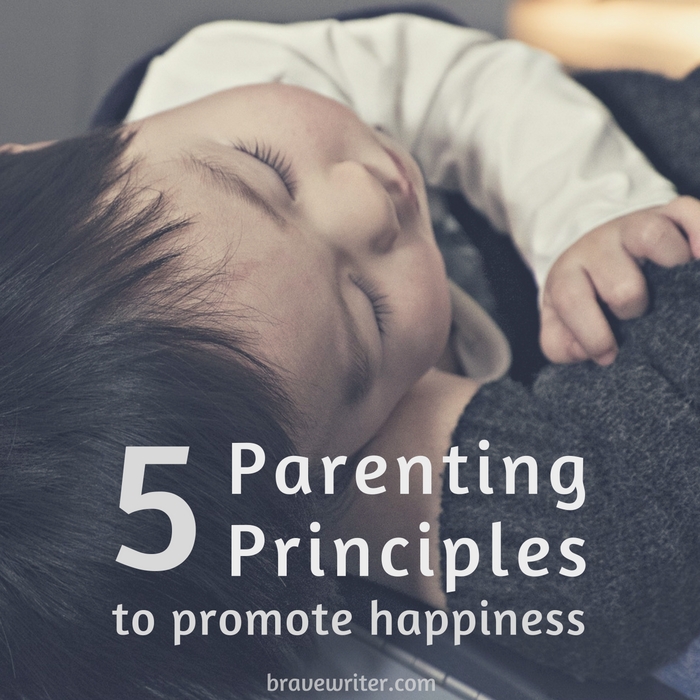
Parenting principles that foster happiness

5 Parenting Principles

Happiness and parenting: good goals, right?

There’s so much written about discipline and training, character development and education, we can sometimes forget the one ingredient that makes it all work: happiness.

I’m not talking about hedonistic vices either.
I’m talking well-being, peace, joy, safety, freedom, contentment; that deep abiding sense of “home.”

We all crave that—adults and kids alike!

As the parents, we get to set that tone every day with the choices we make. Our kids don’t have many choices. They live in the state you picked, the neighborhood you chose, the house you bought or the apartment you rented. They are either in school or not based on your research and decisions. They eat the food you buy, they wear the clothes you provide, they play with the toys you permit.

Recently my teenage son lamented the fact that I didn’t start him on violin at age 3 so that he could one day become a composer. Why didn’t I know that he would want to do that? Of course, he understood why I didn’t—but he was feeling the full weight of MY choices for HIS life.

So our kids are pretty much sidecar riders on our vision of what makes a good, satisfying life. And they know it! They feel it every time you remind them to brush their teeth or finish their scalloped potatoes or stop putting pennies in their noses.

Yet it sometimes feels to you and me that the kids run the show! They throw up thwarting behaviors at every age—pushing the bedtime line back, wanting to stay on the computer for another ten minutes, asking for cookies right before dinner, losing their soccer cleats on the day of the big game.

It’s infuriating and tiring and demanding to constantly make judgments about what they can and can’t do. At some point, it appears that the easiest course is to simply set up the schedule, the system, the program and enforce it. I remember a friend of mine said, “I don’t get why my kids won’t just go with the program! We’d all be so much happier if they would simply cooperate.”

I laughed. Apparently they wouldn’t be happier. That’s why they don’t go along! They have their own ideas of what makes them happy. We continue to imagine there’s a specific map that will ensure peace for us while providing structure for them that creates minimal chaos and maximum order.

Let me let you in on a little secret: There is no spoon. There’s no map either.

When I wrote The Writer’s Jungle, and named it such, my hope was to help moms understand how to survive and navigate the jungle-like landscape of a child’s writing life. There’s no clear path. What is there instead? Minute by minute decisions based on principles that take the child fully into account each step of the way.

Parenting works the same way.

There are principles that create a context for a satisfying home life for all, but they require minute by minute navigating with your child’s input and personality fully taken into account. Here are the ones that have worked in writing and in my kids’ lives. You’ll have others (and I hope you’ll share them in the comments section).

Notice and affirm your child’s
quirky, insightful, unique voice.

Enjoy it, affirm it, cultivate it, mirror it, share it with others and show it off. In other words, pay attention to the things your child says and fall in love with him or her every day that you can!

Pay attention to pain.

When someone says, “I hate this” or “I’m bored” it means…. “I hate this” and “I’m bored.” It doesn’t mean, “I’m lazy and pretending to be bored.” If your child were bleeding from a scraped knee and said, “I scraped my knee. It hurts,” the conclusion you would draw is “He scraped his knee; it hurts.” In relationships, it’s important to take people seriously. When they communicate pain, when they say they’re unhappy, they mean it. Solutions can be found once we allow the other person the full opportunity to explore what is stopping him or her from successfully enjoying whatever the experience is.

Discipline is not done to a person.

It’s cultivated by the individual. Discipline is supported by external structure but is governed by internal motivation. (You can lead a horse to water, but you can’t make her drink, idea.) Flexible routines make it possible for structure and motivation to coincide. Schedules rarely last. Punishment never leads anyone to self-regulated discipline, and mostly drives opposing impulses underground while fostering resentment.

Eye contact and physical touch every single day matter,
even with teens (or perhaps, especially with teens).

These are freebies. Our kids are home with us. Touch them often. I had one mom confess to me that her son asked her to rub his shoulders before he started writing and she told him “No, this is school. I can’t rub your shoulders. Get to work.” Ironically, one of the steps for freewriting is to rub your child’s shoulders before he starts writing.

Create opportunities for fun.

That means several things. You must be willing to tolerate messes, chaos, changed plans, silliness, loud noises, taking too long, going too fast, going too slow, spending money, excessive talking, changing the use of an item for the purpose of the fun (snow saucers become slip n slide rides for pet bunnies), wasting food, wasting materials, trusting your kids with adult toys (video cameras, saws, sewing machines), breaking things, losing things, and failure. If you do all this, fun happens.

So let’s boil these principles down into five easily retained ideas about kids:

  1. Enjoy them.
  2. Take them seriously.
  3. Make a flexible routine.
  4. Be affectionate.
  5. Have fun.

Tomorrow is Tuesday Teatime (a great way to do all five!) and we’ll have new photos posted from yet another Brave Writer family to share. Then on Wednesday, I want to hear from you some of the ways you apply these principles in your home. I’ll share some of the ways we’ve done it over the years, too.

I’ve loved all the feedback about this series. Keep it coming!

Joy is the best teacher.

Posted in Brave Writer Philosophy, Homeschool Advice | 20 Comments »


Friday Freewrite: Giving

If you could give any gift in the world, what would you give and to whom? And why?

Posted in Friday Freewrite | 1 Comment »


Developing a philosophy of mothering

Developing a philosophy of mothering

I’ve never received more comments or email than I did for the On Being a Mother entry. I wrote it quickly, without much revision, as a way to affirm to myself the value I felt in being a mom despite all its obvious hardships. That piece drew a lot of support. Loved hearing from all of you.

There were comments and emails too, though, from those who are on the outside looking in, feeling that mothering really is a hardship, that they don’t enjoy the company of their children, and worse, feel guilty about it. Guilt for something you can’t control is the worst feeling you can possibly have. I have no intention ever of adding to anyone’s guilt! Sorry for that unintended side-effect.

I’m all about nurturing ourselves and our kids
through our pain to health and vitality.

That’s the whole Brave Writer modus operandi! Moms who struggle are certainly as invested in their children, love them as much, yet feel they are missing the genetic material to help them have that energy and joy in mothering that they hear about from their friends.

Their experience is a bit like never having had an orgasm and having to hear how great sex is! You feel instantly shut out from the “universally glorious experience” and you can’t imagine what you’d have to do differently to get to that blissful state of being. Believe me, I get it. (More than you know!) All of us have had that “outside-looking-in” feeling in some area of our lives.

In no way do I want to minimize the pain and bewilderment that women feel when they are handed an 8 lb. bundle of limbs and told “Go, therefore, and mother.” The crucible of total responsibility up against very real human limitations drives most of us into an emotional collapse at some point in our children’s lives (and more than once!). That’s why it’s so important to embrace this “more than full-time” job with the expectation that you can find tenderness, connection and love, or you won’t make it! Chronic stress and disappointment in your life is the stuff of which midlife crisis is made.

My goal in the parenting journey is to experience pleasure with my children. In other words (and here, the sex metaphor really is apt!), I’ve deliberately cultivated happiness as the chief aim of parenting. Not discipline. Not character-building. Not training. Not even education. My main concern for my kids and for our family has been to create a happy, peaceful, honest, nurturing, attentive-to-each-person’s-peculiarities environment so that our relationships with each other would be about connection, not about tolerating or managing each other.

It’s my belief that in a space of joy, humor and kindness, education, love, and satisfaction thrive. Relationships become a source of strength and refuge from which to live the rest of our lives rather than an obstacle filled with frustration and pain. I’ve often said, “Joy is the best teacher.” I’d add, “Peaceful relationships are the foundation of a joyful life.”

Lizzy asked in the comments:

I wonder, Julie, what or who it was that helped you develop your perspective. Was it your own mother? Was mothering a dream you’ve had since you were a little girl? Are you one of those folks who has read ‘all the books’ for inspiration?

These are great questions with longer answers than I can do justice to here. But let me tackle it this way. I never thought about having kids (didn’t like babysitting, couldn’t figure out why babies were “cute”). I come by my passion for children through mothering, not through any inherent maternal drive. My mother is incredible, though. She was the one who threw “back-to-school brunch” parties for my friends in 7th grade. She’s the one who patiently typed my essays in high school. She’s the one who has shared her very real self with me and has always listened to my pain without editing it. She’s also the one who lost her marriage to an affair and checked out emotionally for several years of my young adult life. Her deliberate recovery and prioritizing of emotional health has had a huge impact on me as an adult.

I also had the privilege of being mentored in homeschooling by an utterly free spirit of creativity who showed me the value of picnics over math pages, and dress up clothes with face paints at 10:00 in the morning on a Tuesday. As I’ve given myself to mothering and have paid attention to the writing process as it’s worked out in parent-child relationships, I’ve discovered that people thrive when they have space to be who they are, when their pain is taken seriously and when both are addressed with compassion and creativity.

That goes for both moms and kids. If we get too lost in our children, we become withered, unhappy, grouchy adults. If we are too consumed with our adult selves, we lose sight of our kids and overlook their needs for devoted attention.

Between these extremes is an awesome middle ground;
it’s the space where what you do as an adult
can be shared with your children and vice versa!

It’s the space where you tune into your own needs (I have to get out for a haircut or I’ll scream) and also keep an eye on what’s happening with your children (they need naps). If you love Mary Cassatt, you share her paintings with your kids. If they love Wii Dance Revolution, they get you to compete. There’s a give and take that includes touching, eye contact, sharing interests and problem solving. It’s a mutual admiration society that is fed by time together where all members get something from the shared experience.

In other words: joy in mothering is directly related to ensuring that you do things with and for your kids that make you all happy. Really.


Brave Learner Home

Posted in Brave Writer Philosophy, Family Notes, General, Homeschool Advice, Unschooling | 12 Comments »


« Older Entries
Newer Entries »
  • Search the Blog

  • Julie Bogart
  • Welcome, I’m Julie Bogart.

    I’m a homeschooling alum -17 years, five kids. Now I run Brave Writer, the online writing and language arts program for families. More >>

    IMPORTANT: Please read our Privacy Policy.

  • New to Brave Writer? START HERE

  • FREE Resources

    • 7-Day Writing Blitz
    • Brave Writer Lifestyle Program
    • Brave Writer Sampler: Free Sample Products
    • Freewriting Prompts
    • Podcasts
  • Popular Posts

    • You have time
    • How writing is like sewing
    • Best curriculum for a 6 year old
    • Today's little unspoken homeschool secret
    • Do you like to homeschool?
    • Don't trust the schedule
    • You want to do a good job parenting?
    • If you've got a passel of kids
    • You are not a teacher
    • Natural Stages of Growth in Writing podcasts
  • Blog Topics

    • Brave Learner Home
    • Brave Writer Lifestyle
    • Classes
    • Contests/Giveaways
    • Friday Freewrite
    • High School
    • Homeschool Advice
    • Julie's Life
    • Language Arts
    • Movie Wednesday
    • Natural Stages of Growth
    • One Thing Principle
    • Our Team
    • Parenting
    • Philosophy of Education
    • Podcasts
    • Poetry Teatime
    • Products
    • Reviews
    • Speaking Schedule
    • Students
    • Writing about Writing
    • Young Writers
  • Archives

  • Brave Writer is a participant in the Amazon Services LLC Associates Program, an affiliate advertising program designed to provide a means for sites to earn advertising fees (at no extra cost to you) by advertising and linking to amazon.com

    Content © Brave Writer unless otherwise stated.

What is Brave Writer?

  • Welcome to Brave Writer
  • Why Brave Writer Works
  • About Julie
  • Brave Writer Values
  • Frequently Asked Questions
  • Speaking Schedule

Brave Writer Program

  • Getting Started!
  • Stages of Growth in Writing
  • The Brave Writer Program
  • For Families and Students
  • Online Classes
  • Brave Writer Lifestyle

…and More!

  • Blog
  • Classroom
  • Store
  • Books in Brave Writer Programs
  • Contact Us
  • Customer Service
  • Brave Writer Staff
© 2026 Brave Writer
Privacy Policy
Children's Privacy Policy
Help Center