 Image by Jesse Millan
If you soared over your neighborhood or town, what would you see?
New to freewriting? Check out our online guide.

Image by Jesse Millan
If you soared over your neighborhood or town, what would you see?
New to freewriting? Check out our online guide.

There are 180 days in the school year.
There are 36 weeks.
You have X number of children at writing age.
If you were to do one passage of copywork per week per child, you would have this equation:
36 x X = ______
So if you have 3 children at writing age, the answer is:
36 x 3 = 108 passages of copywork that you have supervised, corrected, and supported.
If you have a child who works to complete a single passage in a week by writing parts of it 2 or 3 times a week, that child is now working on handwriting and copying:
1 child x 3 days of handwriting (1 copywork passage) x 36 weeks = 108 days of writing 36 passages
3 kids x 2 days of handwriting (1 copywork passage) x 36 weeks = 216 days of supervising 36 passages (per child) of copywork
Can you see why you fall short sometimes? Can you see why adding a day of dictation or phonics worksheets or one more day of copywork can feel impossible, even though the actual daily practice is only 5-15 minutes at a time?
The hardest thing to do in homeschool is to sustain a routine without giving up when you don’t feel you’ve “hit the optimal practice.” Just like you wouldn’t abandon your daily math work just because you missed a week or a few days, you can take a similar approach to copywork and dictation. Get to it, as often as you can, within the weekly framework. When you miss, don’t let that derail you into *not* doing it at all.
Come back to the routine and try again. It’s better to have supervised 20 copywork attempts than 5. It’s better to have returned to the practice after being away from it, than to abandon it all together. Over years of time, you’ll see fruit from copywork and dictation, even if there are some (many) weeks you don’t get to it.
Have you noticed how easy it is to wish away your chief personality features? Do you think to yourself, “I’m the wrong personality for my temperament”? You might wish for a clean, orderly home in your heart, but your personality style is relaxed Bohemian. Or you are the sort who keeps a ship-shape house, but wish you could relax when your kids make big creative messes.
Layered on top of the structured versus unstructured selves we bring to homeschool are our memories of school. We compare what we do at home (even when we don’t want to) to what we experienced as children. We react against it (“I’m not doing that!) or we we suffer because of it (“I’m not teaching my kids anything”).
The temptation to overhaul our essential selves is powerful. Advertising everywhere tells us we are one tweak away from being the fantasy person in our heads. We may be able to resist Botox or Coach purses, but the seductress for home educators is any “method” that results in effortless, joyful learning where parents and kids get along all the time.
We hop from one program to the next like frogs on lily pads forgetting to consider which personality is implementing the philosophy!
Let me let you in on a little secret.
There’s no one personality type that is better for homeschooling than another.
Let me drill down further.
There’s no one personality type that is better for parenting, loving, nurturing than another.
Every type has its marvelous strengths, and (darn it all) each type has its blind spots and liabilities.
What you and I need to do is to become self aware people—able to recognize when our personalities are creating the hum of happiness and productivity, and when they are sapping the energy from the room and causing pain.
It isn’t always better to have a messy or a neat house.
Sometimes waking up to a clear kitchen table, fluffed pillows, books easy to access, and a freshly vacuumed carpet is the most nurturing way to start the day. If, however, the process of getting there ended an art project or removed a Robin Hood fort still lingering in the minds of your kids as they went to bed, the same cleared space in the morning may now feel like robbery:
“Where did you put my art project?”
“Do I really have to get out all the blankets again for my fort?”
The question to ask yourself as you move through the day isn’t “How can I be more relaxed?” or “How can I be more productive?”
You want to ask yourself a single question:
“How can I best serve this moment?”
I remember when I went to graduate school, I had just begun our unschooling experiment. It was a study in contrasts. I was being educated by highly trained academics with lectures, a syllabus, reading schedule, essay assignments, and tests. My kids were free to explore the world without any hindrance.
Or so I thought.
What became apparent to me after a semester surprised me. I loved graduate school. It felt nurturing to have someone care enough to create lessons, to show me what I should read to get a full view of the subject, to dialog with me from a position of investment and knowledge. I liked having a plan and a schedule. I felt relief. I had studied the subject area for five years on my own, and now I felt this surge of strength that came from guidance and support.
Meanwhile, the structures I had used in homeschool were on hold. I wanted my kids to feel free to learn what they wanted, to investigate any topic to their hearts’ content. A couple of them took off! But two floundered. They felt (strangely enough) unloved. They wouldn’t have used that language but in hindsight that’s what it was. They felt connected to me when I took the time to plan their lessons and guide their education. They lost that connection when I gave them “freedom.”
I spent hours on unschooling lists learning how to create the context, how to support an unschooling lifestyle, how to foster and nurture a rich learning environment. I didn’t “abandon” my kids to doing whatever they wanted unsupervised. Nevertheless, two of my children missed planned lessons and a structure for learning. I understood this because I was having a parallel experience in grad school.
What becomes so difficult to tease apart as a home educator is the idealized vision of learning that dances in our heads like sugar plums and the very real home and family we have. Our job isn’t to be more organized or more relaxed, more structured or completely free of structure.
Our job is to serve the moment—to serve the needs of our families from within the framework of our delightful personalities.
We can do that best when we lean into our strengths.
If you’re an orderly person, create happy order. Avoid the temptation to require everyone to be like you. Resist your tendency to nag or to have your feelings hurt when the rest of your gang is unenthusiastic for kitchen duty or keeping tables cleared. Straighten, file, assemble check lists, keep the sink empty, make the beds, plan the day. Enthusiastically offer your talent for creating a clean, peaceful, orderly, neat space to the family as a gift.
If you’re a relaxed, go-with-the-flow mom, stop pummeling your personality. Your home is cozy, it’s alive with activity, and it supports messes without stress. Keep big containers nearby for quick clean-ups, make a loose routine to follow each day (rather than a schedule), allow your kids who need order to create systems to support you and the family. Smile.
Do not worry that you aren’t getting enough done in either system or style. Focus on this moment. What is happening right now? How can I help it become a good moment? Shall I ease up and let the mess grow? Shall I hunker down and clear the space so something new can be born? Are we getting along and growing?
Above all: no system saves you. You will eventually go back to being who you are. Your job is to be the best you, you can be. Be the you that creates love and learning, not the you that worries and frets or ignores and pretends away.
You can even say to your kids in a moment of frazzledness:
“You know me! I need everything cleaned up before I can think straight. Anyone willing to help me so we get the day off to a good start? My brain is about to fall out of my head when I see shoes scattered everywhere. Cookies to the helpers!”
Or
“You know me! I can’t put a week-long system together for the life of me. Let’s make a quick list for today of things we want to study and do, and then put them in an order. Who wants to make the list with me? If today feels good, we can do it again tomorrow. Let’s eat cookies while we discuss.”
See? The goal isn’t to “reform” who you are and how you are. The goal is to be the best of yourself that you can be, acknowledging that within your strengths and weaknesses is a real human being doing the best she can. Your kids want to help you and they want to be themselves too.
They’ll learn to love who they are in direct proportion
to how well you love who you are.
Go forth and love yourself.

Jacob is our middle child. He came into our lives, the easiest of the five births, and is known for his basic equanimity. For instance, at age 2 when he’d feel a tantrum coming on, he’d excuse himself, scream it out for a few moments alone in the other room, and then return to the family smiling.
By age 3, however, he wasn’t speaking clearly or well. Jacob developed his own sign language to communicate what he wanted from us while trying to get his tongue around all those syllables words required.
At 5-6, we did take him to the local elementary school for speech therapy. He loved it. Thought it was fun. The therapist enjoyed him—her other public schooled students knew that therapy meant there was a problem. For Jacob, the homeschooler, therapy meant he got to go to a special class just for him!
Jacob showed signs of self-starting early on—teaching himself to read by using a program given to me by a California charter school. I literally didn’t have time to teach him (two other kids, pregnant). He didn’t seem to mind and sure enough, by 7, was reading.
Jacob showed a passion for astronomy so much so that inspired by his father’s suggestion, he started a cookie-baking business in our neighborhood in order to pay for Space Camp in Alabama. In two years, at 12, he had earned the $750.00 necessary for the trip and went!
Jacob attended our local public school for two classes his freshman year so he could join the band. Then he attended fulltime high school his last three years and was a member of the high school marching band that even got to perform at the Rose Parade.
He also started the first chapter of Amnesty International at his high school.
Now Jacob is in his junior year at Ohio State. His list of accomplishments is long, as Jacob is quite ambitious and oriented to human rights. It’s easier to list them than to describe them so here they are, as best as I can remember.
Jacob’s goal is to work in the field of human rights (possibly at the UN), post graduate school. His double major is French and Globalization.
Let me say this. I’m as stunned and amazed as anyone would be by Jacob’s ambition and his success in his chosen field of energy and passion. His heart for what he does and his commitment to the causes he cares about inspire me even more than the “list.” But the list is impressive in a special way. Let me explain.
I homeschooled just like you do, reading about other kids’ accomplishments, and not really believing that one of my kids would go on to do the “impressive stuff” I had read about. I believed in homeschooling (and do!). But I believed in it as an alternative to the standard measures of success. I felt fine with that. I’m proud of each of my children (I look forward to sharing about the last two soon) and the choices they’ve made. They all amaze me in their own ways.
What Jacob’s journey showed me, though, is that home education can be a rock solid foundation for academic advancement and achievement. It’s not a “sub-standard” education nor does it put a child at a disadvantage, if that child is achievement-oriented. Jacob wasn’t always so sure homeschooling had been an advantage (when he got to high school, he was angry, for instance, that I started him on algebra in 9th grade rather than 8th). But I told him he’d be fine. He was… and is. More than.
The foundation he got at home had more to do with his capacity to care and self-educate, than grades. His worldview, his interest in rights, his curiosity about global issues and politics, came from his life at home. He took his natural energy to actualize that caring into active service and achievement. He has a strong work ethic and a lot of motivation, even if he sometimes also loses his shoes. (Which he does.)
Jacob is in Berlin with his brother traveling. Here’s the news he just shared with me:
He was selected as one of two Rhodes Scholar Nominees from Ohio State and found out today.
Jacob will visit Oxford next weekend to check it out before he gets to work on the application this summer. He’ll be in a field of 1500 candidates nationwide. Crossing our fingers!
We joke that poetry teatimes are the ‘gateway drug’ to Brave Writer. They’re the lure, the enticement of all we’re about. And they’re free—no product purchase necessary.
You can read the details of how to hold a poetry teatime here.
But let’s look at why it works and what it does in your family, if you’ll just give it a go (even if right now, you think you hate poetry).
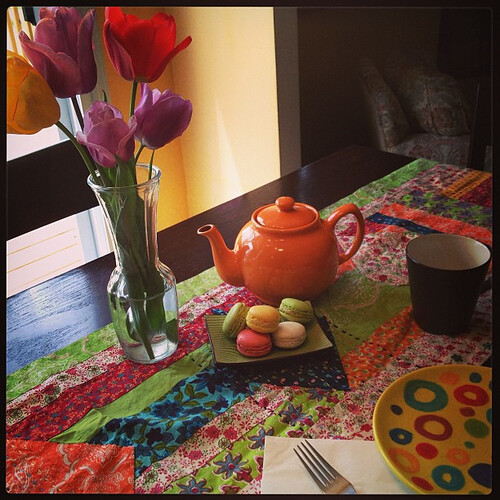
Here’s what happens when you take an hour a week to read poetry and drink beverages in tea cups or mugs with a few sweet treats for munchies.
EVERYONE stops.
Everyone. The whole bunch of you gather and every person is equally important to the teatime—baby, toddler, little kidlet, middler, teen, parent. It’s a moment in the day where the whole gang comes together.
Everyone STOPS.
The workbooks, the calculator, the DVD instructions, the playing with toys, the reading to oneself, the “moving a load of laundry from one machine to the other.” It all comes to a halt.
READING begins.
Poetry books are passed around the table. The readers, read. Long poems, short verses, paired-reading poetry, recited tongue twisters and limericks. Everyone reads—at whatever level they can—the exact poems they want to read. This is not “drumming out a few pages to prove you can read” reading, but a joyful dive into material selected by oneself to share with others!
Reading BEGINS.
Even non-readers read. They hunt for clues on the page that tell them that this poem, this verse is worth hearing. They look at fonts, and pictures, and words they recognize and they make good guesses—”Hey! I think I’d like hearing that poem.” They pass the book to a neighboring, willing reader and almost always want to follow along. Their selection is being read! They picked it! Reading is elevated to a goal, to a sacred practice, to being as cool as the big kids, to “I can almost read because I picked that poem!”
POETRY connects.
Poetry is a stealth writing form. It sneaks in through the backdoor and jumps you when you don’t expect it. T. S. Eliot says that poetry is “a raid on the inarticulate.” Rhymes, riddles, verse, ballads, sonnets, villanelles —whether you “get” the poem or not, there are words for pleasure and pondering, tickling and testing in your mouth. Laughter and puzzlement are part of poetry. Poems enrich vocabulary, imagery, and the pairing of unlikely ideas… which gets a writer’s juices going! Poetry says “Come out and play with me.”
Poetry CONNECTS.
A poem in your pocket, or shared over a bagel, or savored later in the day, once you take time to reread it, is like opening a love letter. There’s a little thrill—What will this set of words show me today that I never thought of before? Next week, and the next, you’ll notice favorite poems recycle and certain poetic forms revisited. Slowly, your family creates a shared poetic language that is uniquely yours. It’s different than story—poetry spans the ages more readily, and more quickly.
TEA and TREATS are enjoyed.
Or the beverage of your choice or your kids’ choice. Hydration (we forget to drink enough already, which causes headaches and crankiness), the soothing ritual of tea (blowing the steam off, slowing down to sip, adding milk, sugar, or honey, stirring and tinkling the cup), tipping a teapot and being careful not to spill…. rituals that alter the rush and race of life.
Also, sweet snacks, like brownies or scones or muffins or cookies or sliced cinnamon-sugar oranges or apple crescents or bunches of grapes, equal ‘happy’ smack dab in the middle of the day. The boost of sweet, the chance to munch, the shared pleasure of rare treats guarantees pleasant attitudes.
Poetry teatimes SHIFT your priorities.
When learning shows up as pleasurable and free, undistracted and rich, it’s harder to go back to dead forms of education. Other ideas to enliven the tedious or difficult subjects will dawn on you, as you move toward connection over completion.
So find a poem, put the kettle on, lay out a few Oreos on a small plate, and get started. You can add a flower arrangement and table cloth next week. Just jump in.
Life gets better with poetry and tea.