A Brave Writer's Life in Brief - Page 557 of 780 - Thoughts from my home to yours A Brave Writer's Life in Brief
  • Start Here
    • For Families
      Multiple Ages
    • Ages 5-7
      Beginning Writers
    • Ages 8-10
      Emerging Writers
    • Ages 11-12
      Middle School Writers
    • Ages 13-14
      High School Writers
    • Ages 15-18
      College Prep Writers
  • Shop
    • Product Collections
    • Bundles
    • Writing Instruction Manuals
    • Literature & Grammar/Punctuation
    • Composition Formats
    • Literature Singles
    • Homeschool Help
    • Book Shop
  • Online Classes
    • Class Descriptions
    • Class Schedule
    • Classroom
    • How Our Classes Work
    • Our Writing Coaches
    • Classes FAQ
  • Community
    • Brave Learner Home
    • What’s Happening
    • Blog
    • Podcast
    • Calendar
  • Cart
  • My Account
    • My Online Classes
    • My Account
  • My Account
    • My Online Classes
    • My Account
  • Start Here

    If you’re new to Brave Writer, or are looking for the best products for your child or family, choose from below:

    • For Families
      Multiple Ages
    • Ages 5-7
      Beginning Writers
    • Ages 8-10
      Emerging Writers
    • Ages 11-12
      Middle School Writers
    • Ages 13-14
      High School Writers
    • Ages 15-18
      College Prep Writers
  • Shop

    If you’re already familiar with Brave Writer products, go directly to what you’re looking for:

    • Product Collections Browse the full catalog in our shop
    • Bundles Everything you need to get started
    • Writing Instruction Manuals Foundational Writing Programs
    • Literature & Grammar/Punctuation Grammar, Punctuation, Spelling & Literary Devices
    • Composition Formats Writing Assignments for Every Age
    • Literature Singles Individual Literature Handbooks
    • Homeschool Help Homeschooling Tools and Resources
    • Book Shop Books associated with Brave Writer Programs
  • Online Classes
    • Class Descriptions
    • Class Schedule
    • Classroom
    • How Our Classes Work
    • Our Writing Coaches
    • Classes FAQ
  • Community
    • Brave Learner Home
    • What’s Happening
    • Blog
    • Podcast
    • Calendar
  • Search
  • Cart

Search Bravewriter.com

  • Home
  • Blog

A Brave Writer's Life in Brief

Thoughts from my home to yours

Are you a Type A mom?

People First

Do you find it difficult to operate without a checklist? Do you find yourself worried about getting it all done?

On the flip side, do you wish you could be more relaxed, but each time you try, the anxiety rises and you don’t quite relax?

It’s difficult to battle who you are—how you naturally interact with the world. Messy people buy the manuals of the naturally organized thinking they can change if they just have a system. Type A parents want to find a way to relax without feeling like they are lazy.

I say: Work with whatchu got! It’s too hard to do a personality-ectomy! Better to suit your aims to your style.

For instance, if you want to be a more relaxed mom—one who puts the warm fuzzies ahead of the workbooks, change the checklist. See if that helps.

Self-awareness is the first step. Each time you are tempted to push your kids toward what feels like work rather than delight, breathe. Feel your face. Are you smiling? Are your brows furrowing? Get back to connection with your children. Measure your day (checklist) with a new “Type A” criteria.

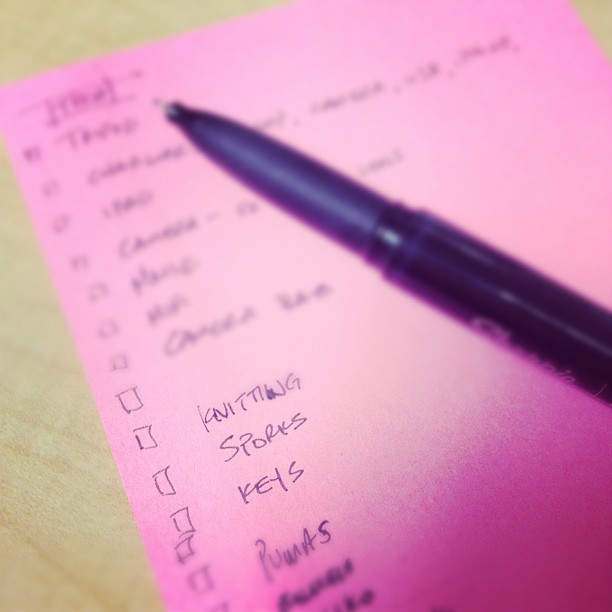
Check these off as you do them:

__ Hugged each kid

__ Made eye contact with one and had a conversation for 3 minutes

__ Asked questions of my quiet child to find out more about her process, not her work completed.

__ Played a game.

__ Took a walk.

__ Cultivated silliness (silly voice, body, jokes, puns, dance moves).

__ Put on music.

__ Smiled at my children, each one, at least once.

__ Gave 5 compliments.

__ Ate tasty foods and noticed the flavors.

__ Let everyone stop “working” sooner than they expected.

__ Did someone’s task for them.

__ Sat next to my child during her hardest subject until she finished it, offering encouragements.

__ Gave myself and kids permission to NOT do a boring chapter of the workbook.

__ Left a mess so my children could return to it later to finish the art project or the Lego build or the play fort.

What if you had a check list like that? Would that help you be a Type A mom who is also more fun?

Try that for a couple of days and see if you find a new groove for your careful personality—one that measures and values connection, over work completed. (You are likely to still get all the work done – that’s who you are! But now you’ll make room for the other stuff you wish you would do more spontaneously.)

Good luck!

A Gracious Space

Image by Betsy Weber (cc)

Posted in Homeschool Advice, On Being a Mother | 1 Comment »


How Writing Is Like Sewing

Brave Writer How Writing Is Like Sewing

A fundamental confusion exists around how to teach writing. I’ve spent two decades looking for just the right metaphor to explain how a parent facilitates writing growth. Then the other day, on the phone, I stumbled upon a perfect metaphor.

Let’s look at learning to use a sewing machine.

A sewing machine makes it possible to create all kinds of sewing products—anything from hemming a pair of pants, to constructing a quilt, to producing an evening gown. The machine doesn’t do it for you. You have to know how to use the machine, and you have to develop skills: how to sew straight seams or how to drop in a sleeve or how to gather a drape. You need to learn how to create casings, and how to use the zig zag, and what the tension dial does.

When learning the skills needed for sewing, students start with scrap fabric. They don’t pick a dress pattern and then sit down to the machine. Usually they have to learn how to thread the needle and bobbin, they have to sew lots of straight lines and learn how to turn corners and how to backstitch the end of a seam so that it doesn’t unravel.

No one can learn all she needs to know in one sitting or even one year of sewing. There are levels of skill that are gained over time, as comfort with the machinery, and dexterity, and familiarity with the properties of sewing are internalized and mastered.

How Writing is like Sewing

But it is possible at each stage of development to introduce a little project. At first, these might be things like bean bags (squares) or a string dress (no pattern, but the dress uses casings). As the student gets comfortable, making an a-line dress for a doll from a pattern becomes possible and a thrill! Producing a doll quilt is the first step toward making one for a bed.

Eventually, the student of sewing learns tricks to make the process easier and faster. They can size up a pattern to know if it’s too difficult or too easy, and can make changes to make the pattern work.

Sewing is not about the dress patterns or quilts. Sewing is a set of skills that can be applied to patterns.

Let’s drive home the analogy to writing.

Firstly, the original writing process is discovered using scrap language—whatever is in the mind and mouth of the child at the time. The writing is interest-driven and exploratory. The child is gaining facility with the practice of accessing language, ideas, insights, and information from within and getting those words to the page in a variety of ways (all different styles of “language stitching”).

Secondly, the child learns to use the mechanics of writing similar to learning to use the sewing machine. How to thread the bobbin, how much pressure to put on the pedal, how to backstitch, how to zigzag, how to set up the buttonholer—these skills enable sewing. Similarly, the functional skills needed to run the machinery of writing are spelling, grammar, punctuation, handwriting and/or typing. And in Brave Writer, we believe that in the beginning that’s best learned through copywork (someone else’s writing).

Thirdly, students create writing projects which are the dress patterns of writing. Now that older children understand how the machine works and can use it with evolving skill, they can manage the demands of the machine, so it’s time to make a dress or placemat or quilt!

How Writing is like Sewing

In writing, once the student knows how to find language within, knows how to get that language to the page, and how to handwrite, expand, revise, and edit it, he or she is ready to “make something” —to write a report or letter, to write a poem or a dialog, to write a story or ad copy, to write an essay.

The point is—don’t hand your brand-new-to-writing student the equivalent of an evening gown dress pattern and expect it to turn out right on the first try, just because there are “clear instructions.” Writing is a set of skills practiced independently of assignments, leading up to developmentally appropriate writing projects that reinforce and expand evolving skills.

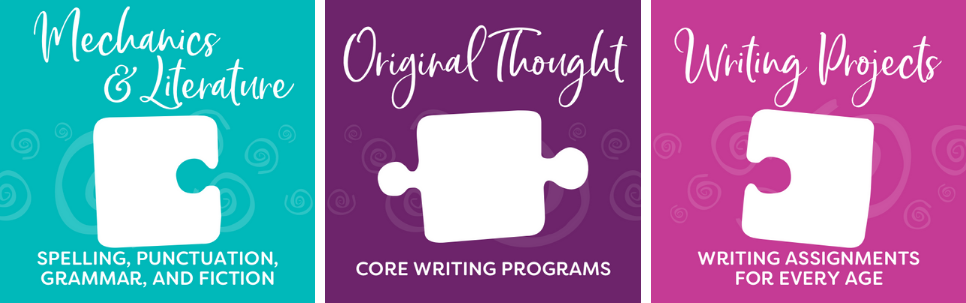
3 components of a complete writing program:

  1. Mastery of the original writing process (Growing Brave Writers)
  2. Rehearsing the mechanics of writing (Quill, Dart, Arrow, Boomerang, Slingshot)
  3. Writing projects to put mechanics and original writing together (Jot it Down, Partnership Writing, Building Confidence, Help for High School, and Online Classes)
Brave Writer Products

Tags: Mechanics
Posted in Brave Writer Philosophy, BW products, Writing about Writing | 2 Comments »


Friday Freewrite: Lost

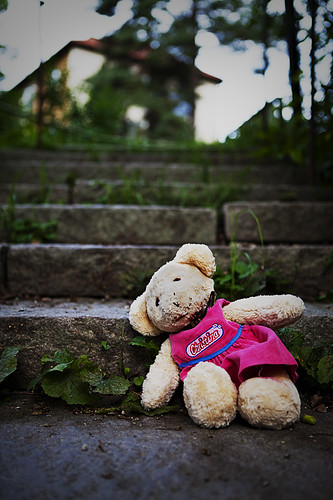
Lost best friendHave you ever lost a favorite toy or something that meant a lot to you?

Write about it.
 
 
New to freewriting? Check out our online guide.


Image by Ulrica Törning

Posted in Friday Freewrite | Comments Off on Friday Freewrite: Lost


That elusive thing called happiness

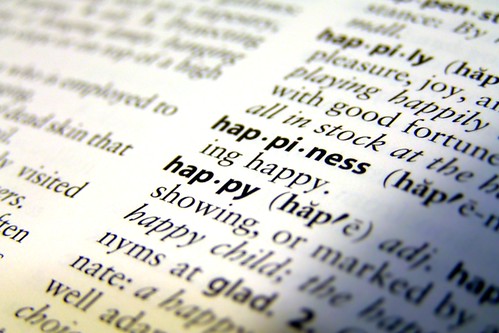
HappinessImage by Caleb Roenigk

I read a blog the other day that reminded me: Happiness is not a completed puzzle with all the pieces glued into place, varnished, framed, and then hung on the wall—as though once you find that last piece and arrange it in the missing space, completing the puzzle “just so,” you will have achieved happiness and that quest will be finished.

What a great image! As though happiness could be contained in a still, framed, lifeless image.

I liked it. I liked it a lot. It’s so easy to think that if I pad my cell with the right set of philosophical bumpers, I will avoid sharp objects and intrusive voices that wreck my peace.

I thought about it more.

Happiness is not just “joy in the journey” of hunting for puzzle pieces either. The hunt implies that there is some key, some magical understanding that puts everything together in such a way that you know you’ve arrived. So the quest for the pieces is part of that vision that you might find the end point. It’s hard to have joy in a journey without a destination (who wants to just drive around all day without arriving somewhere?).

So that’s the problem with “joy in the journey” thinking. We still try to get somewhere so that we’ll finally feel justified in having that feeling of joy or happy.

What if “happiness” is utterly different than we’ve been led to believe by advertisers, experts, and advice-givers?

Happiness in homeschool, as I’ve observed it, and as I’ve lived it at times, is the experience of being okay with my homeschool exactly the way it is today—unfinished, messy, incompleteness spilling out of the sides, and running down my legs, and busting through the neat graphed lines of my schedule.

Happiness in my homeschool looks like slathering a big thick layer of yummy love across my imperfect self and my silly, sometimes struggling, sometimes thriving bunch of little rascals that live their own version of happy in the middle of the mess.

It’s forgiving myself for my lacks and inadequacies and recognizing that I don’t have all that it takes to homeschool. Some days I don’t even have half of what it takes.

Happiness comes when I’m least expecting it—when a moment stirs me or catches me off guard, like a hug and kiss, or a brand new word read, or a note pinned to my pillow, or a pair of kids playing without arguing for ten whole minutes.

It comes when I give up and give in and let today be what it is and trust that tomorrow will be okay too and I look back at yesterday and think, “That wasn’t all bad. It looks even better in hindsight. I can build a memory from that one thing—that little breakthrough or that joke or the way we all teared up at the end of the read aloud. That’s enough to take from yesterday.”

Happiness is a state of being not a goal achieved or a mindset created or a philosophy rigidly followed. It comes when you let go and float and let the waves of your life ride.

Think of labor—yielding, trusting, crests, and valleys. But oh so good, and leading to the oh so right, and messy too.

If you’re in that space of self-recrimination, where you can’t figure it out, can’t identify what’s going wrong, if you wish you were better at being a mom or teaching math or having big juicy conversations… stop. Go inside and let yourself fall a part a little bit.

While you do, be your own best friend for a moment. Notice your limits and love them. Let them be. Blow them kisses. They are part of what make you, you… to yourself, and to your children.

You don’t have to solve it. You can keep going, you can embrace the uniqueness that is your life…. trusting that over time, everyone will find their way when you stop pushing so hard to make it all fit into that framed puzzle.

Be good to you. Accept who you are—hug yourself, wrap that hurting self in a pair of big strong arms. You’re okay. I know you want to grow and change and be better. We all do. One way to get there is to stop trying to fix it. Simply be where you are, as you are, living with the magical people entrusted to your care.

Happiness may find you yet.

Posted in Homeschool Advice | 1 Comment »


It really is enough

The tricky part of homeschooling, and particularly writing, is that you can’t see the growth as it happens. Looking back shows you the growth. But looking back happens when they head off to college… or Europe, or get married. That feels a teensy bit late.

In other words, the very thing you need to reassure you that you are doing a good job with your kids is invisible to you as you do that “good job with your kids.” You’re required to put your faith in the process, rather than confidence in observable results. (Or, alternatively, you have to change how you measure what you see.)

  • It’s enough to read aloud to your kids, to have your children copy some of those words into a little notebook, to have them take a stab at writing some of those words without looking while you dictate them aloud. It’s enough if this happens once a week or 20 times in a year, and some years even fewer times.
  • It’s enough to catch a few of their brilliant thoughts or quirky ideas in writing for them, once in a while, so they know that what’s inside them deserves to be on paper too.
  • It’s enough to linger at dinner, discussing some topic like the puns in Seinfeld or why Pocahontas the Disney movie is both so good you want to keep watching it but so bad (if you compare it to history) that you feel guilty for loving it.
  • It’s enough to sing to your kids at bedtime once in a while or listen to their stories or to tell them some ridiculous saga you made up that goes on and on and stops making sense after a few weeks but you both love just the same.
  • It’s enough if your kids read and read and read the same book series over and over again and it seems like they will never discover another author as wonderful as JK Rowling or Brian Jacques or Suzanne Collins or Ian Fleming or Jeff Kinney. One day you’ll notice… oh hey! She’s reading another book by someone else.
  • It’s enough if you listen to what your kids say, if you have big juicy conversations about the stuff that interests them, if you laugh at funny sounding words and use absurdly big ones around them just to trick them and tickle their linguistic imaginations.
  • It’s enough if they read a little poetry, look up a few song lyrics, memorize a couple tongue twisters, learn to tell a few really funny jokes, and figure out the delicious humor of Will Shakespeare in one of his comedies (in a movie of course).
  • It’s enough if they cast their thoughts onto a page, freely, attending only to the ideas or the sound of the words, and know they have a receptive audience in you.
  • It’s enough if they play with other writing forms, if they learn how to mop up their own mechanics, if they attempt half a dozen essays in high school, figuring out what it means to have a point of view that they assert and then how to back it up because it matters to them.

We make it so difficult. We expect our kids to match some other agenda than the one that delivers them happily into an authentic writing life.

Less is more—less hand-wringing, fewer assignments, less control, less nagging, fewer criteria.

More is more—more conversations, more reading, more delight, more time, more space, more passion for language, more opportunities to play with words, language.

I’m here to help when you lose your nerve or your way.

Posted in Brave Writer Lifestyle, Homeschool Advice, Writing about Writing | 2 Comments »


« Older Entries
Newer Entries »
  • Search the Blog

  • Julie Bogart
  • Welcome, I’m Julie Bogart.

    I’m a homeschooling alum -17 years, five kids. Now I run Brave Writer, the online writing and language arts program for families. More >>

    IMPORTANT: Please read our Privacy Policy.

  • New to Brave Writer? START HERE

  • FREE Resources

    • 7-Day Writing Blitz
    • Brave Writer Lifestyle Program
    • Brave Writer Sampler: Free Sample Products
    • Freewriting Prompts
    • Podcasts
  • Popular Posts

    • You have time
    • How writing is like sewing
    • Best curriculum for a 6 year old
    • Today's little unspoken homeschool secret
    • Do you like to homeschool?
    • Don't trust the schedule
    • You want to do a good job parenting?
    • If you've got a passel of kids
    • You are not a teacher
    • Natural Stages of Growth in Writing podcasts
  • Blog Topics

    • Brave Learner Home
    • Brave Writer Lifestyle
    • Classes
    • Contests/Giveaways
    • Friday Freewrite
    • High School
    • Homeschool Advice
    • Julie's Life
    • Language Arts
    • Movie Wednesday
    • Natural Stages of Growth
    • One Thing Principle
    • Our Team
    • Parenting
    • Philosophy of Education
    • Podcasts
    • Poetry Teatime
    • Products
    • Reviews
    • Speaking Schedule
    • Students
    • Writing about Writing
    • Young Writers
  • Archives

  • Brave Writer is a participant in the Amazon Services LLC Associates Program, an affiliate advertising program designed to provide a means for sites to earn advertising fees (at no extra cost to you) by advertising and linking to amazon.com

    Content © Brave Writer unless otherwise stated.

What is Brave Writer?

  • Welcome to Brave Writer
  • Why Brave Writer Works
  • About Julie
  • Brave Writer Values
  • Frequently Asked Questions
  • Speaking Schedule

Brave Writer Program

  • Getting Started!
  • Stages of Growth in Writing
  • The Brave Writer Program
  • For Families and Students
  • Online Classes
  • Brave Writer Lifestyle

…and More!

  • Blog
  • Classroom
  • Store
  • Books in Brave Writer Programs
  • Contact Us
  • Customer Service
  • Brave Writer Staff
© 2026 Brave Writer
Privacy Policy
Children's Privacy Policy
Help Center