Image by Ano Lobb
Describe the last time you walked outside barefoot. Go!
New to freewriting? Check out our online guide.

Image by Ano Lobb
Describe the last time you walked outside barefoot. Go!
New to freewriting? Check out our online guide.
Dear Julie,
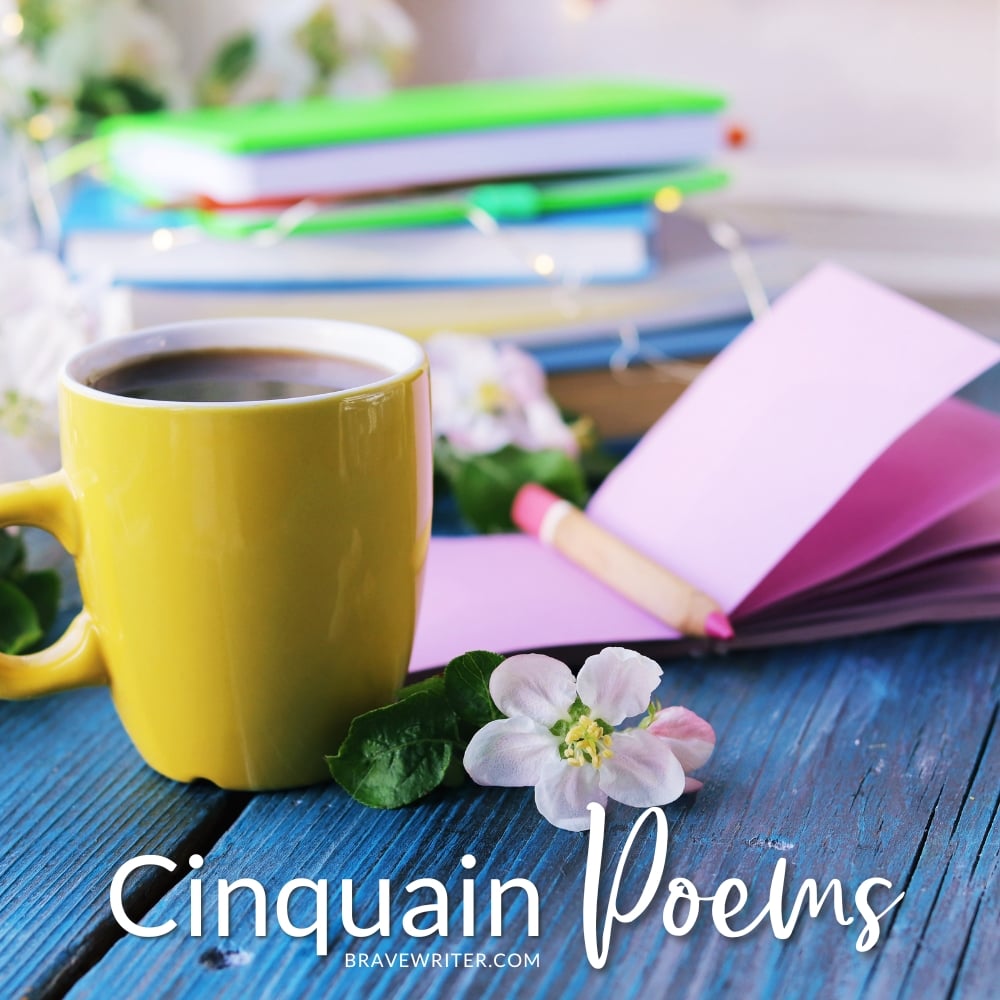
This morning we had a wonderful time writing cinquain poems.* I thought I’d share some of our’ poems with you so you can see first hand what you’re inspiring.
By Fallon (10 yrs):
Sloane
Cute, cuddly
Running, hugging, kissing
I love Sloane
Sister
Dragons
Big, friendly
Flying, eating, sleeping
He burns my hand
Friends
Describing her drawing of a robot couple!
Robot
Metal, electric
Loving, scanning, talking
He loves his wife
Husband
By Eamonn (8 yrs):
Sword
Thin, diamond
Slicing, dicing, ricing
My sword is my hoard
Dagger
By Mama:
Mountains
Majestic, miraculous
Moving, morphing, mourning
Marking many millennia
Monumental
Thanks for all the work you do to inspire and cheer us all on. We appreciate it so much!
Warmly,
Melanie
A cinquain is a five-lined poem and can be written various ways (some cinquains use different numbers of syllables for each line). For young writers and beginners we recommend:

Have you ever noticed that you reinvent homeschool every year? You would think, particularly after having one child go through a certain grade level, that when the next child in line hit the same age and stage, you’d have it all dialed. You’d pull out your notes, books, and memories from the first kid… and apply them as a template right over top of the next one!
Yet it rarely works that way.
Instead, the next child comes down the pike and you find yourself doubting the old tricks and books. You’ve since heard of a sparkly new program that teaches itself and you want to try it. This child is so different from the last one that the old way just wouldn’t work.
Sometimes you will be three children in and realize that you never did like that math curriculum and now that you’ve figured it out, you can’t spend ONE MORE DAY looking at that hideously designed book with its awful colors and nonsense explanations, no matter how much you spent on it.
As you grow in your career of home education, you also get smarter. What satisfied you the first year often feels cramped or schooly to the new brave you that sees learning through new eyes. You feel freer to risk, to try avant garde strategies. You stop quantifying the hours of the day and allow yourself to “count” card games and nature hikes as part of your children’s education.
I had a phone call with a mother of nine children, with two of them grown and raising their own kids, say to me that she was unsure what writing program to buy. She’d already successfully reared, homeschooled, and married off two kids yet was not quite sure if she had the best writing plan for the last two kids still at home.
If anyone should be at ease in this home education business, you’d think it would be a mother who could reassure herself that with two successful homeschool grads, she must be doing a good enough job with the tools she’s already got!
But that’s not how it works.
The truth is: we homeschooling parents are on a never-ending campaign to do right by our children.
That means we tirelessly turn over rocks looking for the next best rightest brightest choice for this specific child at this specific stage of life.
Not only that, we’re a part of the equation too. We want to be stimulated.
We look for triggers for our creativity, we feed our learning curve new ideas and philosophies, we expand our sense of fun and imagination, and we want reassurance that we are making measurable progress with our children.
To that end, homeschooling parents reinvent their homeschools every single year.
It’s a part of the warp and woof of this lifestyle. It’s what enables parents to sustain 20 year commitments. It’s what creates tailor-made educations that accommodate the wide-variety of people in our families.
As you spend time researching what you’ll do next year, allow yourself to go on the adventure of reinvention.
1. What works? How do I feel about it?
If it works, you don’t necessarily have to change it. But if it works and you are sick of it or the child is bored or you’re going through the motions, it’s fine to change it up—even if it’s “working” in theory.
2. What’s not working? What can I do about it?
If it’s not working, you may need more than a new book. You may need a whole new perspective or view of how to work with this particular subject. Read about the philosophy of education with regard to this subject area and shift how you see it.
3. What do I wish I were doing that I’m not?
Try doing it – for a month or more – to see! Take a small bite of the apple. You don’t have to go in all the way… yet.
4. What am I doing that I wish I weren’t?
Can you give it up for a week, a month, or reduce it to just a couple times a week? See how that feels?
5. What do my kids wish we were doing that we aren’t?
Get it on the schedule—plan it, do it!
Enjoy reinvention. No guilt. No self-doubt. It’s one of the many great rewards and satisfactions of being a career home educator.
Top image by Horia Varlan (cc text added)
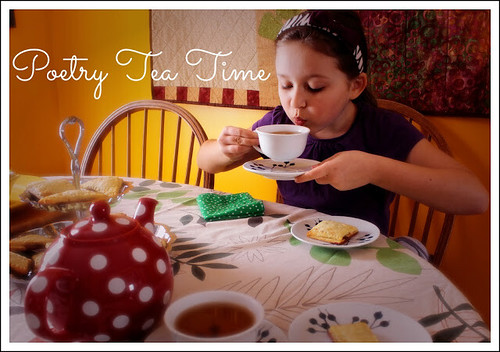
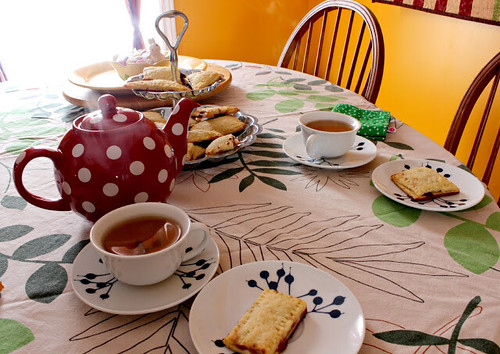
We had another lovely Poetry Tea Time on Tuesday this week. We are trying to keep a regular day for it, but we do enjoy reading aloud and having tea more than just one day a week!
I had found a fun looking poetry book at the thrift store a few weeks ago. The art and the poems appealed to Celeste right away and she asked for more non sense poetry. I put a few titles on hold at our local library.
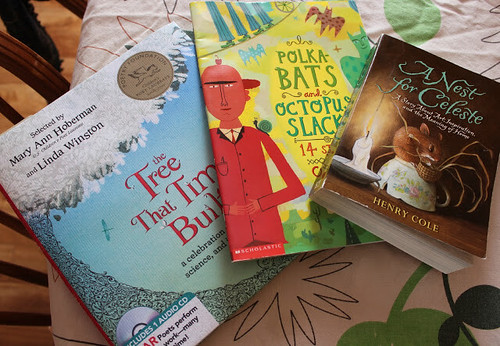
Polka-bats and Octopus Slacks is a collection of 14 stories by Calef Brown. Celeste’s favourite was The Lonely Surfer:
“In a dry and dusty desert town
the lonely surfer hangs around.
Perched upon a prickly pear,
he usually wears a worried frown.
People ask the surfer dude,
“Why so far from the ocean blue?”
“Because I’m so afraid of sharks,”
he says, “and water too!”
Alexandra has many lovely teatime posts on her blog. She’s also shared about her daughter’s writing journey and her experience with Brave Writer. Check it out!
We talk about writing voice in the writing process quite a bit in Brave Writer. We want the writing your kids do to sound like them—to have their vocabulary, inflection, quirky personality, and sense of humor. We don’t want them to sound like a copy of Aesop or the writer of X, Y, Z curriculum. We don’t want them to produce rote writing where no one can tell who wrote it, so devoid of voice it is.
So we start with freewriting.
But what happens when we give freedom to express and little shows up? What if what we find on the page is lifeless and dull, the utter opposite of what shows up in the bathtub or at an amusement park?
Even worse: what if what shows up really does in fact sound like your child, but it’s lifeless and dull (according to you) and feels like the barest beginnings of original thought?
So let’s back up a step.
“Writing voice” is two words. The real word we want to explore is “voice” all by itself.
Peter Elbow (my writing mentor) describes it this way:
“Most children have real voice but then lose it. It is often just plain loud: like screeching or banging a drum. It can be annoying or wearing for others. ‘Shhh’ is the response we get to the power of real voice.
“But, in addition, much of what we say with real voice is difficult for those around us to deal with: anger, grief, self-pity, even love for the wrong people. When we are hushed up from those expressions, we lose real voice.”
Here’s where we sometimes go wrong as parents. We are busy, our children are young and inexperienced. When they risk saying what they really think in the ways they want to really say what they think, we sometimes move into what I call “civilize the savages” mode. We are more worried about the appearance of what they say than what it is, in fact, they are saying.
If your children develop the habit of shutting down their real ideas, thoughts, preferences, wishes, and dreams around you, they will also turn off “real voice.” Then when you go to writing with them, they will turn to you and expect you to tell them what words ought to fill the page, just like they now wait for you to show them what thoughts are acceptable to say out loud.
Writing is a risk, but so is speaking. We must create space for both the prudent, acceptable, “makes Mama proud” words and the “Oh I hope she doesn’t really feel that way” words. We need to pause and let the rumble of language flow through our kids verbally and they must know that you are interested, receptive, and open-minded enough to hear it (without freaking out) in order for them to find their written voice.
Eye contact and a focused minute of conversation where you really hear what one of your kids is saying is the beginning of fostering an environment where what your child means to say becomes the norm for what is written.
You may have to change your own perceptions of what writing is too. It may be that you use an artificial voice when you write—the one the teacher told you sounded more grown up, or the one that keeps you from being perceived as impolite, or the one you use to project a cheery disposition.
Maybe you don’t even write because the risk feels too great and you avoid it.
Take some time to explore how much space there is in your self, in your children, and in your home to express authentic voice (verbally first, in writing second). See what you can do to expand that space…
Baby steps:
“You look angry—want to tell me about it? Want to yell about it?”
“Your giggly, silliness is cracking me up! I want to be as silly as you!”
“It’s okay to be really sad right now. Tell me about it.”
“I hate that too, sometimes.”
“You are so smart using all those big words!”
“I would love to hear you tell me more about that story! Go for it. I want every tiny detail.” (Instead of insisting on summary)
See what happens… I know for me, I have to put my phone down and walk away from the computer. I also find that it’s easy to tune out my kids when the topic doesn’t interest me or they are struggling to find the words. I have to remind myself to pay attention and to care. You can’t do it every time, but you can do it some of the time, for each child in a rotating way. Be mindful and conscious.