Choose three people (you cannot choose yourself) who will each have three wishes granted. Who do you pick and why?
New to freewriting? Check out our online guide

Choose three people (you cannot choose yourself) who will each have three wishes granted. Who do you pick and why?
New to freewriting? Check out our online guide

Whitney Goodman is the author of Toxic Positivity, a book sharing its release date with my own, Raising Critical Thinkers. She’s a psychotherapist with a wonderful Instagram account, @sitwithwhit, where she offers insightful support to young adults seeking to recover from childhood pains and traumas.
She was previously on the podcast in May 2022 where she discussed her book and the downsides of positive thinking. Lately, Whitney has zeroed in on the challenge of creating healthy relationships between adult kids and their parents.
Meanwhile, I’ve been in conversations with my adult friends about how to relate to their Millennial and Gen Z kids as they set boundaries and communicate their pain. We all want connection — but most of us are unsure of how to get it.
On today’s Brave Writer podcast, Whitney and I hope to represent these two generations and discuss how to heal pain and foster connection.
We even do some role-playing!
Why is this such an important topic today?
In Whitney’s practice, most of her patients from the ages of 25 to 35 have been having a really hard time relating to their parents. But why is this such a big issue today, when it doesn’t seem to have been before?
This generation, more than any other, has more awareness of family systems, dysfunctional families, and things like that. The generations of kids are parents today have been raised both on different expectations and even a different vocabulary entirely. Not only does this make relating more difficult, it means that our lens for judging how well we parented or were parented is different.
Now we have parents who look back and believe they did so much better than their parents, and yet they feel like they are being judged even harsher. But most kids aren’t doing this to bully or blame their parents — they’re searching for understanding and connection, and they want to be heard.
How to reach some common ground.
When adult kids dealing with trauma are trying to reach understanding with their parents, it’s important to note that both parent and child can feel differently about the way a certain event took place and both of those things can exist at the same time. Both parties have to be open about the experience the other went through without shutting down.
It’s especially important for adult children to recognize that, while it feels like your emotional maturity will only continue to improve as you get older, that’s not always the case. You in your 20s or 30s may have more emotional maturity and literacy than your parent.
Setting boundaries that aren’t just punishment.
Yes, it’s important to set boundaries and enforce them. But what many people get wrong is that boundaries are not meant to be punishment for a perceived wrong. Boundaries are, instead, meant to be used as a method of self-care: Taking out own needs into account over the wants of others.
To set boundaries that don’t cross over into punishment, you need to apply nuance to the situation. Consider how you approach the conversation. Instead of an authoritative statement — “I’m not celebrating Christmas at your house this year” — try explaining the situation, why it’s important to you, and establish what ways you’re willing to be flexible.
What’s missing from a lot of these conversations is empathy.
Understand the perspective of the other person: Can you recognize what it’s like to be taking care of young children, being incredibly busy, and is expected to drive an hour to someone else’s house early on Christmas day?
Additionally, if your boundaries are hurtful to others and you want to show them some sympathy without completely giving up those boundaries, try finding little ways to make things better. Set time limits, openly say you won’t be cooking, or whatever compromises you can come to.
Whether you’re the parents of adult children or the adult child in that situation, there is still an illusion that “grown-ups” know more than they do. We can put too much pressure on our parents to have everything figured out, but the truth is that we’re all just figuring it out at the same time. And to do that, we need to cooperate and reach some shared understanding.

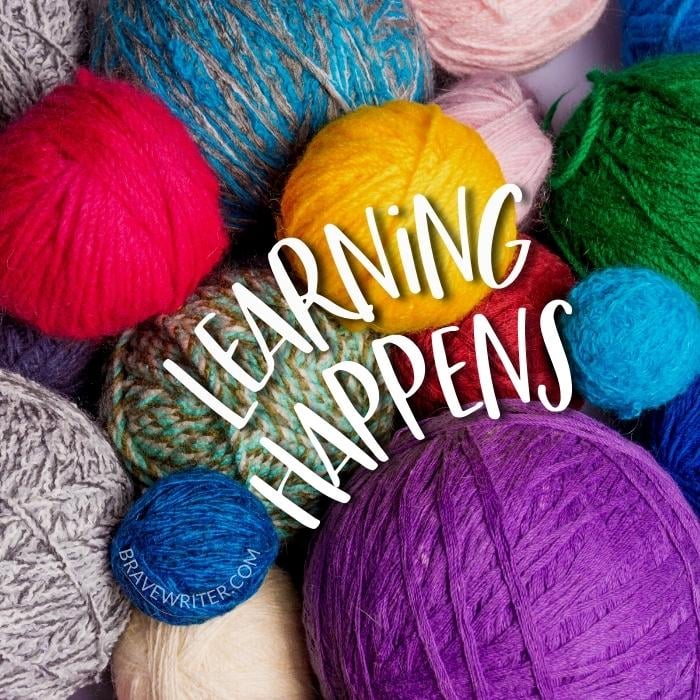
What is my child learning? The content of the subject or resentment of the system that teaches it?
Learning happens whether you want it to or not. What the child is learning? That’s up for grabs.
I like to compare the school subjects to learning a hobby. What’s the difference? When I taught Noah to knit, I had tons of patience. We only worked on knitting when he wanted to knit. I used books, I modeled, I didn’t set a time of day called “knitting.”
He knit when I read aloud, he knit during movie time, he knit during afternoon hours or before I got up in the morning. When he got stuck, he asked for help. He taught himself some skills by reading a book about knitting. I bought him yarn and needles for a Christmas gift. He was delighted to receive them because knitting, for Noah, was an experience and activity he valued.
It’s amazing to think about how easy it was for Noah to learn to knit in part because I felt zero stress over his performance. I didn’t worry that he hadn’t finished X number of rows in an hour or that he lost interest for a week or two or that he needed more help sometimes than others. I didn’t ask myself if he would be a professional knitter or if there was a career path that depended on knitting.
We simply knitted together until he got what he wanted from that experience and moved on.
A great question to ask ourselves: How can learning math or grammar be more like learning to knit? What would we do differently?
If your kids are balking at subjects you consider essential, focus on the how—what is it about the system you are using currently that leads to resentment? Shift the how, and shift the value of the subject for your kids.
Psst: this is how we teach grammar in our program, by the way. We bypass all that stress by making it as easy to learn as knitting.
This post is originally from Instagram and @juliebogartwriter is my account there so come follow along for more conversations like this one!


Mary Van Geffen is an international coaching expert for parents of “spicy ones.” She helps people who are highly competent in life but overwhelmed by the challenges of parenting to lean into the discipline of staying calm. She helps them cultivate warmth and tenderness, all while trying to wrangle the fiery future of their tiny future CEOs.
On today’s Brave Writer podcast, we discuss what it means to have or be a spicy child, and how parents can best react to these spirited young ones.
What is a spicy one?
Spicy can mean a number of things — besides the obvious food connotation.
It can be used to describe a child’s temperament when they express themselves in big and dramatic ways.
They can also use powerful language that can wound or delight. They’re often very aware of other people’s feelings but can also exhibit a lack of perception of others’ feelings. They powerfully negotiate, all the way up until they lose hope and they melt down.
They’re comfortable setting boundaries with adults and staying true to themselves. They’re also highly sensitive and observant. They can’t be consoled physically. They’re also incredibly sweet, caring, and loving. In other words: They’re a lot.
Whether or not a child is spicy is determined by the parent — it’s not diagnosable. It can be impacted specifically by the relationship between parent and child and what the parent is bringing to the table. Many children whose parents say are spicy are also neurodivergent — up to 50% in a poll of Mary’s Instagram followers. And of children with some neurodivergent diagnosis, 80% of parents found the experience to be spicy. So while it doesn’t have to be a diagnosis, that really does make things spicy, doesn’t it?
What does it look like to be a good parent to a spicy child?
Prizing connection over control. It’s not about fixing the situation or motivating our kids. It can just be about connecting with them.
But what do you do when you absolutely need compliance? When what a child is doing is unsafe or you’re on a time schedule? You practice “connect before you direct.”
Spicy kids aren’t immediately won over by your words — you have to get them to buy into your vision and have their own leadership autonomy in that vision. They want to be the CEO, so rather than demoting them, let’s promote them and let their ideas have space.
Some of these kids aren’t misbehaving, they’re just in their own minds. Rather than choosing to ignore your directions, they may not have heard it at all. To get their full attention you have to give your full attention — no multitasking. Bring your body close to theirs, slow them down, and bring them along with your directions.
If there’s one overarching principle to come away with, it’s that you’re doing things right if you are focused on connection over control.