Writing about Writing Archives - Page 11 of 27 - A Brave Writer's Life in Brief A Brave Writer's Life in Brief
  • Start Here
    • For Families
      Multiple Ages
    • Ages 5-7
      Beginning Writers
    • Ages 8-10
      Emerging Writers
    • Ages 11-12
      Middle School Writers
    • Ages 13-14
      High School Writers
    • Ages 15-18
      College Prep Writers
  • Shop
    • Product Collections
    • Bundles
    • Writing Instruction Manuals
    • Literature & Grammar/Punctuation
    • Composition Formats
    • Literature Singles
    • Homeschool Help
    • Book Shop
    • Special Offers
  • Online Classes
    • Class Descriptions
    • Class Schedule
    • Classroom
    • How Our Classes Work
    • Our Writing Coaches
    • Classes FAQ
  • Community
    • Brave Learner Home
    • What’s Happening
    • Blog
    • Podcast
    • Calendar
    • Brave Writer Lifestyle
  • Cart
  • My Account
    • My Online Classes
    • My Account
  • My Account
    • My Online Classes
    • My Account
  • Start Here

    If you’re new to Brave Writer, or are looking for the best products for your child or family, choose from below:

    • For Families
      Multiple Ages
    • Ages 5-7
      Beginning Writers
    • Ages 8-10
      Emerging Writers
    • Ages 11-12
      Middle School Writers
    • Ages 13-14
      High School Writers
    • Ages 15-18
      College Prep Writers
  • Shop

    If you’re already familiar with Brave Writer products, go directly to what you’re looking for:

    • Product Collections Browse the full catalog in our shop
    • Bundles Everything you need to get started
    • Writing Instruction Manuals Foundational Writing Programs
    • Literature & Grammar/Punctuation Grammar, Punctuation, Spelling & Literary Devices
    • Composition Formats Writing Assignments for Every Age
    • Literature Singles Individual Literature Handbooks
    • Homeschool Help Homeschooling Tools and Resources
    • Book Shop Books associated with Brave Writer Programs
    • Special Offers
  • Online Classes
    • Class Descriptions
    • Class Schedule
    • Classroom
    • How Our Classes Work
    • Our Writing Coaches
    • Classes FAQ
  • Community
    • Brave Learner Home
    • What’s Happening
    • Blog
    • Podcast
    • Calendar
    • Brave Writer Lifestyle
  • Search
  • Cart

Search Bravewriter.com

  • Home
  • Blog

A Brave Writer's Life in Brief

Thoughts from my home to yours

Archive for the ‘Writing about Writing’ Category

« Older Entries
Newer Entries »

Sometimes the writing doesn’t have to be brave

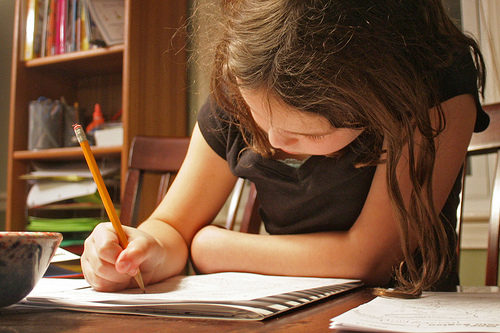
home work routineImage by woodleywonderworks

Sometimes the writing will dribble off the page and puddle around your feet. Spare t’s and floating dots over i’s, unimaginative terms like “good” and “fun,” lack luster sentences of uncertain viewpoint…this is the stuff of regular writing, as much as any brave revelation of a person’s interior or a keenly carefully observed guava—poked, prodded, and tasted.

The days of writing accumulate, just like the days of potty training or balancing on a bike or eating salad.

They aren’t glamorous, and often the contents, particularly of freewrites, feel a bit frightening. I confess: I panic a little each time it’s my turn to read and comment on a freewrite. There’s that moment where the words clack into each other and the sound is unclear—the heart and meaning undifferentiated, and the terms out of tune. I worry that this will be the One Time when I won’t have the right feedback that moves the piece forward or that will support the child’s risky (albeit, bland) self-expression.

To calm myself, I remember that my job isn’t to fix, prop up, or find what isn’t there. My job is to read.

And so I begin.

I read the writing. I notice that it fills the page (or doesn’t). I notice that there are words, lined up—as many as there are. I read them and let myself hear them and feel them. If the words are “unremarkable,” sometimes I ignore the meaning and listen to the sounds—as though hearing English as a foreign language.

I let the writing speak; I do not judge it.

This is the first step in being a brave reader. It is an easy thing to read a piece of writing that pops off the page and entices you forward into its tributaries of well-chosen language and clever ideas. It’s another to accept what is offered and to know that it doesn’t have to shine or sing or stand out above other efforts.

Thank the writer. Be earnest, rather than disappointed (it’s easier to not be disappointed if you go into the reading looking for what to affirm and choosing to find something—one thing!). You can always affirm effort, complete sentences, handwriting, a well-placed piece of punctuation or capitalization, congruence between subject and verb (why not notice that and say “Well done” rather than only noticing when it’s “off”?), and the single best word in the piece. Maybe that word is “I”—how the writer (your child) showed you his or her viewpoint and you appreciate it.

Not all freewriting will delight you or speak to you immediately. Sometimes you must be patient—just like when you go to game after game after game of soccer and your daughter runs along the inside of the sidelines as though she is playing, but really she’s just avoiding the ball. You still cheer, you still hope she’ll bump into it and make contact and be a participant. She still gets the orange slices and juice pack. She sweats and runs and cares.

Then there’s that one day when she least expected it—the ball is right there, right next to her foot and she sees the open net—and out of nowhere, she boots that ball into the goal—no one is more shocked than she is and you cheer even louder!

You loved her no less before, and not more now—you just feel that affection a bit more deeply in that moment. You know she’s a soccer player in a new way.

That’s how it works with writing, too. You can coach, you can share strategies to help ease the challenge. But sometimes it takes a lot of running up and down the sidelines, cowering a bit, avoiding the ball, but hanging around the game anyway, before your child scores.

That’s how it’s supposed to be. Keep finding reasons to cheer. That’s what brave readers do.

Cross-posted on facebook.
Posted in Writing about Writing | Comments Off on Sometimes the writing doesn’t have to be brave

Just how foreign is writing?

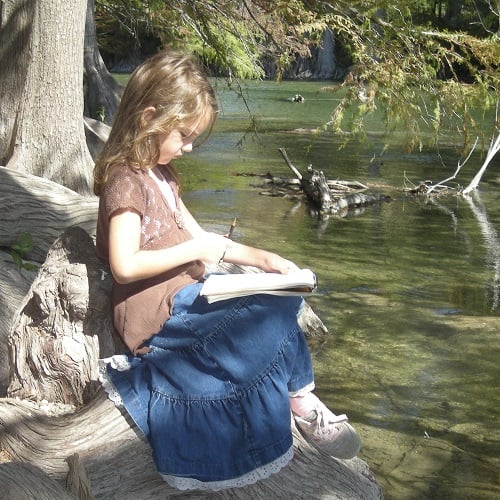
WBWW 118- Image by Lisa

A debate exists about writing: is it related to speech? If so, how much? If not, why not?

One camp says that learning to write is akin to learning to speak a foreign language. Writing is as foreign to native speakers of any language as Amharic is to you or me (unless you are Ethiopian!). That’s why children struggle to become fluent writers, so the thinking goes. Children are naturally wired for speech and are frustrated trying to translate those words into language suitable for writing (the style of it, the vocabulary of it, the spelling of it, the punctuating of it, the organization of it, the handwriting or typing of it). Even my mentor, Peter Elbow, says that some people feel as if they are translating speech into something else when they write. Have you ever experienced the “Hmmm, how shall I say this?” thought as you sit down to actually write the thought you are having?

That’s what this camp is getting at. There’s a weird translation process between speech and writing. Because so many of us have experienced that moment, there’s a sense in which it must be true: writing must be so different from speech, we are prone to writer’s block as a result.

There is a bit of truth in this perspective. The brain is not wired for writing, like it is for speech. Writing is a learned activity. Speech, however, is hardwired into all human beings.

The other camp sees writing as related to speech. Dr. Peter Elbow, again, recently published an entire book, Vernacular Eloquence: What Speech Can Bring to Writing(affiliate link), that attempts to make this case to a resistant academy. Writing is the extension of speech, he argues. If we can understand speech first, and then see how it informs and creates writing, we will wave a wand of release over thousands of frozen would-be writers. The mechanics are only one aspect of writing—writing actually sits inside each of us as native speakers already.


What is fascinating is that in the world of homeschooling programs, both views rely on copywork, dictation, and two varieties of narration (oral and written) to help students gain fluency in “writing.” But their starting points of view are polar opposites.

What I’ve noticed in my work with thousands of families is that children are more inclined to put in the effort of learning the skills associated with writing when they can see that it relates to a skill they have already mastered: the English language.

When we talk about putting their thoughts into written words, we are asking them to identify thoughts! In Brave Writer, I suggest you “catch your child in the act of thinking.” Help your child discover that he or she is having thoughts worthy of record: write them down when they least expect it, when you hear those thoughts tumbling out of their mouths!

Every single day your children are not only thinking thoughts, but using those thoughts to generate oral language. That language can easily become written language when they have a transcriptionist (you!).

Once the connection is made (“what’s inside my head and comes out of my mouth can also be what shows up on paper and is read to others”), teaching the mechanics of writing becomes much more interesting to children. They get it—writing is about their mind lives and they love sharing those thoughts with others.

Are there style differences between writing and speaking? Of course! Are there pesky rules of grammar and syntax that prefer one over the other (sometimes we allow in speech what we prefer not to use in writing)? Naturally.

But if we start by seeing writing as foreign (as a foreign language), if we begin from a mental space that says that writing is “hard work” and that the “discipline” of writing requires rote work with someone else’s words first, if we suggest that what is inside your child is not yet suited to the page until some kind of mastery is achieved in handwriting or spelling, we literally alienate the fluent native speaker from writing—from believing in his or her writing voice before it has uttered a written peep!

That alienation, time and again, manifests as writer’s block or not caring. The spark of individuality that is your child is lost in all this “hard work of precision and accuracy.” Accuracy matters, but it is not more important than originality of thought. Accuracy can be added; originality can be lost.

What studies are showing to be true is that children are far more likely to take writing risks when they believe that their content is valuable, and when they trust their thought lives to be adequate to self-expression. They are more likely to work on their mechanics if they experience the mechanics as supporting their original thoughts, rather than having to show perfect mechanics before they are permitted to have original thoughts.

If we value our children’s thought lives, help them to express themselves in Big Juicy Conversations, if we transcribe some of their ideas and read them back later to our children, if we ask for expansion of thoughts and show curiosity, if we model language choices that are more likely to be associated with written language models, our children will, absolutely, discover writing in much the same way they found speech!

They will risk, test, try, show off, back away, make huge silly errors, make huge leaps of logic, express vocabulary beyond their years, will imitate and create, startle and master, and sometimes mess with you and act like they don’t have a thing to say. But they will grow! This is what growth looks like.

The approach we use in Brave Writer does not see writing as a foreign or antagonistic process that requires painful hard work. Rather, we see writing as the opportunity to take speech further—to enhance, expand, and nourish speech (oral language, inner thought), and then to preserve and share it with interested audiences.

Kids respond well to this vision of writing. They love to read, to be read to, to talk and converse. Writing, particularly in today’s dialogical world of the Internet, is another conversational tool. We can learn how to wield writing for a variety of audiences, but why not start with the one closest to home? Why not let them write for themselves? Then for you, and then for their friends, and finally for “academic purposes.” This is the progression that works.

I hope you feel reassured. You are not teaching Hindi to your kids, with a whole new language structure and vocabulary. Writing in one’s native tongue is built from the English already spoken and understood. Writing is simply gaining mechanical skills to transcribe one’s own fluent thoughts, and learning how to develop these thoughts into the flow of written language.

Brave Writer has created oodles of tools and tactics to help kids “get it.” We’ve got more in the pipeline.

You can help your kids learn to write well. Start from the idea that your children are writers already, learning mechanical skills, in search of a supportive editor/reader: you.

You can do it!

And so can they!

Cross-posted on facebook.

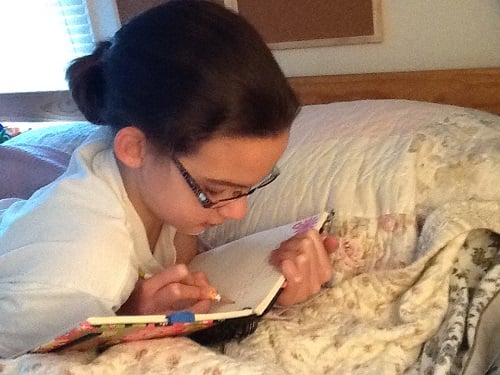
Image by Brave Writer mom, Lisa (cc)

Posted in Brave Writer Philosophy, Homeschool Advice, Writing about Writing | Comments Off on Just how foreign is writing?

Does “Open and Go” work for writing?

http://www.dreamstime.com/royalty-free-stock-image-cardboard-box-image23350346

The “resort on a beach” of all curricula is the “Open and Go” variety. You receive the UPS box in the mail, crack the spine of the new workbook or text, and immediately know what to do, right now, with your kids, without any preparation, reading of instructions, or adoption of a particular philosophy.

This magical product teaches the tough subject you have avoided without taxing you, plus your kids like it! What a bargain!

So do these products work for writing? More specifically, does Brave Writer have a product like this? Please, Mother may I?

Writing is unlike content-oriented subject matter. You aren’t exposing your children to a list of facts or details and asking them to memorize or consume them. Writing isn’t a set of formulae that needs to be introduced and practiced. Writing isn’t the coordination of handwriting, punctuation, spelling and grammar that can be learned, at times, in workbook formats. Writing is more than any of these, even if at times it embodies all of them.

Writing—original writing—is created from thoughts. Thoughts are personal to the writer. Thoughts come first. Everything else is window-dressing.

Just as speech required a context for risk and communication with an active partner, so, too, writing requires a witness and compassionate reader. Writing thrives when it becomes a dialog between the author and his or her audience—particularly the audience of an invested parent.

Scripting that dialog is not possible. A set of workbook pages doesn’t get at the mind life of the child. Writing forms don’t instruct a child in the process of self-inquiry (which is the genesis of all good writing). Handing a child a set of instructions to be read alone, and lines on the page to fill in, doesn’t help a child imagine herself as a writer. Rather the child is being taught that writing is external to self, done for that page, according to someone else’s ideas of what should go there.

Literally—open and go workbook writing programs ask children to think of writing as a task done according to someone else’s prescription of what goes “over there” away from self. Children are taught to think that the thoughts for writing exist inside someone else’s vision, and their job is to hunt them down (pluck them from the thin air) and hope they’ve collected enough of them in one place to get a “good grade.”

This is not writing. This is puzzle solving—holding the directions in the mind, while wrestling language into the imagined form the assignment creator may have intended.

Yet this “assignment writing in a workbook” is the holy grail of writing instruction! Can’t parents hand a book to their children and ask them to follow the clear instructions? Won’t writing grow with practice? What about all those writing assignments in high school and college? Kids don’t get to pick their topics or formats then, do they? Why not practice now?

Parents, typically, don’t have good memories of writing instruction from their childhoods, and many are not self-confident writers today. Yet many programs expect parents to instruct children in writing using similar methods that didn’t work all that well for them. These programs lead to similar results—mediocre, unsure writing. That’s not to say that some kids don’t find their way to brilliance and enthusiasm! Writers (kids who love writing) find their way regardless of method, half the time.

Helpful writing instruction requires a philosophy that is a paradigm shift away from how you, the parent, likely learned to write. The shift is in focus—away from form and accuracy as primary, and toward risk and expression as essential. Original writing is about how the mind generates thought—instruction is about how you foster an environment for creative thinking and language use to grow. It’s about recognizing that writing is more than words on a page, but is, rather, the valuing of the writer’s own perspective of the world—a writer’s personal experiences and values, curiosities, mastery of facts, passionate reads, hopes and aspirations, confusions and frustrations, challenges and arguments, connection to others, and reporting of information.

THIS is writing. All writing is this—this distillation of an individual’s mind life/thought world. Clarity and accuracy matter, but so do inspiration, imagination, critical thinking, and flexible, expanded vocabulary. Form helps to manage these aspects of the topic for writing, but forms can also stifle original thought. Knowing how to write means knowing how to manage the forms, rather than be managed by them.

WBWW 48Image by Brave Writer mom, Sandy

All this to say: “open and go” deprives writing of its essential context—space and room to explore. Can you imagine asking for an “open and go” parenting manual? “Open and go” driver’s training? “Open and go” sexuality and reproduction workbook?

When we are dealing with danger, complexity, values, intimate relationships, connection, or thought lives, we do our children a disservice to think we can teach them by opting out of the hard work of engaging with them. True partnership and dialog go more slowly, but so much more richly.

Brave Writer has materials and classes that support the relationship of new-writer to parent-coach. We even give you specific words to say, and processes and practices to try together. There are tools that can be used again and again as your young writers learn to internalize the self-inquiry style of writing generation. We give you projects to test together—with week by week instructions of what to do. But in each case, all the way until high school, your presence—your appreciation for and understanding of the process, your conversation and modeling—is essential.

Make time and space for writing in your family. It can look like teatime and poetry on some days. It can look like family movie night or read aloud time or freewriting or riddle-creating or limerick reciting. It may be the hard work of jotting down an endless story or the wise support you offer a teen trying to start a blog about recycling. Writing instruction might include the hard work of grammar study or learning to edit for spelling errors. But it isn’t essentially that. It is the discovery of what one has to say that is worth preserving and presenting in a cogent manner.

Writing is unlike any other subject in homeschool. In fact, —not a subject. Writing is about writers. Writers need readers. You are the reader—the partner, coach, and ally your child deserves, as you help your writers discover their voices, their vocabularies, and their powers of refining their messages in the written word.

No “open and go” workbook can show you how to do that. You need to live it alongside your kids, once you’ve adopted the principles into your heart. It’s a privilege to be that person in your child’s life. Don’t delegate it to a workbook! Yes it takes time. So do all the things you care most about.

Surprisingly, teaching writing this way is so pleasurable when you get there, it doesn’t feel like work any more. It feels like relationship. A good, rich one. The kind you want with your kids—the kind that lets you into their minds and hearts.

So worth it.

Curious about Brave Writer?

Image of open box © Sinisa Botas | Dreamstime.com

Posted in Homeschool Advice, Writing about Writing | Comments Off on Does “Open and Go” work for writing?

« Older Entries
Newer Entries »
  • Search the Blog

  • Julie Bogart
  • Welcome, I’m Julie Bogart.

    I’m a homeschooling alum -17 years, five kids. Now I run Brave Writer, the online writing and language arts program for families. More >>

    IMPORTANT: Please read our Privacy Policy.

  • New to Brave Writer? START HERE

  • FREE Resources

    • 7-Day Writing Blitz
    • Brave Writer Lifestyle Program
    • Brave Writer Sampler: Free Sample Products
    • Freewriting Prompts
    • Podcasts
  • Popular Posts

    • You have time
    • How writing is like sewing
    • Best curriculum for a 6 year old
    • Today's little unspoken homeschool secret
    • Do you like to homeschool?
    • Don't trust the schedule
    • You want to do a good job parenting?
    • If you've got a passel of kids
    • You are not a teacher
    • Natural Stages of Growth in Writing podcasts
  • Blog Topics

    • Brave Learner Home
    • Brave Writer Lifestyle
    • Classes
    • Contests/Giveaways
    • Friday Freewrite
    • High School
    • Homeschool Advice
    • Julie's Life
    • Language Arts
    • Movie Wednesday
    • Natural Stages of Growth
    • One Thing Principle
    • Our Team
    • Parenting
    • Philosophy of Education
    • Podcasts
    • Poetry Teatime
    • Products
    • Reviews
    • Speaking Schedule
    • Students
    • Writing about Writing
    • Young Writers
  • Archives

  • Brave Writer is a participant in the Amazon Services LLC Associates Program, an affiliate advertising program designed to provide a means for sites to earn advertising fees (at no extra cost to you) by advertising and linking to amazon.com

    Content © Brave Writer unless otherwise stated.

What is Brave Writer?

  • Welcome to Brave Writer
  • Why Brave Writer Works
  • About Julie
  • Brave Writer Values
  • Frequently Asked Questions
  • Speaking Schedule

Brave Writer Program

  • Getting Started!
  • Stages of Growth in Writing
  • The Brave Writer Program
  • For Families and Students
  • Online Classes
  • Brave Writer Lifestyle

…and More!

  • Blog
  • Classroom
  • Store
  • Books in Brave Writer Programs
  • Contact Us
  • Customer Service
  • Brave Writer Staff
© 2026 Brave Writer
Privacy Policy
Children's Privacy Policy
Help Center