Just how foreign is writing?
A debate exists about writing: is it related to speech? If so, how much? If not, why not?
One camp says that learning to write is akin to learning to speak a foreign language. Writing is as foreign to native speakers of any language as Amharic is to you or me (unless you are Ethiopian!). That’s why children struggle to become fluent writers, so the thinking goes. Children are naturally wired for speech and are frustrated trying to translate those words into language suitable for writing (the style of it, the vocabulary of it, the spelling of it, the punctuating of it, the organization of it, the handwriting or typing of it). Even my mentor, Peter Elbow, says that some people feel as if they are translating speech into something else when they write. Have you ever experienced the “Hmmm, how shall I say this?” thought as you sit down to actually write the thought you are having?
That’s what this camp is getting at. There’s a weird translation process between speech and writing. Because so many of us have experienced that moment, there’s a sense in which it must be true: writing must be so different from speech, we are prone to writer’s block as a result.
There is a bit of truth in this perspective. The brain is not wired for writing, like it is for speech. Writing is a learned activity. Speech, however, is hardwired into all human beings.
The other camp sees writing as related to speech. Dr. Peter Elbow, again, recently published an entire book, Vernacular Eloquence: What Speech Can Bring to Writing
What is fascinating is that in the world of homeschooling programs, both views rely on copywork, dictation, and two varieties of narration (oral and written) to help students gain fluency in “writing.” But their starting points of view are polar opposites.
What I’ve noticed in my work with thousands of families is that children are more inclined to put in the effort of learning the skills associated with writing when they can see that it relates to a skill they have already mastered: the English language.
When we talk about putting their thoughts into written words, we are asking them to identify thoughts! In Brave Writer, I suggest you “catch your child in the act of thinking.” Help your child discover that he or she is having thoughts worthy of record: write them down when they least expect it, when you hear those thoughts tumbling out of their mouths!
Every single day your children are not only thinking thoughts, but using those thoughts to generate oral language. That language can easily become written language when they have a transcriptionist (you!).
Once the connection is made (“what’s inside my head and comes out of my mouth can also be what shows up on paper and is read to others”), teaching the mechanics of writing becomes much more interesting to children. They get it—writing is about their mind lives and they love sharing those thoughts with others.
Are there style differences between writing and speaking? Of course! Are there pesky rules of grammar and syntax that prefer one over the other (sometimes we allow in speech what we prefer not to use in writing)? Naturally.
But if we start by seeing writing as foreign (as a foreign language), if we begin from a mental space that says that writing is “hard work” and that the “discipline” of writing requires rote work with someone else’s words first, if we suggest that what is inside your child is not yet suited to the page until some kind of mastery is achieved in handwriting or spelling, we literally alienate the fluent native speaker from writing—from believing in his or her writing voice before it has uttered a written peep!
That alienation, time and again, manifests as writer’s block or not caring. The spark of individuality that is your child is lost in all this “hard work of precision and accuracy.” Accuracy matters, but it is not more important than originality of thought. Accuracy can be added; originality can be lost.
What studies are showing to be true is that children are far more likely to take writing risks when they believe that their content is valuable, and when they trust their thought lives to be adequate to self-expression. They are more likely to work on their mechanics if they experience the mechanics as supporting their original thoughts, rather than having to show perfect mechanics before they are permitted to have original thoughts.
If we value our children’s thought lives, help them to express themselves in Big Juicy Conversations, if we transcribe some of their ideas and read them back later to our children, if we ask for expansion of thoughts and show curiosity, if we model language choices that are more likely to be associated with written language models, our children will, absolutely, discover writing in much the same way they found speech!
They will risk, test, try, show off, back away, make huge silly errors, make huge leaps of logic, express vocabulary beyond their years, will imitate and create, startle and master, and sometimes mess with you and act like they don’t have a thing to say. But they will grow! This is what growth looks like.
The approach we use in Brave Writer does not see writing as a foreign or antagonistic process that requires painful hard work. Rather, we see writing as the opportunity to take speech further—to enhance, expand, and nourish speech (oral language, inner thought), and then to preserve and share it with interested audiences.
Kids respond well to this vision of writing. They love to read, to be read to, to talk and converse. Writing, particularly in today’s dialogical world of the Internet, is another conversational tool. We can learn how to wield writing for a variety of audiences, but why not start with the one closest to home? Why not let them write for themselves? Then for you, and then for their friends, and finally for “academic purposes.” This is the progression that works.
I hope you feel reassured. You are not teaching Hindi to your kids, with a whole new language structure and vocabulary. Writing in one’s native tongue is built from the English already spoken and understood. Writing is simply gaining mechanical skills to transcribe one’s own fluent thoughts, and learning how to develop these thoughts into the flow of written language.
Brave Writer has created oodles of tools and tactics to help kids “get it.” We’ve got more in the pipeline.
You can help your kids learn to write well. Start from the idea that your children are writers already, learning mechanical skills, in search of a supportive editor/reader: you.
You can do it!
And so can they!
Cross-posted on facebook.
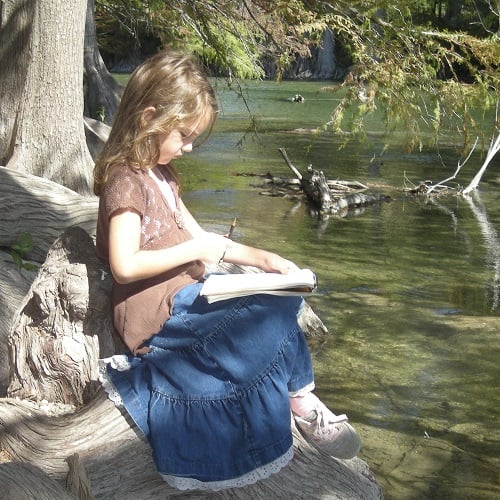
Image by Brave Writer mom, Lisa (cc)