Writing about Writing Archives - Page 12 of 27 - A Brave Writer's Life in Brief A Brave Writer's Life in Brief
  • Start Here
    • For Families
      Multiple Ages
    • Ages 5-7
      Beginning Writers
    • Ages 8-10
      Emerging Writers
    • Ages 11-12
      Middle School Writers
    • Ages 13-14
      High School Writers
    • Ages 15-18
      College Prep Writers
  • Shop
    • Product Collections
    • Bundles
    • Writing Instruction Manuals
    • Literature & Grammar/Punctuation
    • Composition Formats
    • Literature Singles
    • Homeschool Help
    • Book Shop
    • Special Offers
  • Online Classes
    • Class Descriptions
    • Class Schedule
    • Classroom
    • How Our Classes Work
    • Our Writing Coaches
    • Classes FAQ
  • Community
    • Brave Learner Home
    • What’s Happening
    • Blog
    • Podcast
    • Calendar
    • Brave Writer Lifestyle
  • Cart
  • My Account
    • My Online Classes
    • My Account
  • My Account
    • My Online Classes
    • My Account
  • Start Here

    If you’re new to Brave Writer, or are looking for the best products for your child or family, choose from below:

    • For Families
      Multiple Ages
    • Ages 5-7
      Beginning Writers
    • Ages 8-10
      Emerging Writers
    • Ages 11-12
      Middle School Writers
    • Ages 13-14
      High School Writers
    • Ages 15-18
      College Prep Writers
  • Shop

    If you’re already familiar with Brave Writer products, go directly to what you’re looking for:

    • Product Collections Browse the full catalog in our shop
    • Bundles Everything you need to get started
    • Writing Instruction Manuals Foundational Writing Programs
    • Literature & Grammar/Punctuation Grammar, Punctuation, Spelling & Literary Devices
    • Composition Formats Writing Assignments for Every Age
    • Literature Singles Individual Literature Handbooks
    • Homeschool Help Homeschooling Tools and Resources
    • Book Shop Books associated with Brave Writer Programs
    • Special Offers
  • Online Classes
    • Class Descriptions
    • Class Schedule
    • Classroom
    • How Our Classes Work
    • Our Writing Coaches
    • Classes FAQ
  • Community
    • Brave Learner Home
    • What’s Happening
    • Blog
    • Podcast
    • Calendar
    • Brave Writer Lifestyle
  • Search
  • Cart

Search Bravewriter.com

  • Home
  • Blog

A Brave Writer's Life in Brief

Thoughts from my home to yours

Archive for the ‘Writing about Writing’ Category

« Older Entries
Newer Entries »

How to Give Writing Feedback While Providing Emotional Safety

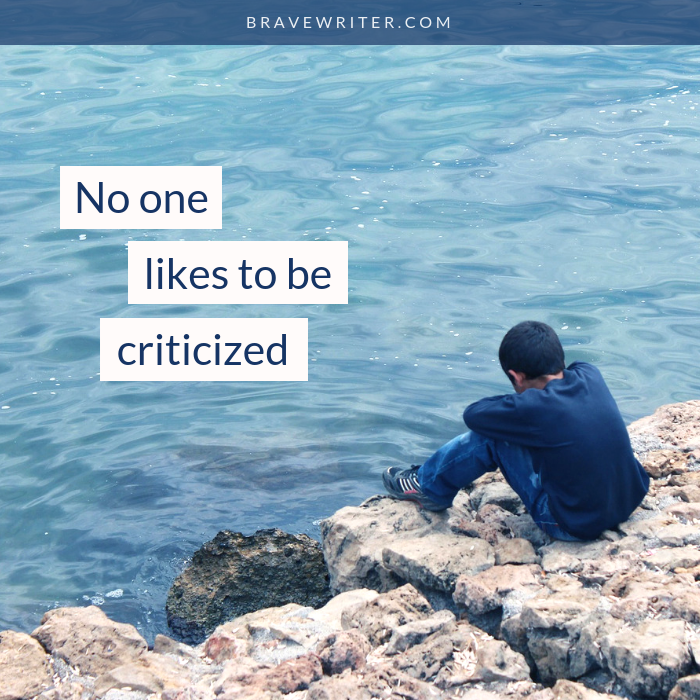
No one likes to be criticized

No one likes to be criticized. No one.

You don’t. You don’t want someone to come along and examine what you do in your homeschool and tell you that you’ve got it wrong.

I don’t. I don’t like being examined and found wanting.

Writers don’t. They risk putting themselves out there, even if what they risk appears paltry and disconnected from what they care about, and still recoil from editorial feedback.

Yet we all want to grow and become better versions of ourselves. Don’t we? In our most honest moments?

It takes some toughness to be open to criticism. There’s a reason for this. Criticism exposes mistakes. The experience of being mistaken is painful. You feel exposed—there it is, your failure, out there for all to see.

No one likes that feeling. Worse, if you are seeking support and feedback, getting criticism in return can feel like a betrayal of trust. You shared your struggle using the words available to you, and this other person picked them apart or misheard your intention or cared only about her superior understanding and appeared to take pleasure in her reconstruction of the “right way.”

There is a way to deliver feedback that doesn’t leave the recipient undone, devastated, hurt, or embarrassed. It’s the chief feature of our writing instruction, and is at the heart of how I operate in my family and business.

I follow these principles because they ensure emotional safety, while allowing for dialog for growth.

1. Value the person.

Your child, your spouse, your best friend, the member of your email list or discussion board needs to know that you value him or her first. The human being taking the risk to share “self” with you must feel that she is valuable, essentially worthy of care and consideration. That comes from the time-consuming task of using words, facial expressions, and internal postures that remind you that, in fact, this person is worthy of my time/energy/care. Most people want to be good people, or regarded as such, which is a good enough basis from which to begin.

Your kids want to be good kids, want to please you, want to do what they are supposed to do to become full-fledged adults. They want your guidance, too. Most spouses want to be loved and to give love back. Most best friends want to be trusted allies. Most participants on most lists and boards want to be heard and helped.

Yes, there are exceptions, but let’s start with the rule: Most human beings seek connection, and want a mirror that tells them: “I see you. You matter.”

2. Failure is painful.

The failure to live up to one’s own vision of success (successful living—homeschooling, marriage, career, writing a paragraph, being a teammate, running a household, parenting, managing finances, exercise and diet, calculating percentages in an online game) is painful. All by itself. This must be appreciated before offering a critique. Even the cavalier, halfhearted effort is often a cover for not wanting to risk full commitment to avoid giving a best effort and failing still. Better to only “half-try” and then when criticized you can tell yourself, “I wasn’t really trying.” This half-effort protects the ego because what if you gave a full effort and still failed? That would mean you were fundamentally flawed, unable to grow/succeed. “What more can be given than a ‘full effort’?” goes the unconscious reasoning.

So before feedback, it’s important to have full appreciation for the pain of failure. Your comments are about to land someone in that pain (particularly if delivered with judgment, anger, or exasperation).

3. Frame your feedback.

Give information, not criticism.

“Looks to me like you wanted the reader to pause here. We use a comma for that.”

Is much better than:

“You left out a comma.”

Or as one of our instructors says, she likes to use “Remember to…” rather than “Don’t forget to…” Even a simple switch to a positive is better received than a negative.

The premise is that everyone is trying his or her best. Even when they aren’t, they can be inspired to try their best when we find the glimpses of effort behind the half-try.

“I’m so glad you answered the question. I look forward to reading more answers from you this week.”

Much better than:

“You aren’t giving me enough material to read so I can comment. I expect more later this week.”

I’ve noticed that homeschool discussion board conversations devolve when the original poster asks a question, not using the evolved vocabulary of the group, and is then challenged for her errant thinking. This experience leads to online flailing: the need to reframe, restate, explain away. The original poster will then try to give some sense of her inner process to justify her poorly worded question, which is batted away by the experts as her not taking criticism/feedback well.

Some people are strong enough for that kind of aggressive help. But many are not. Most children are not.

It helps to receive the intention of the person first, to value the desire to connect, or to ask for help, or to share first efforts in work. It helps to remember that failing is painful, and that having a failure pointed out is exposing and embarrassing. What works at that point is supportive, positive feedback that takes into account the whole person, not just their weakness or failure to perform at the desired level.

You get there through a self-discipline of thinking in a new way. Take time to find it. Your child isn’t lazy. Your child didn’t do the work. Ask yourself why? Think about how you might support a change in atmosphere around the topic, or help your child to see the benefits of effort, even small, short bursts of concentration. Start there rather than a berating of character.

Your child isn’t addicted to video games. He loves playing them. He gets things from them that make him happy. What is he getting? What can you learn about video games to understand why he is so absorbed? What else can you offer him in his life that is also compelling, and could be of interest to him?

Or conversely, is it possible that something “not good” is happening in his world and video games are giving him a way of escape? Can you find out?

Conversations that are non-judgmental, curiosity-seeking, supportive explorations will lead to receptivity more than labels and reactionary anger.

Sometimes we all lose our cool and say mean things or jump to conclusions. Sometimes we’re right—the other person is being mean-spirited or recalcitrant and is not receptive to input from us. Sometimes we are in abusive relationships! No amount of supportive dialog will yield good results.

But on the whole, a practice of this kind will bring about trust, support, and growth. That’s how we grow brave writers, in fact. And it works beautifully.

Brave Learner Home

Posted in Brave Writer Philosophy, Homeschool Advice, Writing about Writing | Comments Off on How to Give Writing Feedback While Providing Emotional Safety

Free up space for written exploration

Image by Juhan Sonin

A couple quick thoughts for today:

1) Speech before writing. Attend to the original speaking voice of your child. Really hear it. Respond to it. Make big facial expressions that show you are paying attention. In fact, pay attention! It’s too easy to seem like you’re listening when in fact you are rummaging through the pantry in your mind for tonight’s dinner ingredients. Listen, respond, engage (ask for “more” – “Tell me more about X,” “What else happened?”, “I want more details! This sounds __________ –exciting, scary, nerve-wracking, calming, wonderful, crazy, fascinating”).

The habit of attending to your child’s spoken voice creates the best foundation for writing. As you listen, sometimes you will want to jot down what is being shared. Do it! Write it down and share it later in the day with an interested party (other parent, grandparent, sibling, friend).

2) Writing is exploration, not performance. Use writing to explore thoughts and ideas, impressions and hunches. Kids need to know that the context for their written thoughts is a safe place to explore those partially formed ideas. It is not a place where they must prefer accuracy to risk. Risk is valued. Accuracy, not so much. Accuracy and technique are “value-added” features that come at the end of the writing process. They must never govern the process or control it. Rather, the experience of writing (particularly that initial burst of language through the hands) must be that risk is exhilarating and valuable.

If exhilaration is not available as a legitimate reaction to writing, the minimum ought to be that risk is permissible. Give permission, take risks, shock your kids and write your own risky, free, un-bound exploration of a word, idea, thought, belief, impression, experience, conversation. Share it. Model what it may look like to really let loose. You are the permission-giver and catalyst in your homeschool. Break your own rules, if you need to, to free up space for written exploration.

Cross-posted on facebook.

Posted in Homeschool Advice, Writing about Writing | Comments Off on Free up space for written exploration

“The obstacle standing in the way of fingers tap, tap, tapping on the keyboard”

keyboard
The email below from Brave Writer mom, Cathy, was in response to a Daily Writing Tip. Here’s an excerpt:

When a child hits writer’s block with a current piece of writing, sometimes it helps to go back and reread a success! Pull it out from the homeschool tomb (aka, the homeschool notebook collecting dust in your basement cabinet) and read it to your child with enthusiasm and feeling.

Hearing polished words that came from inside can be a catalyst for more words to emerge, or for a style to be found that had been lost. Your child can even “borrow” old work into the new piece. We call that “repurposing content” in the publishing biz. Nothing wrong with that!

Julie,

I’m always so grateful for your continued support which allows us to encourage and mentor good and thoughtful writing. You’ve taught me a lot over the years. I’d like to share my continued challenges and successes with writing in our family:

The weekend had almost come to its conclusion when I heard the words, “Mom, I have to prepare a one page short story by tomorrow for my English class.” There is never a dull moment in our family of eight, but trying to stir up energy at the end of the day, let alone a weekend is often an uphill battle.

It very quickly became evident that Louie’s attitude toward this assignment was the obstacle standing in the way of fingers tap, tap, tapping on the keyboard. Super homeschool mom to the rescue! I’ve got lots of ideas up my sleeve thanks to Julie and the Bravewriter philosophy.

“Louie, you’ve got lots of writing from when you were homeschooled, why not look at some of those to help spark an idea for your writing?” says a confident mom.

Abruptly, Louie retorts, “THERE ISN’T ANYTHING I CAN USE IN MY WRITING, I’M AWFUL AT ENGLISH!”

Tired homeschool mom snaps right back, “IF YOU AREN’T GOING TO CHANGE YOUR ATTITUDE, YOUR WON’T BE ABLE TO COMPLETE THE ASSIGNMENT.”

Like an alchemist exploring chemical reactions, Louie and I had our very own explosion at the computer desk. Space and time from one another was necessary.

Level-headed homeschooled sister eventually cajoles Louie back to the computer where she begins to type and collaborate with Louie on short story ideas. Laughter, banter and poking fun of one another is all that could be heard. The right attitude had been harnessed.

For the remainder of the evening, each worked side by side, mostly Louie providing the ideas and words, to complete a wonderful short story. It brought me back to the days when Sarah and Louie shared their days together as homeschool sisters.

Julie you have once again reminded me of the many important steps necessary to affect a small shift in our children’s attitude toward writing. Although I did suggest to Louie to look back at her previous work, I didn’t offer to read it which is so important for the moment when our kids are struggling. She was struggling with her confidence and me reading her work may have infused and reminded Louie that she is a good writer.

Keep the tips coming.

In gratitude,

Cathy

Image © David Hughes | Dreamstime.com

Posted in Email, Writing about Writing | Comments Off on “The obstacle standing in the way of fingers tap, tap, tapping on the keyboard”

« Older Entries
Newer Entries »
  • Search the Blog

  • Julie Bogart
  • Welcome, I’m Julie Bogart.

    I’m a homeschooling alum -17 years, five kids. Now I run Brave Writer, the online writing and language arts program for families. More >>

    IMPORTANT: Please read our Privacy Policy.

  • New to Brave Writer? START HERE

  • FREE Resources

    • 7-Day Writing Blitz
    • Brave Writer Lifestyle Program
    • Brave Writer Sampler: Free Sample Products
    • Freewriting Prompts
    • Podcasts
  • Popular Posts

    • You have time
    • How writing is like sewing
    • Best curriculum for a 6 year old
    • Today's little unspoken homeschool secret
    • Do you like to homeschool?
    • Don't trust the schedule
    • You want to do a good job parenting?
    • If you've got a passel of kids
    • You are not a teacher
    • Natural Stages of Growth in Writing podcasts
  • Blog Topics

    • Brave Learner Home
    • Brave Writer Lifestyle
    • Classes
    • Contests/Giveaways
    • Friday Freewrite
    • High School
    • Homeschool Advice
    • Julie's Life
    • Language Arts
    • Movie Wednesday
    • Natural Stages of Growth
    • One Thing Principle
    • Our Team
    • Parenting
    • Philosophy of Education
    • Podcasts
    • Poetry Teatime
    • Products
    • Reviews
    • Speaking Schedule
    • Students
    • Writing about Writing
    • Young Writers
  • Archives

  • Brave Writer is a participant in the Amazon Services LLC Associates Program, an affiliate advertising program designed to provide a means for sites to earn advertising fees (at no extra cost to you) by advertising and linking to amazon.com

    Content © Brave Writer unless otherwise stated.

What is Brave Writer?

  • Welcome to Brave Writer
  • Why Brave Writer Works
  • About Julie
  • Brave Writer Values
  • Frequently Asked Questions
  • Speaking Schedule

Brave Writer Program

  • Getting Started!
  • Stages of Growth in Writing
  • The Brave Writer Program
  • For Families and Students
  • Online Classes
  • Brave Writer Lifestyle

…and More!

  • Blog
  • Classroom
  • Store
  • Books in Brave Writer Programs
  • Contact Us
  • Customer Service
  • Brave Writer Staff
© 2026 Brave Writer
Privacy Policy
Children's Privacy Policy
Help Center