Writing about Writing Archives - Page 10 of 27 - A Brave Writer's Life in Brief A Brave Writer's Life in Brief
  • Start Here
    • For Families
      Multiple Ages
    • Ages 5-7
      Beginning Writers
    • Ages 8-10
      Emerging Writers
    • Ages 11-12
      Middle School Writers
    • Ages 13-14
      High School Writers
    • Ages 15-18
      College Prep Writers
  • Shop
    • Product Collections
    • Bundles
    • Writing Instruction Manuals
    • Literature & Grammar/Punctuation
    • Composition Formats
    • Literature Singles
    • Homeschool Help
    • Book Shop
    • Special Offers
  • Online Classes
    • Class Descriptions
    • Class Schedule
    • Classroom
    • How Our Classes Work
    • Our Writing Coaches
    • Classes FAQ
  • Community
    • Brave Learner Home
    • What’s Happening
    • Blog
    • Podcast
    • Calendar
    • Brave Writer Lifestyle
  • Cart
  • My Account
    • My Online Classes
    • My Account
  • My Account
    • My Online Classes
    • My Account
  • Start Here

    If you’re new to Brave Writer, or are looking for the best products for your child or family, choose from below:

    • For Families
      Multiple Ages
    • Ages 5-7
      Beginning Writers
    • Ages 8-10
      Emerging Writers
    • Ages 11-12
      Middle School Writers
    • Ages 13-14
      High School Writers
    • Ages 15-18
      College Prep Writers
  • Shop

    If you’re already familiar with Brave Writer products, go directly to what you’re looking for:

    • Product Collections Browse the full catalog in our shop
    • Bundles Everything you need to get started
    • Writing Instruction Manuals Foundational Writing Programs
    • Literature & Grammar/Punctuation Grammar, Punctuation, Spelling & Literary Devices
    • Composition Formats Writing Assignments for Every Age
    • Literature Singles Individual Literature Handbooks
    • Homeschool Help Homeschooling Tools and Resources
    • Book Shop Books associated with Brave Writer Programs
    • Special Offers
  • Online Classes
    • Class Descriptions
    • Class Schedule
    • Classroom
    • How Our Classes Work
    • Our Writing Coaches
    • Classes FAQ
  • Community
    • Brave Learner Home
    • What’s Happening
    • Blog
    • Podcast
    • Calendar
    • Brave Writer Lifestyle
  • Search
  • Cart

Search Bravewriter.com

  • Home
  • Blog

A Brave Writer's Life in Brief

Thoughts from my home to yours

Archive for the ‘Writing about Writing’ Category

« Older Entries
Newer Entries »

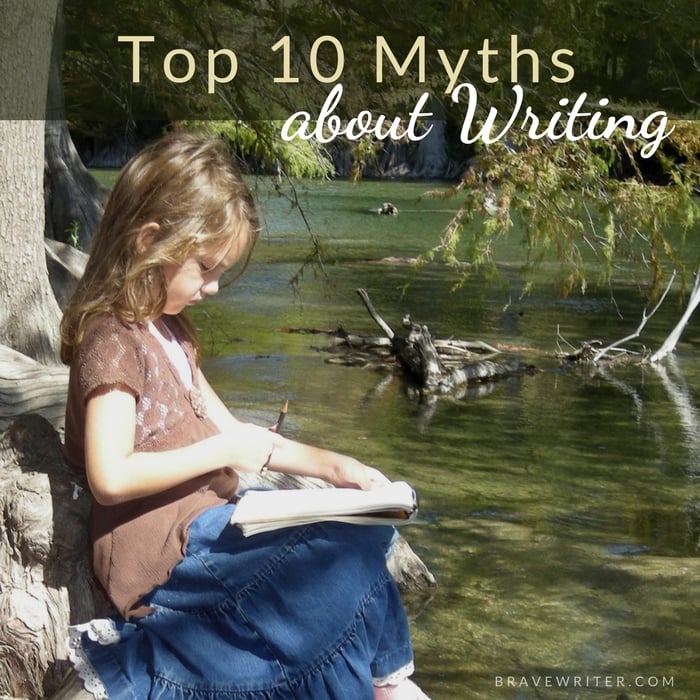
Top 10 Myths about Writing

Top 10 Myths about Writing
Here are the top 10 myths about writing:

1. Writing is entirely different from speech.

Not so. Speech is the source of voice—writing voice comes from being in touch with how the writer generates language and insight. These are first experienced in speech and then modified and expanded for writing. Valuing speech (even jotting some of it down for your fledgling writers) helps kids learn to value their thought lives, which in turn helps them to know what should be on the page/screen. Tell your kids that what is in their heads, what they might say aloud IS what you want to see on their papers. Once it’s there, you can mess with it.

2. Formats help kids know what and how to write.

Nope. Formats act like straight jackets. They tell children too quickly what can’t be included. Formats require a well planned outline and the ability to hold sequence and detail in the mind before writing anything at all. The best use of formats is after a period of freewriting and revising (revising the content to make it pop or feel more complete). Then the sentences can be rearranged to suit a format. But start with freedom and revise to format. Never start with format.

3. Write every day.

My revision of this idea is: Interact with writing every day. Some days read it, some days copy it in your own hand, some days use bits for dictation or word play, some days play a word game, some days revise a draft, some days edit a revised draft. And, of course, on some days, write from scratch! It’s exhausting to come up with original thought through original language every single day. Don’t require that of your kids. Engage language every day and they’ll be just fine.

Top 10 Myths about Writing

4. Imitate the masters.

Imitation is challenging for 4th graders. And 12 year olds. And grown ups! The pressure to “outdo Aesop” is unnecessary. Read the masters. Use their quotable quotes for copywork and dictation. Allow their writing styles to naturally infiltrate your own. But do not deliberately try to write like your favorites (except for fun, fan fiction, or as a language play tool). You want to sound like YOU in your writing, but you also don’t mind if you pick up a bit of a JK Rowling accent or a little EB White on the side.

5. Use a thesaurus to enhance the vocabulary in a piece.

Please don’t do this for more than a word or two (best to use the thesaurus when you are trying to replace a term that repeats itself). Instead, when you see a word that is weak, consider replacing not just the word, but the sentence. Add detail, include an experience, expand the idea, create an analogy. Weak writing is not improved by better vocabulary. It is improved by more writing.

6. Adverbs add a layer of sophistication (the old “ly” words).

The best stylists advise removing every word that ends in “ly.” The use of adverbs is seen as “lazy writing.” For instance, “Instantly, she jumped from her seat.” The jumping is already an expression of “instantaneous action.” Delete the adverb, add power: “She jumped from her seat!”

In academic writing, “ly” words can be covers for an explanation of the fact. “The study positively shows the effects of the drug.” Better to make it clear—are the effects positive or is the study reliable? “The study shows that the effects of the drug are positive when taken with x, y, and z” or “The study showcases the effects of the drug by using hard data, not only anecdotes.” To review: weed out adverbs to enhance the power of your writing. Ask yourself: “What do I want to say with this adverb?” Then say it!

Top 10 Myths about Writing

7. There is no place for “I” in academic writing.

Not so! Ever since the revolution of postmodernity in the academy, the humanities (in particular) allow writers to indicate their “social location” (to explain who they are and how they relate to the topic for writing, if relevant). It is commonly understood today that writers bring bias and personal experience to their research. It’s important to be explicit about how those biases and experiences impact the writer’s position. The use of “I” is limited to writing about personal experience, not used for “I think” or “I believe” writing.

8. If you paraphrase, you don’t have to cite where the idea comes from.

Reverse the sentence. Paraphrasing requires citation just like direct quotes require citation. Always give credit—you can’t overdo it.

9. To grow as a writer, start your day by journaling.

Journaling is not necessary for growth in writing. Writing is. Any kind of writing. Facebook, twitter, texting, papers, stories, and journaling. The only people who should keep a journal are those who wish to. Journaling need not be done in the morning, either (what’s happened in the day to write about by 9:00a.m.?). Journaling before bed is a nicer time to record the day’s thoughts. Journaling only about special occasions, or when life is painful is equally valid to the “daily diary.” Let journaling be the individual’s choice.

10. Do not help your child write; it all must come from him/her.

This is my favorite myth to bust! No child learned to speak in isolation or without scripts given to that child to repeat. Likewise, it is entirely too challenging for children to go from barely reading and handwriting to transcribing their own thoughts all the time. It’s perfectly fine for you to jot things down for them, or to dictate their own words back to them as they write, or for the final product to be a mixture of your words and theirs. This is how every other practice in a child’s life happens—your help until they can do it alone. Writing works the same way.

Go forth and support good writing practices!


Write for Fun!

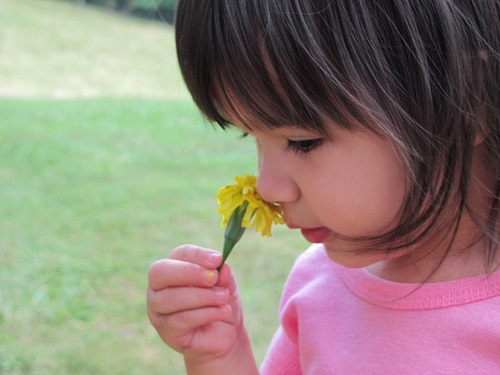
Top image by Brave Writer mom, Lisa

Posted in Writing about Writing | Comments Off on Top 10 Myths about Writing

A word play tip

Does it smell good?Image by Savannah Lewis (cc)

Ask your kids to find the nuance differences between synonyms.

Example— all the words for “smell”

Smell
Fragrance
Aroma
Odor
Scent
Stench
Perfume
Bouquet

How are they used? Can you use ‘odor’ for flowers? Can you use ‘scent’ for a skunk’s spray?

Can ‘aroma’ be paired with anything besides food? Why or why not?

What’s the difference between a ‘bouquet’ and ‘perfume’? Which is lovelier, easier to breathe in?

How much worse is a ‘stench’ than an ‘odor’? Can you think of two different items and why one would be paired with ‘stench’ and another with ‘odor’?

This is how you build vocabulary far better than using a workbook that makes kids identify definitions or put the words correctly into sentences.

Focus on complexity—nuances, subtlety, relationships, contexts, situations, habits, contradictions in language. These practices help the words “stick” and enrich a child’s writing as you find that some of them will “pop through” to their own work.

Cross-posted on facebook.

Posted in Writing about Writing, Writing Exercises | Comments Off on A word play tip

Talk, Talk, Talk…and Talk Some More

http://www.dreamstime.com/royalty-free-stock-images-mother-son-sits-kitchen-dinner-image23186299

Writing comes from thinking. Thinking is expressed in several ways:

Action (you act on the thought: Toothbrush into mouth to clean teeth)

Speech (you speak the thought: “Hand me my toothbrush.”)

Writing (you fingerwrite a note on the steamy bathroom mirror: “Where did you put my toothbrush, goofball?”)

Because writing is the transcription of thoughts into words, we need to recognize all three components and help our kids make the connections.

For instance, action often occurs without much “word-conscious” thought. We go about our business without narrating it to ourselves in words. We might walk to the refrigerator to get a carton of milk, but are thinking about when we get the next turn on the Wii to play Dance Revolution. At least, this is what is happening for our kids. Both require thought, but one is thought in words and the other is thought in activity.

One way you can help your kids grow into writers is to help them narrate their actions and thoughts with words (spoken words). By speaking words: “Let’s see, I need to brush my teeth before I put on my pajamas and before Jordan hides my toothbrush again,” you help your child to use language for thinking.

You model the narrating of life in front of your kids. Literally be the crazy lady or man who talks to self: “I need to pick up the dry cleaning before I call the arena to buy the football tickets.”

Some kids (particularly math/science kids, or those who are introverted, or speech-delayed) find it most difficult to speak their thoughts. They can do them more easily (punch the offending party, slam a door, open the bottle of 7Up, toss a football, take the dog for a walk, roll around on the floor in frustration).

Your job with your kids is to talk: talk, talk, talk, talk. Name what you see (without judgment) giving the action language:

“I see you rolling around on the floor. You were just playing a game. What happened?”

Get the story. Try not to evaluate what you see; allow your child to find words. You can help as he or she works it out.

“Are you frustrated? Angry? Worried? Did someone misunderstand you?”

You can’t reel these off in a list, but you can ask them gently over time. You can help the child to sort the action into feeling words.

Feelings aren’t the only “thoughts without words” that kids experience though (and mothers often think this is the height of child self-awareness, but articulating feelings are only one piece of the thought-without-language puzzle).

Sometimes kids need help puzzling through actions and sequences of those actions in words.

“Okay, you’ve finished breakfast. Let’s go over what will happen today. Catie, what do we do next this morning? What comes after that? When will we eat lunch? How many hours until lunch then? Okay, so how much time do you think we have for reading and copywork? Is there time for you to play Candy Crush now or later in the day?”

That’s a dense word-picture of how to engage through words, but these comments can be items in a dialog of conversation back-and-forth, back-and-forth. Your goal is to lead your child into language for action and thought. So your child, who mostly operates without a clock and let’s you initiate all the activities of the day, can now begin to put words to those activities, can be called on to calculate time frames, can sequence the events of the day, can examine how her desires fit into the structure of home education. All in language.

How does this help with writing? Kids need practice sequencing, naming emotion, evaluating priorities, planning in words. These are all skills that go into the production of papers and detailed examination of other processes and sequences.

Your job, as a home educator, is to talk your mouth off! You want to talk, talk, talk, narrating—probing in a gentle, genuinely curious way, lending words and vocabulary to your fledgling thought-generator.

You do so much automatically, as though you’ve always lived from this ease-of-thought to action and word, you forget that you need to train your kids in these practices. The more your children explore language for ideas, thoughts, actions, experiences, sequences, priorities, plans, and connections, the more language will be available to them when they go to writing. Count on it.

You’ll also have models to draw from: “Remember when you were frustrated? How did you show that to me? How did I know? Exactly: you were yelling at the computer screen. How might you use that action to show General Washington’s frustration when he….?”

You might say, “Remember when we figured out how to plan the day so you had time to play your favorite game? We saved the game for last. ‘Emphatic order’ is kind of like that: you save the best argument for last…”

This is how it works—a dialog between one’s natural life and language, leading to an application of all that narrating to writing.


Brave Writer Blog Roundup

Shared on Hip Homeschool Moms.

Top image © Miszaqq | Dreamstime.com

Posted in Brave Writer Lifestyle, Homeschool Advice, Writing about Writing | Comments Off on Talk, Talk, Talk…and Talk Some More

« Older Entries
Newer Entries »
  • Search the Blog

  • Julie Bogart
  • Welcome, I’m Julie Bogart.

    I’m a homeschooling alum -17 years, five kids. Now I run Brave Writer, the online writing and language arts program for families. More >>

    IMPORTANT: Please read our Privacy Policy.

  • New to Brave Writer? START HERE

  • FREE Resources

    • 7-Day Writing Blitz
    • Brave Writer Lifestyle Program
    • Brave Writer Sampler: Free Sample Products
    • Freewriting Prompts
    • Podcasts
  • Popular Posts

    • You have time
    • How writing is like sewing
    • Best curriculum for a 6 year old
    • Today's little unspoken homeschool secret
    • Do you like to homeschool?
    • Don't trust the schedule
    • You want to do a good job parenting?
    • If you've got a passel of kids
    • You are not a teacher
    • Natural Stages of Growth in Writing podcasts
  • Blog Topics

    • Brave Learner Home
    • Brave Writer Lifestyle
    • Classes
    • Contests/Giveaways
    • Friday Freewrite
    • High School
    • Homeschool Advice
    • Julie's Life
    • Language Arts
    • Movie Wednesday
    • Natural Stages of Growth
    • One Thing Principle
    • Our Team
    • Parenting
    • Philosophy of Education
    • Podcasts
    • Poetry Teatime
    • Products
    • Reviews
    • Speaking Schedule
    • Students
    • Writing about Writing
    • Young Writers
  • Archives

  • Brave Writer is a participant in the Amazon Services LLC Associates Program, an affiliate advertising program designed to provide a means for sites to earn advertising fees (at no extra cost to you) by advertising and linking to amazon.com

    Content © Brave Writer unless otherwise stated.

What is Brave Writer?

  • Welcome to Brave Writer
  • Why Brave Writer Works
  • About Julie
  • Brave Writer Values
  • Frequently Asked Questions
  • Speaking Schedule

Brave Writer Program

  • Getting Started!
  • Stages of Growth in Writing
  • The Brave Writer Program
  • For Families and Students
  • Online Classes
  • Brave Writer Lifestyle

…and More!

  • Blog
  • Classroom
  • Store
  • Books in Brave Writer Programs
  • Contact Us
  • Customer Service
  • Brave Writer Staff
© 2026 Brave Writer
Privacy Policy
Children's Privacy Policy
Help Center