Tips for Teen Writers Archives - Page 11 of 16 - A Brave Writer's Life in Brief A Brave Writer's Life in Brief
  • Start Here
    • For Families
      Multiple Ages
    • Ages 5-7
      Beginning Writers
    • Ages 8-10
      Emerging Writers
    • Ages 11-12
      Middle School Writers
    • Ages 13-14
      High School Writers
    • Ages 15-18
      College Prep Writers
  • Shop
    • Product Collections
    • Bundles
    • Writing Instruction Manuals
    • Literature & Grammar/Punctuation
    • Composition Formats
    • Literature Singles
    • Homeschool Help
    • Book Shop
  • Online Classes
    • Class Descriptions
    • Class Schedule
    • Classroom
    • How Our Classes Work
    • Our Writing Coaches
    • Classes FAQ
  • Community
    • Brave Learner Home
    • What’s Happening
    • Blog
    • Podcast
    • Calendar
  • Cart
  • My Account
    • My Online Classes
    • My Account
  • My Account
    • My Online Classes
    • My Account
  • Start Here

    If you’re new to Brave Writer, or are looking for the best products for your child or family, choose from below:

    • For Families
      Multiple Ages
    • Ages 5-7
      Beginning Writers
    • Ages 8-10
      Emerging Writers
    • Ages 11-12
      Middle School Writers
    • Ages 13-14
      High School Writers
    • Ages 15-18
      College Prep Writers
  • Shop

    If you’re already familiar with Brave Writer products, go directly to what you’re looking for:

    • Product Collections Browse the full catalog in our shop
    • Bundles Everything you need to get started
    • Writing Instruction Manuals Foundational Writing Programs
    • Literature & Grammar/Punctuation Grammar, Punctuation, Spelling & Literary Devices
    • Composition Formats Writing Assignments for Every Age
    • Literature Singles Individual Literature Handbooks
    • Homeschool Help Homeschooling Tools and Resources
    • Book Shop Books associated with Brave Writer Programs
  • Online Classes
    • Class Descriptions
    • Class Schedule
    • Classroom
    • How Our Classes Work
    • Our Writing Coaches
    • Classes FAQ
  • Community
    • Brave Learner Home
    • What’s Happening
    • Blog
    • Podcast
    • Calendar
  • Search
  • Cart

Search Bravewriter.com

  • Home
  • Blog

A Brave Writer's Life in Brief

Thoughts from my home to yours

Archive for the ‘Tips for Teen Writers’ Category

« Older Entries
Newer Entries »

Pinch me; I’m happy!

I love it when I hear from students who take those pesky English placement tests for college and ace them. I had one student a few years ago write to tell me that his essay was chosen as the new standard model for proper essay format for the college he attended. The examiners had to ask his permission to use it. They said his form was fantastic. 🙂

Today, I heard from a mother of another student:

[M]y oldest, Sarah, who took most of your courses, placed out of freshman English at West Virginia University based on her ACT score. Her astonished advisor asked her if she had been an AP student. No, but homeschooled! And that’s with the writing portions not counting yet, on which she scored even higher. I hope I can continue in my homeschool group the writing philosophy you helped develop in my family. We will still take Bravewriter courses, but are taking a breather from subscriptions this year, filling in with yet-to-be-used back issues. Thanks again.

I like it!

I had some fun with my own son who has always struggled to enjoy writing. He loves to read it, keeps an online journal faithfully, attempted to write a novel in a month last year, but still finds the generative process of writing daunting. He took his English placement exam this week for the University of Cincinnati.

“How did it go?” I asked.

“Surprisingly well. The topic was music censorship, something I care about. I started with an anecdote that came to mind and then outlined three points, included transitions and then concluded. It was easy.”

(I should mention that the anecdote in question was supplied by our overly-controlling—censoring—behavior toward his musical tastes when he was 13, which included something about no computers for six months and lots of haranguing, shaming and pleading… So glad that bit of bad parenting came to serve him in the end!)

I pressed, “So you remembered the format and didn’t have a hard time thinking of what to write?

“No. You know, the essay format is pretty easy, like you always said. Once I had the anecdote, the whole thing just flowed.”

We both smiled at this point–that knowing mother-son smile that says, “I-told-you-so but I promise I won’t say I-told-you-so now because I’m so proud of you.”
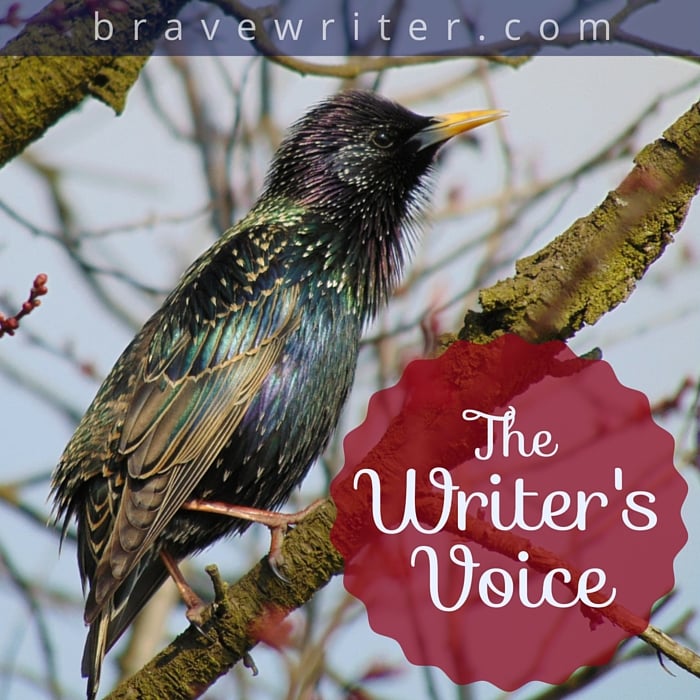

Posted in Brave Writer Philosophy, General, Tips for Teen Writers | Comments Off on Pinch me; I’m happy!

Do Formats Hush the Writing Voice?

Do formats hush the writer's voice

If a writing format is the “house”
then the writer’s voice is the life within.

If you start with a freewrite, you want to then think about what kind of format would best house the writing. Often, just revising the freewrite for clarity, a sense of humor, organization and powerful language is enough. You will wind up with a paper that is a few paragraphs long that retells or describes or narrates or exposes or instructs or remembers or explores.

However, as your child develops skill in writing, it’s great to introduce some of the more common formats for writing.

Some writing curricula focus on formats almost exclusively:

  • Write a portrait of your mother’s face.
  • Write a narrative paragraph about last year’s birthday.
  • Write an expository paragraph about Custer’s last stand.
  • Describe the autumn leaves in two paragraphs.

These kinds of writing tasks can be perfectly fine for kids who write naturally and comfortably. The issue is helping them first get those words onto the page and then helping them reorganize those words into a form.

So if the assignment calls for an expository paragraph about Custer’s last stand, the goal is to write about that last stand that exposes to the reader details about that moment in history.

Do you now need to consult those websites or writing books that explain what a topic sentence is, how many lines ought to fit into the paragraph, what a clincher is and so on?

They may serve as guides (though I would avoid those that treat formats like formulas or recipes that allow for no variation). As a caveat, the SAT/ACT test evaluators don’t like to be able to “see” the format in the writing. They want fluency and smooth transitions, not obvious emulation of a rigid format.

A writing teacher I admire put it this way:

“As a student grows his writing voice, he will not always use the most accurate or sophisticated structure. Yet it is essential that he develop his voice first, without those restraints, so that he knows what it is to speak genuinely and with personal confidence. It is at this point that formats may be taught.”

Do formats restrain the writer’s voice?

When they are taught, however, initially some of that spark may fade. The writer’s voice might become submerged in the restrictions and specifics of the format. That is because the student is putting his energy into mastering a new way of writing and gives less attention to what he has to say specifically.

The writer who has a sense of her own writing voice, however, will eventually move through the awkward, stiff writing phase and reincorporate the personal, individual writing style as she becomes more comfortable with the purpose and structure of the format.

What this means is that you may introduce formats for writing to kids who write fluently and naturally. As you do, don’t be surprised at a bit of regression in terms of flair and personality in the writing. As the child begins to master the format (like the expository essay), look for ways to enhance the content by writing more sophisticated transitions, by including personal experience, by upgrading word choices and so on.

Formats are the “next step” not the “first step” for your young writer.

Questions about writing formats come up frequently. Keep reading about things you can do to help strengthen your child’s writing voice before introducing formats.


Brave Writer

Tags: writing formats
Posted in Brave Writer Philosophy, Tips for Teen Writers, Young Writers | Comments Off on Do Formats Hush the Writing Voice?

Generating Insight in Writing

Getting a new perspective starts with curiosity.

Quality writing depends on several key components such as surprise, beautiful language, sentence variety and distinct voice. Perhaps the most important ingredient in good writing, however, is insight. Insight is that intangible something that reveals a fresh perspective. Insight is the discovery of what you’ve always known for the first time.

The Power of Insight:

When we read a writer’s work and have that “Aha!” moment, we are experiencing the power of the writer’s insight. Insight is deeply rooted in experience and description (there are other features as well, but for this short blog post, let’s explore those two).

To get to a new perspective that resonates at a deep level, the writer has to start by telling the truth about his or her experience. This is a foreign experience for many people. We become so habituated to saying what is expected, to experiencing life through a set of preconceptions handed to us by family, culture, religion and national identity that the potential for truth-telling is blunted by expectation and conditioning. We are especially prone to unconsciously imposing those kinds of pressures on our kids so we have to explicitly give them permission to mess up our preconceptions as they explore topics for writing.

Brave Writers learn how to tell the truth of their new experiences.

Click to Tweet


I remember reading in one writing check list for revision that the writer should check her piece to be sure that all of the descriptions were edifying. If the writer is forced to make all descriptions rosy so as not to reveal chinks or blemishes, then the writer will not be able to dig honestly into her experience and thus bring forth truth. The writing will suffer and there will be no insight.

The Power of Curiosity:

To access experience, it helps to divest oneself of prejudgments. Start with reading widely or observing keenly. Let yourself ask questions, ponder comparisons and open yourself to new interpretations of the old data. Let your experience of the topic, scene or person deepen before writing. Take notes and allow for contradictions. “The criminal exhibits a kind manner toward animals.”

The second important aspect of gaining insight is the ability to describe thoroughly. Brave Writer offers several tools for accessing the ability to describe deeply both concrete items and concepts/ideas. When describing, you want to pay attention to the small details. In a familiar object, it might be the way the light catches the item or the blemish that you overlook when merely glancing. In describing an idea, you’ll want to look for the way that idea illuminates another related idea or the way it exposes a myth or stereotype, or even the way it reinforces that stereotype. You might look at it through the opposing viewpoint or pretending to agree where you disagree.

As you give yourself to hidden details of thought and perspective, you allow yourself to generate new experiences. These experiences lead to questions which will inevitably lead you to a fresh perspective. It is that perspective that I like to call insight!

Insight takes time to birth, but the labor leading up to it need not be painful. You merely need to take the time to be open to new possibilities, to comparisons and hidden meanings. Let your mind percolate, examine the idea/item multiple times, take notes and ask good questions. Then apply yourself to accurate (not necessarily edifying) description. As you do, you’ll generate insight.


Brave Writer Online Class Writing the Short Story

Writing the Short Story: Brave Writer Online Class

Unlike our other fiction writing classes, the point of this one is to complete a story. You’ll take all that exploratory freewriting you’ve been doing and hone it until it reveals itself as a finished piece. If you have a long story or novel you’ve been developing, this is a great place to find its essence and travel a shorter narrative arc. Later, you can transfer what you’ve learned to your longer-form work.


Image by Chris, Flickr (cc Modified to add text.)

Tags: brave writing, Writing Advice
Posted in Brave Writer Philosophy, Tips for Teen Writers, Young Writers | 1 Comment »

Writers and Meltdowns: Better Coaching, Better Response

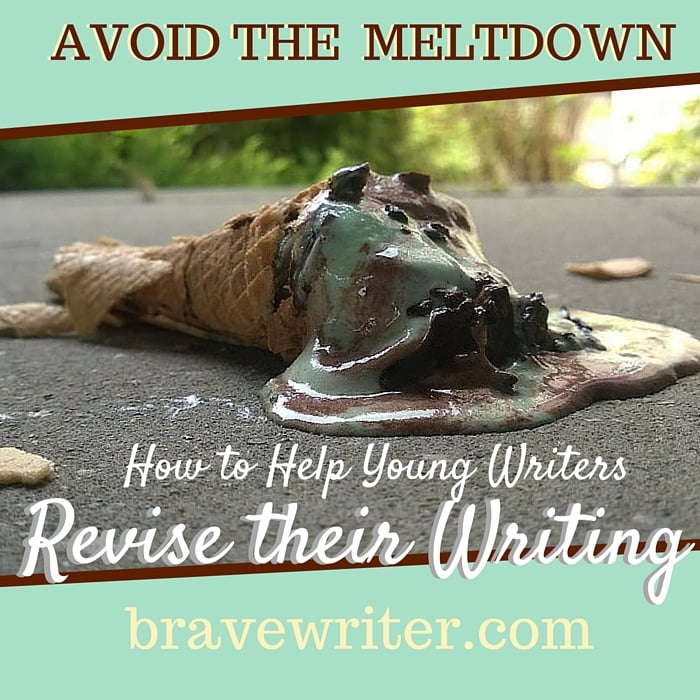
How to help young writers avoid meltdowns when it's time to revise their writing.

It’s possible to offer your young writer editorial feedback without triggering a meltdown!

From Hilary:

I was trying to coach my dd (10) on her first draft of an essay. We had talked about using her first draft (which she did on her own, without my prompting) as a base for a writing project, and she agreed.

As we went over it I commented on the good things I saw, the detail I liked, the flow of the essay, the excellent ending. Her topic was Helpful, Influential Genres (she agreed this was more accurate a title than Helpful, Influential Books). As I commented on the things that could be spruced up to be made more powerful, she really got defensive and closed up emotionally. I wanted her to choose a different word or a phrase for “helpful” in her essay, to fill out what that means.

Neither of my daughters likes to be corrected, even when I preface everything with things I liked and things that they did well. How do I help them understand that I want to help them grow as writers?  Is there a way to help them before they have a meltdown?

My response:

Meltdowns over editorial input are familiar to all writers. It takes time to let go of the ego investment long enough to recognize that someone’s input may actually help you write better than you realized you could.

As you rightly note, I like to start with what I like about a writer’s writing before I express ideas for improvement. So let me affirm you for doing what so many moms forget to do – that is, you found valuable ideas and detail, affirmed an excellent ending and applauded the flow of the piece. Thank you for being concrete and for making sure to do that.

Then you wanted to offer feedback for revision and this is where things got touchy. I have some principles and practices that may help.

First, kids need to know that they are the authors who have the final say over their writing. Just because you know that a change would enhance the piece doesn’t mean that it must be made. The writer must know that she is evaluating the input and making a judgment about it, not that she is victim to the changes a power figure requires her to make. See the difference? So offer the comment like this: “Hmmm. It seems to me that the word ‘helpful’ isn’t as clear as the rest of this title. What do you think?”

Or you might say, “Are you interested in hearing any feedback about the title? I have an idea that might make it pop to life, but want to be sure you are interested before I suggest it.”

By respecting her authority over her original writing, you give her the power which makes it easier for her to either hear you or to admit that she doesn’t want to hear you. In either case, you have a win-win. You develop trust. Eventually, when trust is built, she will want to hear you and perhaps over time, will even take your suggestions as welcome.

By respecting her authority over her original writing, you make it easier for her to hear you and to hear herself.

Click to Tweet

Second, the positive feedback can’t be seen as “buttering up” before delivering the “real feedback” which will then be critical. Be specific (as you were) and leave some space between affirmation and constructive critique (like lunch or a couple of days). Let the positive have its impact before offering critique.

Third, remember that your feedback makes an impact even when she doesn’t take your advice. For instance, when you pointed out that the word “helpful” wasn’t that clear, she may choose not to make the change in this piece. However, you can bet that the next time she writes the word “helpful” she will remember that discussion about it and may at that time “self-edit” and choose a better word for the new paper.

Fourth, not every piece of writing needs to be improved. You can ask if this is one she wants to work on or if she is happy with it as is. If she appears to never want to revise a paper, you can suggest the following.

“Mary, let’s collect four of your papers and pick one to revise. You choose. Then I want you to share with me ways that you can improve it. If you need some ideas for how to revise, I can help. If you’re interested in my feedback about this particular piece, I’m here to help you too. Just let me know.”

This helps her to see that it’s important to revise and to learn to revise, but you leave her in control of when it happens, to which piece and how she will receive feedback.

Finally, don’t worry if it appears that she is resistant to feedback for a long time. It takes time to build trust between writer and editor. If she senses that you consistently are on her side, that you affirm what works well and that the feedback you offer is for her consideration, not as a command, she will come to trust you. If the feedback you give results in a wonderful change that makes the writing spring to life, she will then be likely to ask for your input the next time, rather than being suspicious of it.

Hope those help!

-Julie

Tags: revision, revision advice, revision tactics
Posted in Brave Writer Philosophy, Email, Homeschool Advice, Tips for Teen Writers, Young Writers | 2 Comments »

Breaking the Mold

Some writing assignments are like jello molds. They expect the writer to pour the hot liquid of her thoughts into a shape and then cool those thoughts down so that they congeal into a pineapple, celery and raspberry gelatin ring. (Can you believe that celery is ever added to jello?!)

Time to ditch the jello mold approach to writing.

Start with original, quirky thoughts. Get them on paper.

Dig through those words to find the most interesting hook – the part of the writing that caught your attention – and move it to the top. Don’t worry if it’s explicit or if it is a “topic sentence.” Grab the reader’s attention. You can use an exaggerated comparison (like I did at the top), you can start with dialog, you can describe noises or action, you can even lead with a question. But please, never begin a writing assignment with the birth date of a famous person, or the statistics of the Civil War, or the export percentages of lumber from Maine.

Get me into the topic through my curiosity or my emotions and then, as an IV drip keeps a person on life support fed, drip the facts into the writing. Don’t make facts and numbers the center piece of your writing. Let them add flavor and support to your otherwise wonderful retelling or description of the event, process or person in question.

Don’t mistake encyclopedia writing for a model of good writing. Encyclopedias are designed to meet certain criteria. That criteria doesn’t include entertaining, persuading or involving the reader. So leave encyclopedias on the shelf. Instead, use quality non-fiction (found in the juvenile section of your local library) as models for good non-fiction writing. Not all of these books achieve the goals I’ve stated here, but many of them do, particularly the ones written in the last five years.

Break free from the mold and write to impact. You’ll be glad your kids did.

Posted in Brave Writer Philosophy, General, Tips for Teen Writers, Young Writers | Comments Off on Breaking the Mold

« Older Entries
Newer Entries »
  • Search the Blog

  • Julie Bogart
  • Welcome, I’m Julie Bogart.

    I’m a homeschooling alum -17 years, five kids. Now I run Brave Writer, the online writing and language arts program for families. More >>

    IMPORTANT: Please read our Privacy Policy.

  • New to Brave Writer? START HERE

  • FREE Resources

    • 7-Day Writing Blitz
    • Brave Writer Lifestyle Program
    • Brave Writer Sampler: Free Sample Products
    • Freewriting Prompts
    • Podcasts
  • Popular Posts

    • You have time
    • How writing is like sewing
    • Best curriculum for a 6 year old
    • Today's little unspoken homeschool secret
    • Do you like to homeschool?
    • Don't trust the schedule
    • You want to do a good job parenting?
    • If you've got a passel of kids
    • You are not a teacher
    • Natural Stages of Growth in Writing podcasts
  • Blog Topics

    • Brave Learner Home
    • Brave Writer Lifestyle
    • Classes
    • Contests/Giveaways
    • Friday Freewrite
    • High School
    • Homeschool Advice
    • Julie's Life
    • Language Arts
    • Movie Wednesday
    • Natural Stages of Growth
    • One Thing Principle
    • Our Team
    • Parenting
    • Philosophy of Education
    • Podcasts
    • Poetry Teatime
    • Products
    • Reviews
    • Speaking Schedule
    • Students
    • Writing about Writing
    • Young Writers
  • Archives

  • Brave Writer is a participant in the Amazon Services LLC Associates Program, an affiliate advertising program designed to provide a means for sites to earn advertising fees (at no extra cost to you) by advertising and linking to amazon.com

    Content © Brave Writer unless otherwise stated.

What is Brave Writer?

  • Welcome to Brave Writer
  • Why Brave Writer Works
  • About Julie
  • Brave Writer Values
  • Frequently Asked Questions
  • Speaking Schedule

Brave Writer Program

  • Getting Started!
  • Stages of Growth in Writing
  • The Brave Writer Program
  • For Families and Students
  • Online Classes
  • Brave Writer Lifestyle

…and More!

  • Blog
  • Classroom
  • Store
  • Books in Brave Writer Programs
  • Contact Us
  • Customer Service
  • Brave Writer Staff
© 2026 Brave Writer
Privacy Policy
Children's Privacy Policy
Help Center