
Brave Writer Philosophy Archives - Page 14 of 84 - A Brave Writer's Life in Brief A Brave Writer's Life in Brief
  • Start Here
    • For Families
      Multiple Ages
    • Ages 5-7
      Beginning Writers
    • Ages 8-10
      Emerging Writers
    • Ages 11-12
      Middle School Writers
    • Ages 13-14
      High School Writers
    • Ages 15-18
      College Prep Writers
  • Shop
    • Product Collections
    • Bundles
    • Writing Instruction Manuals
    • Literature & Grammar/Punctuation
    • Composition Formats
    • Literature Singles
    • Homeschool Help
    • Book Shop
  • Online Classes
    • Class Descriptions
    • Class Schedule
    • Classroom
    • How Our Classes Work
    • Our Writing Coaches
    • Classes FAQ
  • Community
    • Brave Learner Home
    • What’s Happening
    • Blog
    • Podcast
    • Calendar
  • Cart
  • My Account
    • My Online Classes
    • My Account
  • My Account
    • My Online Classes
    • My Account
  • Start Here

    If you’re new to Brave Writer, or are looking for the best products for your child or family, choose from below:

    • For Families
      Multiple Ages
    • Ages 5-7
      Beginning Writers
    • Ages 8-10
      Emerging Writers
    • Ages 11-12
      Middle School Writers
    • Ages 13-14
      High School Writers
    • Ages 15-18
      College Prep Writers
  • Shop

    If you’re already familiar with Brave Writer products, go directly to what you’re looking for:

    • Product Collections Browse the full catalog in our shop
    • Bundles Everything you need to get started
    • Writing Instruction Manuals Foundational Writing Programs
    • Literature & Grammar/Punctuation Grammar, Punctuation, Spelling & Literary Devices
    • Composition Formats Writing Assignments for Every Age
    • Literature Singles Individual Literature Handbooks
    • Homeschool Help Homeschooling Tools and Resources
    • Book Shop Books associated with Brave Writer Programs
  • Online Classes
    • Class Descriptions
    • Class Schedule
    • Classroom
    • How Our Classes Work
    • Our Writing Coaches
    • Classes FAQ
  • Community
    • Brave Learner Home
    • What’s Happening
    • Blog
    • Podcast
    • Calendar
  • Search
  • Cart

Search Bravewriter.com

  • Home
  • Blog

A Brave Writer's Life in Brief

Thoughts from my home to yours

Archive for the ‘Brave Writer Philosophy’ Category

« Older Entries
Newer Entries »

Enchanted Education

Brave Writer

What is being learned, exactly, when your kids walk with you on a trail in the woods?

What’s educational about visiting Disneyland or the zoo with an annual pass?

Is there educational benefit to meandering through a farmer’s market or picnicking by a pond?

I remember days of enchantment. There was the afternoon my girls made fairies out of fabric and pipe cleaners. They created little houses out of leaves and sticks, and then planted the fairies in their homes in the nooks and crannies of tree branches and bushes.

Our little homeschool brood took trips to the art museum so frequently, each child had a favorite painting. The quiet, the color, the high ceilings, the Chihuly chandelier, the post cards in the gift shop… magical.

In those outings and experiences, time moved molasses slow, deliberately, peacefully (for the most part), with pleasure and focus.

And yet…were these outings, these experiences ‘educational’?

I’m certainly not the first home educator to strip an event of magic through ‘adding information.’

Fairies? Here’s a book about the history of fairies. The act of making little houses isn’t enough. We need information to legitimize the craft. Let’s read, narrate, and discuss fairies, and then write about it.

The woods? Shouldn’t we pluck wild flowers (by name) or make bark tracings or compare birds to a field guide? We walk quietly, together. Is pleasure and fresh air enough? Surely not! Here—use these binoculars, draw this tree, note the temperature in your notebook.
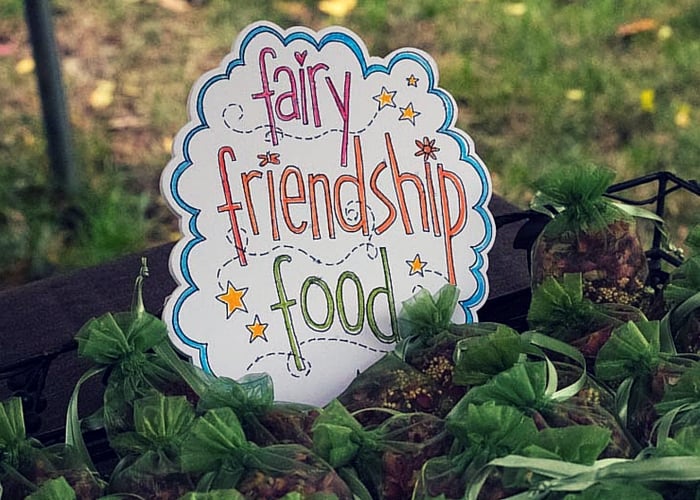
The Enchanted Education
Image by Steven Depolo (cc cropped, tinted)

Sometimes the most sacred moments in our days with our children
show no outward educational value.

We can’t quantify them. Books and records ruin the spirit—the shared purpose, invisible, intangible, yet felt by all.

The enchanted education. Collect these moments like treasures.

Set them on a shelf in your heart—the time you all soaked your tennis shoes in the tide pools; the trip to the frozen yogurt stand that led to sitting side-by-side on a wall in the sunshine; the weekly visit to the zoo where the lions and tigers nearly became your family pets.

You can’t say or know what is being learned. You know it by heart, by feel, by love, by pleasure, by shared memory.

These little wisps of attentive focus without an intended program lay the rails for so much learning that is by the book. It’s just that you won’t always see the correlation—because this is a work happening on the interior, person by person, connection to connection, created through peace.

The threads of happiness and opportunity, creativity and exposure in outings and long stretches of focused attention forge connections, invisible to you. Education results.

The Enchanted Education. Trust it.


For more about an Enchanted Education, watch the broadcast below
or check out my book, The Brave Learner
Posted in Brave Writer Philosophy, Homeschool Advice, Periscopes, Video of Julie, Webinars | Comments Off on Enchanted Education

Becoming Comfortable with Language

Brave Writer

Think of teaching writing to your children in the same way you taught them to speak. You didn’t tell them to conjugate verbs or to use articles. Sometimes they even made attempts to get the right plural and “missed.” But over time, through exposure, modeling, and a little intentionality, they “got the hang” of speech.

Instruction after they were comfortable with spoken language created opportunities to teach your kids etiquette, how to introduce people, how to answer the phone (maybe!), and more.

Written language can work the same way. For instance, each of our Darts focuses on language inductively—the passage suggesting the focus. You can certainly ask your children questions:

  • What is the dot at the end of the sentence?
  • Do you know its name?
  • What do you think it does?
  • What do you see in the word after every period?

Your kids’ answers may even surprise you and yield new ways of “seeing” what the sentence markings do.

The point is you don’t have to follow a systematic approach to written language any more than you did with speech. The goal of the entire Brave Writer language arts programs (Dart, Arrow, Boomerang, and Slingshot) is to help you immerse—with your kids—noticing, commenting, exploring, playing with.

Over time, your children will develop a sense of how it works through copying, dictation, and practice that is intuitively fluent (which is easier to sustain than memorizing rules).

Also, allow yourself to be led by your own curiosity and understanding. Some of the writing in our products IS for the parent—to help you grow in your own understanding of how language works and what are literary devices—to keep you aware and present to possibilities within the text. But if something doesn’t yet feel comfortable, you’ve got years with each child ahead of you. You’ll be circling back over these ideas again and again.

Sips—take sips.

Brave Writer Language Arts

Image by Africa Studio / Fotolia (text added)

Posted in Brave Writer Philosophy, Writing about Writing | Comments Off on Becoming Comfortable with Language

The Power of Story

Power of story- Jen

We read aloud to our children each day, fulfilling this basic “requirement” that our kids get an education from quality literature often not aware of how deep that education goes just from reading Redwall (again) or The Wind in the Willows. I don’t know if we (as a group) have plumbed the depths of how powerful all that reading is. In fact, I daresay that we mostly have not!

How many of us have associated the pleasure of Trumpet of the Swan with furnishing academic brilliance?

Yet this is precisely what is happening in living rooms strewn with Legos across the country (and globe). Home educators are doing a greater service for their children and the aims of education through the simple practice of immersing themselves in story each day than any other single practice.

You’re providing the education academics DREAM of providing.

Did you know that STORY is the foundation of a quality liberal arts education?

Rudyard Kipling says:

“If history were taught in the form of stories,
it would never be forgotten.”

Story as Education

Narratives, tales, myths, legends, fictions–the ability to see the story
in any subject area is the heart of a sophisticated, multi-faceted education.

Here’s why.

Academics like to talk a lot about the “imagination”–the capacity to imagine oneself into other times and places, cultures and worldviews, value sets and moral dilemmas.


Your child’s academic imagination grows
in direct relation to immersion in story.


Reading aloud, reading fiction, reading poetry, reading biographies, reading non-fiction, reading religious texts: Reading leads to a robust exploration of what it means to be human, sharing a planet.

Story also comes from other sources: film, video games, plays, documentaries, lectures, sermons, artwork, music, and television.

What homeschoolers do better than any other educational tool is plunge their children into the heart of STORY, every day:

narrative,
plot,
characters,
perspectives,
experiences,
moral dilemmas,
enriching cultural detail,
other times, other places, other worlds!

You’re great at it!

As we give our children this gift of STORY from the rocking chair or cuddled on a couch, we create connections in our children’s minds that resurface again and again. Charlotte Mason calls these connections: “The Science of Relations.” In Brave Writer, we call them: “Powerful Associations.”

Modern day stories that make use of ancient mythology are resonant for active readers (Percy Jackson books, Harry Potter, Hunger Games). Historical fiction shows us the world before we arrived and gives us context for our every day experiences (Johnny Tremain, The Master Puppeteer, The Bronze Bow).


Cross-cultural exploration through story shrinks the globe
and creates empathic ties to people who are different from us.


One of my favorite professors (40+ years as a professor, Harvard Ph.D.) said to me last week that what’s missing in too many of today’s in-coming college freshmen is the capacity to imagine richly–with texture, openness, and connection between subjects. Reading and writing in the humanities, in particular, depend on a complex intuitive understanding of the narrative arc:

what creates surprise,
the nature of viewpoint,
power dynamics,
moral right and wrong as they are funneled through lived experiences and confronted by characters/actors through dilemmas,
the underlying mythology of the narrative.

Moral Imagination

One of the core curriculum classes at Xavier University is called “Literature and the Moral Imagination.” The goal of that class is not dissimilar to what you all do every day you read aloud to your children. You are shaping your children’s understanding of morality, intuitively, without lecture. Your kids are forming their values through confronting the moral dilemmas faced by beloved characters!

As I spoke with Professor Dewey, I shared about what we do in Brave Writer. We offer classes that are designed to plunge our children into the juicy soul of STORY.

We not only read Rudyard Kipling’s Just So Stories, we ask our students to write them!

We not only enjoy Greek Myths, we explore them for their structure and ask students to produce their own fictional accounts of Gods and Goddesses they create!

Dr. Dewey was thrilled, saying that he wished all schools did this for children.

We’re not just “creative writing” here at Brave Writer.


Our story writing classes offer your students a pathway to
intellectual excellence and moral development.


Hope you’ll take advantage of them!

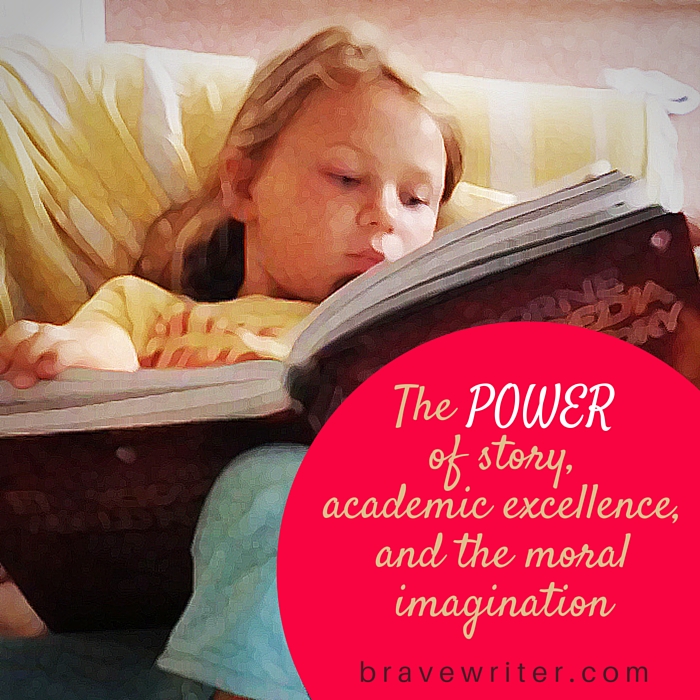
Image of child reading by Brave Writer mom Jen

Posted in Brave Writer Philosophy, Homeschool Advice, Online Classes | Comments Off on The Power of Story

Give Up the Guilt

Give Up the Guilt

As your “I’m so done with this year; so now I’ll think about next year” brain kicks in, let’s help it to plan in a sane way! The temptation is major overhaul and doubling down on the subjects that got short shrift this year.

Writing is often in that category. You look back at the scraps of freewriting and the incomplete report that your daughter wrote, but never copied over and you resolve to not let THAT happen again.

So you begin. You plan to have each child complete a single writing project per month, the way I tell you to. Or so you think.

We know that it’s important not to rush through the writing process, to allow time for research and revision. This once-a-month scheme sounds sane compared to curricula that suggest writing an essay every week, or a paragraph a day including drafting and revision!

However, what if you have five kids (like I did)? What if all five are capable of writing?

Let’s do the math. There are ten months in a school year. Five kids. Each doing one writing project per month. Even I can make that calculation: 50 writing projects, in a single school year.

Ha!

Do you think I supervised successfully 50 writing projects in a year? Do you think any home educator is supporting the production of 50 completed writing projects at five different levels in a single school year?

I’m here to tell you: we are not. I talk to home educators all the time. What leaks out in their moments of desperate confession is that they fear they are not doing enough writing. Some are not doing any writing, because of the paralysis that results from staring at a curriculum that requires even MORE writing than ten projects per child in a year.

So here’s my rule of thumb.

You want each of your kids to experience your hand-holding, super kind, invested involvement in one or two big writing projects per year—

  • where they have a start (original draft, freewrite, list, notes, dictated narration to you),
  • a middle (rereading, adding new stuff, research, taking out stuff that doesn’t fit),
  • and an end (editing the grammar, spelling, and punctuation, typing it up, reading it to interested readers),
  • all accompanied by your availability and caring.

The rest of the time, attempt lots and lots of writing projects or pursue lots and lots of writing opportunities. It’s totally fine to, for instance, start any writing project in our materials and NEVER finish it! Maybe the meat of the project was simply attempting, or collecting, or getting an initial draft, or working through the research but never writing. Maybe the fantasy of the project was enough—talking about what it could be, or what your child wished he or she could do.

Kids are developing—they are not complete themselves. Sometimes you have to have lots of fantasies about what you might be able to do some day before you get the cajones and courage to try!

Maybe you decide to do a group writing project where one kid does the artwork and another does the writing and a third edits it and lays it out on the computer. That counts! For everyone!

Freewriting weekly is a great practice and never requires revision, unless you and the child want to.

Reading books, playing with words, watching TV, language games, poetry tea times, listening to books on CD, memorizing song lyrics, telling jokes, leaving Post-it Notes with love messages on the doors of bedrooms, having Big Juicy Conversations, going to the movies…

That ALL counts as writing program.

You can certainly work through a writing project or two from start to finish with your kids this year (with each one)—and it will be enough if you actually do it and trust that it IS enough. Too often in our defeat, we give up completely or do a half job and then entertain ourselves with guilt.

Give up the guilt. Plan to get through the process with your kids 1-2 times a year (more is a wonderful bonus—and I promise, as you get better at supporting the complete writing process, it will be easier to do and more enticing). Not only that, as your kids understand the writing process, they will need you less!

So let’s get realistic about the coming year.

  • Lots of writing and reading and word play and conversations.
  • Some fantasizing, starting and stopping, trying and abandoning of writing projects.
  • A few start-to-finish supported writing project completions.

Okay?

You got this.


Partnership Writing

Posted in Brave Writer Lifestyle, Brave Writer Philosophy, Homeschool Advice | 2 Comments »

Returning to the Brave Writer Philosophy for High School

Brave Writer

Brave Writer mom, Dona, writes (emphasis is ours):

Dear Julie,

We started homeschooling in January of 2002. I remember feeling the weight of the world on my shoulders as I began the journey of educating our children at home. In some areas I felt competent; in others completely incompetent. Writing was one of those terribly incompetent areas. We tried many different curricula, as well as me just making up writing assignments (oh, my, that was disastrous!). With each attempt I felt like I was alienating my child from the world of writing. I wasn’t much of a writer in school at any level; my undergrad and grad degrees are in a scientific field and my writing was rather bland. I wanted my children to learn how to write and write well. None was working.

Finally when Kimberly, our oldest, was 10 years old, I found you. We signed up for the [Writer’s Jungle Online] and my eyes were opened to writing like never before. I watched my daughter flourish and begin to like to write. The feedback that you and your teachers give these children is so valuable in drawing out the writer in each of them. You teach them the power of words and language through real literature, their own experiences and by teaching them to observe the world they live in. You are rigorous and hold these kids to high standards, but in such a supportive environment that the kids succeed.

One of the greatest aspects of your classroom is the fact that each student can read the work of all the other students and see the teacher’s feedback. My children have learned about what works and what doesn’t work by reading so many other pieces of writing with feedback. I remember always wanting to see my peer’s work to understand where I fell in the spectrum and to see if I could learn more from others. It was often very difficult to get this kind of information unless my close friends were willing to share. Brave Writer is so much more than a language arts program; it is a philosophy that can be applied across the board…

The high school thing scares me, I’ll admit! Why? I don’t know for sure… I was in a foreign country in a foreign school during my HS years, don’t have a HS diploma, but managed just fine in college and grad school. I’m looking for a much more relaxed atmosphere here in our home. This year, everybody has been glued to the computer all day, tied to strict deadlines in everything. Kimberly thrives on this environment. I’m comfortable with her finishing here next year; she had 2 years of HS at home with a different atmosphere.

Nicole on the other hand, has lost any zeal for learning and is just checking off boxes. Part of online school she likes… interacting with the other kids. But the schedule is killing her. Her passion is her goats. We are just barely into building a real show herd. She has learned so much about the goats and is the best midwife ever! She knows how to go in and find legs that are coming out and arrange them to come out and pull. For her, studying out of a book doesn’t cut it. She needs hands on, an apprenticeship would be so good for her. Why don’t we have apprenticeships for HS aged kids? Why do we have to sit in a classroom or at the kitchen table to learn everything? I am not sure how to fashion a learning environment for her that could lead her to where she wants to be; possibly an American Dairy Goat Association judge, maybe an animal science degree, maybe vet tech or vet school. She isn’t motivated enough yet to do all the tedious study required to be accepted at vet school. I want to restore her love her learning. At the same time I’m afraid I won’t prepare her for college if that’s where she intends to go. I personally don’t think college is the end all be all and it may not be for her. Her father thinks otherwise, though. Mind you, he is very supportive of homeschooling, but believes all paths must lead to college.

I’ve been reading your posts and been feeling nudged to make changes; return to the Brave Writer philosophy I love so much. I’m trying to think out of the box, but that is hard for me! It would sure be nice to toss ideas around with you and those who really know how to do it. I want to bring back Tuesday Teatime more reading together and still be able to prepare my kids for college if that’s where they are headed. I’m having a difficult time wrapping my brain around how to accomplish this. Is the ACT really the only factor for most schools if you don’t have a HS diploma? We can teach to the test, study for it and probably do well on it. Kimberly has done very well on the ACT. Do we have to have a transcript?

Sallie just finished [an Essay Prep class] with you. She absolutely loved the class! She is sold on Brave Writer. I need to figure out what my “out of the box” is so I can be prepared for her and the 2 boys who follow her! Sallie loves to write and I don’t want to intimidate her or squash that love at all. She loves reading your daily writing tips. I’d like her to take Expository Essay next fall or winter. Do you think she is ready for that? Would that be your recommendation for her next course?

Julie, thank you so much for all you do. I’ve told you before, but I’ll tell you again… you are a presence in our home in a way that no other homeschooling influence has ever been. I feel like you are our friend and I so appreciate you! Thanks for listening!

Sincerely,
Dona

Thank you so much for your wonderful kind words of feedback! They mean a lot.


[This post contains Amazon affiliate links. When you click on those links to make purchases,
Brave Writer receives compensation at no extra cost to you. Thank you!]


A few things occurred to me:

1) The Teenage Liberation Handbook by Grace Llewelyn is fabulous for helping you think about things like apprenticeships, preparing for college in a more unschooling natural learning format. So get that. Cafi Cohen’s What About College? is also excellent.

2) Colleges LOVE unique experiences. They see transcript after transcript of AP courses and GPAs. They are far more impressed by stuff a child pursues independently. Noah put Klingon on his transcript for college and they counted it! He spent years immersed in constructed languages and supplied his reading list. They waived his second year of foreign language and second year of science due to that (he attends University of Cincinnati). Remember: becoming a cool person is far more interesting to colleges than ticking off the boxes. You have to do a certain amount of that, but it’s not the only thing.

3) The Expository Essay class would be great for Sallie. She can take it now or in the fall. Either.

4) College is important but it’s also expensive. I made the mistake of paying for Noah when he wasn’t ready. He quit for 3 years then went back and paid for it himself. Liam was undecided about college so went to Europe for a month just to get out of the tedium of work and life here. He needed to have a new experience. I didn’t pay for college until he knew he was ready.

That is an okay way to live. There’s no rule here that says they have to be ready at 18. Your daughter could be looking at places to work with goats. Why not? Is there a way to become a goat midwife? Or could she be a goat midwife blogger who photographs and records difficult births, regular births etc.?

My daughter Caitrin kept a fashion blog for an entire year (13-14). She shopped at thrift stores and wore a completely new outfit every day. We took photographs each day and she wrote a description of the pieces, where they came from, and witty remarks. She subscribed to Vogue, Elle, W and other fashion magazines all year.

It’s good to fulfill basic high school requirements and to be “prepared” for the option of college, but you don’t want to shortchange the chance to do amazing things! This is the time for it.

My oldest two kids were in a Shakespeare Acting company in high school, btw, as one of their “big things.”

I hope that helps a little. You’ve been a wonderful family to work with over the years!

Julie


Expository Essay Online Class

Posted in Brave Writer Philosophy, Email, Help for High School, Homeschool Advice, Tips for Teen Writers | Comments Off on Returning to the Brave Writer Philosophy for High School

« Older Entries
Newer Entries »
  • Search the Blog

  • Julie Bogart
  • Welcome, I’m Julie Bogart.

    I’m a homeschooling alum -17 years, five kids. Now I run Brave Writer, the online writing and language arts program for families. More >>

    IMPORTANT: Please read our Privacy Policy.

  • New to Brave Writer? START HERE

  • FREE Resources

    • 7-Day Writing Blitz
    • Brave Writer Lifestyle Program
    • Brave Writer Sampler: Free Sample Products
    • Freewriting Prompts
    • Podcasts
  • Popular Posts

    • You have time
    • How writing is like sewing
    • Best curriculum for a 6 year old
    • Today's little unspoken homeschool secret
    • Do you like to homeschool?
    • Don't trust the schedule
    • You want to do a good job parenting?
    • If you've got a passel of kids
    • You are not a teacher
    • Natural Stages of Growth in Writing podcasts
  • Blog Topics

    • Brave Learner Home
    • Brave Writer Lifestyle
    • Classes
    • Contests/Giveaways
    • Friday Freewrite
    • High School
    • Homeschool Advice
    • Julie's Life
    • Language Arts
    • Movie Wednesday
    • Natural Stages of Growth
    • One Thing Principle
    • Our Team
    • Parenting
    • Philosophy of Education
    • Podcasts
    • Poetry Teatime
    • Products
    • Reviews
    • Speaking Schedule
    • Students
    • Writing about Writing
    • Young Writers
  • Archives

  • Brave Writer is a participant in the Amazon Services LLC Associates Program, an affiliate advertising program designed to provide a means for sites to earn advertising fees (at no extra cost to you) by advertising and linking to amazon.com

    Content © Brave Writer unless otherwise stated.

What is Brave Writer?

  • Welcome to Brave Writer
  • Why Brave Writer Works
  • About Julie
  • Brave Writer Values
  • Frequently Asked Questions
  • Speaking Schedule

Brave Writer Program

  • Getting Started!
  • Stages of Growth in Writing
  • The Brave Writer Program
  • For Families and Students
  • Online Classes
  • Brave Writer Lifestyle

…and More!

  • Blog
  • Classroom
  • Store
  • Books in Brave Writer Programs
  • Contact Us
  • Customer Service
  • Brave Writer Staff
© 2026 Brave Writer
Privacy Policy
Children's Privacy Policy
Help Center