
Brave Writer Philosophy Archives - Page 15 of 84 - A Brave Writer's Life in Brief A Brave Writer's Life in Brief
  • Start Here
    • For Families
      Multiple Ages
    • Ages 5-7
      Beginning Writers
    • Ages 8-10
      Emerging Writers
    • Ages 11-12
      Middle School Writers
    • Ages 13-14
      High School Writers
    • Ages 15-18
      College Prep Writers
  • Shop
    • Product Collections
    • Bundles
    • Writing Instruction Manuals
    • Literature & Grammar/Punctuation
    • Composition Formats
    • Literature Singles
    • Homeschool Help
    • Book Shop
  • Online Classes
    • Class Descriptions
    • Class Schedule
    • Classroom
    • How Our Classes Work
    • Our Writing Coaches
    • Classes FAQ
  • Community
    • Brave Learner Home
    • What’s Happening
    • Blog
    • Podcast
    • Calendar
  • Cart
  • My Account
    • My Online Classes
    • My Account
  • My Account
    • My Online Classes
    • My Account
  • Start Here

    If you’re new to Brave Writer, or are looking for the best products for your child or family, choose from below:

    • For Families
      Multiple Ages
    • Ages 5-7
      Beginning Writers
    • Ages 8-10
      Emerging Writers
    • Ages 11-12
      Middle School Writers
    • Ages 13-14
      High School Writers
    • Ages 15-18
      College Prep Writers
  • Shop

    If you’re already familiar with Brave Writer products, go directly to what you’re looking for:

    • Product Collections Browse the full catalog in our shop
    • Bundles Everything you need to get started
    • Writing Instruction Manuals Foundational Writing Programs
    • Literature & Grammar/Punctuation Grammar, Punctuation, Spelling & Literary Devices
    • Composition Formats Writing Assignments for Every Age
    • Literature Singles Individual Literature Handbooks
    • Homeschool Help Homeschooling Tools and Resources
    • Book Shop Books associated with Brave Writer Programs
  • Online Classes
    • Class Descriptions
    • Class Schedule
    • Classroom
    • How Our Classes Work
    • Our Writing Coaches
    • Classes FAQ
  • Community
    • Brave Learner Home
    • What’s Happening
    • Blog
    • Podcast
    • Calendar
  • Search
  • Cart

Search Bravewriter.com

  • Home
  • Blog

A Brave Writer's Life in Brief

Thoughts from my home to yours

Archive for the ‘Brave Writer Philosophy’ Category

« Older Entries
Newer Entries »

The Myth of the “Dream of Constant Okayness”

Surf the waves of uncertainty

Pema Chodron writes:

“Our discomfort arises from all our efforts to put ground under our feet, to realize our dream of constant okayness.”

No matter what my worldview has been, no matter how well I work out the right principles (for parenting, the cosmos, home education, self improvement, intimate relationships), I’m repeatedly surprised to find that other factors I haven’t considered interrupt my “dream of constant okayness.” I want control so badly—I want to be assured of outcomes, to be known as conscientious, faithful, intentional, self-aware, and open. I want to know that those in my circle of influence feel heard, valued, trusted, upheld, and supported.

I put all my energy into living that kind of life—the one that is examined, the one worth living.

And still unexpected waves of confusion, complexity, suffering, and pain find their way to me and my loved ones. Even as I try to make peace with the less than ideal, my peace is assaulted again. Even my attempts to “be okay” with not being okay are foiled.

I can’t stay there—even the awareness that it’s important to accept life on its own terms is one that comes and goes. I can’t pin it down and cling to it either.

If life is like that, how much more is something as uncertain as home education?! We are continually

  • revising our efforts,
  • revisiting old ideas,
  • adopting new ones,
  • testing curricula and philosophies.

Even as we find a rhythm, someone gets sick or someone ages out of the wonderful plan or we get bored.

The way forward is acceptance of this fractured lifestyle—the one that never quite gets up and running consistently, predictably, with clear results evident to us when we need them.

One way I help myself is to say: “So this erupted and I’m freaking out. To be expected.”

Then I have the full freak out! I don’t try to thwart it—I just feel it, completely, right down to spilling all my anxiety on the most willing party in my life. I get to work meeting the demands of this new moment as best I can. I have to remind myself that I’ve been in a pickle before and have gotten out of it, and that I will again. I also remind myself that no peace is lasting and so here is that moment without peace (which means—huzzah!—that peace will return to overcome this “no peace” place).

The “dream of constant okayness” is the message sold to us in advertising, spirituality, education, and relationships. It’s a myth.

As Pema concludes, we long for “freedom from struggling against the fundamental ambiguity of being human.” Yet in our lived experience, we rarely stay there.

Real life is as unnerving as you experience it to be—which is how it is and is supposed to be. Which is a-okay. Ultimately.



The Homeschool Alliance

Posted in Brave Writer Philosophy | Comments Off on The Myth of the “Dream of Constant Okayness”

Is It Confusing? Is It Difficult? Are You Worried?

Find it hard to homeschool?

Good. Means you’re doing it right. Means you want to do it right. Means you’re evaluating and considering, caring, and revising.

  • How can you possibly find the right program and not ever reconsider?
  • How can you teach high school math when you found it impossible yourself?
  • Why wouldn’t you worry about your socially awkward tween or your dyslexic 2nd grader or your moody 16 year old?

Of course you’re tired—anxious, weary, feeling alone.

You have assigned yourself an enormous task—the complete education of your precious children, without any certainty that you can do it. You live in a petri dish of your own making—hoping that if you bring together the right ingredients with your children then educated persons will emerge and contribute to the world.

Even more—there are no guarantees your children will thank you for the herculean effort you are making on their behalf. They may grow up, go to college, marry, and say, “Heck no! I’m putting my own kids in school.” What then? Will that feel like you somehow failed them?

So, yes. You worry. Some days you feel overwhelmed and sad—wondering if this is how homeschool is supposed to feel. You want joy, natural learning, enthusiasm to explore the wide open world. You hope to see ties form between bickering children, and you want to feel close to your teens as they move away from you into their inevitable independence.

Will you do a good enough job? Will your kids agree?

Yes, this is how it is supposed to feel. Lean into it. As long as you homeschool, some doubt will ride sidecar to all the good you do every day. Not every decision will pan out, not every day will show fruit, not every effort will be worthwhile.

Yet if you stick with it, if you make adjustments that are considerate of your children as they are (as they show themselves to you), over time (cumulatively), your children will receive an education that suits them to adult life.

Doubt, worry, confusion, anxiety—as long as these are not swamping you (preventing you from doing the work of home education), they are simply conditions that go with the territory.

Keep going.

Keep trying.

Keep expanding your options.

Once in a while pause—admire how far you’ve come, how many things you’ve learned, how much you know now about education that you didn’t know when you started. Remind yourself that you are still learning and will know even more in another year! How grand is that!?

You’re okay now. Just as you are. Breathe.


The Homeschool Alliance

Posted in Brave Writer Philosophy, Homeschool Advice | 3 Comments »

Single Efforts can Teach Profound Skills

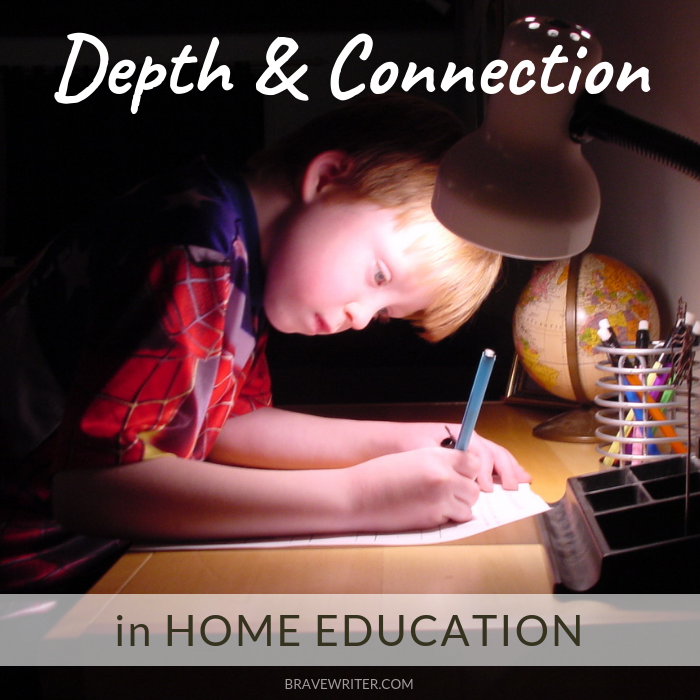
Depth and Connection in Home Education

Because we focus on depth and connection when we teach, we don’t need repetition of activities to the degree that schools need it. We aren’t pushing kids through material to ensure we don’t “miss anything.” On the contrary, we have the opportunity to patiently focus on an individual moment in time, looking at a specific skill, working with that child until it is understood.

It may be that you will revise a single piece of writing with one child this year. If you do a thorough, caring, patient job with your child, ensuring that the child feels connected to you and open to the teaching (through kindness, consideration, and helpfulness), that single editing/revision experience may be enough for the entire year! It is possible to learn it all in that one paper—enough for this year’s effort. When a child is well taught—when you care to give full commitment once in a while to a specific skill—your student will “get it” and not need repeated pushes and nudges and practice over and over again to the point of irritation and tedium.

Instead, your child will be able to take what you imparted and then practice as needed using the skills acquired in that one event.

Likewise, you might find that your child produced one fabulous session of copywork where the handwriting looked elegant, and the proportions on the page were spot on, and the care to copy punctuation and indentation succeeded. That experience teaches so much more than dozens of pages of half-hearted effort.

We focus too much on what isn’t getting done instead of recognizing the power of specific, intentional, well-executed moments in time. Do your kids need to love every lesson? No. They don’t have to fall in love with writing to become good writers. They need the skills—they can get them with far less pain if you change your expectations. Quality instruction, affection and closeness over quantity of products.

Trust these single efforts. They are working better for you than you know.

Top image by Tim Pierce (cc cropped, text added)

Stages of Growth in Writing

Posted in Brave Writer Philosophy | Comments Off on Single Efforts can Teach Profound Skills

Stick Up for Yourself Inside

Stick Up for Yourself Inside

15+ years ago, I started an online discussion board for (mostly) homeschool mom friends called The Trapdoor Society. The concept was this: Because our days were filled with small children and home-keeping demands, we needed an escape—a trapdoor through which we could pursue our own self-education: art, literature, film, politics, religion, poetry, and more. We’d be friendly and supportive when we disagreed and we’d help each other expand our worlds together…

In other words, Internet Utopia.

In other words, good luck with that.

We did become incredible friends (there are still about 40 of us in touch today). But those friendships also survived some truly painful clashes of personality, belief systems, emotional meltdowns, and even a version of trolling (though that word didn’t exist back then). I remember spending hours crafting response posts in my head when I felt maligned or judged or misunderstood.

Underneath that surface reason, though, was an invisible-to-me-at-the-time one. Fear. I didn’t want to be wrong. I didn’t want to be misunderstood. I didn’t want to have made an irrevocable choice.

When criticism came my way, I wanted to fight back—to not take it. I fought back on the outside.

If I could get everyone out there to agree that I was okay, then I would finally allow myself to feel okay in here.

The benefit of aging is the increasing awareness that it is nigh to impossible to get all the people out there to all agree that you are perfectly wonderful as you are. (I know, I’ve tried.) No one likes you enough to do that for you. They’re all too busy trying to get you to tell them that they are okay, as they are.

One of the reasons it’s tough to hear our kids tell us that some of our choices were painful to them is that we especially want their approval—after all, we are “sacrificing” careers, manicures, a good tennis game, grad school, hobbies, and beautifully decorated homes to ensure they have the best possible childhoods. How they can’t know that, can’t see that, can’t forgive us for our foibles is incomprehensible.

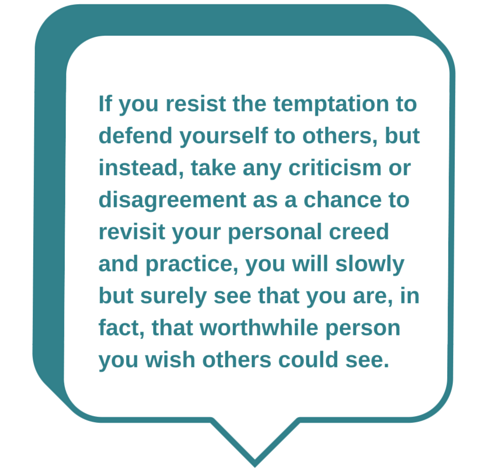
If you resist the temptation to defend

The only way out is inner confidence—to firm up your shaky insides with your resilient belief that you are conscientious, intentional, and sincere. These three qualities won’t prevent mistakes or over-reach. They won’t guarantee romanticized notions of success. But they can be the firm base from which you continue to grow, revise, and expand your life’s vision.

If you resist the temptation to defend yourself to others, but instead, take any criticism or disagreement as a chance to revisit your personal creed and practice, you will slowly but surely see that you are, in fact, that worthwhile person you wish others could see. You’ll know it from the inside—that your choices and your vision are perfectly valid for you.

Meanwhile, rather than eviscerate your persecutors with better arguments or lengthy diatribes, go soft on the outside.

It is often the perfect response to children—respond in the opposite spirit. They come with anger and force, you respond with internal strength and gentle words: “I hear you. That sounds awful. I want better for you.”

Strong on the inside, soft on the outside.

Stick up for yourself to yourself.

Trust—you don’t know the outcome of this grand risky experiment. The only way forward is one day at a time, with your conscientiousness, sincerity, and intentionality to guide you.


Brave Learner Home

Posted in Brave Writer Philosophy, Julie's Life | Comments Off on Stick Up for Yourself Inside

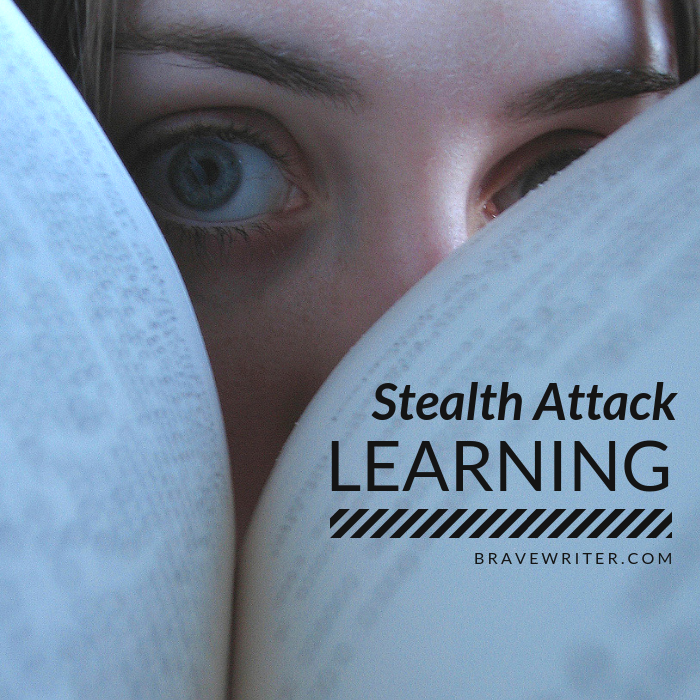
Stealth Attack Learning

Stealth Attack Learning

Rather than teach, lead. Rather than talk, act. Rather than following the curriculum or opening the book, express what it is you wish to be known.

The secret of a vibrant homeschool is not in a book. It’s you. You are the secret weapon. You don’t have to be a good teacher. In fact, it helps if you are not.

It’s better if you are an enthusiast—someone for whom the feast of ideas is so compelling, you sneak time to follow up on the material you read to the kids to get the adult perspective. You are the best home educator when you can’t wait to make dinner because that’s when you park the kids in front of PBS to watch Arthur while you listen to Jane Austen on Audible.

There’s no magic here apart from the contagious energy that oozes from your engaged, fascinated mind! This is why home education actually works! It’s why you don’t need teacher training. Yes, you might learn something about how to impart the mechanics of writing or the formulas of math. Of course! But you don’t need to know how to give lectures or prepare worksheets or organize data into incremental chunks to be mastered through quizzes and grades.

You get to lead by passionate example.

We wonder why our kids don’t jump on the train with us? Usually it’s because we take that raw energy for the material we are about to learn with them and turn it into something schoolish. We say things like, “Let me check the lesson plan book” or “Go get me the teacher’s manual” or “I wonder what X curriculum has us doing today.”

When we delegate the work of homeschool to a company, we dilute the natural curiosity and energy with someone else’s prescriptive expectations.

But what would happen, say, if you read the manual before bedtime? What if you committed 10-15 minutes a day to simply looking at the material you hoped to cover the next day? If in doing so, you could authentically lead with that material the next day without referring to a program or a schedule or a system, what might happen?

Here’s what I mean.

It’s one thing to open a Brave Writer writing program in front of your kids and to say, “We’re going to do Project Six which is called Body Art. Come here. I need you to lie on the floor.”

It’s another entirely to get up from the breakfast table and say to one of your kids: “I’m going to lie on top of this long sheet of butcher paper. Would you mind tracing around my body with this big Sharpie? Thanks.”

Once the child has done it, you get the scissors and begin cutting your body out. Your kids are going to wonder what you are doing at some point. In the meantime, you keep going. You clip words from Pottery Barn Catalogs and you glue them to your body-butcher paper.

As you work, you ask for help: “Hand me the glue stick, would you?” and “Do you think the word ‘sparkly’ describes me?”

Before you know it, someone is going to want to have their body drawn and clipped and words stuck to their elbows and forehead too.

This is leading and immersing and playing and learning all rolled into one. Stealth attack style—the same way you taught your kids to kick a soccer ball or play peek-a-boo or decorate a Christmas tree. There was no moment where you said to your 8 year old: “Now let’s see—the planner for childhood says you need to learn how to hold a kite string and it will take six steps.”

Kill the atmosphere

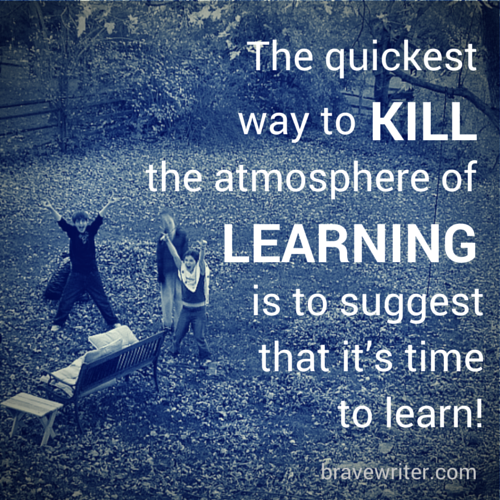
The quickest way to kill the atmosphere of learning is to suggest that it’s time to learn!

What do you do with those pesky skills that require some incremental work? You do the best you can to support a rich atmosphere—you add treats, you rub shoulders, you sit next to your struggling second grader, you give encouragement, you try the process yourself in front of your child, you use calculators, you use Spell Check, you add brownies and candles and nature hikes before or after.

LIFE is appealing to everyone. Everyone. Life is learning. Invest in what feels alive and good and curiosity making.

If what you want to learn is not on the agenda of your child, YOU go learn it in your off minutes. Read an extra chapter. Check out the adult version of the event from the library or online (book, DVD, podcast). Your appetite need not be held back by an 11 year old’s boredom with the abolition movement. You are free to read all about the Underground Railroad now—without your child coming along.

Trust me: if you become passionate about the topic, you will naturally talk about it in your children’s presence and at some point, they will find it interesting or they will have absorbed it simply by sharing oxygen and square footage with you. Perhaps as teens. Perhaps as college students home on break.

If you’re looking for a way to start a new trajectory, stealth lessons are the way to go. Set the table with the materials or stack up the books, all after the kids are in bed. Get up and begin, without a word, without explanation or mission or objective or preamble. No one wants to be told “We’re going to have fun today.” The moment they hear the words, they want to prove you wrong! So simply begin.

If the lesson today is all about homonym confusion in the editing process, resist the temptation to talk about the problem your child is having with homonyms. A surefire way to kill any interest in learning about homonyms.

Instead, what if you tried this? Before breakfast, fill a white board with homonyms (as obscure and surprising a set as you can find) and then play a game—ask everyone to make the meaning clear of each word on scratch paper with either drawings, synonyms, sentences, or definitions. Can they Google? Of course! That’s how adults learn everything!

Get back to enthusiasm, creativity. Remind yourself of that tedious classroom where you watched the tick tick tick of the clock desperately waiting for the sentence-in-your-seat to end. That will help you remember to keep it real at home—open, direct, clear, interesting—HOME.

You can do this!

Image woman and book by Amy (cc cropped, text added)


Brave Learner Home

Posted in Brave Writer Philosophy, Homeschool Advice | 3 Comments »

« Older Entries
Newer Entries »
  • Search the Blog

  • Julie Bogart
  • Welcome, I’m Julie Bogart.

    I’m a homeschooling alum -17 years, five kids. Now I run Brave Writer, the online writing and language arts program for families. More >>

    IMPORTANT: Please read our Privacy Policy.

  • New to Brave Writer? START HERE

  • FREE Resources

    • 7-Day Writing Blitz
    • Brave Writer Lifestyle Program
    • Brave Writer Sampler: Free Sample Products
    • Freewriting Prompts
    • Podcasts
  • Popular Posts

    • You have time
    • How writing is like sewing
    • Best curriculum for a 6 year old
    • Today's little unspoken homeschool secret
    • Do you like to homeschool?
    • Don't trust the schedule
    • You want to do a good job parenting?
    • If you've got a passel of kids
    • You are not a teacher
    • Natural Stages of Growth in Writing podcasts
  • Blog Topics

    • Brave Learner Home
    • Brave Writer Lifestyle
    • Classes
    • Contests/Giveaways
    • Friday Freewrite
    • High School
    • Homeschool Advice
    • Julie's Life
    • Language Arts
    • Movie Wednesday
    • Natural Stages of Growth
    • One Thing Principle
    • Our Team
    • Parenting
    • Philosophy of Education
    • Podcasts
    • Poetry Teatime
    • Products
    • Reviews
    • Speaking Schedule
    • Students
    • Writing about Writing
    • Young Writers
  • Archives

  • Brave Writer is a participant in the Amazon Services LLC Associates Program, an affiliate advertising program designed to provide a means for sites to earn advertising fees (at no extra cost to you) by advertising and linking to amazon.com

    Content © Brave Writer unless otherwise stated.

What is Brave Writer?

  • Welcome to Brave Writer
  • Why Brave Writer Works
  • About Julie
  • Brave Writer Values
  • Frequently Asked Questions
  • Speaking Schedule

Brave Writer Program

  • Getting Started!
  • Stages of Growth in Writing
  • The Brave Writer Program
  • For Families and Students
  • Online Classes
  • Brave Writer Lifestyle

…and More!

  • Blog
  • Classroom
  • Store
  • Books in Brave Writer Programs
  • Contact Us
  • Customer Service
  • Brave Writer Staff
© 2026 Brave Writer
Privacy Policy
Children's Privacy Policy
Help Center