
Brave Writer Philosophy Archives - Page 16 of 139 - A Brave Writer's Life in Brief A Brave Writer's Life in Brief
  • Start Here
    • For Families
      Multiple Ages
    • Ages 5-7
      Beginning Writers
    • Ages 8-10
      Emerging Writers
    • Ages 11-12
      Middle School Writers
    • Ages 13-14
      High School Writers
    • Ages 15-18
      College Prep Writers
  • Shop
    • Product Collections
    • Bundles
    • Writing Instruction Manuals
    • Literature & Grammar/Punctuation
    • Composition Formats
    • Literature Singles
    • Homeschool Help
    • Book Shop
    • Special Offers
  • Online Classes
    • Class Descriptions
    • Class Schedule
    • Classroom
    • How Our Classes Work
    • Our Writing Coaches
    • Classes FAQ
  • Community
    • Brave Learner Home
    • What’s Happening
    • Blog
    • Podcast
    • Calendar
    • Brave Writer Lifestyle
  • Cart
  • My Account
    • My Online Classes
    • My Account
  • My Account
    • My Online Classes
    • My Account
  • Start Here

    If you’re new to Brave Writer, or are looking for the best products for your child or family, choose from below:

    • For Families
      Multiple Ages
    • Ages 5-7
      Beginning Writers
    • Ages 8-10
      Emerging Writers
    • Ages 11-12
      Middle School Writers
    • Ages 13-14
      High School Writers
    • Ages 15-18
      College Prep Writers
  • Shop

    If you’re already familiar with Brave Writer products, go directly to what you’re looking for:

    • Product Collections Browse the full catalog in our shop
    • Bundles Everything you need to get started
    • Writing Instruction Manuals Foundational Writing Programs
    • Literature & Grammar/Punctuation Grammar, Punctuation, Spelling & Literary Devices
    • Composition Formats Writing Assignments for Every Age
    • Literature Singles Individual Literature Handbooks
    • Homeschool Help Homeschooling Tools and Resources
    • Book Shop Books associated with Brave Writer Programs
    • Special Offers
  • Online Classes
    • Class Descriptions
    • Class Schedule
    • Classroom
    • How Our Classes Work
    • Our Writing Coaches
    • Classes FAQ
  • Community
    • Brave Learner Home
    • What’s Happening
    • Blog
    • Podcast
    • Calendar
    • Brave Writer Lifestyle
  • Search
  • Cart

Search Bravewriter.com

  • Home
  • Blog

A Brave Writer's Life in Brief

Thoughts from my home to yours

Archive for the ‘Brave Writer Philosophy’ Category

« Older Entries
Newer Entries »

Reframe Their Resistance

Reframe their resistance

by Stephanie Hoffman Elms

The age old dilemma. Should we or should we not “give in” when we get a lot of resistance from our kids, especially in regards to school work? After all, if we don’t “make” them continue when they start complaining, then won’t we be rewarding them for that behavior? And if we “reward” the behavior, then won’t it just encourage it? Plus, don’t they have to learn that sometimes you just need to do things even if they don’t want to?

I will admit that when my kids were that age, I definitely erred on the side of “giving in” and now that they are 17 and 20, I am happy to say that the leap of faith paid off.

Here is what I found. Giving in did not mean throwing up my hands and giving up and letting them decide everything. What it did mean was that I recognized that resistance was their way of communicating that something was not working for them and that it was up to me, as the adult in the relationship, to try to better understand what that was. Yes, whining and complaining is a very immature form of communicating, but then again, kids are by definition immature!

Sometimes “giving in” took the form of just recognizing that an 8-year-old’s priorities and my priorities were naturally going to be different. Is it really that strange that an 8-year-old might not want to do all the school work that I deem is important? 😉

Reframing their resistance from them being stubborn or difficult or lazy to them being a typical 8-year-old little boy can open up lots of options that I might not have seen before…

  • can I shift around when we do things,
  • can I let something that is causing a lot of head butting go for right now (for both our sakes),
  • can I “add brownies” and find a way to make it more acceptable,
  • can I troubleshoot with him and see if he has any suggestions for making it work better?

The tricky thing with this approach is that it is one that takes a long-term view and does not always produce quick results. By focusing on our relationship, it turns things into an ongoing conversation and a series of experiments which might take awhile to hit on a workable solution. But it also makes life with my kids easier on the whole and more enjoyable (I just don’t have it in me to be the enforcer all the time!)

Contrary to worries that I had about reinforcing the resistance, the more that I demonstrated that I was willing to work with them, the more they became willing to work with me. I often shared that I really was not sure of what was the best thing to do…that I could understand where they were coming from, but still had my own concerns (which I shared with them) and we would go from there…sometimes giving what they wanted to do a try, sometimes me realizing that nope, I felt strongly enough about this to not want to give in this time.

Where this paid off was in the teen years. I joke that Jason listened to me way more as a teen than he ever did at 8 years old and that is the truth! Because I did my best to “give in” when I could when was younger, he did not get into the habit of pushing back against me. So as he got older and more mature, he started wanting and valuing my advice…he had learned to trust that I truly wanted to let him do what he wanted to do, so when I had concerns, he was more willing to listen.

It can feel like a huge leap of faith, though! Hoping my experience helps. I really worried about “creating a monster” (especially with Jason, my more intense, head strong kid) and there seems to be little support in much of the parenting advice out there in our society at large, so this is a topic I like talking about. I also wrote about this more on my blog: On Giving in to Our Children.


Stephanie Elms has homeschooled her two boys for ten+ years and is a former coach for Brave Writer’s Brave Learner Home. She blogs at Throwing Marshmallows.

Posted in Brave Writer Philosophy, Parenting | Comments Off on Reframe Their Resistance

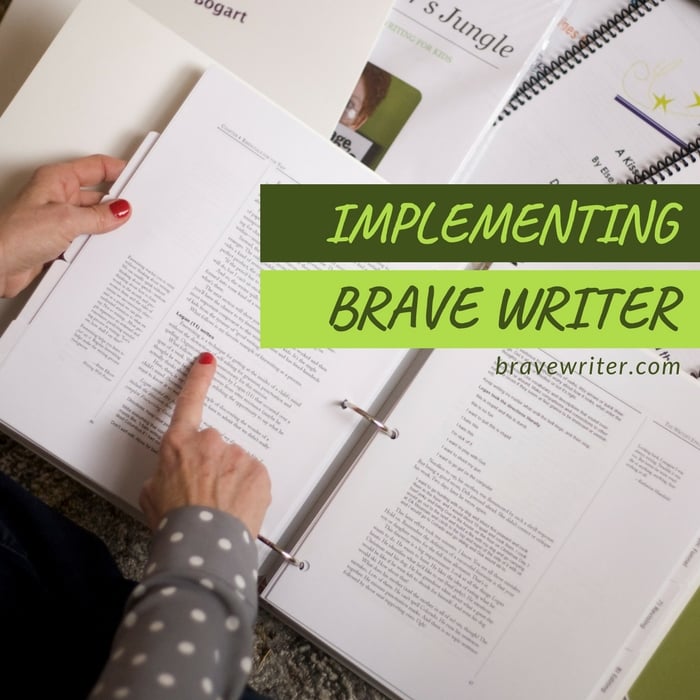
Implementing Brave Writer in Your Homeschool

Implementing Brave Writer in Your Homeschool

The goal of The Writer’s Jungle:

  • Read a chapter.
  • Do what’s in it.

Allow yourself to actually take the time to do the processes. Don’t hurry ahead. Trust that the process IS teaching. You want your kids to slowly build the ability to tune in to themselves and hook up the hand with the brain.

Each chapter in The Writer’s Jungle gives you something to do. Don’t run ahead. Focus on one chapter at a time. Skip the Preface (it is meant to be additional material that we added in 2005). Save it for later. Start with the core chapters (and Chapter 14 provides a nice overview).

For the Arrow—the process goes like this:

  • Read the book aloud.
  • Go at any pace that works for you.

Then each week, look at the passage for the week. Read it together. You can read it from The Arrow or in the book itself. You can read the notes I give you ahead of time and discuss them with your child in your own voice, or you can read them aloud. Whatever feels right to you. You don’t HAVE to cover every item in the notes. They are meant to slowly train YOU to see literary devices, grammar and spelling opportunities, punctuation and more.

You can zero in on one or two or all of them depending on your child. Discuss a little. Look at the passage and say (for instance): “Who sees periods?” They will point them out. Then ask, “Any other end marks?” They point to an exclamation point and a question mark. Ask: “How do they change how you read the sentences?” Then have them try reading the sentences in a row each one with a slightly different emphasis. Then use the notes to help you explain. Like that.

Next, your child will handwrite (copy) the passage—it might take all week, it might take a day. You can choose to then use the same passage for dictation or one of the other two methods on a day of your choosing. Read the Guidelines to get some insight into how to do that.

The WHOLE goal in the Arrow is to give you tools to help you bring the passage to life and to see it for its mechanics and literary value—while using copywork and dictation practices.

The Literary Element each month can be read and discussed and then experienced with the Writing Activity of the month (which should take about half a day). You aren’t going for some kind of mastery as much as conversational exposure and repetition until your kids SEE them themselves in writing and then eventually TRY them in their own writing.

Try not to overthink this. It is meant to be easy for you!

Think of it more like this: we are giving you notes (things to consider as you read). You don’t even have to master them yourself. Just consider. For instance, in The Green Ember we talk about affixes. You certainly don’t even need to use the name “affix” unless you want to. But what it you simply go back to the Week One passage and find any word that seems to have a little extra bit on it? The “un,” the “ly,” the “in” are all given to you to find. Look at the words. Think about them. Discuss how words are “built” like Lego. Like that.

Our goal is to give you things to look at, to talk about, to consider. Try to move away from “mastery” and “getting things done.” Allow the notes to give you pause and create moments of inquiry. Yes, you may not actually know these terms or categories! It’s like when I realized I didn’t understand multiplication or couldn’t remember how to divide fractions.

Take the time to think about the concepts so that YOU have a moment of transformation. If it feels like too much, just do that for one passage in a month. Let THAT be enough depth and simply copy the other passages. Like that.

Grow over time, allow the tools to be your guide, not your task-master.

Curious about Brave Writer?

Posted in Brave Writer Lifestyle, Brave Writer Philosophy | Comments Off on Implementing Brave Writer in Your Homeschool

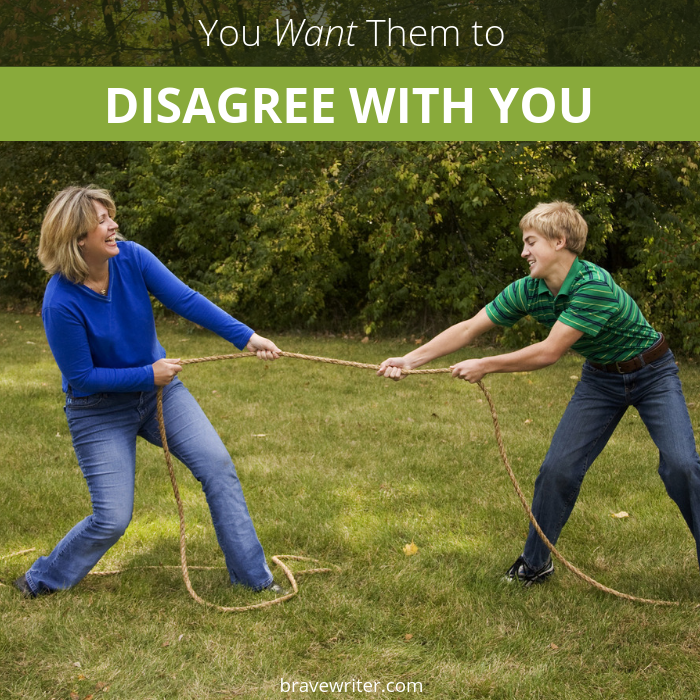
You Want Them to Disagree with You

You Want Them to Disagree with You

Trust me on this.

When you get that inevitable push back to your great ideas from one of your kids, the initial energy surge is, well, about like this:

“Wait, what? Why are you not cooperating with my genius plan for your life? If you simply do as I say, we will all be happier.”

Your “genius plan” includes a whole slew of practices and beliefs that wind up in disputes with your kids. You might ask them to:

  • Wear shoes rather than slippers to the store
  • Hang up coats before they sit to watch TV
  • Agree that brushing teeth prevents cavities
  • Choose to go to bed before 3:00 am without nagging
  • Realize that the family can’t add two ferrets to the pet menagerie
  • Accept the family budget limits; no big dreams
  • Enjoy G rated films rather than PG and R films
  • Support the family politics and religious viewpoint
  • Date the right people
  • Eat the food the parent prepares even if the child doesn’t like it
  • Help around the house without ever being asked
  • Finish every book, even if the child loses interest
  • Complete assigned schoolwork without ever complaining
  • Suck it up when having a bad day
  • Reserve silliness for the “appropriate” times
  • Put on a jacket because it’s cold
  • Never argue with a sibling
  • Always show gratitude properly to everyone
  • Be polite, kind, and generous no matter what

… you can think of more.

These seem like perfectly reasonable requests of a child—until you see them in a list… And then, don’t they feel like a straight jacket of good manners and expectations rather than the organic growth of a human soul? Is it possible to be kind, polite, cooperative, and helpful all the time, every day, no matter what? Yet this is what we ask!

Kids know (intuitively) that they grow when they challenge authority, when they ask big questions, when they resist what doesn’t feel right to them. They push back not to make a parent’s life miserable. They push back to explore the boundaries of the ideas that inform the request.

For instance, why is it better to hang up a coat when you first get home rather than an hour later after watching TV? Is one choice morally superior? Is one action more necessary? According to whom?

If we pause and consider why a child resists our plan, we discover that a whole different calculus is at work. The child has different priorities—and these priorities make a natural, personally-arrived-at-sense for the child. The choice to “civilize” a child into the family standards can be experienced as stifling, as nonsensical, as irritating.

You want them to disagree with you

When kids have had too many commands in a day, sometimes the child simply picks the latest one to resist, “But why? Why does it matter when I hang up my coat?” This question feels like disrespect when in fact it is the self standing up and asking to be noticed.

We respond, “Don’t try to get out of it.”

We say, “Coats need to be hung up immediately or you will never do it and then I get stuck with the task.”

We chide: “I’m tired of your stubbornness.”

We give up: “Fine. Leave it out. See if I care.” (Except that we do.)

What’s needed is engagement! Think instead: Aha! There’s a child thinking, processing, wondering.

“Good question! I like it when we hang up coats because it keeps the house a little neater for me and I am a nicer mother when my field of vision isn’t cluttered with stuff. How do you see it?”

If we share our truth and then invite comment, we give our children a chance to witness our own priorities and how we came to them. We allow them to mull over their own. It’s so tempting to play parent rather than to connect!

When your child challenges the plan, pause and remember: This brilliant child of mine is using her mind, is exercising his will and choices. Draw them out—”Tell me more about why you believe tooth-brushing is a waste of time and doesn’t prevent cavities. I want to hear more about where you learned that and why you believe it.” Then really listen!

Big debates on topics of moral importance to your family go much better if you’ve cultivated a habit of listening to your child’s pushback in the early years over things like bedtimes, jacket wearing, and what to eat for dinner.

Children and teens become self-regulating when they are allowed to challenge parental regulation. Boom Right? How are they self regulating if we tell them what to do ALL the time? The only way they learn how to form their own priorities is if we take them seriously when they tell us what those are!

If a child isn’t polite or doesn’t say thank you? What happens? What does that child experience? Sometimes they need to find out through action, not blame and shame.

A child who wants to stay up until 3:00 am to play an online game with a friend in another time zone is creating a new life habit—going to bed later, sleeping in. Is it worth it to find out if this is a boon to that child’s happiness and thus life before considering it from a parent’s point of view? We’re so quick to say, “You’ll be too tired tomorrow. So no.”

Your kids grow in direct proportion to how well you allow them
to explore their own understanding of why they do what they do.

The more children get to expose and articulate their own thinking, the more power they have to create meaningful lives. They may not always side with your interpretation of what creates a great life, but they will be better able to negotiate with you when they know that you respect their efforts to communicate their own vision.

Next time one of your kids argues with you, stop and think: “This is great! I see a mind at work. I must be doing it right.”

Then enter into the conversation with curiosity and love.

Image by Catherine Murray / Fotolia


For Coaching and Support
Join The Homeschool Alliance

The Homeschool Alliance

Posted in Brave Writer Philosophy, Parenting | Comments Off on You Want Them to Disagree with You

« Older Entries
Newer Entries »
  • Search the Blog

  • Julie Bogart
  • Welcome, I’m Julie Bogart.

    I’m a homeschooling alum -17 years, five kids. Now I run Brave Writer, the online writing and language arts program for families. More >>

    IMPORTANT: Please read our Privacy Policy.

    Introduction to Brave Writer

  • FREE Resources

    • 7-Day Writing Blitz
    • Brave Writer Lifestyle Program
    • Brave Writer Sampler: Free Sample Products
    • Freewriting Prompts
    • Podcasts
  • Popular Posts

    • You have time
    • How writing is like sewing
    • Best curriculum for a 6 year old
    • Today's little unspoken homeschool secret
    • Do you like to homeschool?
    • Don't trust the schedule
    • You want to do a good job parenting?
    • If you've got a passel of kids
    • You are not a teacher
    • Natural Stages of Growth in Writing podcasts
  • Blog Topics

    • Brave Learner Home
    • Brave Writer Lifestyle
    • Classes
    • Contests/Giveaways
    • Friday Freewrite
    • High School
    • Homeschool Advice
    • Julie's Life
    • Language Arts
    • Movie Wednesday
    • Natural Stages of Growth
    • One Thing Principle
    • Our Team
    • Parenting
    • Philosophy of Education
    • Podcasts
    • Poetry Teatime
    • Products
    • Reviews
    • Speaking Schedule
    • Students
    • Writing about Writing
    • Young Writers
  • Archives

  • Brave Writer is a participant in the Amazon Services LLC Associates Program, an affiliate advertising program designed to provide a means for sites to earn advertising fees (at no extra cost to you) by advertising and linking to amazon.com

    Content © Brave Writer unless otherwise stated.

What is Brave Writer?

  • Welcome to Brave Writer
  • Why Brave Writer Works
  • About Julie
  • Brave Writer Values
  • Frequently Asked Questions
  • Speaking Schedule

Brave Writer Program

  • Getting Started!
  • Stages of Growth in Writing
  • The Brave Writer Program
  • For Families and Students
  • Online Classes
  • Brave Writer Lifestyle

…and More!

  • Blog
  • Classroom
  • Store
  • Books in Brave Writer Programs
  • Contact Us
  • Customer Service
  • Brave Writer Staff
© 2026 Brave Writer
Privacy Policy
Children's Privacy Policy
Help Center