Brave Writer Lifestyle Archives - Page 19 of 27 - A Brave Writer's Life in Brief A Brave Writer's Life in Brief
  • Start Here
    • For Families
      Multiple Ages
    • Ages 5-7
      Beginning Writers
    • Ages 8-10
      Emerging Writers
    • Ages 11-12
      Middle School Writers
    • Ages 13-14
      High School Writers
    • Ages 15-18
      College Prep Writers
  • Shop
    • Product Collections
    • Bundles
    • Writing Instruction Manuals
    • Literature & Grammar/Punctuation
    • Composition Formats
    • Literature Singles
    • Homeschool Help
    • Book Shop
  • Online Classes
    • Class Descriptions
    • Class Schedule
    • Classroom
    • How Our Classes Work
    • Our Writing Coaches
    • Classes FAQ
  • Community
    • Brave Learner Home
    • What’s Happening
    • Blog
    • Podcast
    • Calendar
  • Cart
  • My Account
    • My Online Classes
    • My Account
  • My Account
    • My Online Classes
    • My Account
  • Start Here

    If you’re new to Brave Writer, or are looking for the best products for your child or family, choose from below:

    • For Families
      Multiple Ages
    • Ages 5-7
      Beginning Writers
    • Ages 8-10
      Emerging Writers
    • Ages 11-12
      Middle School Writers
    • Ages 13-14
      High School Writers
    • Ages 15-18
      College Prep Writers
  • Shop

    If you’re already familiar with Brave Writer products, go directly to what you’re looking for:

    • Product Collections Browse the full catalog in our shop
    • Bundles Everything you need to get started
    • Writing Instruction Manuals Foundational Writing Programs
    • Literature & Grammar/Punctuation Grammar, Punctuation, Spelling & Literary Devices
    • Composition Formats Writing Assignments for Every Age
    • Literature Singles Individual Literature Handbooks
    • Homeschool Help Homeschooling Tools and Resources
    • Book Shop Books associated with Brave Writer Programs
  • Online Classes
    • Class Descriptions
    • Class Schedule
    • Classroom
    • How Our Classes Work
    • Our Writing Coaches
    • Classes FAQ
  • Community
    • Brave Learner Home
    • What’s Happening
    • Blog
    • Podcast
    • Calendar
  • Search
  • Cart

Search Bravewriter.com

  • Home
  • Blog

A Brave Writer's Life in Brief

Thoughts from my home to yours

Archive for the ‘Brave Writer Lifestyle’ Category

« Older Entries
Newer Entries »

Our Brave Writer Lifestyle


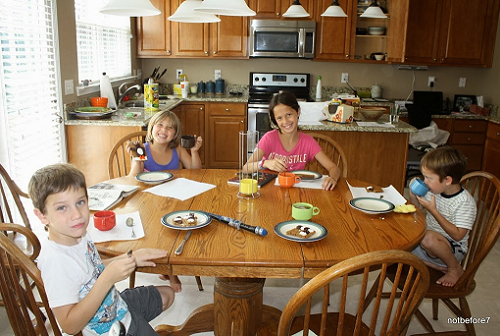
We recently featured a poem by 11 year old Kayleigh. Her mom, Mary, blogs at Not Before 7:00 and she wrote three fabulous posts about her family’s Brave Writer lifestyle. Check them out!

Part I: Our Brave Writer Lifestyle

Mary shares her journey from Classical Education to Brave Writer. She writes:

I don’t even know where to begin with the changes in our homeschooling since I found Julie at Brave Writer. I have been inspired and encouraged to finally embrace the homeschooling lifestyle that I think has always been “me” deep down inside.

Part II: Our School Year

Their Language Arts program is explained. Read how Mary “deprogrammed” herself and tossed out the spelling, grammar, and vocabulary workbooks!

Best of all…this year my kids all consider themselves WRITERS!  They keep poetry journals.  They talk about their stories and write for fun.  Even my 4 year old asked one night if he could tell me a story!  The next day he told me another and I wrote it down in his writing journal.

They all have learned that they EACH have ideas WORTH WRITING DOWN!  And I can think of no better goal for writing at this age!

Part III: Essentials

Take a peek at their Tuesday Teatimes and Friday Freewrites (complete with adorable photos!).
Posted in Brave Writer Lifestyle, Homeschool Advice, Linky-links | Comments Off on Our Brave Writer Lifestyle

Brave Writer Spotlight: Claire

Brave Writer spotlight Claire

From Brave Writer mom, Jennifer:

Dear Julie,

This is bound to become lengthy, but I am so excited about our day, that I feel compelled to share it with you! My daughter is 6.5 and my son is almost 4. My daughter has always been “verbally precocious” with a vocabulary of well over 300 words at 2, reading at 4, and at a roughly 5th grade reading level now. I have subscribed to your blog, Facebook feed, Yahoo group, etc. for perhaps a year now. I find your words inspiring and your philosophies resonate with me. I haven’t been sure about where to begin BraveWriter-style writing instruction with my daughter. We don’t do any explicit reading instruction any more – just spelling. She gets handwriting through copy work, she reads voraciously, and I read aloud several times daily. Her writing has been largely lists, love notes, thank-you cards, and occasionally she writes her own “Thankful Thought” in a daily journal we keep – though she typically prefers me to write for her. She did spontaneously write a story during her quiet time one day, and I was thrilled!

I began Poetry Tea Times with my children this summer. The first time I used a fancy table cloth, fresh cut flowers, a candle, fancy tea cups, and fresh, home-baked treats. They LOVED it! We read mostly Shel Silverstein – my daughter read her own selections, and I read those that my son chose. He asks for “Bear in There” regularly. I found that level of preparation a bit much for weekly commitment. It seems that the tea, baked goods, and poetry are enough for them to find magic in it. When we bake, I put the cookies, muffins, or quick bread in the freezer, so I can just pull some out when I need it. I put the tea kettle on while they gather the books, and we enjoy it even with the dirty daily table cloth and mugs. We have branched out a bit with the poetry, but they still prefer humorous selections. As someone who has never found the appeal in poetry, it is funny to me that they enjoy this so much, but it does seem to be a magical time.

Last month, I bought my daughter a journal for writing, with the intention of doing Friday Freewriting with her, but I only ever manage to get a sentence or two. I am thinking I should write in my own journal at the same time. I thought maybe Jot It Down would be too simple for where my daughter is at, but got some feed back from another user that it might be good fit after all, so I purchased it.

I told her we were going to do a fairy tale project, and since “The Emperor’s New Clothes happened to fit in with something else we were doing, I got a bunch of versions of that tale from the library. Over the last week and a half she read several versions on her own, and I read a few to her as well. She completed her illustration last week, (choosing to work on it during her brother’s doctor appointment!) After math and our literature read-aloud (we are reading Pippi Longstocking in preparation for seeing the play on Friday), I sat down to take her dictation today. She gave me the first sentence, and then squirmed a little bit and declared she didn’t know what to call the characters who pretend to weave fabric. She said, “They are sort of like burglars, but that doesn’t seem right.” So I showed her my thesaurus, and we looked up “burglar.” It had a few options, but only one was sort of close to what she wanted, so we looked that word up, and found a host of options that would work. She settled on “swindler.” From there, the words just poured out. I was typing as quickly as I could, making a bunch of spelling mistakes – which she noticed. I assured her that the important part was that we capture all her wonderful thoughts – we can always go back to correct spelling and punctuation or make changes if she wants to. She finished her retelling, and we made the easy spelling and punctuation corrections, and talked about paragraph breaks. We plan to read it over again tomorrow and make sure she is satisfied (my experience with her tells me that she will not choose to make any structural changes, additions, etc.) I am so pleased with her story, and she was pretty pleased with the whole experience too. It did feel like we were partners – or at least that I was simply coaching and facilitating when she needed it. Once or twice I thought about asking a clarifying question, or asking her to elaborate on something, but I decided against it. I think there is time for that a little later. I want her to solidly feel ownership and joy in this for now. I can’t wait to do the next tale in a week or two!

After we finished writing, we went to the library, out to lunch, and to swimming lessons. During her quiet time after swimming, she listened to Tchaikovsky and read the third book in “The Roman Mysteries” series for an hour and a half. (My son listened to “House At Pooh Corner” on audio book.) Then we had a poetry tea with Vanilla Rooibos and apple muffins. It was a great day! Thank you so much for letting people know that it is the writer’s voice that should be nourished – all the boring mechanics can easily be learned later. No sense in drumming the joy out of writing for children!

Thank you!
Jennifer

The Emperor’s New Clothes

by Claire (age 6)

Once upon a time, there lived an emperor who liked lots and lots and lots of new clothes. One day some swindlers came long and said that they were the best weavers in the land. The emperor said, “I must have the cloth they make!” So the swindlers came and pretended to work on looms all day and all night.

The emperor sent a servant to check on how the swindlers were doing. When he saw the swindlers working at the empty looms, he said to himself, “I can’t believe that there is nothing at the looms! I must not let anyone know that I saw nothing on the loom!’ The swindlers pretended to hold silk out to him, asking “Isn’t it marvelous?” When he went back to the emperor he said, “It is marvelous, the silk!”

After a few months the emperor became impatient and sent a servant to check on how the swindlers were doing again. When that servant saw nothing on the looms he though to himself, “I must not let anyone know that I saw nothing on the looms!” When he went back to the emperor, he said. “It is magnificent, your majesty!”

After a few more months the emperor became even more impatient and sent another servant to check on how the swindlers were doing. When he saw nothing on the looms, he said to himself.”Well, there is nothing on the looms, but I must not let the emperor himself know that there is nothing on the loom.” When he went back to the emperor he said, “It is so beautiful, Emperor!” Then the emperor sent him back to see when the swindlers would be done. The swindlers said, “We will be done tomorrow night.” He rushed back to the emperor and said, “They said they will be done by tomorrow night.” The emperor said, “Then I shall hold a great celebration on the day after tomorrow night!”

When that day came, the swindlers brought the cloth before his majesty and pretended to dress him in it. When he walked out everyone crowded to see him and they said, “How marvelous the emperor looks in his new clothes!” Then a little boy said, “But the emperor has no clothes on!” and all of the villagers started whispering to each other, “But the emperor has no clothes on!” Soon they were shouting, “The emperor has no clothes on!” But the emperor, foolish enough to think that he did, just waved and walked on.

The End


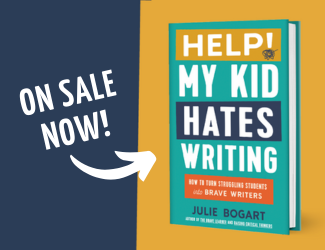
Help! My Kid Hates Writing

Posted in Brave Writer Lifestyle, Students | 3 Comments »

Brave Writer spotlight: Sarah

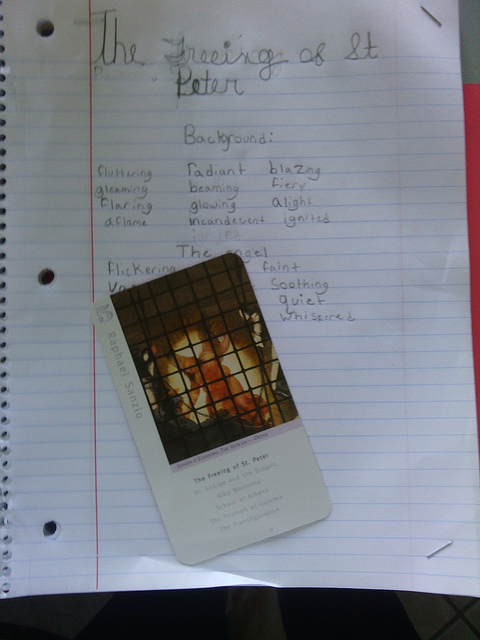
Freeing of St. Peter


From Brave Writer mom, Kerry:

Hi,

Sarah is 11 [and attends] Bridges Virtual Academy. [Her] curriculum is science based for the most part, because that is where she finds a lot of joy.

I spontaneously created the project [above]; I was tired of seeing her bored with heavy writing projects. I am inspired by the Brave Writer lifestyle and am grateful for the emails and blog posts that Julie shares. They are a gift. I find that the more trust and freedom I give Sarah in writing, the more beautifully she does.

The cards came from this set.

Lots of opportunities for learning, we worked on the following:

Capitalization of proper nouns
Spelling
Adjectives
Interpretation of a subject
Visual cues from artists
Perspective
Renaissance
Saints

In the end her only question was, “Why did St. Peter need to be freed?” which I found quite witty. She decided on her own to categorize the adjectives into “The angel” and “The background.”

She’s a busy girl and a great student, I am so proud of her.

All the best,
Kerry

Image The Freeing of St. Peter (cc)

Posted in Brave Writer Lifestyle, Students | Comments Off on Brave Writer spotlight: Sarah

What healthy looks like

What Healthy Looks Like

I spent the night at a friend’s home. I woke up before the married couple who lived there. Their dog was awake and eager to be uncrated. So I opened the latch and then opened the sliding glass door to let him go outside to do his business.

This is how it worked with my dog and I assumed it would work with Kapu. He panted and yelped a bit, he made circles in his crate but wouldn’t leave it. I coaxed him to come out and eventually he put a paw outside the crate, followed by another. Clearly agitated, though, he didn’t romp outside the way I expected.

At about that time, the “man of the house” and long term dear friend descended the steps and noticed the dog’s confusion (and mine!). He saw that Kapu was hovering near the sliding door. Bill turned to me and said, “You know dogs. They have their habits. Kapu is used to eating in his crate right when he wakes up before we put him outside.” Then he turned to his dog and with the kindest, friendliest voice urged Kapu to go outside, “Go on Kapu. I know. You’ll get your food after. That’s a boy! Go on!” He chuckled lightly. Kapu obeyed and returned to the house ready to eat. Bill scratched him behind the ears.

Unremarkable moment in Bill’s life, I’m sure. But for me, it was one of those “Oh wow!” moments. A routine event didn’t go the way it was supposed to, and that break in routine was greeted with gentleness, humor, and a kind spirit.

I stood there in Bill’s kitchen watching his gentle guidance offered to Kapu and I thought to myself: No one has to get angry just because something isn’t going the way it should or because the other party is confused or momentarily off balance. It’s possible to bring clarity and support to another with kindness. No sternness required, no assumption of nefarious motives.

How much our children deserve that kind of sympathy! How much anyone in our lives does!

I made a list of what “healthy” looks like to me a few years back:

Curiosity over accusation. When you find someone’s behavior strange or upsetting or simply different than you expected, ask questions, show interest. Don’t make assumptions, accuse, or assign intentions/motives.

Kindness over force. Kindness means a quiet voice, a gentle tone. Force is coercive—it uses an urgent (sometimes loud) tone to create anxiety in the other person to provoke an action. Kindness assumes that the person can be reached through support rather than control.

Trust over suspicion. As a friend says, “I look for reasons to trust people.” A disposition that trusts creates open lines of communication and freedom to take risks. It creates a willingness to own up to mistakes or poor choices. Suspicion kills creativity and it drives shame underground. Secrets grow in an atmosphere of suspicion.

Acceptance over control. To truly accept means that you are willing to receive what is offered without judgment or interference. Control means the other person needs to match my expectations before I can accept what is offered. (Your five minutes at dinner with me before you head out the door again is enough because you gave it freely; not: Because you didn’t eat a full dinner with me, I won’t be friendly to you during the meal.)

Owning personal limits over imposing personal limits. If I need something to be a certain way, I make it happen or take responsibility to make it happen. I don’t require others to create the space I need to live in. I create it for myself. I don’t blame others for my lack.

Expressing my disappointment over calling you a disappointment. When expectations surface and aren’t met, sharing my disappointment as an unmet need rather than assigning you the label “disappointing” is healthy.

Asking for help over requiring it. It’s risky to say “Would you help me….?” because the person might say, “No.” But to require “help” is to remove the possibility of “gift.” A requirement of help can become a source of festering resentment. To share what you need and ask for help means a person has the chance to be good to you. People love to know that what they do is genuinely appreciated as a free gift, not as an obligation.

Surprise me over “that’s who you are and always will be.” I like to find out you are more than I know or thought I knew. Labels limit people and we stop being surprised and amazed by them. If when you risk sharing a new way of seeing or being with someone you love and you are met with skepticism “You don’t like X” or “You’re not that kind of person,” it shuts down the adventure of living… for both of you. Give your children the gift of being delightful surprises to you.

Passion over discipline. Discipline fuels passion, true enough. But you can’t get to passion by starting with discipline. Knowing a person’s passion and supporting it does more to create a climate of enthusiasm and joy than all the rules, systems, structures, and good ideas in the world. Discipline alone is soul-stealing.

Yelling never works. Unless your house is on fire or a semi is about to crush your car.

Affirm over suggest. Find traits to affirm, look for ways to validate the other person’s judgment, thought processes, ideas before offering your own. Only make suggestions when asked.

What others can you think of?

If we treated the people we love (and even those we don’t yet know) as intelligent, reasonable, logical human beings, whose insights, practices, yearnings, and hopes made good sense (given who they are, where they live, how they got to this phase of life) rather than as dangerous, misguided, self-centered, or illogical, we’d discover so much more to love between us.

If we listened well and showed interest, if we held back judgment and attempted to see through the eyes of the other, if we kept a cheerful tone (or at minimum, a gentle one), and waited patiently for more understanding before slapping on labels or expecting someone to be who we say they are…we could avert so much emotional punishment…the feeling that you are scorned for being yourself.

The image that comes to my mind is a huge WELCOME mat. I welcome you to my space, as you are, ready to serve you and enjoy you. How about tea?

Cross-posted on facebook.

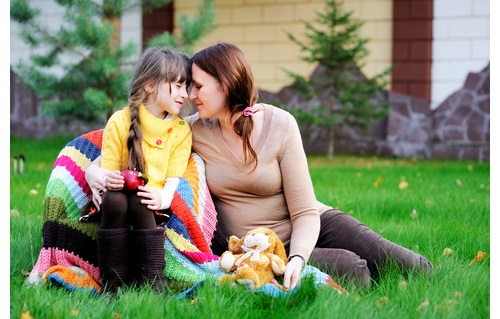
Image © Alina Shilzhyavichyute | Dreamstime.com

Posted in Brave Writer Lifestyle | 3 Comments »

When Your Child Writes Hurtful Words

What to do when your child writes hurtful words

Sometimes freewriting yields an emotional catharsis in your child. You find out that she is angry at her father for teasing her about her table manners. You discover that your son is mad at you for “making him do math.” You read that your child thinks your mother is mean or that another child calls her brother “stupid.”

It takes a big person to withstand criticism in almost any setting. But when it comes from a beloved child, it’s like running a tractor over your heart. Freewriting sometimes calls forth buried emotions, but it can also yield truths that you might not want to face.

For instance, maybe your mother was mean the last time she visited, or perhaps your spouse did cross the line from teasing to mocking and humiliated the daughter.

It’s important to stand up for reality in your family. So if your child detected misbehavior by an adult and it showed up in writing, validate it. You don’t need to pretend it away or minimize it. Simply acknowledge it:

  • “You’re right. Grandma was pretty harsh. I don’t like it when she shouts either.”
  • “Let’s talk to Dad. I wonder if he knows he hurt your feelings.”
  • “Thanks for sharing this with me. Let’s see what can be done to repair the damage.”

If the freewriting is slanderous: “Joey is stupid” or “Mom is the worst mother in the world,” you can talk about it from a writing point of view.

Powerful writing “shows” it doesn’t “tell.”

Suggest your child lay off of the “slams” and focus instead on revealing the character of the one being accused. What can happen in those moments is powerful. Now your child is being required to find support for the assertion. As he or she does that, sometimes perspective has a way of creeping in. Maybe she discovers that Joey isn’t actually stupid, he just plays too hard sometimes and your daughter gets overwhelmed. Maybe your son discovers that what is bugging him is that he wants to play his computer game longer and you stop him for dinner. Now you have a real problem that can be addressed and solved, rather than name-calling.

Use this kind of writing to heal pain and damaged relationships. Honor it. Don’t judge it. Never require anyone to write only edifying depictions of others. Some of the best writing is the accurate recognition of another person’s flaws. Learning how to depict those with care is the challenge. If the writing is a veiled plea for support and love, take care of that too.

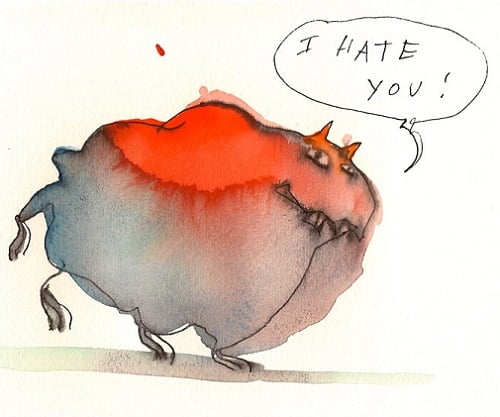
Image by waltercolor (cc cropped)

Posted in Brave Writer Lifestyle, Homeschool Advice, Writing about Writing | 2 Comments »

« Older Entries
Newer Entries »
  • Search the Blog

  • Julie Bogart
  • Welcome, I’m Julie Bogart.

    I’m a homeschooling alum -17 years, five kids. Now I run Brave Writer, the online writing and language arts program for families. More >>

    IMPORTANT: Please read our Privacy Policy.

  • New to Brave Writer? START HERE

  • FREE Resources

    • 7-Day Writing Blitz
    • Brave Writer Lifestyle Program
    • Brave Writer Sampler: Free Sample Products
    • Freewriting Prompts
    • Podcasts
  • Popular Posts

    • You have time
    • How writing is like sewing
    • Best curriculum for a 6 year old
    • Today's little unspoken homeschool secret
    • Do you like to homeschool?
    • Don't trust the schedule
    • You want to do a good job parenting?
    • If you've got a passel of kids
    • You are not a teacher
    • Natural Stages of Growth in Writing podcasts
  • Blog Topics

    • Brave Learner Home
    • Brave Writer Lifestyle
    • Classes
    • Contests/Giveaways
    • Friday Freewrite
    • High School
    • Homeschool Advice
    • Julie's Life
    • Language Arts
    • Movie Wednesday
    • Natural Stages of Growth
    • One Thing Principle
    • Our Team
    • Parenting
    • Philosophy of Education
    • Podcasts
    • Poetry Teatime
    • Products
    • Reviews
    • Speaking Schedule
    • Students
    • Writing about Writing
    • Young Writers
  • Archives

  • Brave Writer is a participant in the Amazon Services LLC Associates Program, an affiliate advertising program designed to provide a means for sites to earn advertising fees (at no extra cost to you) by advertising and linking to amazon.com

    Content © Brave Writer unless otherwise stated.

What is Brave Writer?

  • Welcome to Brave Writer
  • Why Brave Writer Works
  • About Julie
  • Brave Writer Values
  • Frequently Asked Questions
  • Speaking Schedule

Brave Writer Program

  • Getting Started!
  • Stages of Growth in Writing
  • The Brave Writer Program
  • For Families and Students
  • Online Classes
  • Brave Writer Lifestyle

…and More!

  • Blog
  • Classroom
  • Store
  • Books in Brave Writer Programs
  • Contact Us
  • Customer Service
  • Brave Writer Staff
© 2026 Brave Writer
Privacy Policy
Children's Privacy Policy
Help Center