
Julie Bogart, Author at A Brave Writer's Life in Brief - Page 138 of 484 A Brave Writer's Life in Brief
  • Start Here
    • For Families
      Multiple Ages
    • Ages 5-7
      Beginning Writers
    • Ages 8-10
      Emerging Writers
    • Ages 11-12
      Middle School Writers
    • Ages 13-14
      High School Writers
    • Ages 15-18
      College Prep Writers
  • Shop
    • Product Collections
    • Bundles
    • Writing Instruction Manuals
    • Literature & Grammar/Punctuation
    • Composition Formats
    • Literature Singles
    • Homeschool Help
    • Book Shop
  • Online Classes
    • Class Descriptions
    • Class Schedule
    • Classroom
    • How Our Classes Work
    • Our Writing Coaches
    • Classes FAQ
  • Community
    • Brave Learner Home
    • What’s Happening
    • Blog
    • Podcast
    • Calendar
  • Cart
  • My Account
    • My Online Classes
    • My Account
  • My Account
    • My Online Classes
    • My Account
  • Start Here

    If you’re new to Brave Writer, or are looking for the best products for your child or family, choose from below:

    • For Families
      Multiple Ages
    • Ages 5-7
      Beginning Writers
    • Ages 8-10
      Emerging Writers
    • Ages 11-12
      Middle School Writers
    • Ages 13-14
      High School Writers
    • Ages 15-18
      College Prep Writers
  • Shop

    If you’re already familiar with Brave Writer products, go directly to what you’re looking for:

    • Product Collections Browse the full catalog in our shop
    • Bundles Everything you need to get started
    • Writing Instruction Manuals Foundational Writing Programs
    • Literature & Grammar/Punctuation Grammar, Punctuation, Spelling & Literary Devices
    • Composition Formats Writing Assignments for Every Age
    • Literature Singles Individual Literature Handbooks
    • Homeschool Help Homeschooling Tools and Resources
    • Book Shop Books associated with Brave Writer Programs
  • Online Classes
    • Class Descriptions
    • Class Schedule
    • Classroom
    • How Our Classes Work
    • Our Writing Coaches
    • Classes FAQ
  • Community
    • Brave Learner Home
    • What’s Happening
    • Blog
    • Podcast
    • Calendar
  • Search
  • Cart

Search Bravewriter.com

  • Home
  • Blog

A Brave Writer's Life in Brief

Thoughts from my home to yours

Author Archive

« Older Entries
Newer Entries »

See Your People

Brave Writer

Get to know the people who live with you; become fascinated by them; learn from them; protect them. Everything falls into place when you genuinely like each other and no one is seen as an adversary.

In our world of discord, one of the best ways to respond is to ensure that the bonds of affection at home are strong. We take each other for granted because too frequently we stop seeing them. They become like wallpaper: too familiar.

One of the best ways to experience love for members of your family again is to notice something new about them. Be on a treasure hunt for that specialness that causes you to pause and be delighted.

  • For instance, you might notice a child’s use of her hands when she talks or his incessant need to know.
  • You might be reminded that one of your kids is routinely a pleasure to be around and another is the first to offer help when you need it.
  • Perhaps you are standing in one room and you look up to see that the shape of this little person has morphed again and into a more grown up version.
  • You might watch your partner watch television and remember just how beautiful those eyes really are.

SEE your people. Know them anew. Love them more.


This post is originally from Instagram and @juliebogartwriter is my account there so come follow along for more conversations like this one!


Brave Learner Home

Posted in Homeschool Advice | Comments Off on See Your People

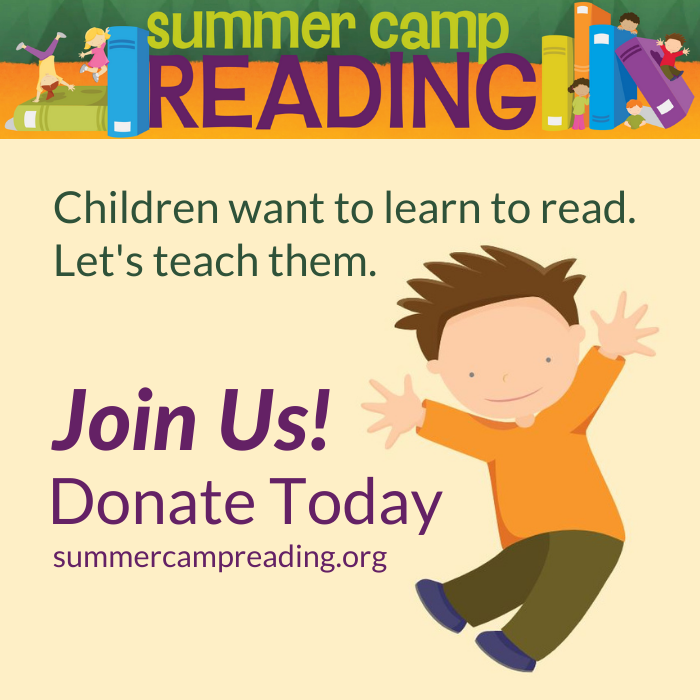
Summer Camp Reading

Summer Camp Reading

Help us Support Summer Camp Reading!

Donate Here

This year, Brave Writer is using some of our proceeds to fund an organization in Cincinnati dedicated to making reading a powerful and enjoyable experience for children 7-10 years of age.

Because Brave Writer prioritizes reading and writing, equity in education, and online access for all, we are thrilled to partner with Summer Camp Reading.

With sites in under-resourced neighborhoods and online, Summer Camp Reading works with upcoming 2nd 3rd and 4th graders who are struggling to read. The key to their success is the combination of:

  • one-on-one tutoring with reading professionals,
  • Book of the Day with crafts,
  • group work,
  • writing,
  • laptop center,
  • service project,
  • books to take home and own,
  • and a lot of fun in a nurturing environment.

Every child improves.

Their style of education is such a great match to Brave Writer’s! In fact, the organizers told me that these are camps not summer school. Don’t you love it?

We’ll be donating our Dart and Arrow books from past years to the camps as well.

Will you join us?

Your donation will increase online access for families that cannot afford tutoring, will allow them to update online curriculum and website, and to provide books for children to own.

Let’s do this together!

Summer Camp Reading

Posted in Reading | Comments Off on Summer Camp Reading

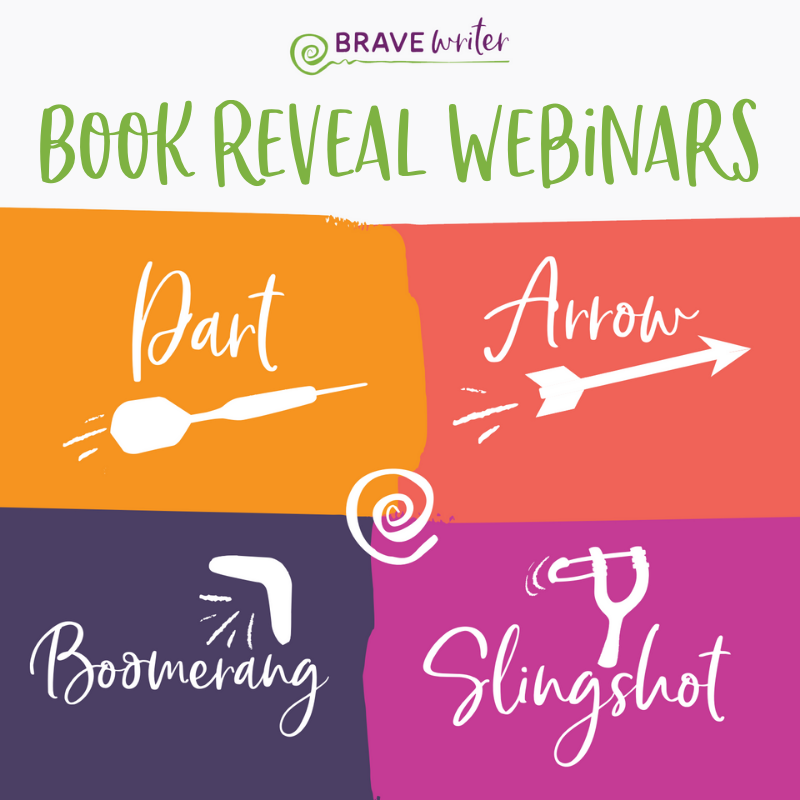
Four FREE Writing Webinars

Brave Writer Book Reveal

Here are four webinars that help you understand both the philosophy and practice of Brave Writer’s literature + writing mechanics programs for ages 8-18.

Each webinar is jam-packed with information to help you be successful this coming school year, in addition to helping you understand Brave Writer materials.

Watch the replays (links below).

Why Teach Writing Mechanics with Living Literature?

The best books, the best words—allow your children to be bathed in high quality writing while they learn the mechanics and craft of writing.

REPLAY


Effective Teaching: Grammar, Punctuation, Spelling

Our programs offer a gentle, seamless way to build strong writing skills! Julie will show you how.

REPLAY


Literary Analysis & Writer’s Craft

To grow a writing voice, it helps to listen to and learn from a wide variety of writing voices. Not only that, literary analysis can be the tool that unlocks buried treasure in a book and we intend to help you dig! We’ll also take a closer look at the NEW product called Slingshot (15-18 year olds).

REPLAY


The Sale is Almost Over Q&A

With 24 hours left (the June Special Offer ENDS June 30, 2021 at midnight), get your last minute questions answered so you can make the right purchase for your family!

REPLAY


Brave Writer Language Arts

Posted in Arrow, Boomerang, BW products | Comments Off on Four FREE Writing Webinars

Podcast: How Enneagram Types Think Critically with Leslie Hershberger

Brave Writer Podcast

What a treat I have for you today!

On today’s podcast we’re talking about the enneagram, a tool for self-knowledge. It’s a hot field of interest in the world of personality, temperament, and raising kids. A lot of what I find online, however, focuses more on the idiosyncrasies and caricatures of each type (because, let’s face it, humor!) than parsing the way we can use our self-awareness for depth and growth.

Today, we’re going to deep dive into the way our drives and motivations influence how well we think. In fact, you’ll get a much better idea of how to work with your “different-from-you” kids too!

Leslie Hershberger is one of my dear local friends and also an internationally renowned master teacher of the enneagram. I have participated in her panel work and her conferences. She’s awesome!

Because this area is new to many of you (and because some of you are uber-fans of the enneagram), Leslie is offering us a SWEET deal for her most popular course. Take advantage of it while you can!

And be sure to listen to our podcast episode together (listen below). We had fun!

For the discount code go HERE.

Use coupon code: bravewriter

Get: 25% off


The Enneagram can be a useful tool for understanding the different ways in which people perceive the world, but how can it apply to critical thinking?

Leslie Hershberger has a unique blend of wisdom, practical training, and insight. She has worked with the three-centered Enneagram approach for over 20 years as a consultant, master teacher, coach, spiritual guide, facilitator, and mentor. She’s certified in The Narrative Tradition and in Enneagram in Business and has served on the board of the International Enneagram Association.

On this episode of the Brave Writer podcast, Leslie talks about how critical thinking shows up in each of the nine Enneagram types. Some of this conversation gets into the weeds of the Enneagram system, but if you stick with it you will come away with a greater understanding of the ways people sort the world.

Listen to the Podcast

Show Notes

What is the Enneagram?

Every time we walk into a room, we apply a filter to the information we receive. The Enneagram is an examination of how we use that filter to sort and make use of this knowledge. It comprises nine different patterns of thought, emotion, and behavior. The brain can’t process all of the data available at any given time, so the Enneagram acts as a way to provide some predictability.

A quick way to see the filter in motion: imagine a friend mentions over coffee that they’ve been spending their evenings on a new crypto casino. The Observer wants to understand the technology underneath. The Epicure files it away as something novel to try. The Perfectionist quietly weighs whether it’s a wise use of the friend’s time. Same sentence, three different reactions — and none of them consciously chosen. That’s the Enneagram doing its work before the conversation has even moved on.

Every child has a different temperament from birth. It dictates how they start to look for power, control, connection, affection, security, and a sense of safety. Their natural Enneagram personality type shapes their entire personality.

The Nine Enneagram Types

First are the body types, oriented towards power and control:

  • 1: The Perfectionist
  • 8: The Protector
  • 9: The Mediator

Next is the heart center, oriented towards connection:

  • 2: The Giver
  • 3: The Performer
  • 4: The Romantic

Lastly, the head center is oriented towards security and safety:

  • 5: The Observer
  • 6: The Loyal Skeptic
  • 7: The Epicure

How Critical Thinking Shows Up Through the Three Centers

The Body:

Body types feel things strongly in their anatomy. They are defined by what they do and don’t like. They often hold a defensive position when it comes to power and control. When dealing with children who are body types, don’t push your agenda. And if you are a body type, pay attention to how your automatic and instinctual preferences come up in the present moment — and how you defend against them. Have some kindness for yourself because you’re protecting something that matters for you, and once you’ve acknowledged that, you can start to make room for other viewpoints.

The Head:

Head types can get so wrapped up in their thoughts that they miss what’s happening to others. They get so locked into their thoughts and ideas that they can even dissociate from the information. The first thing head types need to do to open up to other viewpoints is to ground themselves in their bodies. Head types need to get in touch with their feelings, otherwise they can be overwhelmed by trying to find meaning in the world.

The Heart:

Heart types focus on the “doing.” They shapeshift in order to connect with other people. They are primed to be conditioned by their environment, and they often lose their connection with how they feel inside. Understanding their past can allow them to trace their experiences forward, giving better understanding of the present.

The more you learn about your style of thinking — strengths, weaknesses, and blindspots — the more you can adapt and course-correct where necessary. There’s a reason it’s called “critical thinking:” it’s not automatic and it’s going to take work, but if we think actively and consciously call out our biases, we can all become stronger critical thinkers and better people as a result.

Resources

  • lesliehershberger.com
  • Sign up for The Centers Approach Course and get 25% off using code “bravewriter”
  • Read: “The Complete Enneagram” by Beatrice Chestnut
  • Peter O’Hanrahan: theenneagramatwork.com
  • Purchase our Intuitive Homeschool Planning Tool at store.bravewriter.com
  • Want help getting started with Brave Writer? Head over to bravewriter.com/getting-started
  • Sign up for the Brave Writer Newsletter to learn about all of the special offers we’re doing in 2020 + you’ll get a free 7-Day Writing Blitz guide just for signing up: http://go.bravewriter.com/writing-blitz

Connect with Julie

  • Instagram: instagram.com/juliebogartwriter
  • Twitter: twitter.com/bravewriter
  • Facebook: facebook.com/bravewriter
Brave Writer Podcast

Posted in Podcasts, Raising Critical Thinkers | Comments Off on Podcast: How Enneagram Types Think Critically with Leslie Hershberger

How Brave Writer Picks Books

Brave Writer

How many books do you think Dawn, our Director of Publishing, had to read to select the books featured in our Mechanics & Literature programs? I’ll wait…

Did you guess 40? 55? 70? In fact, she read over 100. 

The jigsaw puzzle of selecting books is no small feat! What follows is Dawn’s outline of how we go about putting together a year of reading with your family that leads to rich learning and family closeness. Can’t wait to share our brand new book lists with you!

What’s the process of pulling the book lists together?

  • Customers recommend books or topics
  • Staff members suggest books
  • We follow publishers to keep up with what’s new
  • We keep tabs on new and popular books on GoodReads and other book-related sites

Those recommendations go into a project and we read throughout the year—yes, we are already reading for the 2022–2023 lists! 

There’s no guarantee that a book we love will even make a list. There are lots of moving parts once we start putting the books into a sequence and stand them up side-by-side. For instance, we don’t want a string of depressing story-lines or too many books in a row that feature animals as the protagonists.

As the year progresses, we look for what’s missing—holes—in the lists. We want to ensure a year of reading that feels fresh each month, not a retread of what has already been experienced. 

We also keep in mind the books we feature in our Literature Singles—books from previous years. The trick is to find the magic TEN that will make a list (FIVE, for the Slingshot). 

What does a book need to make the cut? 

  • Amazing writing is the first hurdle for a book. That’s not to say that every book on our list has the most stellar writing—sometimes a book’s popularity with kids lands it a spot which allows us to showcase mechanics in a book your kids already enjoy.
  • We look for an engaging plot or slice of life. A rip-roaring plot can pull readers along and keep them engaged, but sometimes it’s nice to slow down and appreciate the quiet moments in life. Bronze and Sunflower comes to mind—there’s a plot, of course, but the amazing aspect of that book is the level of daily life details, and, of course, the writing. It knocked our socks off! 
  • The book needs to be appropriate for the developmental level. A book might bump up to a Boomerang or down to an Arrow or Dart depending on the themes or the vocabulary.
  • We always look for party possibilities, of course! (*wink*). Some books just scream “Party with me!” (we’re looking at you, PIE!), while other books deal with heavier topics that don’t lend themselves to a “party” atmosphere. You may have noticed that some issues refer to the book club as a “gathering” rather than a “party.” It’s a slight shift, but a good distinction to make when considering the celebration of books with heavier topics. 

What are our considerations? 

  • Library of variety. Our goal in putting together our book lists is to provide a “library of variety” in two ways: genre and representation. In terms of genre, we include historical fiction, graphic novels, fantasy, poetry, and modern fiction to name a few. In terms of representation, we look for characters and authors from a wide variety of backgrounds. We are particularly attuned to the trend in publishing called Own Voices books—meaning the author is a member of the community that is the focus of the book.
  • Filling gaps in our overall Literature Singles list. In the fall of 2019, Dawn attended an Equity in Action course for librarians. The goal of the course was to learn how to audit a collection of books by surveying the standing collection and looking for gaps in representation. Our audit helped us make selections that fill those gaps. It’s a satisfying process, even if it’s a long and ongoing one here at Brave Writer.
  • Finding windows and mirrors. You may have heard that books can be both windows and mirrors. The phrase “mirrors and windows” was first introduced by Emily Style for the National SEED Project. A mirror is a story that reflects your own culture and helps you build your identity. A window is a resource that offers you a view into someone else’s experience.  Rudine Sims Bishop expanded on these concepts with the addition of sliding glass doors that allow readers to walk into a story. Then Grant Snider, a comic artist, expanded it even further: stepping stones, overcoats, anchors, springboards, escape hatches, quiet corners, warm blankets, flying carpets, and beacons for new readers.  

We are so excited to introduce you and your kids to great literature! Read along with us this year by purchasing a year-long program: Quill, Dart, Arrow, Boomerang, or Slingshot!

Brave Writer

Posted in Arrow, Boomerang, Living Literature | Comments Off on How Brave Writer Picks Books

« Older Entries
Newer Entries »
  • Search the Blog

  • Julie Bogart
  • Welcome, I’m Julie Bogart.

    I’m a homeschooling alum -17 years, five kids. Now I run Brave Writer, the online writing and language arts program for families. More >>

    IMPORTANT: Please read our Privacy Policy.

  • New to Brave Writer? START HERE

  • FREE Resources

    • 7-Day Writing Blitz
    • Brave Writer Lifestyle Program
    • Brave Writer Sampler: Free Sample Products
    • Freewriting Prompts
    • Podcasts
  • Popular Posts

    • You have time
    • How writing is like sewing
    • Best curriculum for a 6 year old
    • Today's little unspoken homeschool secret
    • Do you like to homeschool?
    • Don't trust the schedule
    • You want to do a good job parenting?
    • If you've got a passel of kids
    • You are not a teacher
    • Natural Stages of Growth in Writing podcasts
  • Blog Topics

    • Brave Learner Home
    • Brave Writer Lifestyle
    • Classes
    • Contests/Giveaways
    • Friday Freewrite
    • High School
    • Homeschool Advice
    • Julie's Life
    • Language Arts
    • Movie Wednesday
    • Natural Stages of Growth
    • One Thing Principle
    • Our Team
    • Parenting
    • Philosophy of Education
    • Podcasts
    • Poetry Teatime
    • Products
    • Reviews
    • Speaking Schedule
    • Students
    • Writing about Writing
    • Young Writers
  • Archives

  • Brave Writer is a participant in the Amazon Services LLC Associates Program, an affiliate advertising program designed to provide a means for sites to earn advertising fees (at no extra cost to you) by advertising and linking to amazon.com

    Content © Brave Writer unless otherwise stated.

What is Brave Writer?

  • Welcome to Brave Writer
  • Why Brave Writer Works
  • About Julie
  • Brave Writer Values
  • Frequently Asked Questions
  • Speaking Schedule

Brave Writer Program

  • Getting Started!
  • Stages of Growth in Writing
  • The Brave Writer Program
  • For Families and Students
  • Online Classes
  • Brave Writer Lifestyle

…and More!

  • Blog
  • Classroom
  • Store
  • Books in Brave Writer Programs
  • Contact Us
  • Customer Service
  • Brave Writer Staff
© 2026 Brave Writer
Privacy Policy
Children's Privacy Policy
Help Center