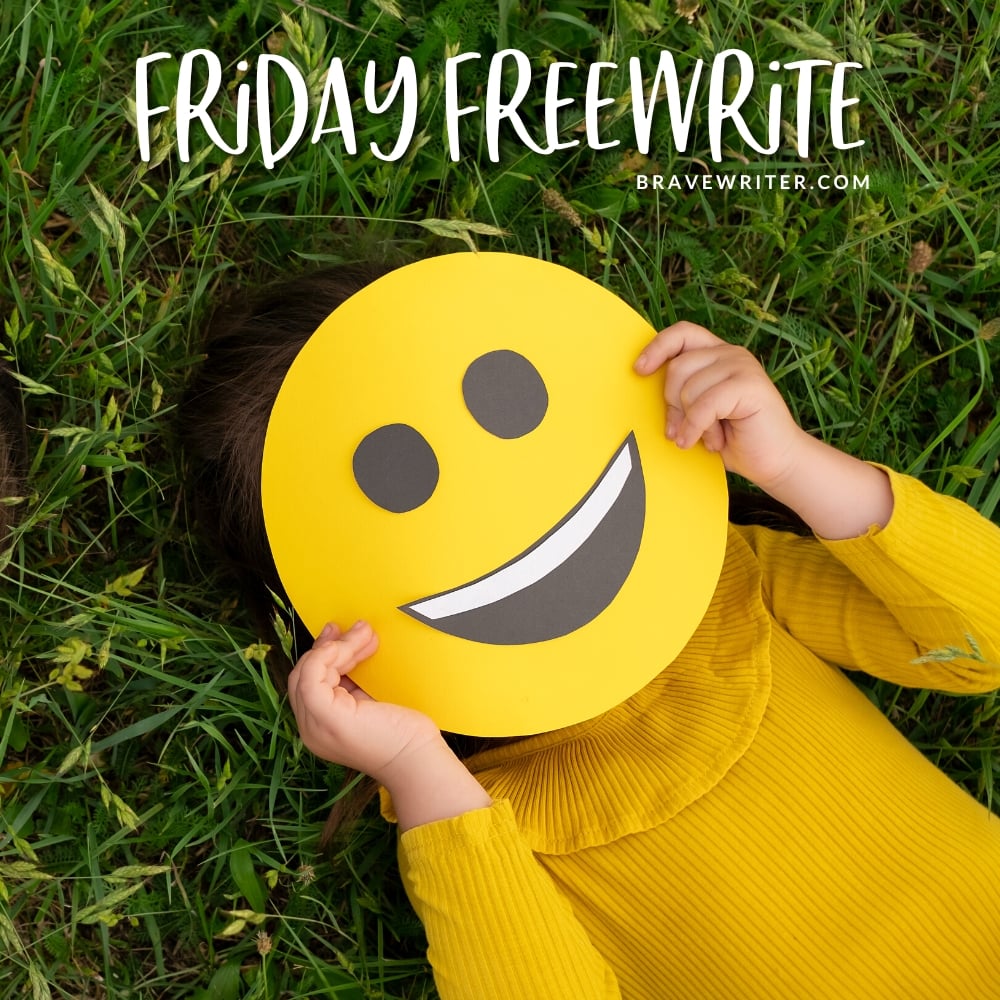
For each of your friends and family members, pick an emoji that represents them. Explain your choices.
New to freewriting? Check out our online guide.

For each of your friends and family members, pick an emoji that represents them. Explain your choices.
New to freewriting? Check out our online guide.
While the field of reading science is buzzing today with various theories, philosophies, and approaches, Brave Writer’s method stands out.
Let’s be clear, Brave Writer is not a reading program. We don’t teach phonics or whole language. We aren’t focused on reading instruction, but we do recognize that the ability to write effectively relies heavily on proficient reading skills.
Today’s podcast conversation goes beyond conventional methodologies. Figures like Thomas Jefferson learned to read without phonics, and so can your kids. We explore the essence of our Brave Writer programs.
Joining us is Melissa, our co-host, and Dawn Smith, the director of publications at Brave Writer, each bringing valuable insights from their respective realms of expertise.
The philosophy of Brave Writer
Our journey with Brave Writer began when we recognized that a significant number of children struggled with the transition from reading to writing. The common complaints from kids ranged from not having anything to write about to physical discomfort. This challenge prompted us to look beyond traditional writing programs and tap into self-expression and reader engagement.
Our approach prioritizes the individual voice of each student as something sacred. While we do offer support for traditional foundational skills like phonics and handwriting, we never sacrifice the development of each student’s unique expression. This emphasis on meaningful self-expression is how Brave Writer seeks to inspire children to write.
Capturing interest first
Our approach to creating educational content focuses on sparking interest first and achieving academic objectives second. To engage the student, we use:
For instance, in our DART program, we use a novel read aloud and pick four passages to study throughout the month. We prioritize delightful passages and fun wordplay over rigid grammar and punctuation rules. By keeping our approach lively and playful, we ensure that the learning process remains enjoyable for the child.
Embodying language
At Brave Writer, we encourage students to go beyond simply learning about grammatical constructs and instead focus on meeting and becoming familiar with them. We even employ physical activities to ensure children embody the concepts they are learning.
Our goal is to enable children to form friendships with concepts like prepositions and verbs, not just recognize them.
Writing is more than words on a page
Brave Writer places a strong emphasis on critical thinking. Writing is not just about functional literacy or self-expression; it’s also a tool to engage the world, generate insights, ideas, and construct a valuable worldview. It allows us to examine our thoughts and beliefs in the process of translating them into written words.
One of our students’ testimonies beautifully encapsulates this perspective. His mother wrote to us:
“I’m sharing this with you and your staff because I feel like this is our win, yours and mine. You already know the long-term impact of Brave Writer pedagogy, but I thought I would tell you about my mind-blowing day yesterday. We have a beautiful, gentle 16-year-old who has some developmental delays and was bullied and and pulled from school. The Brave Writer lifestyle enabled him to travel through his education, believing he was amazing. Each milestone celebrated, rich language introduced, and big juicy conversations presented in ways he could understand. He took many of your online classes and received nothing but encouragement, positive feedback, and more celebrations from your staff. He’s now in college. Yesterday, he was writing about the long-term political impacts of the Treaty of Westphalia, and I couldn’t get my head around the treaty. And he turned to me and said, ‘Let me explain this to you in a way you will understand. Think of the Thirty-Year War as the Galactic Civil War, and of France, Sweden, and German princes as the rebel alliance. They considered the Catholic Church as Darth Sidious because they thought it was secretly trying to create a world monarchy that would remove the heads of state. Then you need to consider the Holy Roman Empire as Darth Vader, who ends up on a redemption arc. It was closely aligned with the Catholic Church, but then ended up being the biggest advocate for introducing and implementing a palatable treaty to end the war.’ This is what he learned in Brave Writer, to interpolate, to present information in a format someone could understand, to use appropriate, respectful language, to love, love, love reading, and most of all, believe in himself. All the games, parties, celebrations, challenges, and thinking outside the box for solutions were worth it.”
To me, that encapsulates what we want to accomplish with every child. It’s that level of empowerment.
Brave Writer believes that every child has the potential to articulate their thoughts in a way that is both meaningful and engaging. It is through this prism that we view the journey of teaching writing, and we couldn’t be more excited about the amazing transformations it can produce.


Go forth and be interested in life! And bring your kids along. They’ll thank you for it when they get older.
Nothing is more enticing than an adult’s activities that feel a little beyond the current skills of your child.
Get off your phones and do something that is difficult for you! Let your kids come along. Hand them the tool, show them how to focus the lens of your DSLR camera, walk through a museum of art whispering to each other, groom the dog together.
The more you involve your kids in the miracle of being human, the more they learn. The more they enjoy what they learn, the more they trust you to keep bringing them that steady diet of the really good stuff.
Live your life, involve your kids, build trust, learn.
Start there.
This post is originally from Instagram and @juliebogartwriter is my account there so come follow along for more conversations like this one!


Use these 5-syllable words in a story:
New to freewriting? Check out our online guide.
Get ready for an entertaining journey into homeschooling on this episode of our podcast! We delve into an inspiring approach to education that proves learning can be:
This episode features an exciting discussion with our special guest, Lise McGuinness, a veteran preschool teacher and homeschooler (and Brave Learner Home member!) with an infectious enthusiasm for what she calls ‘party school’.

Don’t miss this episode filled with enthusiasm, inspiration, and tons of practical insights on homeschooling with a twist. Lise’s zest for learning and her party school concept may just revolutionize your approach to education at home.
Lise’s journey to homeschooling
Lise, originally on the path to become a traditional teacher, found inspiration in the works of ’60s progressive educators, such as John Holt, which instilled in her a thirst for non-conventional teaching methods. Her teaching philosophy was further influenced by the progressive preschools of Reggio Emilia, Italy, known for their child-centered approach, which emphasizes children’s competence, encourages their multifaceted language development, and promotes learning guided by children’s interests—an approach known as the emergent curriculum.
Lise’s homeschooling odyssey truly began when she discovered the Unschooling Handbook, a guide that opened her eyes to the possibilities of applying these progressive teaching methods to older grades. This pivotal revelation led her to establish a family childcare, a decision driven by her desire to apply her newfound educational perspectives while also remaining at home.
Lise’s association with Brave Writer, a staple in her teaching arsenal, traces back to her early teaching days when she resonated deeply with the concept of “Jot It Down”—an approach she had already been applying with her preschoolers. Over the years, she has integrated various Brave Writer resources into her homeschooling curriculum, such as Arrows, the Seven-Day Blitz, the Writer’s Jungle, and classes focused on movie discussions and essay writing. As we move forward, she is excitedly preparing to embark on the journey of “Help for High School,” another powerful resource from Brave Writer. This comprehensive insight into Lise’s educational journey provides a blueprint for those seeking innovative and personalized approaches to homeschooling.
Hosting a successful book party
Brave Writer book parties are unique gatherings which seamlessly blend literature discussions with enjoyable activities and social elements, transforming the often solitary act of reading into a communal celebration. The inspiration for these parties springs from the party guides included in various Brave Writer materials like the Arrow, Dart, and Boomerang. These guides propose a wealth of creative suggestions, ranging from book-specific activities and decorations to themed food ideas.
Lise recalls one notable instance of such literary celebrations that featured author Melissa Wiley discussing her book “Prairie Thief” via Zoom. Lise’s prolific club has impressively journeyed through 60 books and has a goal to reach a total of 100 books by the time the daughter graduates from high school.
To distinguish these gatherings from traditional school-based book discussions, Lise injected elements of fun and excitement. Children were encouraged to dress up, and book club meetings were turned into vibrant parties. Books like “My Side of the Mountain” and “The Wild Robot” sparked associated activities like foraging for food and crafting dioramas with natural items. Outside professionals, such as dance teachers, were even brought in for certain books like “Jazz Owls” and “The Red Umbrella,” enhancing the immersive reading experience.
To execute these events smoothly, planning ahead was crucial. Platforms like Pinterest proved useful for gathering related party ideas, and other homeschoolers like Mary Hannah Wilson served as a source of inspiration. But above all, the essence of these book parties was not just about discussing the book. The emphasis was equally placed on crafting an enjoyable atmosphere, filled with related activities, decorations, and themed food. By doing so, learning became an exciting and meaningful adventure, helping children engage with literature in a deep, yet joyous manner.
Whether they are elaborate events or much simpler endeavors, the goal of a book party is to celebrate the act of reading as a group. By bringing people together to have fun and share in the joys of reading, you encourage a lifelong habit of reading that is sure to benefit your children for years to come.