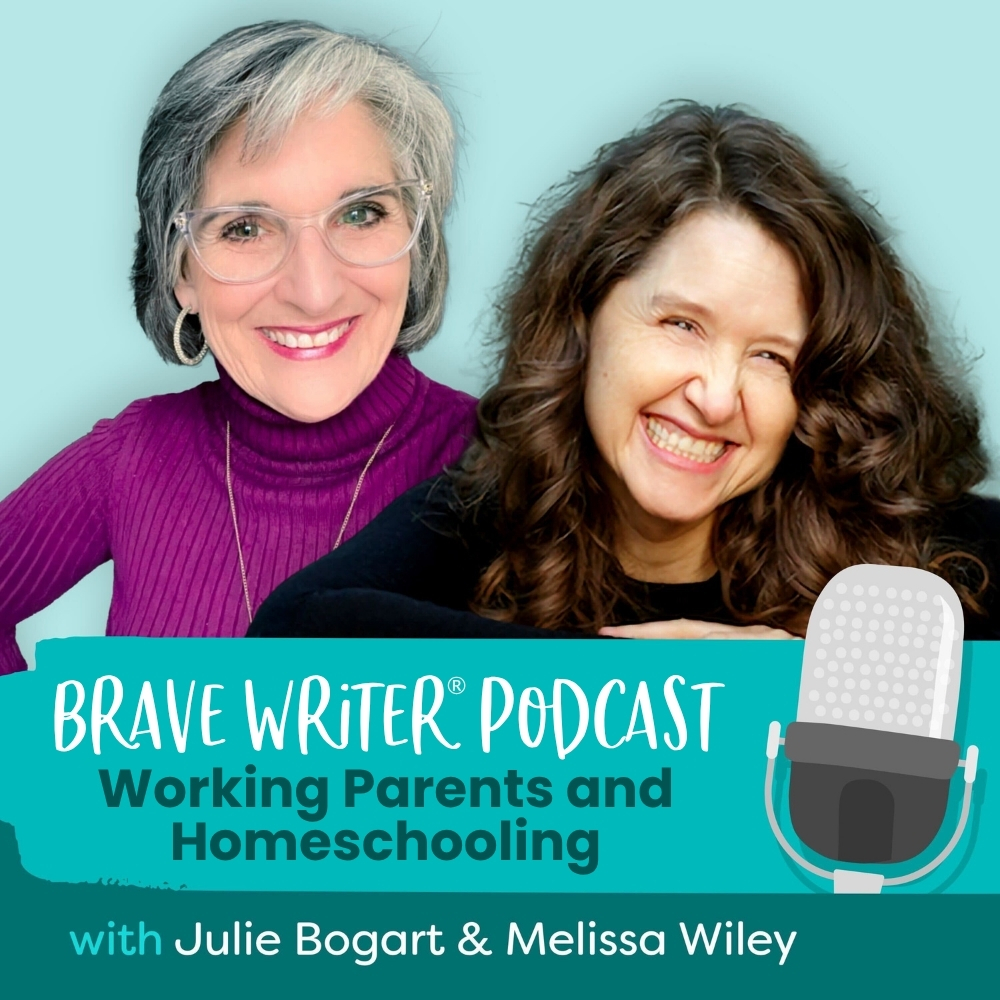
Can you really homeschool well while also holding down a job? Yes, but the answer may require us to rethink when, where, and how learning happens.
With Brave Writer president Dawn Smith joining us, we explore:
- flexible schedules,
- morning meetings,
- night schooling,
- body doubling,
- buddy reading,
- planning from behind,
- and the art of “triangling in” support.
We also look at why homeschool doesn’t need to imitate a nine-to-three school day and how ordinary moments, from breakfast to dishwashing, can become rich opportunities for connection and learning.
Come discover how work and homeschool can fit into the same family tapestry.
Show Notes
For many families, paid employment, caregiving, freelance work, and other responsibilities don’t disappear simply because we’ve chosen to educate our children at home. The good news is that homeschooling gives us something conventional school schedules don’t always offer: flexibility.
The first shift is to stop imagining homeschool as a miniature school day running from morning until mid-afternoon. Most families don’t need six hours of direct instruction. In a classroom, many minutes are devoted to transitions, classroom management, passing out materials, moving between rooms, and waiting for a group. At home, a focused block of explicit instruction can accomplish a great deal in much less time.
That leaves us free to ask a better question: Where are the pockets of time that actually work for our family?
Maybe we read biographies over breakfast. Maybe math happens before a morning meeting. Maybe history gets a leisurely Saturday afternoon. A teen who does her clearest thinking at night might do “night school” with us after dinner. Science could become a summer deep dive instead of appearing in thirty-minute increments five days a week.
Learning can also weave itself through the parts of family life that don’t look much like school.
Try planning from behind.
A conversation about a novel while washing dishes counts. So does listening to Latin vocabulary on the drive to piano lessons. When our children tell us about the books they’re reading, they are organizing ideas, remembering details, and making meaning. When we look back and notice those experiences, we’re planning from behind, giving them the credit they deserve.
Work schedules can become more flexible too.
Some of us do our best concentration work before the kids wake up. Others need a protected afternoon block while a partner takes over. When children are old enough, independent project time can create room for work. A child might even share our workspace, quietly drawing, reading, or building LEGO while we work beside them. That kind of “body doubling” can satisfy a child’s desire for proximity without requiring our constant participation.
We also don’t have to do all of this alone.
A spouse, mother’s helper, grandparent, tutor, online class, homeschool friend, or childcare provider can become another point of support. We sometimes call this triangling in help. For a parent who works full time outside the home, that support may be essential rather than optional.
And yes, there will be trade-offs. We might work from the corner of the library while our kids attend an activity instead of chatting with the other parents. We might say no to an outing because our work block matters too.
The goal isn’t perfect “balance.”
Family life rarely distributes itself into neat, equal portions.
Instead, imagine a tapestry. Work, appointments, activities, and responsibilities form part of the structure. Learning threads its way through all of them. The pattern changes as our children grow, our work changes, and new needs emerge.
We aren’t trying to preserve one perfect homeschool schedule forever. We’re creating a family culture flexible enough to change with us.
Resources
- Registration is open now for Registration is open now for Playing with Poetry: Discovery and many other Brave Writer classes!
- Check out the special offer at Talkbox.MOM/brave and start speaking a new language with your kids from day one!
- Start a free trial of CTCmath.com to try the math program that’s sure to grab and keep your child’s attention
- If you’ve ever thought of trying out online music lessons, now is the time! Claim your free Maestro Music lessons at Maestromusic Free Music Lessons for Brave Writer Families | Maestro Music.
- Find our favorite readalouds and nonfiction in the Brave Writer Book Shop
- Visit Julie’s Substack to find her special podcast for kids (and a lot more!)
- Purchase Julie’s new book, Help! My Kid Hates Writing
- Melissa’s books make great readalouds—and there are Darts for The Prairie Thief and The Nerviest Girl in the World.
- Find community at the Brave Learner Home
- Learn more about the Brave Writer Literature & Mechanics programs
- Subscribe to Julie’s Substack newsletters, Brave Learning with Julie Bogart and Julie Off Topic, and Melissa’s Catalog of Enthusiasms
- Sign up for our Text Message Pod Ring to get podcast updates and more!
- Send us podcast topic ideas by texting us: +1 (833) 947-3684
- Interested in advertising with us? Reach out to media@bravewriter.com
Connect with Julie
- Instagram: @juliebogartwriter
- Threads: @juliebogartwriter
- Bluesky: @bravewriter.com
- Facebook: facebook.com/bravewriter
Connect with Melissa
- Website: melissawiley.com
- Substack: melissawiley.substack.com
- Instagram: @melissawileybooks
- Bluesky: @melissawiley.bsky.social
Produced by NOVA