Format writing teaches kids to solve the “puzzle” of the assignment rather than teaching kids to tap into their writing voices. #homeschool
— Julie Bogart (@BraveWriter) September 29, 2013
Not puzzle-solving, but voice-finding
Brave Writer spotlight: Maya
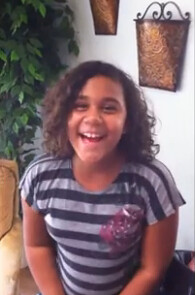 Our students are not just Brave Writers, they’re Brave People. Take nine-year-old Maya, for example. She’s making friendship bracelets to raise money for her uncle’s medical treatment. Her mom writes:
Dear Julie,
Since purchasing the Writer’s Jungle and following your tips/tricks, I’ve been thinking about writing in a whole new light. I cannot begin to tell you how Maya has grown in her writing abilities. Not only that, she’s so verbal now. To me, to friends, to strangers, she’s no longer timid. She realizes now that she has a voice. She appreciates direct eye contact and notices right away if she’s getting full attention or not, and she lets me know about it. Thank you for making me understand that conversation is a first step in writing. I never thought of it that way until you showed me the light.
Our relationship has grown so much just by having great conversation. SHE is growing by having conversation. Over the weekend, she expressed an interest in raising funds for her Uncle Josh. (My brother, who has a severe traumatic injury, in need of Hyperbaric Oxygen therapy.) So we went to my mom’s and made a video to start an online fundraising campaign. I don’t think she would have had the courage to do this just a few short months ago. But because of your encouraging and uncomplicated writing advice, she is gaining valuable skills. Skills that I wouldn’t have recognized before. Like organizing her thoughts to make cohesive statements and becoming a confident speaker. I’m sure you can think of many more.
I thought you might like to see the video (silly as it is) and to thank you for your practical, no-nonsense, simple yet profound advice that is turning my little nine year old into a deep-thinker, with compassion and determination. Who would have thought that talking could do all of that?
Thanks again,
Misty
Pick a passion

This year, as you plan, pick an area of interest for yourself. It could be learning how to cultivate African violets (that was mine!) or how to quilt. It could be art history or learning to play acoustic guitar. It might be studying personality types through the enneagram or exploring the skies with a telescope. You might be fascinated by therapies for language impaired kids. You might ache to hike the gorge near your house.
Perhaps you want to become a blogger or start a business organizing people’s homes for them. Maybe you wish you could cut hair or learn Latin. What about geo-caching or running a marathon?
You might paint, pot, or write slam poetry.
You can learn algebra from the ground up, just because you want to prove to yourself that you are smart enough to learn it.
Growing an herb garden so you can make your own pesto, dying wool to knit, sanding the old kitchen table and painting it turquoise blue, joining a fantasy football team online…
Any of these constitute learning that is yours, that engages you with the world around you and the process of learning. Not all of what you do has to have immediate applicability to homeschool, either. You don’t have to pass on what you are learning, though I promise it will bleed into the rest of your lives together.
When you make time for your own learning, you discover what it is to learn—to self-teach. You discover how you evaluate what fosters learning and what constitutes a dead end. You engage a process that teaches you what teaches.
All of you benefit when you become a curious, self-guiding, learner in your own right! Go sign up for that yoga class or enter grad school for history, just because.
Be a labor coach or a La Leche League meeting host.
Bike. Swim. Read the entire Jane Austen canon and then watch all the films that go with it.
Write a novel in a month.
Make your own ice cream.
Take tap lessons.
Hang dry wall.
The world is not just waiting for your kids to grow up. It’s waiting for you too. Get out in it. Explore it. Enjoy it. Live it—with your kids, in front of your kids, for yourself.
Cheers!
Image by Abigail Batchelder
Friday Freewrite: Birthday
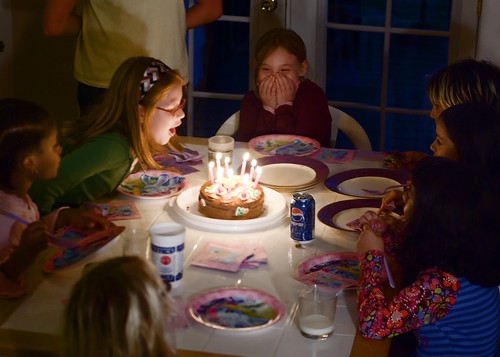 Image by Jesse Milan
Describe the last birthday party you attended (yours or someone else’s).
New to freewriting? Check out our online guide.
For single parent homeschoolers and their friends
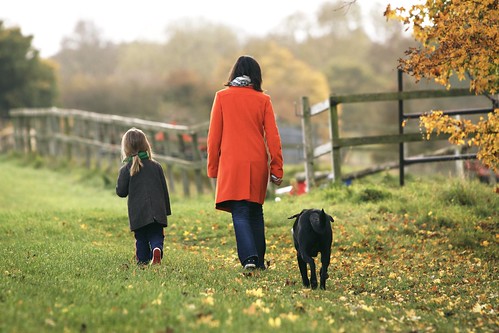 Image by Henry Scott
It’s hard enough to home educate when you have a partner who supports you, runs to the grocery store, and earns the primary income.
It’s a whole other level of commitment to home educate when you are on your own—through divorce, due to the untimely death of your partner, or because you never married to begin with.
Homeschoolers are typically found in two parent families because one is required to earn the money so the other can stay home. Eliminate the wage-earner, and most kids wind up in school while the single parent works. (It’s at those moments that single parents feel grateful for that state-funded option, too, and rightfully so.)
My goal in this little update is to give support to those parents (most often mothers) who want to sustain their homeschooling commitment, while working and parenting on their own. I have a little advice for the friends of those parents, too.
For single parent home educators:
You’re okay. You aren’t sub-standard nor are you “not quite as good” as your married friends. You are on your own (un-partnered) for good reason or a reason you couldn’t control. This is the right life for you, right now. You are just as able to raise healthy, emotionally grounded, well-educated kids as the next married person. In fact, in some cases, the fact of being alone has introduced peace and health, or closure to a long struggle. Your family now has a chance to relax, to be, to find their footing and a new way. Relish it. Home education is a wonderful space to grieve, and draw close to each other, too. Consider yourself fortunate that you can keep that going.
You don’t have to spend a lot of money to homeschool. The library, museums, co-ops, borrowing hand-me-down curriculum, used book sales, and your own ingenuity can go a long way in home education. Be careful not to envy “four color school texts.” You can do a lot with a little.
You can’t do everything alone, but neither can your married, partnered friends. You all need each other. Be in a support group or a co-op or some kind of online community where you can vent, ask questions, and share your needs. Pick a non-judgmental group. You need support, not scrutiny.
Your business is your business. You don’t owe explanations or details of how you came to be single to anyone, particularly the casually curious. Protect yourself from unneeded gossip.
Take care of you. You will need adult attention. Date, go out with girlfriends, take personal days for yourself. Hire a babysitter, or swap with a friend who would love you to watch her kids free-of-charge. You need to remember what it is to be an adult woman, not just a mother, homemaker, and educator. It will help you in the long run, and your kids want to see you thrive, not be a martyr.
You don’t have to homeschool “better than Jesus” to offset whatever awful thing happened in your family. You get to do your best job, like everyone else, and trust that that is enough. It is not up to you to lay on healing hands. Your job is to love your kids, and educate them. Same as everyone else.
My California-born advice is: get therapy for everyone. Do it in rotations, if you can’t afford it. Or join a twelve-step group, or divorce recovery, or a grief support group. This stuff really helps all of you (all of us!) to recover and grow.
If you work from home, hire a babysitter for some of those hours so there are times when you are working (clear to everyone) and your kids are still tended to. This matters. If you work outside the home, homeschool when you are home. Even if it’s at nighttime and on the weekends. It’s tough to expect kids to monitor themselves every day, all day, all the time. You are essential to your homeschool.
Make sure homeschooling is working for all of you. It’s okay to reevaluate, or to have some kids go to school and some stay home. Take it a year at a time, a child at a time.
For the friends of single parents:
Affirm the new life your friend is embracing. Remind her of all the wonderful opportunities that come with this (wanted or unwanted) freedom/change.
Help her out! If she needs someone to drive with her to the mechanic so she isn’t stuck there for three hours, that’s a big help! One adult in the home means that there isn’t that second person for things like two different kids at two different sports’ practices at the same time, or taking one kid to get stitches while someone watches the other four. Offer to be that middle of the night friend she can call any time.
Share your materials! Give her the stuff you aren’t using, share stuff (she can teach with you or you can swap lessons for one subject). If you’ve got money, buy something for her (a second of what you’re buying). It’s amazing how helpful/inspiring that can be.
Go out together to a movie or for dinner. Get her out of the house.
The best thing you can do for the single person is to see that person as whole, and his or her family as a family (not as a broken family). It’s awful to feel like a second-class citizen in the world of homeschooling. A well family isn’t necessarily a two-parent family. After all, there are plenty of dysfunctional married couples and families out there. A single-parent family deserves the same faith that it can be wonderful as a two-parent family.
A final word from me: Single parents are important to me. I love to help them, in particular. Feel free to contact me with the specifics of your situation, and I’ll help you in any way I can.
Cross-posted on facebook.