A Brave Writer's Life in Brief - Page 535 of 779 - Thoughts from my home to yours A Brave Writer's Life in Brief
  • Start Here
    • For Families
      Multiple Ages
    • Ages 5-7
      Beginning Writers
    • Ages 8-10
      Emerging Writers
    • Ages 11-12
      Middle School Writers
    • Ages 13-14
      High School Writers
    • Ages 15-18
      College Prep Writers
  • Shop
    • Product Collections
    • Bundles
    • Writing Instruction Manuals
    • Literature & Grammar/Punctuation
    • Composition Formats
    • Literature Singles
    • Homeschool Help
    • Book Shop
  • Online Classes
    • Class Descriptions
    • Class Schedule
    • Classroom
    • How Our Classes Work
    • Our Writing Coaches
    • Classes FAQ
  • Community
    • Brave Learner Home
    • What’s Happening
    • Blog
    • Podcast
    • Calendar
  • Cart
  • My Account
    • My Online Classes
    • My Account
  • My Account
    • My Online Classes
    • My Account
  • Start Here

    If you’re new to Brave Writer, or are looking for the best products for your child or family, choose from below:

    • For Families
      Multiple Ages
    • Ages 5-7
      Beginning Writers
    • Ages 8-10
      Emerging Writers
    • Ages 11-12
      Middle School Writers
    • Ages 13-14
      High School Writers
    • Ages 15-18
      College Prep Writers
  • Shop

    If you’re already familiar with Brave Writer products, go directly to what you’re looking for:

    • Product Collections Browse the full catalog in our shop
    • Bundles Everything you need to get started
    • Writing Instruction Manuals Foundational Writing Programs
    • Literature & Grammar/Punctuation Grammar, Punctuation, Spelling & Literary Devices
    • Composition Formats Writing Assignments for Every Age
    • Literature Singles Individual Literature Handbooks
    • Homeschool Help Homeschooling Tools and Resources
    • Book Shop Books associated with Brave Writer Programs
  • Online Classes
    • Class Descriptions
    • Class Schedule
    • Classroom
    • How Our Classes Work
    • Our Writing Coaches
    • Classes FAQ
  • Community
    • Brave Learner Home
    • What’s Happening
    • Blog
    • Podcast
    • Calendar
  • Search
  • Cart

Search Bravewriter.com

  • Home
  • Blog

A Brave Writer's Life in Brief

Thoughts from my home to yours

Make a Mess

I received an email from a mom whose daughter struggles with perfectionism and anxiety (maybe spectrum issues too). She writes:

“When my little girl gets stuck, she gets stuuuuuuck. Because she continues to inadvertently invert the letter S, the entire page of copywork is “ruined”…and so is the rest of the day.”

Do you have a child like that? Won’t write unless every word is perfectly spelled or masterfully handwritten? If he detects a single mistake, he gives up or throws a tantrum or cries?

Maybe you have a daughter who is so careful, that she writes really slowly and loses track of what she was trying to say and so wilts into tears because she finds writing so tedious, so laborious, so hard.

What do we do?

Often, in the face of reading or writing failure, we homeschool parents scour the Internet, badger our friends, and consult specialists for a better method to ensure successful results. We want to protect our children from feeling like failures so we try to find a way to help them never fail—to get the right spellings every time, or to guarantee that they never forget which way the “b” goes.

In other words, we inadvertently reinforce the perfectionism!

When those programs don’t work (since no child or adult can achieve perfect writing every time they write), we change our story and tell our kids that it’s okay to make mistakes. But by then, our sweet children have internalized the perfectionist standard and made it their own. They won’t be okay while mistakes are on their papers, no matter what you say to them.

Conversations about progress and growth rarely impact kids. They need concrete experiences to change how they see reality.

So my advice to the mom of the girl of the backwards ‘s’? This is what I wrote to her. Maybe it will help you too.

“So do a whole page of backwards s’s. Deliberately have your daughter make big mistakes. Tell her you want a whole page where nothing is right—where she tries to trick you with her outrageous spellings and handwriting gaffes. Ask her to see how many letters she can do upside down or backwards. PLAY with writing. Take away the zero sum game. Help her to get into play.”

There are all kinds of ways to get out of the perfectionist rut, and trying harder to be perfect isn’t one of them. See if any of these will help you and your stressed out kids.

  • How about using alphabet tiles to spell rather than handwriting? What if you play a game? You trade turns picking letter tiles: you pick “C” and she picks “A” and you pick “T” and then say the word. Then…
  • What if you make words that don’t work? “C” followed by a “T” followed by a “W” followed by a “U.” Try to pronounce it. Why doesn’t it work? What is the mouth doing? Create nonsense words that can be pronounced and those that can’t. What’s the difference? Talk about it, while pushing tiles around.
  • For writing: wrinkle the page. Scrunch it up into a ball, smooth it out. Now do copywork or freewriting.
  • Use the back side of a flyer for writing. (Unconscious message: can’t be perfect – paper is already not perfect.)
  • Write with markers. Or paintbrushes. Or crayons.
  • Make an entirely writing-unrelated mess before writing. Get really dirty (play in the mud), or make muffins and let your hands messy. Then write.
  • Write about messes. Tell your kids they have to make the writing messy, too. Put out a variety of pens and highlighters. Write with them and show them the mess you are making in copywork or freewriting. Make it a weekly writing practice for a bit.
  • Crowd the table with so much stuff, there’s nowhere to write. Tell your kids they have to find some hidey hole place in the house to write (a cramped tight space).
  • Write in the dark. Turn out the lights and write on the page without seeing your handwriting.
  • Write really really tiny. Scrunch it all down. Now write on the next several lines, REALLY REALLY BIG! Take up several lines with each letter.

Are you getting the idea? Stop feeding perfectionism. Play. Do all of these alongside your kids. You write. You make mistakes. You make a big sanctioned mess along with your kids. Laugh at your mistakes!

Be more exploratory and less focused on ‘right’ and ‘wrong.” Help your kids to play with phonetics and handwriting, rather than helping them “get them right” all the time.

There’s obviously room for growing and learning correct spellings. Original writing is not that time. Ever. Original writing is about thought, content, ideas—dictated to a parent who writes them down, or handwritten in whatever way seems right to the child in the moment. As that child ages and grows in mechanics using someone else’s writing, some of those skills will show up in original writing.

The worst thing you can do is expect mastery of mechanics and spelling in original writing. That requirement erases content like acetone on a painted nail. Who can possibly have fun thinking thoughts if worried about which direction the letter ‘s’ goes? Seriously!

If your child is stressed by copywork and its demand for accuracy and perfection, why can’t you take those shackles off for a month? How about subverting that expectation with freedom to explore? Freedom to try different handwritings? Can you slope your alphabet the other way? Can you make it big, small, really squiggly, really straight?

I remember when I was getting married that I tried 50 different signatures to find the one I liked best. Why can’t our kids try 10 different handwriting styles and 10 different spellings and 10 different sizes for their work?

Let it all go. Declare this month as “getting it all wrong on purpose” month and then really go for it. Push the boundaries and break the rules. Make messes on paper. Play with handwriting. Open the space for creativity, not just accuracy.

If you can minister in the opposite spirit, if you can let yourself go, your kids may have a chance to find their internal freedom and permission-giver as well. They will discover that they are free—that nothing existentially bad happens to them when they explore language in writing. That’s when learning can happen. That’s when breakthroughs can occur.

All the teaching you want to do is possible when your children know the space is emotionally safe for risk-taking.
Posted in Homeschool Advice, Writing about Writing | 2 Comments »


Yes, it is enough

I got a call from a sweet mom of three (8, 6, and toddler). She had ordered Arrow and Jot it Down, and her question was one I imagine many of you have. Here it is:

“If I do the Brave Writer Lifestyle—watch a movie once a week with my kids, go on nature hikes, read books aloud, have poetry teatimes, do copywork and dictation each week, enjoy art, play with language, jot down the cute things my kids say, do the one writing project per month pace with them, talk to my kids—is that really enough?”

My answer: “Yes. It’s enough.”

Here’s why. Growth in writing is not all that different from growth in speech. It’s doubly difficult, however (you have to coordinate two competing parts of the brain for mechanics control and idea/thought generation). So I like to say it takes five years to become fluent in speech and ten to become fluent in writing. If you start your writing life in earnest at age 8, fluency will “kick in” at age 18.

In the meantime, remind yourself how you led your children to become fluent speakers. Remember? You talked with them. You modeled speech, you celebrated their misspoken words, you put them in contact with lots of native speakers, you gently corrected them when they flipped around words or syllables, or when they picked the wrong tense or nominalized a verb with the wrong suffix. You gave them literal sentences to say when it mattered to you that they got it right (like how to answer the phone or thank Grandma for the gift). You did all of this naturally, without thinking! And your kids turned into fluent speakers.

Naturally writing has components that speech doesn’t. That’s why it takes longer. But the style of instruction can mirror what you did in speech. You can enthusiastically share writing with your kids (reading it aloud), you can teach your kids to read. You will converse with them about the stuff that matters to them and jot some of it down. You will enthusiastically share what they write with others. You will show them how valuable it is to copy the writing of professional authors to get a feel for the competent use of language, to become familiar with punctuation conventions, to gradually improve handwriting coordination and dexterity.

You can make writing a meaningful part of your life right in front of your kids—leaving notes, making lists, sending texts, writing blogs and emails and letters, journaling, signing cards… You can choose to live your writing life in front of your kids every day and help them to emulate what you do.

When you include movies, art, television, nature, and poetry in their literacy diets, they find themselves:

  • thinking in story-form,
  • attending to nuanced vocabulary,
  • paying attention to theme and subtext (unconsciously, but nevertheless doing it).

This really is enough. Scratch that. It is more than enough. It is what works. In fact, it works so well, it continues to depress me that writing isn’t taught this way everywhere.

What isn’t enough is…

  • workbooks.
  • memorizing rules and detaching mastery of mechanics from meaningful communication.
  • hammering home assignment after assignment, without a child’s invested interest.
  • assuming that once your children can handwrite, they should be able to write fluently with spelling correct and complete content without any help from you.
  • assuming that grades and red marks teach a child to write.
  • “doing” writing during “school” but not valuing it during the rest of the day.
  • expecting a child to write well just because that child is 10 or 13 or 16!

Vocabulary building comes through language play, reading widely, and listening to trained actors (and other adults) use it well.

Writing skill comes from practicing the skills of writing without regard for scopes and sequence, but through repeated opportunities to explore language in writing (without pressure, with care and conversation).

So yes. This works. This Brave Writer Lifestyle is just the name I give for what ought to be a natural (mostly) process of instruction. Brave Writer exists to support you in that process (like a book on breast feeding helps you to nurse your infant more successfully even though breast feeding is a natural process).

A life richly textured with a love of words, supported by parents who model and explain how the writing process happens inside a person’s head and hands, embellished by lively experiences that foster a craving to share thoughts, memories, and insights with others leads to quality writing.

Oh, and the Internet. You can’t forget what a powerful tool it is in the development of writing fluency. The single best writing machine out there – even if sometimes you pick up a bad writing habit or two. The benefits of writing on the Internet far outweigh the disadvantages.

So there you have it!

  • Play with words.
  • Get some of them to the page.
  • Marvel at the words of others.
  • Copy some of them.
  • Get out into the world of language (art, nature, film, plays, poetry).
  • Celebrate writing in your daily life.
  • Be fascinated by the mind life of your child (more than impressed by mastery of some format).
  • Read and write online.
  • Model and support the journey from thought to word to page to revised idea to polished copy.

By 18, you’ll have a fluent, competent writer.

It really is that simple!

Posted in Homeschool Advice, Writing about Writing | 4 Comments »


Poetry Teatime: Jumping in with both feet

Poetry Teatime

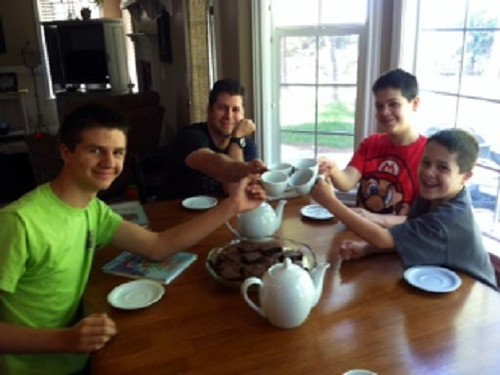
My goal for school this year is to more fully implement a Brave Writer Lifestyle. Ever since I started planning our school year, I’ve been so excited to start Tuesday Tea Time. We’ve done it off and on before, but this year I wanted to jump in with both feet and really implement it more consistently as well as the other components of the Brave Writer lifestyle. With this in mind I’ve been on the lookout for a real but inexpensive tea set. I also didn’t want something fancy, as I have four boys and no girls. Last week I came across this great little, all white tea set for under $20 and I had to buy it up! Then I ran to the store and bought four different types of Koolaid (for tea) and a box of brownie mix. We started school last Wednesday and I couldn’t wait for Tuesday to finally get here!

We piled all of our poetry books on the kitchen table, set out our tea cups and saucers, sliced some brownies and put them on a lovely glass tray, and our Tea Time officially began. We read from a book called “Forget-Me-Nots: Poems to Learn by Heart” , from “Kids Pick the Funniest Poems”, and from a little book called “The Wonder Book.” While technically not a book of poetry it has so many fun language “treats” it seemed like the perfect addition to our tea. It includes poems, palindromes, lists, word games, and just generally amusing word play. Dad didn’t read from a book. He recited the poem “Invictus” from memory. Although we’ve heard him recite it several times, we enjoy hearing it and watching him get choked up as he finishes with a stirring, “I am the captain of my soul.” This is going to be, by far, my favorite thing we do this year. I can’t wait until next Tuesday.

~Shalynn

Visit our Poetry Teatime website!

Posted in Poetry Teatime | 1 Comment »


Meet their needs, and some day they’ll meet yours

Don't expect yr kids to meet yr emotional needs. Meet theirs. One day, they'll try yr tactics on you, testing them for future relationships.

— Julie Bogart (@BraveWriter) September 30, 2013

Posted in Brave Writer Philosophy | Comments Off on Meet their needs, and some day they’ll meet yours


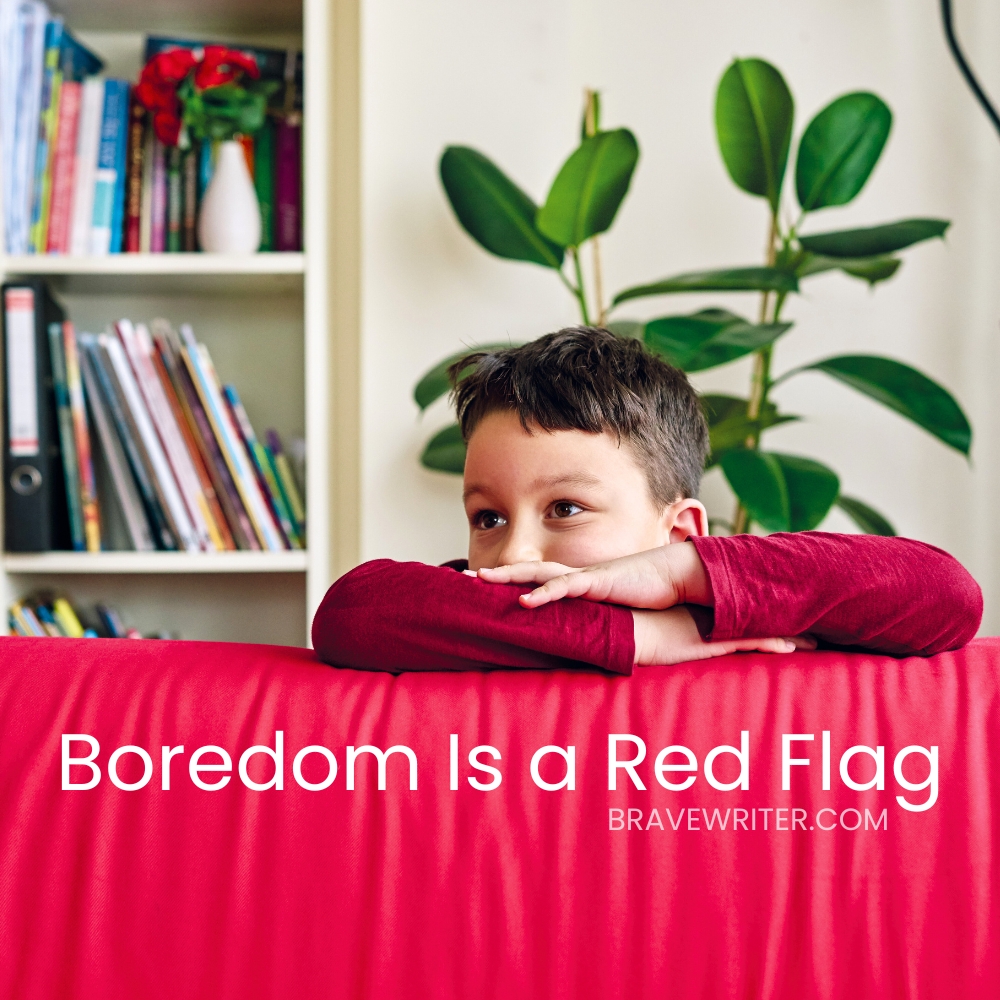
Boredom Is a Red Flag

Brave Writer

“I’m bored.”

Words no parent wants to hear.

My dad, unhelpfully, used to reply to us that we had no idea how valuable our free time would appear to us as adults, and that we shouldn’t waste it since we’d never get it back.

Like I said: Unhelpful.

In that moment, I was genuinely bored, as a kid with free time. I didn’t know what to do with myself. My declaration was a cry for help (ideas, materials, suggestions, participation). It wasn’t a philosophical musing in need of expansion.

Boredom is a signal!

It’s a sign that something needs to change about the environment or your interactions with your kids. It is not an indictment on a child’s ability to self-soothe or auto-entertain.

Some parenting “experts” suggest leaving your child in a bored condition, as though once bored long enough, stores of creativity will rush forward. The advice goes something like this: “It’s okay for your children to be bored. If they are bored long enough, eventually they will become creative geniuses because they had nothing better to do.”

Only that isn’t what happens. If you leave a child bored long enough, they typically whine louder, get into mischief, or pick a fight! Boredom doesn’t ensure creativity, problem solving, or learning. Deliberately fostering an environment that produces boredom is cruel.

The experts aren’t entirely out of line in their hope that a child without something to do will find something he or she wants to do, and it will be fresh and new. But boredom doesn’t take anyone there.

There’s a difference between “boredom” (a feeling of futility) and “pause” (the let-down after a rush of activity). Sometimes a child is simply recalibrating after a vacation or visit from his best friend or post-birthday party. A soothing “downtime” activity like watching a DVD or taking a bath or going for a walk with the dog may be just the transition needed.

The way to address the “I’m bored” comment that comes from “nothing to do” is not to shame it or blame it. Rather, you want to create “space” for newness, for freshness. It’s okay not to plan all the activities for the day. It’s okay to let children explore their environment in search of something new to do. What isn’t okay is leaving them to search in a tedious, empty-of-possibilities environment. That’s what produces boredom and “I can’t think of anything to do.”

Your job is to keep a home that is flexible enough, well enough stocked, surprising enough (on many occasions, not just once-in-a-blue-moon), and accessible enough to your kids. It should be a home where kid activity is welcomed. It should be a home where messes are freely made.

Like this:

Put an arts and crafts table in the middle of the main room in the house (not the basement, not in a corner of a room no one is in, not in the child’s bedroom). The arts and crafts table ought to be where the family hangs out. It should hold materials like paintbrushes in tin cans, watercolors, finger paints, paper for painting. It should have scissors, sponges, polymer clay, scotch tape, pipe cleaners, markers, pencils, and stencils all in little bins or on trays. Hang out-of-use men’s dress shirts on a nearby hook to wear over clothes to protect your kids from staining their shirts and shorts. The table can be covered in contact paper for ease of wiping messes after they are made. Containers for water to dip brushes ought to be available too. A trash can can be tucked under the table for scraps of cut up paper or used up materials. Art books with real art in them make great models for inspiration, too.

In our family, I mounted a bulletin board right above the arts and crafts table so paintings and drawings could be hung right away. We also strung a clothing line across the room and used clothespins to hang masterpieces.

Clear the coffee table. At bedtime, put out the “new” item you want your kids to find in the morning on the now cleared surface. It might be a new set of jacks, pick up sticks, or a book that teaches knitting with needles and yarn waiting. Perhaps you leave a snorkel and goggles on the table and when the kids wake, you let them know you are off to the beach or swimming pool. Put out a new board game (Sorry, Risk, Stratego, Spinergy, Clue, Life). A stack of beautiful note cards and pens (maybe even calligraphy or fountain pens!) with a list of addresses, stamps, and sealing wax for the envelopes could cause even reluctant writers to send letters to grandparents, aunts, and cousins. Bouncy balls will create a chaos of fun, as will a bigger ball for handball against the garage door. Teach them how to play. Sidewalk chalk for hopscotch—so much fun! Make your own markers out of polymer clay. Buy a book of origami and a stack of the beautiful squares of paper. Make paper cranes!

Invest in technology. Buy the game or camcorder or iPad. It’s the future. It’s worth turning your kids loose to discover how these work. They will show you things to do on your device you didn’t even know were possible. Know that they will break them all eventually. Be prepared for that outcome. Do not “loan” your precious tool to your kids. Get them their own.

Make the kitchen kid friendly. Bored kids often become engaged when they are making real stuff. Food is about as real as it gets. Let them make the lunch or afternoon snack. If you are ambitious, they can do dessert or the entire dinner. Find recipes that are kid friendly (English muffin pizzas, ice cream sundae bar, omelets, hamburgers, shish kabobs, stir fry, cupcakes, wraps, Mexican food, chili). Someone can lay the table with place cards and a centerpiece.

Dress up clothes and face paints: these two together provided untold distractions for my children. What I discovered, though, was that they liked it better if an adult did the face painting because the results were clean and satisfying. They also liked involving me (and a friend who was a lot better at face painting than I was!). We also would say: “Give us a show at ________ o’clock.” That kind of time frame helped the kids to not just play but to know there was a check-in time with the parents too (the kids weren’t being “sent away” because they were annoying, but to produce something to share).

Be the buddy. Play the card game, jump the rope, watch the movie (for the jillionth time), bake the muffins, paint, model, dress up. You deserve to play too. Your kids deserve to have your involvement. The goal isn’t to get them to stop being bored so you can have a break. The idea is to create conditions that lead to self-started entertainment. Sometimes that happens best when you’re a participant.

Lastly, boredom is a fact of life. Kids are notoriously short on patience for the “next thing.” They want to be doing it right now! Suggesting that they clean their rooms is not useful.

Make a big list (with the help of your kids) of all the activities possible in your home that children and teens can do alone. Post the list to the refrigerator and send your children to it to consult when they forget what they can do. Put supplies in obvious places so that they get inspired. Kids don’t find activities in their heads. They find them among the items they encounter in the house. Don’t hide all that good stuff behind cabinet doors!

Make sure there is nothing on the refrigerator list that still needs to be purchased! Nothing worse than getting that perfect idea of what to do only to find out that you are out of paints or batteries.


Brave Learner Home

Posted in Homeschool Advice | Comments Off on Boredom Is a Red Flag


« Older Entries
Newer Entries »
  • Search the Blog

  • Julie Bogart
  • Welcome, I’m Julie Bogart.

    I’m a homeschooling alum -17 years, five kids. Now I run Brave Writer, the online writing and language arts program for families. More >>

    IMPORTANT: Please read our Privacy Policy.

  • New to Brave Writer? START HERE

  • FREE Resources

    • 7-Day Writing Blitz
    • Brave Writer Lifestyle Program
    • Brave Writer Sampler: Free Sample Products
    • Freewriting Prompts
    • Podcasts
  • Popular Posts

    • You have time
    • How writing is like sewing
    • Best curriculum for a 6 year old
    • Today's little unspoken homeschool secret
    • Do you like to homeschool?
    • Don't trust the schedule
    • You want to do a good job parenting?
    • If you've got a passel of kids
    • You are not a teacher
    • Natural Stages of Growth in Writing podcasts
  • Blog Topics

    • Brave Learner Home
    • Brave Writer Lifestyle
    • Classes
    • Contests/Giveaways
    • Friday Freewrite
    • High School
    • Homeschool Advice
    • Julie's Life
    • Language Arts
    • Movie Wednesday
    • Natural Stages of Growth
    • One Thing Principle
    • Our Team
    • Parenting
    • Philosophy of Education
    • Podcasts
    • Poetry Teatime
    • Products
    • Reviews
    • Speaking Schedule
    • Students
    • Writing about Writing
    • Young Writers
  • Archives

  • Brave Writer is a participant in the Amazon Services LLC Associates Program, an affiliate advertising program designed to provide a means for sites to earn advertising fees (at no extra cost to you) by advertising and linking to amazon.com

    Content © Brave Writer unless otherwise stated.

What is Brave Writer?

  • Welcome to Brave Writer
  • Why Brave Writer Works
  • About Julie
  • Brave Writer Values
  • Frequently Asked Questions
  • Speaking Schedule

Brave Writer Program

  • Getting Started!
  • Stages of Growth in Writing
  • The Brave Writer Program
  • For Families and Students
  • Online Classes
  • Brave Writer Lifestyle

…and More!

  • Blog
  • Classroom
  • Store
  • Books in Brave Writer Programs
  • Contact Us
  • Customer Service
  • Brave Writer Staff
© 2026 Brave Writer
Privacy Policy
Children's Privacy Policy
Help Center