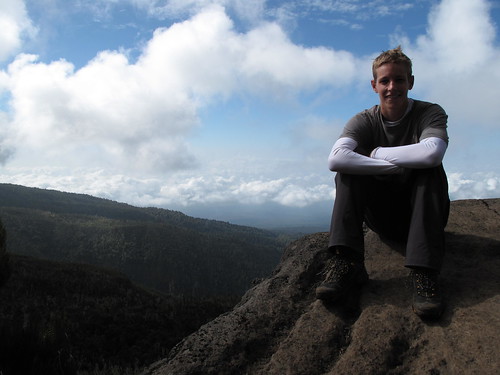
 Image by Clark H
Ever been up high, flying in a plane or looking out the window of a skyscraper or sitting on top of a mountain? What was it like?
New to freewriting? Check out our online guide.
Image by Clark H
Ever been up high, flying in a plane or looking out the window of a skyscraper or sitting on top of a mountain? What was it like?
New to freewriting? Check out our online guide.
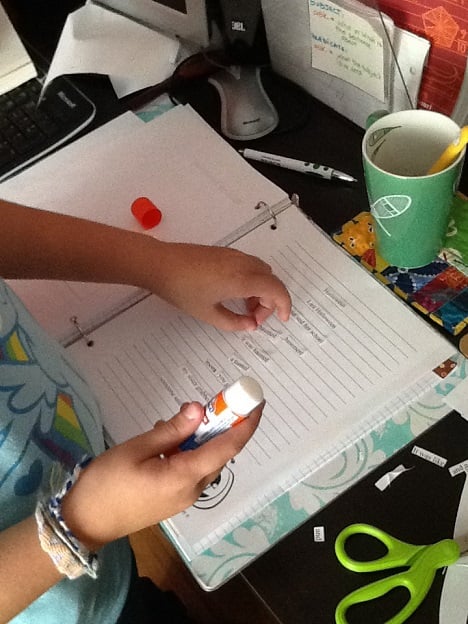
From Brave Writer mom, Alexandra:
Good morning Julie!
First, I want to thank you again for bringing such joy in our home with your writing and language arts curriculum! My daughter was a late bloomer with reading. She only started being really comfortable with reading last year. Writing is something that stressed her out. She would block herself, saying that she couldn’t write. She would refuse to put anything on paper. She could physically write but refused. I honestly didn’t know what to do. I followed your advice and took a gentle approach. I explained to her that she could write and that I would be happy to spell every word if that is what she wanted or that she could write things as she thought they should be and we could fix the spelling later.
We often followed this pattern: she would tell me what she wanted to write, I would write it down for her, then she would copy it. With the shark mini book, she started taking my short points and building them into sentences. That was a huge step for her!
Today, I read your instructions for the free verse exercise in The Arrow to her and she chose which prompt to do for the free write process. I spelled a few words for her but she did it all and without stressing herself.
Here is her freewrite:
Last Halloween my sister and her school had a haunted basement and it was haunted. It was like a tunnel and a lot of rooms that you go in. My sister grabbed my leg, and someone said my name.
I told her her writing was good. I did ask her if she wanted to add anything, a little more of what the prompt mentioned. She said no. I wanted to push a little but realized that this was enough for her. She finally was comfortable with the idea of writing, I couldn’t ruin it.
We continued with the exercise. She didn’t get it at first, cutting away some of her words must have been weird, especially after she worked hard to write these on paper! But after we read the tips in the appendix, she went to work.
Here is her free verse poem version:
Last Halloween
my sister and her school
had a haunted basement
It was haunted
a tunnel
rooms you go in.
my sister grabbed my leg
someone said my name!
She told me once she was done gluing the poem down that she loved poetry. I told her she could do another one next week. She said yes and told me she would do one on Christmas!
I am so happy. The books in The Arrow we have read so far have been fabulous. Celeste has gone on to read all the books in the Lemonade Series because she liked the first one so much. She re-read the first one three times. Now she is already starting to re-read the Inside Out & Back Again, even if we are not finished yet!
Thank you again for putting together wonderful, interesting, but still challenging language arts programs!
Image of Celeste working on her free verse project (cc)
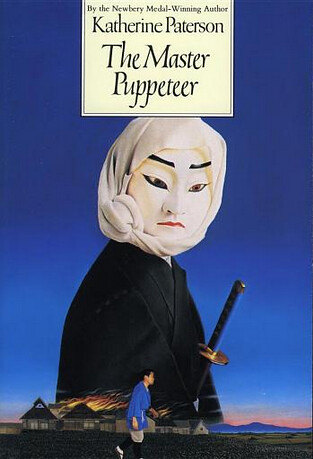 In celebration of Katherine Paterson’s birthday (born October 31, 1932) we’re making a special offer! The Boomerang for her novel, The Master Puppeteer, is:
Half price for one day only: $4.95! OFFER HAS EXPIRED
Katherine Paterson said she never wanted to be a writer growing up (she wanted to be either a movie star or a missionary), but she went on to pen some of the most admired works of children’s literature. She’s best known for Bridge to Terabithia. Other works include The Great Gilly Hopkins and Jacob Have I Loved.
Paterson tackles difficult themes in her stories, such as death, jealousy, and being outcast in society. Her young protagonists often triumph over adversity through inner strength and self-sacrifice.
The Master Puppeteer won the National Book Award for Children’s Literature 1977. Paterson’s website describes it like this:
Who is the man called Saburo, the mysterious bandit who robs the rich and helps the poor of the Japanese city of Osaka? And what is his connection with the Hanaza, the puppet theater run by the harsh master of Yoshida? Young Jiro, an apprentice puppeteer, is determined to find out even though this could be very dangerous.
So, celebrate Katherine Paterson’s birthday and take advantage of this special offer today!
The Boomerang is a monthly digital downloadable product that features copywork and dictation passages from a specific read aloud novel. It is geared toward 7th to 10th graders (ages 12—advanced, 13-15) and is the indispensable tool for Brave Writer parents who want to teach language arts in a natural, literature-bathed context.
Answer: Yes.
It is enough to spend your days exploring the novels you read by talking about what you find there: the plot, the characterizations, the passages that put dialog into quotes, the semicolons, the active verbs, the powerful descriptions, the emotional catharsis that comes once the climax is reached…
It’s enough to copy some of those passages into a little notebook and to then use those passages for dictation. You can trust the process because over time, you’ll see the results show up like magic in the drafts and revisions your kids do all by themselves. The growth may not be evident in one dictation or even by the end of one year. But after a year or two of these practices, you’ll notice that the ease with which your child punctuates resembles the ease with which your toddler suddenly spoke English—complete sentences that seemed to come out of nowhere! The practice (like the tide riding in and out) is a soothing wave of investment each day that eventually pays out in confident transcription. Count on it.
It is enough to watch a movie and talk about it. Writing a review isn’t required, but a high school student may enjoy doing just that! Reading reviews by others and arguing about their points is a great way to grow in one’s own thinking about how evaluations are made. It is good to evaluate and to make comparisons to other evaluators. Movies are always reviewed so they are an easy source of this habit. But it’s just as good to read conflicting opinions about politics, artwork, video games, how to organically garden, and the best practices for playing forward in soccer.
Writing is best learned in the doing, in real life contexts (not just assignments drummed out for some textbook). It’s fabulous to write letters to people you love. It’s important to put a collection of thoughts about a topic into writing because the act of transcribing one’s thoughts has a way of both clarifying the thinking and revealing weaknesses in thought. This exploratory writing is also a wonderful way to codify learning (to keep a record) almost like a journal. Writing lists, and making posters, and drawing comic books with captions, and updating social media sites—these are the opportunities to grow a variety of inner writing voices and must be supported and appreciated. It is enough to consider these part of a robust writing program.
The nurturing that comes with really appreciating a child’s writing risk—reading the writing without judgment but with admiration, discovering the mind life of your child and letting it awe you, becoming aware of your child’s strengths and habits of thought, experiencing the joy of a child’s openness with you—your willingness to share these reactions with your child DOES, in fact, generate the necessary development in writing that your child will need to boldly write in high school and college (that child knows that his or her thoughts have value, weight, significance).
A writing project a month means you value the project (you don’t rush, you don’t treat it like it’s a “task to get done”). It means you are more likely to invest deeply and care about the outcome. It means you are more likely to share the result with an interested audience. It means your child is more likely to learn the skill called revision because there is breathing room around the draft, allowing new thoughts to emerge, new ideas, new ways of expressing the slowly developing perspective the project articulates.
You have the power to ensure that your child gets what he or she needs by investing in who that child is, deeply, now; valuing all forms of communication; seizing opportunities to create real contexts for writing; dialoguing about language in its multifaceted natural contexts you encounter daily; and helping your child get his or her voice to the page or screen as often as is naturally possible.
You can do this. It really is enough.
If you want to toss in a word origins book or a vocabulary growing worksheet or a spelling program or a phonics text—be my guest. You aren’t betraying the principles to try what attracts you. You aren’t wrong for wanting to ensure that your kids “cover the bases.” Who knows? You may have a child who thrives on Latin and Greek roots and you may foster a lifelong love of vocabulary!
The point isn’t to tell you not to do something. My point is to tell you that if this is all you do, you are right in the zone of growing a healthy, free, competent, confident, brave writer.
It’s enough. More than.
Image by peapodsquadmom
 In the last nine months, I’ve lost four friends (one online friend and three from high school). These friends were in their forties and early fifties. Each one “dropped dead” out of nowhere (no warning, no long illness). To say I’m still in shock is an understatement.
Each day I log onto Facebook, I see references to these friends (their profiles are still up and people pay tribute). The most recent high school friend, Alison, died, leaving behind two kids and a much loved husband, not to mention all of us—her friends. Breathtaking how quickly she is gone and not coming back—and how much we all miss her.
The rest of us live with the illusion that we’ll all get 70+ years on the planet. Today, with advances in medicine, it seems as if we all deserve 80 or more!
But the truth is: we just don’t know when our time will come. When I read the lovely notes written to the ones who’ve gone on before me, after they are gone and unable to read them, I’m reminded of how important it is to reach out to the people in our lives now, in writing, to say “I love you. I value who you are and have been to me.”
Ironically, my college boyfriend did that for me. It had been 30+ years since we had last spoken. In his note, he reflected back to me who I was at the time and compared that image of me to who I am today. It was powerful to read his words and to take stock of all the changes, all the growth, and even some of the losses. His writing = gift, to me, at this time.
These experiences (so much more common in our fifties, I’m sure) have given me pause. I’ve put a lot of who I am in writing (there would be a lot to read from me, if I were to pass suddenly, and that writing might be a comfort to the family and friends I would leave behind). But it occurred to me also that it’s important to express *to* those we value just how much we do love them, and why—and how they’ve been precious to us in our lives.
My mother, Karen O’Connor, has kept “grandchildren journals” for each of her grandchildren. Each time she sees any of them, she makes an entry (unless they are local, then she makes entries after special events). On the 18th birthday of the grandchild, she presents this journal as a snapshot of how her relationship with this person has grown and been cherished for 18+ years. Writing. Love. Personal and concrete. Able to be read again and again, even after she eventually leaves us (sob – don’t want to think about it!).
I say all this today so you might pause and cherish someone right in front of you, or even remotely. Maybe it’s a long lost friend, maybe it’s a relative, maybe it’s the child sitting across from you behind your computer screen right now. It’s good to say “I love you” and to mean it. It’s even better to put it in writing sometimes—to do the soul excavation of why this person has value in your life and how grateful you are to know this friend, parent, spouse, child.
Why wait until the loved one is gone to express all in your heart to say? Say it now. Write it now. Cherish the people you love, and let them have a concrete, tangible record of your love for them.
Pick one person today.
Cross-posted on facebook.
Image by Jose Roco