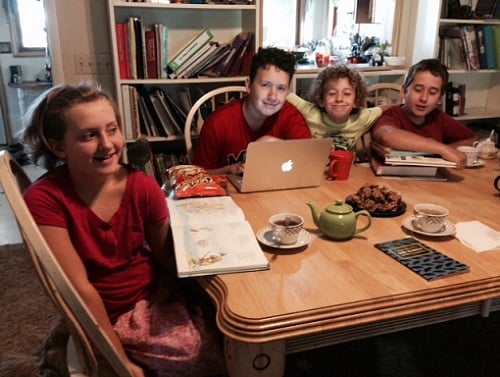
We LOVE Tea Time. And thanks to a schedule change the college student got to join us for tea.
I love how Brave Writer brings us all together.
Thank you!
Cindy
Image (cc)

We LOVE Tea Time. And thanks to a schedule change the college student got to join us for tea.
I love how Brave Writer brings us all together.
Thank you!
Cindy
Image (cc)

Whenever I share about a great moment in one of my kids’ lives, my friend says, “Pay day!” We were homeschoolers together for years. She has 8 kids, I have 5. We have had our share of challenges and doubts, like any parent. Home education is unique in how it puts pressure on us, though. We feel every set back more deeply—after all, no one blames the “school system” when our kids are behind.
We home educators have a hard time not blaming ourselves. When our kids struggle, we assume that it is up to us to figure it out and handle any challenge. We worry—can’t remember that some years are years of struggle for a child who, with a little time and maturity, will figure it out just fine (whatever “it” is)!
Home education doesn’t always show the fruit we want to see in a single year or handful of years. Some kids who say they don’t like home education discover as adults that, in fact, they appreciate having been homeschooled.
Not only that, we don’t get paid. Not in money. Not in credible experience for a resume. Not in vacation days or bonuses. We provide this service to our families out of sheer conviction that this form of education—this method—has a shot at providing our children with a preferred environment for learning and family bonding.
Chutzpah out the wazoo!
So, on those days when a child suddenly surprises you with an achievement or a good report out in the world, THAT’S when we get paid.
Your child tests well on the Iowas? Pay day!
Your child gets into college? Pay day!
Your daughter is chosen to be the lead in a play? Pay day!
Your son builds his own computer from scratch? Pay day!
Your mother finally reports that she is amazed by your 10 year old’s vocabulary? Pay day!
The library selects your child’s poem to display on their wall? Pay day!
Your son’s soccer coach selects him to be team captain because of his maturity? Pay day!
The child who would not learn times tables with the math book suddenly knows how to calculate percentages because of online gaming? Pay day!
You’ve worked for three years to help your poor child to read, who has begged to read every day since she turned 5, and is now going on 9 and finally read her first book aloud to you? PAY DAY!!!!
Your adult child tells you that his scholarship interview went well in part because he shared about poetry teatimes? Pay day!
Your adult daughter uses your methods for appreciating art in a museum with under privileged kids as a social worker? Pay day!
Your kids know how to study when they get to college because they know how to teach themselves anything? Pay day!
Your children are bonded to each other and look out for each as adults because they are close? Pay day!
There are dozens of pay days happening all the time. What are yours? How can we help each other to call them out when we see them?
You do get paid. Pay attention. Then, take it to the bank—your emotional bank—and make a big deposit.
You’re doing it!
Well done.

Are good manners important? Explain your answer.
New to freewriting? Check out our online guide.
Image © Ericro | Dreamstime.com

The temptation when faced with learning challenges is to set up a system to address the problems—a structure that will take the issues seriously and will create benchmarks for measurable progress. This kind of approach feels quite “teacherly” and valid. We (worried parents) trust a system that is incrementally organized with practices that we can use that promise us good results. We cling to it, sometimes, and follow it to the letter.
What happens, though, when a child balks? Your son or daughter won’t do the practices, hates them, cries or whines that the work is boring or too difficult?
Tension escalates and the relationship between you and your child is at risk.
Certainly professional help for kids with diagnosed learning disorders can be quite useful to language-impaired kids. Some materials built from these methodologies may target issues that you didn’t even realize were constitutive to the disorder or challenge your child faces. Naturally, incorporating these tactics and practices is loving and right!
Still, I want to caution you here. The temptation to get very serious about problems and to follow the protocols to the letter is powerful for parents. We want to believe that if we “do it right,” our child will overcome their disorders or learn to cope with their challenges. Once we “get serious,” the space for risk-taking, joy, play, and imagination sometimes go right out the window! We tend to “clamp down” rather than to loosen up!
The most effective way to make progress with struggling learners is to enhance the parent-child bond, not just turn to systems and structure. With trust and affection between you, any process you use can contribute to growth.
That nurturing bond is created between parents and children when the parent understands the child’s need for a couple of things:
Play. Children need to know that you value play, humor, happiness, freedom to explore, jokes, kinesthetic activity.
Breaks. Kids will try almost anything, but they need to know that if it is too stressful, they get to quit, take a break, move away from the process or activity.
Create playful ways to address the issues that are not systematic at all! Perhaps for handwriting, you will use paintbrushes and buckets of water to write messages on the driveway.
What if your child stood behind you, put his arms through to the front as though he is your hands, and you had him open a jar of pickles or try writing your name from that blind position? What if you get him in touch with his body and hands and uses for hands in new ways?
Can he trace words? Can he trace them better if the two of you hold the same pencil and you move gracefully together over the letters—first you controlling his hand, and then he controls your hand?
We are so quick to think all learning happens on paper, with pen, following a set of assignments.
See if you can get outside of this frame of reference—play, take breaks, build trust.
Good luck!
Cross-posted on facebook. Image by Brave Writer mom, Cheryl (cc).
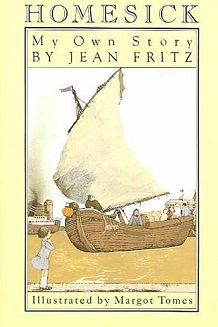 Homesick: My Own Story by Jean Fritz
This fictionalized autobiography tells the heartwarming story of a little girl growing up in an unfamiliar place.
The Arrow is a monthly digital product that features copywork and dictation passages from a specific read aloud novel. It’s geared toward children ages 8-11 and is an indispensable tool for parents who want to teach language arts in a natural, literature-bathed context.
Purchase the Homesick Arrow here.
Buy the novel on Amazon here (referral link).
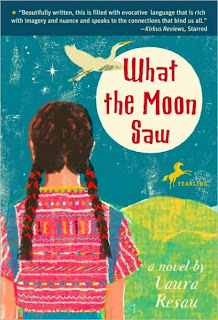 What the Moon Saw by Laura Resau
Out of the blue, 14-year-old Clara Luna receives a letter from her grandparents inviting her to spend the summer with them in Mexico. She has never met her fathers parents and he has not seen them since he left his homeland more than 20 years ago. Wary of visiting people she doesn’t know and yet frustrated and restless with her life at home, Clara embarks on the two-day journey to the remote village of Yucuyoo.
The Boomerang is a monthly digital downloadable product that features copywork, dictation passages from a specific read aloud novel, and a number of think piece questions. It is geared toward 7th to 10th graders (ages 12—advanced, 13-15).
Purchase the What the Moon Saw Boomerang here.
Buy the novel on Amazon here (referral link).
PLUS our online Boomerang Book Club (geared toward students in 8th grade and up) discussion of What the Moon Saw starts today!
Images @ Amazon.com