
Writing Exercises Archives - Page 5 of 14 - A Brave Writer's Life in Brief A Brave Writer's Life in Brief
  • Start Here
    • For Families
      Multiple Ages
    • Ages 5-7
      Beginning Writers
    • Ages 8-10
      Emerging Writers
    • Ages 11-12
      Middle School Writers
    • Ages 13-14
      High School Writers
    • Ages 15-18
      College Prep Writers
  • Shop
    • Product Collections
    • Bundles
    • Writing Instruction Manuals
    • Literature & Grammar/Punctuation
    • Composition Formats
    • Literature Singles
    • Homeschool Help
    • Book Shop
    • Special Offers
  • Online Classes
    • Class Descriptions
    • Class Schedule
    • Classroom
    • How Our Classes Work
    • Our Writing Coaches
    • Classes FAQ
  • Community
    • Brave Learner Home
    • What’s Happening
    • Blog
    • Podcast
    • Calendar
  • Cart
  • My Account
    • My Online Classes
    • My Account
  • My Account
    • My Online Classes
    • My Account
  • Start Here

    If you’re new to Brave Writer, or are looking for the best products for your child or family, choose from below:

    • For Families
      Multiple Ages
    • Ages 5-7
      Beginning Writers
    • Ages 8-10
      Emerging Writers
    • Ages 11-12
      Middle School Writers
    • Ages 13-14
      High School Writers
    • Ages 15-18
      College Prep Writers
  • Shop

    If you’re already familiar with Brave Writer products, go directly to what you’re looking for:

    • Product Collections Browse the full catalog in our shop
    • Bundles Everything you need to get started
    • Writing Instruction Manuals Foundational Writing Programs
    • Literature & Grammar/Punctuation Grammar, Punctuation, Spelling & Literary Devices
    • Composition Formats Writing Assignments for Every Age
    • Literature Singles Individual Literature Handbooks
    • Homeschool Help Homeschooling Tools and Resources
    • Book Shop Books associated with Brave Writer Programs
    • Special Offers
  • Online Classes
    • Class Descriptions
    • Class Schedule
    • Classroom
    • How Our Classes Work
    • Our Writing Coaches
    • Classes FAQ
  • Community
    • Brave Learner Home
    • What’s Happening
    • Blog
    • Podcast
    • Calendar
  • Search
  • Cart

Search Bravewriter.com

  • Home
  • Blog

A Brave Writer's Life in Brief

Thoughts from my home to yours

Archive for the ‘Writing Exercises’ Category

« Older Entries
Newer Entries »

Happy St. Patrick’s Day!

How about writing a limerick with your kids today to celebrate?

Here’s the format (each space is a syllable, not a word):

______ ______ ______ ______ ______ ______ ______ ______
______ ______ ______ ______ ______ ______ ______ ______
______ ______ ______ ______ ______
______ ______ ______ ______ ______
______ ______ ______ ______ ______ ______ ______ ______

For a fun Irish twist, look up some cities on a map of the Green Isle and use them in your Limericks:

  • Dublin
  • Galway
  • Kilkenny
  • Cork
  • Derry
  • Armagh
  • Belfast
  • Lislurn

You might add Irish items like pots of gold, rainbows, leprechauns, and shamrocks. St. Patrick is also a perfectly suitable character to include in your St. Patrick’s Day limerick, too, of course.

Here’s a Limerick by the intrepid Edward Lear (his are most famous and can be found in a quick google search):

There was an Old Man of Kilkenny,
Who never had more than a penny;
He spent all that money,
In onions and honey,
That wayward Old Man of Kilkenny.

Please share your delightful results with me on social media (#bravewriterlifestye)!

Growing Brave Writers

Posted in Poetry, Writing Exercises | 1 Comment »

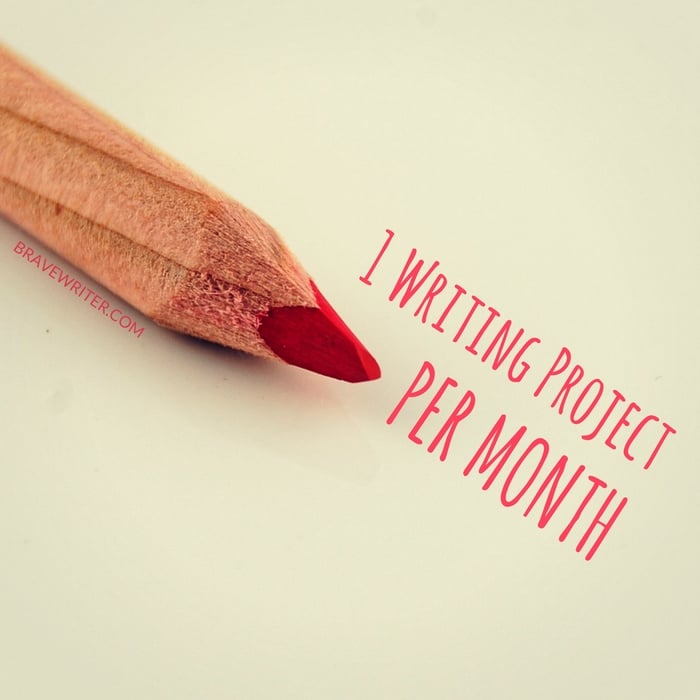
One Writing Project Per Month

One writing project per month

Brave Writer philosophy suggests that you only tackle one writing project per month, per kid. That’s right. One a month. I figure you’ll get sidetracked by Thanksgiving or surgery or a ski trip during a couple of those months meaning, you may not complete the project slated for that month. Therefore, if you have ten projects slated and get 6-7 of them through the revision process in a school year, be happy! You’ve done good work!

But wait, how does this work? you ask. I understand. It sounds like so little output. So let me give you some guidelines for why writing less equals more value.

Let’s look at the four week process for writing any piece (paragraph, letter, essay, poem, article, story).

Week One: Saturation

During the first week, you aren’t writing. You’re reading, talking, watching videos, looking stuff up on the Internet. You might also be doing the thing you will write about. If the topic is Native American basket weaving, perhaps you will even try to weave a basket! No writing comes forth without saturation in the topic/subject matter. This is why we always recommend that your kids write about what they know well. They’ll have richer vocabulary and a deeper grasp of the topic. If the topic is new-ish to your student, you need more time to absorb the material before becoming saturated. Might take two weeks or three. Don’t rush it. Writing is the result of an overflow of knowledge about a topic. You can’t read a paragraph about Columbus and then require your child write a paragraph about Columbus. The sane response from a child is: But didn’t we just read about Columbus?

Week Two: Freewriting

The second week is when you put pen to page. This is the time to get words from the guts upchucked onto paper. We do this in any way we can. We use freewriting to help catalyze that process. You can do several freewrites over a period of days. There’s no law in the writing world that says the first draft is the only draft. You can select parts of the topic to write about and do those over two or three days with breaks in between. During the freewriting (or drafting) week, the goal is to get as much raw writing to work with as possible. Think of a specific aspect of the topic (gathering materials for basket weaving) and write about it. Then on another day focus on another aspect (patterns in basket weaving). Break it up! Makes life so much happier.

Week Three: Revision

Revision is not the same thing as editing (when I use the term). Revision is injecting new vision into the raw writing. It’s re-imagining the piece so that it springs to life. During revision, you want to focus on content, not mechanics. That means you’ll read the freewrites and look at places you can narrow the focus and expand the writing. Perhaps your child wrote, “Basket weaving is hard work.” You can look at that sentence and ask for more! What does he mean by “hard work”? Can he describe the process? And so on. You might want to rewrite the opening line (I always recommend that). Make it pop, surprise, sizzle. Draw the reader right in. Revision can take many days or short bursts of energy tackling a little bit at a time. Don’t do it all in one day. Don’t fatigue your young writer. Revise two or three important content related items and leave the rest alone. (Psst. I promise anything you don’t correct in this piece will magically reappear in another for you to address at a later date.)

Week Four: Mechanics Mop-up

Now you edit. Editing is simply cleaning up all the stuff that makes the paper hard to read: misspellings, missing punctuation, grammar errors, typos, indentations. Have your child look over his or her work first. Let the student find as many errors as possible. You only make the additional changes once the child has taken a whack at it. Never complain about something he or she missed. Make a mental note that you need to address the semi-colon in copywork or dictation. Let what they miss be information to guide you in teaching; don’t use it as a way to shame your child. Print and share with readers.

Once you work through this process, you’ll have had a rich experience of how writing is supposed to work. Believe me, doing this 5-6 times in a year is a huge amount of teaching! Far superior to cranking out contrived paragraphs based on tedious writing prompts in a workbook. Give your kids the chance to experience what writers actually do. They saturate and incubate. They mess around with words, getting their ideas onto the page or computer screen however they might. They revise those words once they get a little distance to make them more compelling and interesting. Then they mop up the mistakes and share it with readers! Your kids get to do that too. For more information on how to do this process, see The Writer’s Jungle.

Freewriting Prompts

Posted in Brave Writer Philosophy, Homeschool Advice, Machete Mechanics, The Writer's Jungle, Writing Exercises, Young Writers | 9 Comments »

The most beautiful example of Keen Oberservation

Email:

Julie, I did the Keen Observation exercise with the kids on Monday. What a lovely time. I really can’t fully express (in the limited time available) how much I appreciate your program and your blog. There is a sense of yoga about it – being in the moment, being where you are in terms of skill, a deepening of experience with reality. Thank you.

I thought you might like my description of what we did. I let Mary Poppins and Ms Frizzle out to play.

Immersion Learning

—

What a truly awesome visual to go along with the powerful and delightful comments her kids made. That’s what I call keen observation for sure!

Posted in Brave Writer Philosophy, BW products, Language Arts, Writing Exercises | Comments Off on The most beautiful example of Keen Oberservation

« Older Entries
Newer Entries »
  • Search the Blog

  • Julie Bogart
  • Welcome, I’m Julie Bogart.

    I’m a homeschooling alum -17 years, five kids. Now I run Brave Writer, the online writing and language arts program for families. More >>

    IMPORTANT: Please read our Privacy Policy.

  • New to Brave Writer? START HERE

  • FREE Resources

    • 7-Day Writing Blitz
    • Brave Writer Lifestyle Program
    • Brave Writer Sampler: Free Sample Products
    • Freewriting Prompts
    • Podcasts
  • Popular Posts

    • You have time
    • How writing is like sewing
    • Best curriculum for a 6 year old
    • Today's little unspoken homeschool secret
    • Do you like to homeschool?
    • Don't trust the schedule
    • You want to do a good job parenting?
    • If you've got a passel of kids
    • You are not a teacher
    • Natural Stages of Growth in Writing podcasts
  • Blog Topics

    • Brave Learner Home
    • Brave Writer Lifestyle
    • Classes
    • Contests/Giveaways
    • Friday Freewrite
    • High School
    • Homeschool Advice
    • Julie's Life
    • Language Arts
    • Movie Wednesday
    • Natural Stages of Growth
    • One Thing Principle
    • Our Team
    • Parenting
    • Philosophy of Education
    • Podcasts
    • Poetry Teatime
    • Products
    • Reviews
    • Speaking Schedule
    • Students
    • Writing about Writing
    • Young Writers
  • Archives

  • Brave Writer is a participant in the Amazon Services LLC Associates Program, an affiliate advertising program designed to provide a means for sites to earn advertising fees (at no extra cost to you) by advertising and linking to amazon.com

    Content © Brave Writer unless otherwise stated.

What is Brave Writer?

  • Welcome to Brave Writer
  • Why Brave Writer Works
  • About Julie
  • Brave Writer Values
  • Frequently Asked Questions
  • Speaking Schedule

Brave Writer Program

  • Getting Started!
  • Stages of Growth in Writing
  • The Brave Writer Program
  • For Families and Students
  • Online Classes
  • Brave Writer Lifestyle

…and More!

  • Blog
  • Classroom
  • Store
  • Books in Brave Writer Programs
  • Contact Us
  • Customer Service
  • Brave Writer Staff
© 2026 Brave Writer
Privacy Policy
Children's Privacy Policy
Help Center