Homeschool Advice Archives - Page 95 of 144 - A Brave Writer's Life in Brief A Brave Writer's Life in Brief
  • Start Here
    • For Families
      Multiple Ages
    • Ages 5-7
      Beginning Writers
    • Ages 8-10
      Emerging Writers
    • Ages 11-12
      Middle School Writers
    • Ages 13-14
      High School Writers
    • Ages 15-18
      College Prep Writers
  • Shop
    • Product Collections
    • Bundles
    • Writing Instruction Manuals
    • Literature & Grammar/Punctuation
    • Composition Formats
    • Literature Singles
    • Homeschool Help
    • Book Shop
  • Online Classes
    • Class Descriptions
    • Class Schedule
    • Classroom
    • How Our Classes Work
    • Our Writing Coaches
    • Classes FAQ
  • Community
    • Brave Learner Home
    • What’s Happening
    • Blog
    • Podcast
    • Calendar
  • Cart
  • My Account
    • My Online Classes
    • My Account
  • My Account
    • My Online Classes
    • My Account
  • Start Here

    If you’re new to Brave Writer, or are looking for the best products for your child or family, choose from below:

    • For Families
      Multiple Ages
    • Ages 5-7
      Beginning Writers
    • Ages 8-10
      Emerging Writers
    • Ages 11-12
      Middle School Writers
    • Ages 13-14
      High School Writers
    • Ages 15-18
      College Prep Writers
  • Shop

    If you’re already familiar with Brave Writer products, go directly to what you’re looking for:

    • Product Collections Browse the full catalog in our shop
    • Bundles Everything you need to get started
    • Writing Instruction Manuals Foundational Writing Programs
    • Literature & Grammar/Punctuation Grammar, Punctuation, Spelling & Literary Devices
    • Composition Formats Writing Assignments for Every Age
    • Literature Singles Individual Literature Handbooks
    • Homeschool Help Homeschooling Tools and Resources
    • Book Shop Books associated with Brave Writer Programs
  • Online Classes
    • Class Descriptions
    • Class Schedule
    • Classroom
    • How Our Classes Work
    • Our Writing Coaches
    • Classes FAQ
  • Community
    • Brave Learner Home
    • What’s Happening
    • Blog
    • Podcast
    • Calendar
  • Search
  • Cart

Search Bravewriter.com

  • Home
  • Blog

A Brave Writer's Life in Brief

Thoughts from my home to yours

Archive for the ‘Homeschool Advice’ Category

« Older Entries
Newer Entries »

You Are Smart Enough!

You are smart enough


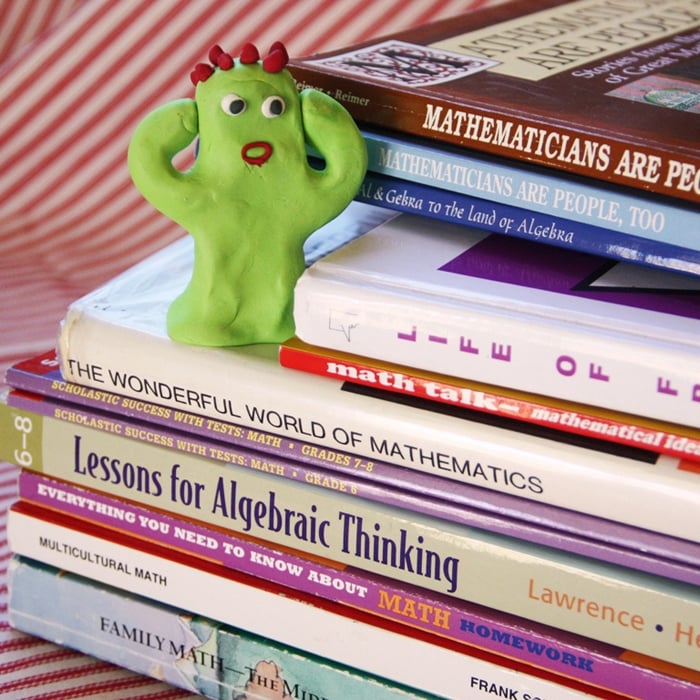
I remember when Noah was in the 4th grade, his math text had a lesson about fractions: dividing them, multiplying them, adding and subtracting them. I looked at the page and panicked. I couldn’t remember a single thing about fractions—except they had confused me as a girl, and I resented the United States of America for not going on the sane metric system like they had promised back in 1975!

I stared blankly at the page. Nothing. Not a thing. I had no idea how to find a common denominator, or when to flip the fraction, or how to reduce the overgrown result once you got past the equals sign.

I was 35 years old.

My father’s voice rang in my head: “The only true intelligence is mathematical intelligence” shared with me after I had earned straight A’s in English, Social Studies, Spanish, Science, and Acting.

He didn’t mean any harm. I think he really believes that to this day, though he always approves of my work and was proud of my good grades.

Still, I managed to bungle math so many times, my Algebra 2 instructor suggested I quit at the semester. He bargained, “I’ll give you a B if you drop the class. It’s torturing you and I don’t want you to harm your GPA for college.”

Needless to say: my confidence in teaching math to my kids was low.

I used Cuisinaire Rods in the early years to help them understand multiplication, only to realize with astonishment: “Did everyone know that four groups of four makes sixteen? How had I never learned that?!”

Oh I knew my times tables. I just didn’t understand them.

I had not comprehended multiplication—the basis of it. To me, it was a set of memorized magic—tables of numbers associated with each other for inscrutable reasons. I never quite grasped the fundamentals: multiplication meant multiples of the same thing. Mind Blown!

How had I missed that? With the endless tutoring, teacher help, textbook study, math labs, and a father with an engineering degree, how had I missed the primary structure of multiplication? Why had no one made sure I had got that much? Perhaps because it was so obvious to everyone else, it didn’t seem possible that it was not obvious to me?

I don’t know. But what I do know is the day I had an epiphany about the times tables is the day I began my true math education. In my thirties. With four children and a baby on the way.

So when faced with fractions, I took the book, excused myself to the garage, and sat on the concrete floor playing with the rods and making myself understand fractions. It took me a bit of time, but not that long. After all, I had been baking, cooking, and quilting for a decade and a half. I had familiarity with fractions even if I didn’t understand how to use them in mathematical equations.

Understanding returned; or rather, grew! I saw what had eluded me in my grade school days.

I re-entered the house armed with the information, and now, understanding, that would enable me to teach Noah. He learned it all easily. Then he said, “So basically what you are saying is that I need to learn fractions now because we use them in school, but adults never need to use them, right? Because you didn’t understand them until a few minutes ago…”

Ha! Caught me. Made me laugh. I explained my profound lack of skill in math and how it had hampered me from many possible career options, and had made some of the work I do difficult as a result. But I resolved now that we learn together.

I never did become a fabulous math teacher to my children. Yet they have all surpassed my impoverished skills. I made sure they had tutors or went to classes at the local public school for higher math. Each of them has shown an aptitude far ahead of mine. But then again, they each had individualized help to catch those oversights before they mushroomed. They didn’t live under the wrong impression that true intelligence was only found in mathematics.

There is no subject area you can’t learn along with your children. I had a friend who was bilingual in Spanish and English, but without a good working knowledge of written Spanish or English. She hired a tutor…for herself! And learned. Then taught her kids.

It can be done. You are now an adult, with far more experience, patience, and mental agility than when you were 10, 12, and 16. What you missed before can be learned now. At the very least, you can ensure that your children have the chance to understand what was inscrutable to you. Take the time to find the tools that bring you understanding, not just information or practice sheets.

Then share them with your children and continue to advance your own understanding. You are smart enough. You are committed enough. You love your children enough. There are tools and helps enough.

Enjoy your educational renaissance!

Image by jimmiehomeschoolmom (cc)
Posted in Homeschool Advice, Julie's Life | Comments Off on You Are Smart Enough!

Delay Grades as Long as You Can

Brave Writer Delay Grades

Homeschool is no place for grades (unless you are making a transcript for college applications).

That’s a strong absolute statement—the sort I refrain from making on this page. If you are using a grading system for a reason that makes sense in your family, please don’t take this post as an indictment of that practice. You do you!

For the rest of us—for homeschoolers who ask me regularly about how to “grade” writing—I offer you the following thoughts.

Thoughts on Grading

Letter grades (scores) in years K-8 are irrelevant to your children. We parents are used to the hang-over of traditional school where our parents were able to determine if we were performing adequately by the report card at the end of the semester.

You live with your children as they learn. You know if they know how to read, how to spell, and how to calculate. You know where they get stuck on the times tables and when they surge ahead to mastery.

The goal isn’t to measure and label the achievements of your child with a value judgment (grade). Rather, your job is to identify the areas of growth and to establish a trajectory for continued skill acquisition. If you become concerned that your child is struggling specifically in an area (you see little change in the course of an entire year of consistent, kindly supported effort), you may want to ask your peers or an expert if they would “worry yet” about a learning disability or some other impediment to natural growth.

I still wouldn’t grade that child. Grades forge an “outside-in” identity—either “I’m not as good as others,” or “I’m way better than others.” Each of those identities is flawed and unhelpful to your child’s unique educational path. The child is not evaluating self based on his or her own curiosity and skill strength from within. Rather, grades drive the child to either feel discouraged (I can’t learn this) or sometimes to feel overly self-confident (I already know this; Why do I have to keep reading/growing/studying?).

The Best Feature of Home Education

Curiosity about a subject area is the best feature of a homeschool education. A child can go as far as they like. There isn’t an arbitrary end when a grade has been assigned, as though the study of the subject is confined to a school term and is now complete. Rather, topics and skills blend together, weaving in and out of each other, informing one another, for the duration of the home education lifestyle.

This is why it is difficult to explain to other friends and family how homeschooling works. Your children don’t identify with “going up a grade level” or “finishing math” in the same way traditionally schooled children do. The end markers aren’t there in the same ways.

But this is all to the good! You really can let Ancient Rome take over your homeschool for 18 months because in it, you’ll discover math, science, literature, spelling, grammar, foreign language, mythology, art, religion, and (obviously) history! There’s no “discreet unit” about Ancient Rome that lasts 16 pre-planned weeks with objectives to cover and tests to prove you are finished. There is only learning and exploring as long as Ancient Rome fascinates and gets the job done (leading your children into a glorious “science of relations” between all subject areas).

As long as those connections are happening, you are in the homeschool zone where learning is experienced and validated by how engaged your children are in interesting subject matter.

High school is a time when you may assign grades. But let me throw out a word of caution here. Most colleges/universities have little regard for the grades of a homeschooling parent. They are focused much more on the standardized tests (ACT, SAT) that either validate or invalidate the homemade transcript.

That should reassure you.

You don’t have to suddenly become a scrupulous parent-teacher where you give unnecessarily harsh grades to your child to “prove” you weren’t biased.

Nor should you become the mom who overlooks a child’s performance in order to give all “As.”

What you want to do is give As for completion of work and mastery of the material insofar as you can measure that. Don’t labor over it. Bs are fine too.

Then make a transcript that has both grades (GPA) and course descriptions. The transcript should match the SAT/ACT score. In other words, don’t pretend your child did Honor’s level work and is a 4.5 GPA student if the SAT and ACT score are average (in the 50-70%).

Your child has had an avant-garde education. Focus on that in the application. Don’t try to make your kids look like they went to public school. Major on the unique experiences, reading, and areas of expertise they have cultivated while home educated. THAT’S their ticket to college.

And the essay: make sure it’s a winner!

Bottom line: grades are school’s domain. Homeschool is built from different bricks. Focus on the strengths of homeschool and let go of the tools of traditional school. You’ll be glad you did.


Brave Writer

Posted in BW and public school, Homeschool Advice, Tips for Teen Writers | 1 Comment »

Homeschool Carnival: A little something for everyone

Carnival of Homeschooling

“It’s not learning, it’s having learned” is included in this week’s Homeschool Carnival at SmallWorld!

Today’s edition is packed full of helpful posts like: “A Typical Day in Our Charlotte Mason Homeschool,” “Relaxed Homeschool, Not Lazy Homeschool,” and “Navigating the Red Tape Part 3: Our Path to an Accredited Diploma.”

Check it out!

Posted in Homeschool Advice, Linky-links | Comments Off on Homeschool Carnival: A little something for everyone

When it’s working, keep going

Go this wayImage by Richard Masoner / Cyclelicious

Are you a tinkerer? As things are moving along in a pattern that flows, do you get itchy fingers? Are you likely to pry and probe, question, and analyze? Do you doubt yourself when all is calm? Do you wonder if you are “doing enough” or if the absence of passion or struggle means the work is too easy or not really teaching?

If you’re the type of person who is stimulated by risk or “trying the new,” you might miss that moment when your homeschool is actually going along as you’d always hoped. You might mistake your boredom for homeschool not working. It’s possible that you will re-insert drama or too much challenge or change into a scenario that is actually satisfactory and healthy as a way to stay stimulated, yourself (to have something for you to work on).

Don’t fall for that trap. If the kids are engaged (showing quiet engagement, cooperation, and care), you’ve succeeded. You don’t need to see marvels of creativity or passion every day of the year (or even every week or every month!). It’s okay to make steady or slow progress. It’s okay to be at peace.

As Susan Elliott (friend and therapist) says, “Make peace with the peace. That’s the sound of your life working.”

Allow your family to find its rhythm. If you have an idea that supplements the flow and nicely established calm of your home, you’ll know it. The idea will dovetail—it won’t dominate and upend, it won’t change the tone or feel of your home so dramatically that the kids now aren’t sure what they should or shouldn’t be doing.

I want to give an example of a time in my life when I made a big mistake.

My family was following a routine that I had built from my years of Charlotte Mason study. It was a good routine; a happy one, that held up well in all kinds of circumstances. It felt like a true fit for us (both lifestyle and content). They were happy; I was happy. They were learning; I was able to support and facilitate that learning. I could measure their growth without testing or hand-wringing. That season was my favorite for homeschooling.

However, there came a point one year where my CM support group disbanded, and I looked for another source of inspiration (for me!). I also noticed that a couple of my kids became crabby about some of the history lessons (the way I had them structured or modeled after CM). I went in search of new stimulation.

I found it in the world of unschooling. Given my temperament and habit of parenting, it felt like a wonderful fit for my ideas of what I believed about learning. I read and read, I discussed with my kids’ dad how I felt about this philosophy, I absorbed the advice of the online unschoolers (so much so, I lost a little of myself in the process).

One day, Jon (kids’ dad) and I took the kids out for breakfast and announced that we had a new idea for homeschool. We explained the theory of unschooling with great joy and enthusiasm. “You get to learn whatever you like! You are in charge! We will participate and help and facilitate, but you are no longer bound by a set of criteria to follow!”

Two of the five hooted: “Woo-hoo!” They high-fived.

Two of the five panicked: “How will I learn math? But I liked my vocabulary building book. Does this mean that what I’ve learned so far doesn’t matter?”

One of the five was too young to care one way or the other and went back to eating pancakes.

Over the course of the next two years, I noticed a few things. One, we lost the hub of our homeschool and it took me some time to find it again. While we discovered some truly awesome and inspired passions that developed and grew, for Jacob and Johannah (in particular), the un-measured progress felt like abandonment. They enjoyed setting out a goal and completing it. They enjoyed me giving them a goal to complete. All that freedom felt a little unhinged—rendering hard work meaningless.

Truth be told: we entered an unschooling lifestyle the “wrong” way. I learned later on all those lists that a big announcement can be utterly disorienting for kids. I got ahead of myself—pushing a vision, rather than supporting growth and learning naturally.

We found our way through this unschooling wilderness (more about that another time). But as I look back now, our best homeschooling years were the ones with that balance between routine (with a few well chosen expectations) and freedom, between parent-led learning and child-led passion.

So it is with real experience that I say to you: If it’s working, keep going. Don’t fool or trick yourself. There isn’t always a “better.” Sometimes “better” is already happening in your home. Embrace it.

Make peace with the peace.

Your life is working.

Cross-posted on facebook.

Posted in Homeschool Advice, Julie's Life | 1 Comment »

It’s not learning, it’s having learned

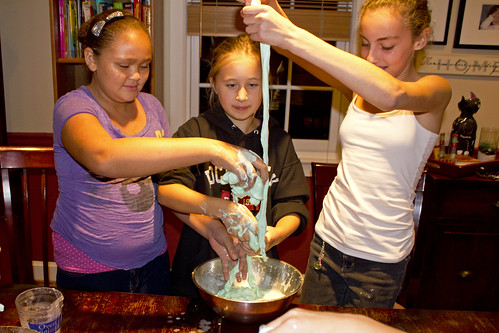
Harry Potter slime party

Harry Potter slime party image by woodleywonderworks (slime recipe)

If you can’t detect a pulse in your homeschool, it’s time to get your heart pumping again. There’s no shame in finding yourself exhausted or bored. These are ordinary experiences in any long-term activity. The idea isn’t to make yourself feel better by pretending, or to explain away the lost enthusiasm, or to judge yourself for the natural result of hard work and commitment. We get nowhere when we heap blame and shame on ourselves.

I’ve urged parents to consider the idea that their investment in home education ought to exceed their children’s output. When I did so, I did not have in mind that the parent would necessarily sit side-by-side with a 16 year old pointing to the next Algebra 2 problem on the page to ensure that it gets done (though truth be told, I did do that for one of my kids because he needed it at the time). Still, that is not the vision I had in mind.

The concept to consider is this one:

Your homeschool depends on what you, the parent, brings to it.

Let’s take a look at what you can bring that will create/foster learning. Then let’s take a look at what you can do for yourself to prevent exasperation, fatigue, and disillusionment with the whole project (we’ll cover the second one in an additional post.)

To foster an environment for learning means that you, yourself, have a sense of what generates learning to begin with! Textbooks don’t do it. Workbooks don’t do it. Heck, even some teachers and tutors and classes don’t do it. Learning is not imposed from external sources, though external sources can facilitate learning.

Learning is an internal experience that comes from connecting to the ideas presented and making them your own. The concepts, practices, ideas, systems, facts, and stories are taken in through any number of means (lectures, DVDs, workbooks, classes, YouTube videos, conversations, cartoons, the Kahn Academy, reading, your local public school, self-teaching through following the rabbit trail of your own interest, a library, the Internet, hearing about the topic from your best friend, trying it yourself, practice, using whatever it is in ‘real’ life…). You get the idea.

Learning is what happens to human beings who are engaged with life. Intentional learning (where you set out to master X set of concepts or books or musical pieces or dance steps…) happens when a learner takes responsibility to follow through on a course of study using any one of those means suggested above. Sometimes intentional learning is supported by accountability structures (weekly piano lesson, tests, narrations, due dates and deadlines, competitions, attempts to be published, co-op classes, a promise to mom, rehearsals, performances, traditional school). Sometimes intentional learning is not structured or monitored and it happens at the pace and enthusiasm level of the learner.

The key to a happy homeschool is the experience of satisfying progress in learning. Kids and parents need to know that together they are in a context of stimulating discovery, that satisfies the child’s need for two things:

1) challenge to grow, and

2) comfort at having mastered or achieved.

Parents often measure learning by challenge (how much effort the attempt to learn requires) and see mastery as an “end point” to be acknowledged, but then to move on to the next challenge.

We all like to be challenged to grow (that’s what drives us forward in life). But an equally important part of growth is enjoying the fruits of having learned—it is the act of using what has been gained that solidifies “the thing” as a person’s own possession. It feels incredible to use skills that are mastered before moving onto the next challenge. Too often in homeschool we forget to revel in “having learned.” We forget to indulge the desire to do what feels easy and natural, for a good bit, before hurrying off to “long division” or the next unfamiliar historical period, or from an easy musical piece to Beethoven, or from readers to chapter books.

Playing Piano
Image by Shardayyy
Maybe your child just wants to write limerick after limerick after limerick once he’s got the pattern down. There’s nothing wrong with that! No need to hurry him into the villanelle or sonnet to prove he’s “still learning.”

Just because your child is over the hump with manuscript writing doesn’t mean she needs to immediately plunge into cursive. Enjoy manuscript. Get tools that enhance the experience (different styles of manuscript, make place cards, decorate photo pages with captions). Really enjoy the skillful use of manuscript without any demand to “grow again.”

If your homeschool feels strained, it could be that too much emphasis is being put on “next, next, next” and you haven’t sufficiently enjoyed “having achieved.” One way to regain the pleasure of home education is to spend a week (a month!) simply recounting and using the skills mastered. What would happen, for instance, if after mastering the multiplication tables, you found dozens of ways to use them?

You, the parent, could find games online, you could set up a scavenger hunt where the clues are revealed after answering a multiplication fact, your children could create times table pages that are decorated and laminated, you could go through your house looking for all the games that can be played using multiplication and then stack them up and play them!

For a week long period, each time you and the kids find a use for multiplication, toss nickels, dimes, and quarters into a jar, and at the end, you could sort them and then multiply the number of coins by the coinage value to see how much money you collected.

The possibilities are endless, but they need to be created by you. This is what I mean by your investment. This is how you partner with your kids.

Your kids won’t think of ways to reinforce their learning on their own (necessarily—though sometimes they do and we might be the ones to shut them down saying, “We already did that. It’s time to do x, y, and z”). Heck, you may find it rough to think of creative ideas on your own. That’s why we have each other and the oh-so-awesome Internets (ha!) to aid us! We want to get beyond the endless drive, push, press, complete, move on, try harder moments of learning and learn to also revel in the joy of having learned!

If you just completed reading aloud the entire Harry Potter series, why wouldn’t you now dedicate the next weeks to watching all the films? Why wouldn’t you host a Harry Potter party with games, and trivia quizzes, and cookies that look like each of the characters?

“Having learned” is under-appreciated in homeschooling, yet it is one of the ways that you sustain the momentum and joy of the experience!

Making the subject area your own possession is another way of saying what Charlotte Mason says:

“We, believing that the normal child has powers of mind which fit him to deal with all knowledge proper to him, give him a full and generous curriculum, taking care only that all knowledge offered to him is vital, that is, that facts are not presented without their informing ideas. Out of this conception comes our principle that:––

“Education is the Science of Relations’; that is, a child has natural relations with a vast number of things and thoughts: so we train him upon physical exercises, nature lore, handicrafts, science and art, and upon many living books, for we know that our business is not to teach him all about anything, but to help him to make valid as many as may be of––

“Those first-born affinities; That fit our new existence to existing things.”

So revel! Enjoy! Validate “having learned.” It’s your right as a homeschooling family.

Posted in Brave Writer Philosophy, Homeschool Advice | 3 Comments »

« Older Entries
Newer Entries »
  • Search the Blog

  • Julie Bogart
  • Welcome, I’m Julie Bogart.

    I’m a homeschooling alum -17 years, five kids. Now I run Brave Writer, the online writing and language arts program for families. More >>

    IMPORTANT: Please read our Privacy Policy.

  • New to Brave Writer? START HERE

  • FREE Resources

    • 7-Day Writing Blitz
    • Brave Writer Lifestyle Program
    • Brave Writer Sampler: Free Sample Products
    • Freewriting Prompts
    • Podcasts
  • Popular Posts

    • You have time
    • How writing is like sewing
    • Best curriculum for a 6 year old
    • Today's little unspoken homeschool secret
    • Do you like to homeschool?
    • Don't trust the schedule
    • You want to do a good job parenting?
    • If you've got a passel of kids
    • You are not a teacher
    • Natural Stages of Growth in Writing podcasts
  • Blog Topics

    • Brave Learner Home
    • Brave Writer Lifestyle
    • Classes
    • Contests/Giveaways
    • Friday Freewrite
    • High School
    • Homeschool Advice
    • Julie's Life
    • Language Arts
    • Movie Wednesday
    • Natural Stages of Growth
    • One Thing Principle
    • Our Team
    • Parenting
    • Philosophy of Education
    • Podcasts
    • Poetry Teatime
    • Products
    • Reviews
    • Speaking Schedule
    • Students
    • Writing about Writing
    • Young Writers
  • Archives

  • Brave Writer is a participant in the Amazon Services LLC Associates Program, an affiliate advertising program designed to provide a means for sites to earn advertising fees (at no extra cost to you) by advertising and linking to amazon.com

    Content © Brave Writer unless otherwise stated.

What is Brave Writer?

  • Welcome to Brave Writer
  • Why Brave Writer Works
  • About Julie
  • Brave Writer Values
  • Frequently Asked Questions
  • Speaking Schedule

Brave Writer Program

  • Getting Started!
  • Stages of Growth in Writing
  • The Brave Writer Program
  • For Families and Students
  • Online Classes
  • Brave Writer Lifestyle

…and More!

  • Blog
  • Classroom
  • Store
  • Books in Brave Writer Programs
  • Contact Us
  • Customer Service
  • Brave Writer Staff
© 2026 Brave Writer
Privacy Policy
Children's Privacy Policy
Help Center