Homeschool Advice Archives - Page 94 of 144 - A Brave Writer's Life in Brief A Brave Writer's Life in Brief
  • Start Here
    • For Families
      Multiple Ages
    • Ages 5-7
      Beginning Writers
    • Ages 8-10
      Emerging Writers
    • Ages 11-12
      Middle School Writers
    • Ages 13-14
      High School Writers
    • Ages 15-18
      College Prep Writers
  • Shop
    • Product Collections
    • Bundles
    • Writing Instruction Manuals
    • Literature & Grammar/Punctuation
    • Composition Formats
    • Literature Singles
    • Homeschool Help
    • Book Shop
  • Online Classes
    • Class Descriptions
    • Class Schedule
    • Classroom
    • How Our Classes Work
    • Our Writing Coaches
    • Classes FAQ
  • Community
    • Brave Learner Home
    • What’s Happening
    • Blog
    • Podcast
    • Calendar
  • Cart
  • My Account
    • My Online Classes
    • My Account
  • My Account
    • My Online Classes
    • My Account
  • Start Here

    If you’re new to Brave Writer, or are looking for the best products for your child or family, choose from below:

    • For Families
      Multiple Ages
    • Ages 5-7
      Beginning Writers
    • Ages 8-10
      Emerging Writers
    • Ages 11-12
      Middle School Writers
    • Ages 13-14
      High School Writers
    • Ages 15-18
      College Prep Writers
  • Shop

    If you’re already familiar with Brave Writer products, go directly to what you’re looking for:

    • Product Collections Browse the full catalog in our shop
    • Bundles Everything you need to get started
    • Writing Instruction Manuals Foundational Writing Programs
    • Literature & Grammar/Punctuation Grammar, Punctuation, Spelling & Literary Devices
    • Composition Formats Writing Assignments for Every Age
    • Literature Singles Individual Literature Handbooks
    • Homeschool Help Homeschooling Tools and Resources
    • Book Shop Books associated with Brave Writer Programs
  • Online Classes
    • Class Descriptions
    • Class Schedule
    • Classroom
    • How Our Classes Work
    • Our Writing Coaches
    • Classes FAQ
  • Community
    • Brave Learner Home
    • What’s Happening
    • Blog
    • Podcast
    • Calendar
  • Search
  • Cart

Search Bravewriter.com

  • Home
  • Blog

A Brave Writer's Life in Brief

Thoughts from my home to yours

Archive for the ‘Homeschool Advice’ Category

« Older Entries
Newer Entries »

Free up space for written exploration

Image by Juhan Sonin

A couple quick thoughts for today:

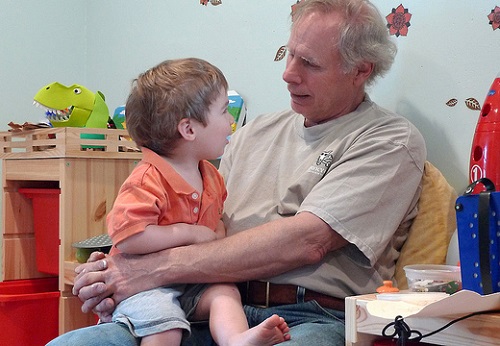
1) Speech before writing. Attend to the original speaking voice of your child. Really hear it. Respond to it. Make big facial expressions that show you are paying attention. In fact, pay attention! It’s too easy to seem like you’re listening when in fact you are rummaging through the pantry in your mind for tonight’s dinner ingredients. Listen, respond, engage (ask for “more” – “Tell me more about X,” “What else happened?”, “I want more details! This sounds __________ –exciting, scary, nerve-wracking, calming, wonderful, crazy, fascinating”).

The habit of attending to your child’s spoken voice creates the best foundation for writing. As you listen, sometimes you will want to jot down what is being shared. Do it! Write it down and share it later in the day with an interested party (other parent, grandparent, sibling, friend).

2) Writing is exploration, not performance. Use writing to explore thoughts and ideas, impressions and hunches. Kids need to know that the context for their written thoughts is a safe place to explore those partially formed ideas. It is not a place where they must prefer accuracy to risk. Risk is valued. Accuracy, not so much. Accuracy and technique are “value-added” features that come at the end of the writing process. They must never govern the process or control it. Rather, the experience of writing (particularly that initial burst of language through the hands) must be that risk is exhilarating and valuable.

If exhilaration is not available as a legitimate reaction to writing, the minimum ought to be that risk is permissible. Give permission, take risks, shock your kids and write your own risky, free, un-bound exploration of a word, idea, thought, belief, impression, experience, conversation. Share it. Model what it may look like to really let loose. You are the permission-giver and catalyst in your homeschool. Break your own rules, if you need to, to free up space for written exploration.

Cross-posted on facebook.
Posted in Homeschool Advice, Writing about Writing | Comments Off on Free up space for written exploration

Don’t Trust the Schedule

Don't Trust the Schedule

Scheduling is a necessary tool for dental appointments, piano lessons, and date nights.

It is less useful for homeschooling. Here’s why.

Home is where we let go, let down, and live in a relaxed, unhurried, no pressure state. It’s where we go to get away from time’s demands. We unconsciously unwind at home (or at least, we certainly want to unwind at home).

But along come our “school-at-home” notions, built from our memories of traditional schooling; we bring the clock and bell into this relaxed, “be myself” environment. We decide to structure things like breakfast and teeth-brushing so that we can “start” the day of schooling.

We try to monitor the length of time spent at one subject area so that we can move to the next. We manage naps for babies and DVDs for toddlers to free time for the focused attention our older kids need. We pick a time for lunch and try to hit it consistently.

Some parents are brilliant schedulers, and make this uncomfortable fit of time measurement and home, work. But for those who fail (or believe they are failing), there’s a good reason for it. Not only do your children resist being marshaled to accommodate the artificial imposition of time constraints on home activities, but at some level, so do you.

You know it’s artificial.

  • You do answer the telephone or respond to a text in the middle of the math lesson.
  • You do sleep in some days when the baby kept you up all night.
  • You are likely to flop on the couch and take a micro nap after the read aloud, because you literally can’t stay awake.
  • You walk around in pj’s long after breakfast, and suddenly remember you need to go online to pay a bill or reserve a space or change an appointment.

Home is a fabulous space because you actually can do all those things! You can’t in an office. You certainly can’t in a school!

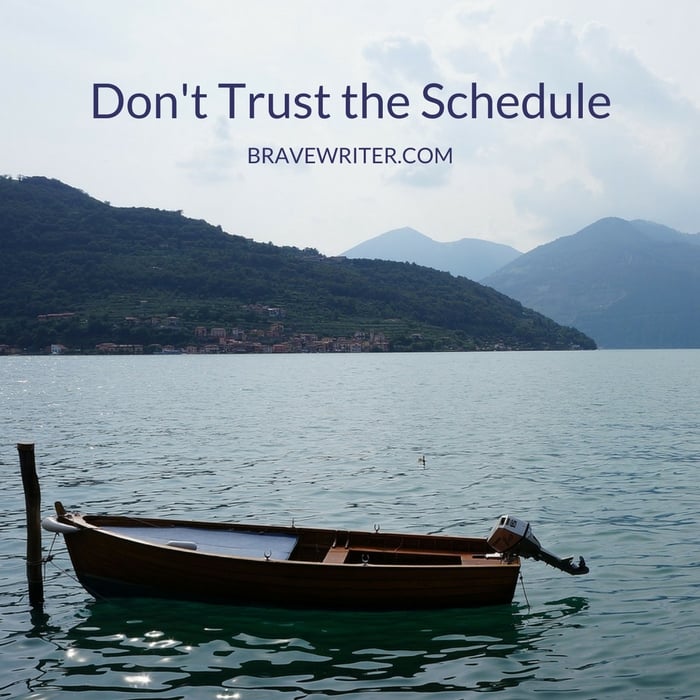
Home is that place where you maneuver through the waves of activity like a skiff—quick, sharp turns, at full speed. You aren’t an ocean liner, needing ample warning to avoid icebergs, monitoring every engine, taking huge quantities of time to make small adjustments. You are navigating your day freely, weaving and bobbing around the interruptions, taking advantage of an open sea of time when it arises, and then shutting it all down when 3 out of 4 kids get sick.

You do this even after you’ve created a schedule! That’s what’s so odd. You know that you aren’t truly tied to that schedule, which is why you violate it.

  • If you live by a schedule, sick children produce resentment: they are messing with your project for efficiency!
  • If you live by a schedule, the day you sleep in means you are behind all day (when I’m behind all day, I’m not as nice a mother or person).

The Conflict

The conflict between home and schedule can be resolved by dumping the schedule and admitting the nature of home.

Home is a space where each person has a certain amount of freedom to just “be.” Within that “beingness,” it’s possible to learn an enormous quantity of information. That’s why we brought our kids home from traditional schooling—we believed that the homey-ness of home was not antithetical to learning. Rather, we believe that home is even more conducive to learning than school with its clocks and bells.

That’s because it happens to be true: tutorial-based, interest-driven, time-unbound learning is effective—supremely so.

Home creates a space for that kind of learning to flourish. Why ruin it with a schedule?

Honor the rhythms of life.

The Solution

What I propose is the homeschool routine. Rather than trying to schedule the days, set up a routine (a spare one—with a few reliable practices) that can be returned to when you have “one of those days.” Follow inspiration whenever possible. She is not a lengthy visitor.

But on the rest of the days, we can know that after we wake up, we eat breakfast (no matter how early or how late in the morning). After breakfast, we move to the family room for read aloud and I read until we are done (a single chapter or four, depending on the mood and happiness of the family).

After reading, we do copywork (at least a couple days a week). We pick the days based on everyone’s energy level for writing (if it’s a heavy writing day, we don’t do copywork and addition).

We move to math after reading and writing. The math pages are chosen based on progress and effort. If a child struggles with a concept then more time is given with fewer problems to solve. If the concept is easy, the page is completed quickly and perhaps only alternating problems assigned.

An on-going history lesson or project follows lunch, picking up where we left off before (no assigned pages, no “place to get to by the end of February” in mind). History can continue this way…forever. Who said there’s a certain amount you must finish by June? My family got stuck in Ancient Greece and Egypt for two years. We loved it! We wanted to camp there.

Perhaps you have other library books to read to the little kids (picture books) later in the day. These are done before naps, as many as everyone wants.

Other activities can be included like:

  • scrapbooking
  • Poetry Teatime
  • an ongoing game
  • computer play
  • Rosetta Stone
  • Movie Wednesday
  • birding
  • building a model
  • art and piano lesson/practice

But each of these is given time (without a constraint) to be done as the child has the capacity to sustain interest.

It’s nearly impossible to schedule energy and interest level. That’s why school feels dull so frequently. The assigned hours have nothing to do with a student’s attention span, curiosity, energy to perform well, and the peacefulness of the atmosphere. Regardless of how students feel, they are expected to perform in hard chairs, with small desks, surrounded by others, facing a teacher who is examining their eyes for attentiveness, while (perhaps) remembering being bullied at recess.

At home, kids have the benefit of being themselves. They can make themselves comfortable—lying prone on the floor, lounging on the couch, sitting at the kitchen island. Of course this kind of freedom produces two effects: keen concentration and absolute sloughing off! Both occur when we are allowed to “be” rather than feeling pressure to “perform.”

We create the conditions of excellence and quality performance when we honor the rhythms of life, when we value the hot white fire of passion when we see it (rather than remarking, “But that’s not on the schedule today”). We sustain growth when we return to the comfort of the routine when all other energies are subdued. And we honor our human frailty if we toss routine, schedule, or structure when we are falling apart (sick, irritated, frustrated, in pain, exhausted, or bored).

Schedule is tempting. It holds the promise of “getting it all done” which we translate into our heads as “completing our children’s education.” Don’t be seduced by that promise. Mostly what I hear from parents under the pressure of schedule is “I’m behind” and “I feel like a failure” and “I’m terrible at staying on schedule.”

Embrace the properties of home.

Of course you are. You’re at home. Be home. Love. Live. Learn. Thrive.

We’re so lucky to be home. The best gift you can give your family is to be glad that you are, and to live as though home is the ideal space for learning to occur. Because it is.

Brave Learner Home

Posted in Brave Writer Lifestyle, Homeschool Advice | 7 Comments »

Let joy be your guide!

Joy is the best teacher

The Brave Writer motto used to have nothing to do with writing, except everything to do with it:

“Joy is the best teacher.”

I still believe that.

Trust it. This one you can take to the bank. When your doubts flare and you wonder if you are “serious” enough or “organized” enough or “doing” enough, pause. Scan your environment. Where is joy happening? What’s causing joy? Chase it! Go after that. See what happens.

Who’s laughing? Has it been a while since you heard laughter? Who’s engaged and deeply involved?

Example: When Liam was small, his passions combined were Legos and Pokemon/Yugi-oh card games. He created his own world of Lego men who held supernatural comic book powers. I got into his world with him. He couldn’t read yet, but I could jot down the names of these Lego men. I could record their powers in a list on a sheet of paper on a clipboard. He could carry that around for a month sharing it with everyone. And he did.

We played those card games (mind-numbing for me; sheer delight for him!) for over a year! Who knows how much this early interest in card-playing helped him read? I just know it did.

An interest in the discovery of gold led my family to a whole new way to homeschool I call “party-school” where we created a full scale Gold Rush party with other homeschool family-friends.

Reading entire series back-to-back, over-and-over; knitting; coloring pages; sewing; Legos; forts made from sheets; fingerpainting; a treehouse-ish structure in the backyard that was built from scrap wood and nails and an abundance of hammers; learning to draw (all together, on the deck, in the sunshine); baking, baking, baking; poetry reading; walks with the dog and strollers and baby backpacks—on the beach, in the woods, up the street of condos; picnics because we could; reading too many chapters because we had to know what happened next and so, skipping math; Googling and googling and googling to find out more, to confirm a hunch, to invalidate an incorrect statement; online video games; the whole LOTR trilogy on DVD for the nth time (extended edition); making candles; dying cloth like they did in colonial times…

See?

Sure a workbook here and there might reassure you that you are being responsible to “educate.” Ask yourself. What do YOU remember from your education? Content can be delivered in many packages. Risk something—find a package that is big and life-encompassing whenever you can.

You are at home. Let joy lead the way. When you see the spark, chase it! Sprint, leap, grab hold, and ski to the learning.

Will you always successfully shake a jar with heavy cream and a marble in it and get butter and see smiles at the end? Not necessarily! Some of the initial passion to “try” an idea will be muted by hard work or a bad fit or a simple debacle of failure. That’s okay! That’s true of workbooks too, by the way. But at least the attempt is in the right trajectory.

Wash your hands of the flawed attempt and move on. Laugh about it later.

Let joy be your guide. Leave guilt in the basement. Flick the “ghost of public school past” off your shoulder.

Let joy be your teacher and your children’s teacher. Joy does it best. She’s so freaking adorable, who can resist her when under her spell?

Exactly.

That.

Image by CJ Sugg (cc cropped)

Posted in Brave Writer Philosophy, Homeschool Advice | Comments Off on Let joy be your guide!

Intensity

boy game

The key to depth learning is intensity. We hear about passion, immersion, delight-directed learning, deep-dives, talent, intelligences, curiosity, and other language around self-education that all attempt to create an image of focused attention and sustained interest in any number of subject and skill areas.

While each of these terms and phrases has a place in the self-education conversation, the key factor that creates the retention of what is studied or explored is intensity. The most talented, sharpest mathematics-whiz kid will not go beyond what is easily attained through natural aptitude without it! A physically gifted athlete cannot progress to the first string or select teams without it.

Intensity creates clarity of focus, the drive to work hard and struggle through the challenging parts, and serves to magnify the importance of the material or skills so that the child is motivated to master them. Intensity in learning is what is missing in most traditional school settings. Kids are introduced to subject matter in the least catalyzing ways, and then are asked to master it without any “hook” – no intrinsic reason, no obvious benefit to them. They learn to passively work on homework or take notes for the sake of passing tests, rather than the deep dive into the material because it compels them to know!

Intensity in learning, then, is the “compelled to know” ingredient to an education. When I was in high school, I became obsessed with theater (all sides – acting, stage managing, lights, set design, PR, directing). By the time I was a senior in high school, all of my classes were in the theater and I used time outside of class to read plays, to diagram the sets, and to set the blocking as a kind of enjoyable exercise for my own self-instruction.

You know intensity when you meet it. These kids are driven to know and to create time to find out. Sometimes we demean the chosen passions (video gaming, shooting free throws, studying fashion and make up). Still, you can tell what your child cares about by the level of intensity that shows up with it.

Sometimes intensity looks like a child walking through the house with a full length original novella and red pen in hand, editing it at all hours of the day.

Sometimes intensity looks like a boy cradling his lacrosse stick in the car, at the store, sleeping with it by his bed.

Sometimes intensity is marathon DVD viewing of the same LOTR trilogy over and over again, while reading the books and visiting fan sites online.

There’s a persistence and an insistence in intensity. The child keeps at it without being nagged. The child cares about it without being convinced. The child acquires the vocabulary of that world, without workbooks or lectures.

Intensity in children is not always attractive, however. It can look like throwing stuff, and shouting at the computer screen. It sometimes manifests as taking a swing at a sister or crumpling up the paper so carefully written and stuffing it in the waste basket.

Angry comments come from intense children:

“I hate it. You can’t like it. It’s ugly.”

“I’ll never be good at ___________.”

“Leave me alone. I’m trying to figure it out!”

“I don’t need your help. Quit telling me how to do it.”

“This book is stupid!”

“I was just getting to the good part. I can’t stop now!”

“I’m not tired (hungry, dirty, angry). I have to finish.”

Euphoric comments come from intense children:

“I’m the best speller in the world!”

“I figured it out WITHOUT your help!”

“I’m going to read every JRR Tolkien book in order and learn elvish.”

Make you feel stupid comments come from intense children:

“You’re wrong!”

“Actually, that’s not true. The truth is…..”

“You don’t know anything. (Expert person) says _________.”

Intensity shows engagement, even if the expression of intensity from an immature person comes across harshly or brashly. Being cocky is the privilege of expertise and while adults learn how to be cocky without offending everyone in the room (at least, some of them do), your kids may not yet have been “socialized” to discover that they need to reign in their “lording it over others” disposition.

The only thing you need to do around intensity is to admire it. It’s intrinsic to the person. You can’t “drum it up.” Disposition is not what I’m talking about. You don’t have to be loud or bug-eyed to be intense about an interest. Rather, intensity is measured through the raw commitment of your child to that one particular area that lasts longer than a moment in time.

When you see it, please support it. Intensity around a video game could well lead to intensity in other areas. I watched one of my kids spend an enormous amount of time on an Elijah Woods fan site that led her to discover the wide range of lives other girls her age led. She is now a social worker. Another child loved the Internet so much that when he discovered Google could be rendered in other languages, he switched his Google page to Klingon and that led to a fascination with linguistics (which he studied for two years in college!).

I read a book about a homeschooled child who became a conductor of a symphony. His passion in life began not musically, but with blocks. He became obsessed with building them, arranging them, moving them into new configurations. When he finally studied piano, this deeply held passion for arranging parts led to his fascination with conducting music. Who could have known that blocks would lead to music in that way?

You can’t know how the intensity in your child will morph into a long term interest that has value that you understand and appreciate. All you can do is admire it! Enjoy it. See if you can look behind the intensity that worries you to a possible benefit.

My online gaming son has become quite the chess player. Funny how we all admire his endless fascination with mastering opening moves and watching international contests for chess, but are put off by his endless love of specific online video games. Strange, isn’t it? We approve one intensity and the other we want to call an “addiction.” I’ve had to learn what those games mean to him and am trusting that they will lead to the next thing—that next intensity.

It would be fun to hear all the ways your kids show you their intensities. Please share what fascinations are showing up in your household. Also, of course, feel free to post questions. One of the challenges of raising an intense child is what to do when that child becomes belligerent or excessively arrogant.

Here’s to intensity!

Cross-posted on facebook.

Image © Dmitry Naumov | Dreamstime.com

Posted in Brave Writer Philosophy, Homeschool Advice | Comments Off on Intensity

Keep the focus pure

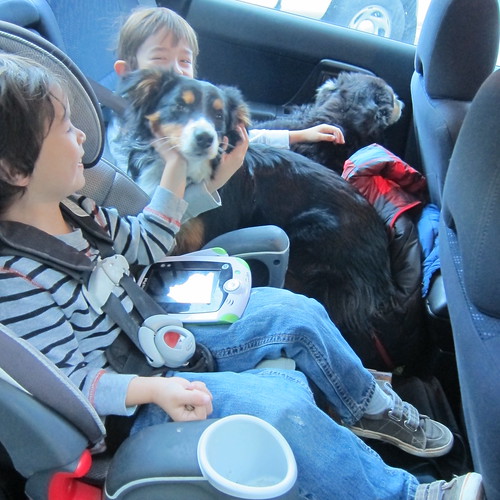
2 kids, 2 dogs and a cat

The competing demands on your time will eventually eat into your homeschool. You will ping pong between getting your kids out of the house into the big world so that they have experiences, meet other children, learn from passionate adults, and become skilled athletes, musicians, dancers, or pet rescuers, to utter seclusion where you shut the doors against that big world, and stay happily home steadily making progress in the subject areas of “school”—until you get tired of the routine and burst back onto the world’s stage.

This back-and-forth is not uncommon among homeschoolers, and is not even wrong. For some families, it’s a seasonal thing. In my family, for instance, we kept the sanest “stay-at-home” schedule in winter quarter while indulging a much more energetic out-of-home schedule in fall and spring (coinciding with soccer and lacrosse practices).

Even so, you can feel spread thin like too little butter over so much bread trying to keep up with the competing beliefs you have about a healthy, happy homeschool and childhood.

Opt out of that maze of confusion and adopt a different rubric. Fix your gaze on your individual children, and your children as a group. They are the focus. They are the rubric.

Ask yourself these questions:

1. Who is left out?

2. What needs have I catered to and which ones have I overlooked?

3. What can I cut out? Or, conversely, what can I add in?

4. Which child is the most vocal about his or her needs? Who gets overlooked?

5. Why am I [adding in/taking out] this activity? Am I trying to please someone else?

6. If I could have a week the way I want it, would it look like the week I’m currently having? What one thing can I do to make it look more like what I wish it were?

7. Am I doing any of my activities out of guilt? Which ones?

8. Are there any activities that my child can do without me?

9. Are we having fun yet?

Your attention needs to be on your family, not on your philosophy or your community or your fears and worries. Over 15+ years of homeschooling, you will undulate between seasons of intense community involvement and quiet spans of time in at-home peacefulness. Balance isn’t always achieved week-to-week. Sometimes it is achieved over an entire childhood. That’s okay!

I remember that with five children, we made a rule that only two kids could play sports at any one time. That was our only route to sanity with all the driving involved.

Think about how your family functions best in this season and do that. You’ll know when that season needs to change by how your children are behaving, performing, and holding up. You’ll know it by how you are feeling too. At that moment, don’t beat yourself up! Simply recognize it’s time for a shift in the routine. Follow through and enjoy that season as long as it lasts.

Keep your focus pure.

Cross-posted on facebook.

Image by originallittlehellraiser

Posted in Homeschool Advice | Comments Off on Keep the focus pure

« Older Entries
Newer Entries »
  • Search the Blog

  • Julie Bogart
  • Welcome, I’m Julie Bogart.

    I’m a homeschooling alum -17 years, five kids. Now I run Brave Writer, the online writing and language arts program for families. More >>

    IMPORTANT: Please read our Privacy Policy.

  • New to Brave Writer? START HERE

  • FREE Resources

    • 7-Day Writing Blitz
    • Brave Writer Lifestyle Program
    • Brave Writer Sampler: Free Sample Products
    • Freewriting Prompts
    • Podcasts
  • Popular Posts

    • You have time
    • How writing is like sewing
    • Best curriculum for a 6 year old
    • Today's little unspoken homeschool secret
    • Do you like to homeschool?
    • Don't trust the schedule
    • You want to do a good job parenting?
    • If you've got a passel of kids
    • You are not a teacher
    • Natural Stages of Growth in Writing podcasts
  • Blog Topics

    • Brave Learner Home
    • Brave Writer Lifestyle
    • Classes
    • Contests/Giveaways
    • Friday Freewrite
    • High School
    • Homeschool Advice
    • Julie's Life
    • Language Arts
    • Movie Wednesday
    • Natural Stages of Growth
    • One Thing Principle
    • Our Team
    • Parenting
    • Philosophy of Education
    • Podcasts
    • Poetry Teatime
    • Products
    • Reviews
    • Speaking Schedule
    • Students
    • Writing about Writing
    • Young Writers
  • Archives

  • Brave Writer is a participant in the Amazon Services LLC Associates Program, an affiliate advertising program designed to provide a means for sites to earn advertising fees (at no extra cost to you) by advertising and linking to amazon.com

    Content © Brave Writer unless otherwise stated.

What is Brave Writer?

  • Welcome to Brave Writer
  • Why Brave Writer Works
  • About Julie
  • Brave Writer Values
  • Frequently Asked Questions
  • Speaking Schedule

Brave Writer Program

  • Getting Started!
  • Stages of Growth in Writing
  • The Brave Writer Program
  • For Families and Students
  • Online Classes
  • Brave Writer Lifestyle

…and More!

  • Blog
  • Classroom
  • Store
  • Books in Brave Writer Programs
  • Contact Us
  • Customer Service
  • Brave Writer Staff
© 2026 Brave Writer
Privacy Policy
Children's Privacy Policy
Help Center