
Homeschool Advice Archives - Page 96 of 144 - A Brave Writer's Life in Brief A Brave Writer's Life in Brief
  • Start Here
    • For Families
      Multiple Ages
    • Ages 5-7
      Beginning Writers
    • Ages 8-10
      Emerging Writers
    • Ages 11-12
      Middle School Writers
    • Ages 13-14
      High School Writers
    • Ages 15-18
      College Prep Writers
  • Shop
    • Product Collections
    • Bundles
    • Writing Instruction Manuals
    • Literature & Grammar/Punctuation
    • Composition Formats
    • Literature Singles
    • Homeschool Help
    • Book Shop
  • Online Classes
    • Class Descriptions
    • Class Schedule
    • Classroom
    • How Our Classes Work
    • Our Writing Coaches
    • Classes FAQ
  • Community
    • Brave Learner Home
    • What’s Happening
    • Blog
    • Podcast
    • Calendar
  • Cart
  • My Account
    • My Online Classes
    • My Account
  • My Account
    • My Online Classes
    • My Account
  • Start Here

    If you’re new to Brave Writer, or are looking for the best products for your child or family, choose from below:

    • For Families
      Multiple Ages
    • Ages 5-7
      Beginning Writers
    • Ages 8-10
      Emerging Writers
    • Ages 11-12
      Middle School Writers
    • Ages 13-14
      High School Writers
    • Ages 15-18
      College Prep Writers
  • Shop

    If you’re already familiar with Brave Writer products, go directly to what you’re looking for:

    • Product Collections Browse the full catalog in our shop
    • Bundles Everything you need to get started
    • Writing Instruction Manuals Foundational Writing Programs
    • Literature & Grammar/Punctuation Grammar, Punctuation, Spelling & Literary Devices
    • Composition Formats Writing Assignments for Every Age
    • Literature Singles Individual Literature Handbooks
    • Homeschool Help Homeschooling Tools and Resources
    • Book Shop Books associated with Brave Writer Programs
  • Online Classes
    • Class Descriptions
    • Class Schedule
    • Classroom
    • How Our Classes Work
    • Our Writing Coaches
    • Classes FAQ
  • Community
    • Brave Learner Home
    • What’s Happening
    • Blog
    • Podcast
    • Calendar
  • Search
  • Cart

Search Bravewriter.com

  • Home
  • Blog

A Brave Writer's Life in Brief

Thoughts from my home to yours

Archive for the ‘Homeschool Advice’ Category

« Older Entries
Newer Entries »

It All Adds Up

Boy relaxing

It’s so easy to feel behind, or like you aren’t doing enough. In fact, when our kids are good at their schoolwork and “get finished” quickly (math page or copy work, grammar or reading), we might be tempted to undervalue the effort. We think: “It wasn’t hard enough,” or “She’s rushing through it,” or “This program is incomplete and too easy.”

Then we find ourselves in the quicksand of reevaluation and angst—not satisfied with the evidence of progress, accomplishment, success, and achievement.

Honestly, we doubt success when we should doubt struggle—we overvalue struggle as evidence of learning, when if we really think about it—joy and pleasure are much better signs of learning and growth.

Isn’t it strange? It’s like we’re never happy! My best friend in the homeschooling trenches used to say to me: “When my kids are outside playing, I wonder why they aren’t at home reading a book. When they are inside reading a book, I wonder why they are wasting the sunshine and not playing outside. I’m never happy.”

How true!

Our relentless need to push our kids (and ourselves), our insecurity about what progress looks like, and our memories of school (which are distorted by time and self-doubt), lead us to miss the evidence in front of our eyes—ease in learning, happiness in subject areas, brevity in finishing a task—these are evidences of successful education. Of course our kids will misspell or miscalculate. Of course they will sometimes use their worst handwriting or get distracted by a toddler who wants to play rather than finishing the chapter.

But that’s okay too! All of it adds up to learning.

Today, instead of looking for what’s missing, turn away from your fantasy homeschool vision. Notice reality. Make a list of all the things that go right today, such as:

• She brushed her teeth without my prompting her.
• He comforted his little brother when he started to cry.
• She finished her math page in ten minutes!
• He remembered which way the letter ‘b’ goes twice.
• She enjoyed listening to the read aloud.
• He wrote a list of materials to buy for his BB gun on his own!
• She practiced her dance routine.
• He went to his piano lesson and remembered to bring all the sheet music.
• She ate a good lunch.
• He laughed a lot while watching TV.
• I got to spend five minutes talking to him about his favorite game.
• I helped her find her hair net and she was grateful.

See?

So much goes right every single day. All of it is education. Pace yourselves. Enjoy the periods where the “school part” feels a little too easy and the lessons, a little short, and the home, relatively functional and happy.

That’s what you live for—don’t forget to notice when it happens!

Cross-posted on facebook.

Image © Windujedi | Dreamstime.com

Posted in Homeschool Advice | 1 Comment »

It’s not what you do, it’s what you do next

This Way Next signImage by David Amsler

You know how you get it right? By getting it wrong and making adjustments. By getting it right and repeating…until it doesn’t work and then you switch again. By toggling between what works and what doesn’t—staying responsive to the moment. Again and again.

You know how you get it wrong? By doing what doesn’t work. And then repeating it. And then defending it. And then reinforcing how right it is in spite of the evidence in front of your very eyes and blaming others for what doesn’t work.

If you are told that a certain practice will yield (fill in the blank) with your child and it doesn’t—if that child is miserable and angry, or listless and avoidant—that one doesn’t work. Stop.

Parenting and home education should not yield tension, ongoing anger, battle lines drawn, shaming, coercion, or repression.

We will all set boundaries that are too tight on the oldest child and boundaries that are fairly slack for the youngest. Welcome to parenting 101. Perfectly normal, ordinary, boring parenting. Well done.

What doesn’t work is rigidity that doesn’t see the child as a unique, choice-endowed, agent in his or her own life. This respectful view of the child must start early if we’re going to survive the teen years. Teenagers, even in families that were attachment parents and round-the-clock breastfeeding, non-spanking, shared sleepers, will foil your vision of who you thought they’d become. Why? They’re teenagers. Their job is to differentiate—to become “not” you. They want to prove to themselves that they will, in fact, be adults in their own right. They can’t know themselves if they are busy trying to be who you think they should be, or if they have to oppose what you think they should be. That just delays the self-awareness piece they deserve to explore.

I have said many times—just because your kids show you how different they really are than you doesn’t mean they are becoming worse people. In fact, in many cases, your teens will become much better people than you were at their ages. They just might care about different causes than you do.

All this to say: we make the mistake of barging in with our great ideas, our good advice, our systems and methods, our aspirations, our desire to protect our kids from what we suffered. Again: good parenting—those desires spring from invested loved.

Our job is to notice the effect of our advice, boundaries, rules, opinions, suggestions, interferences, and requirements. Then we can be the responsive people our kids need. Anything (short of molestation and violence) can be repaired with love and adjustment. Kids are tremendously forgiving people (no backlog of resentments yet). You can modify any decision, shorten any consequence, revise any plan, and rethink any viewpoint. They will respect you when you do.

It’s also good to ask forgiveness and to let them in on what your process is. “I heard that this is a good strategy to help you grow into a person who is responsible and kind. Does it sound like it would help you be that kind of person? Do you want to be that kind of person? What are your thoughts?”

Then be truly interested in the answer.

Our children are smart! They have minds and thoughts and ideas about who they are and who they want to become. You did too, at their ages. Remember how you felt minimized or managed by your parents. Let that guide you now in how you treat your children. They deserve just as much care and reverence as the good china.

It’s not what you do—we all do stuff we want to fix or change or repair.

It’s what you do next—how you adjust, modify, really listen, and show care.

Cross-posted on facebook.

Posted in Homeschool Advice | 1 Comment »

Do you like to homeschool?

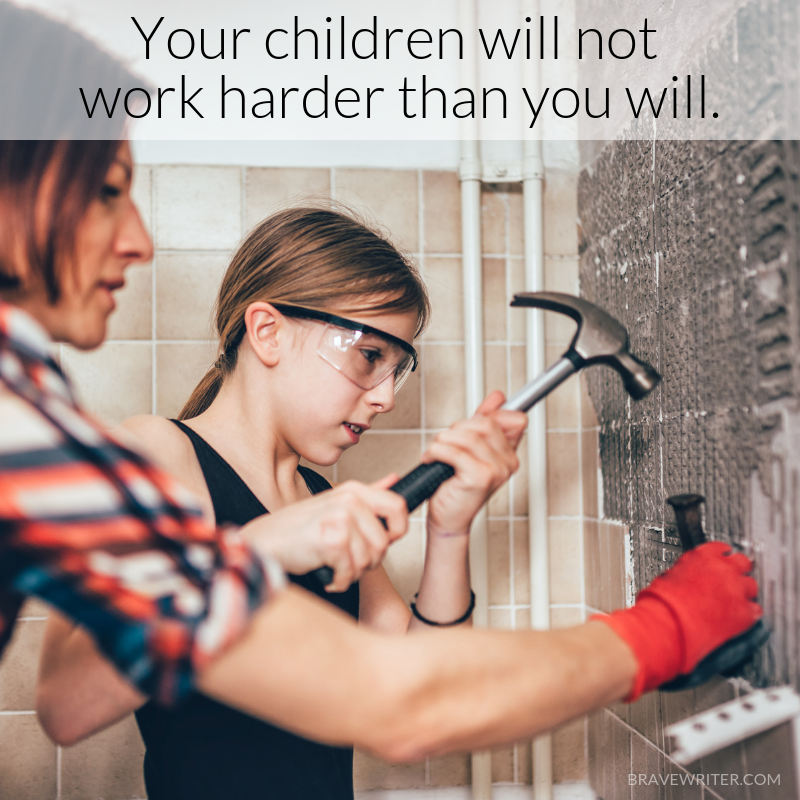
Your children will not work harder than you will

Corollary to the post, If it’s not working, it’s not working.

Sometimes when I hear about children who “won’t do their work” or “who are lazy,” I hear the following comment from the mom: “I need them to work independently.” Then they supply the reason which is one of the following: “I’m too busy, tired, sick of homeschool, have a part time job, need to tend to the younger kids, just moved, am pregnant, had a new baby, they are older and should not need me…”

A homeschool that is unhappy or a big struggle is often one where there is “work to be done” by children and a parent who can’t figure out how to “get the child to do the work.”

In other words:

An unhappy homeschool is one where neither parent
nor child wants to do the work that is homeschool.

Let’s look at that for a moment.

Think back to your favorite educational experiences. They weren’t all easy, were they? They weren’t all independent, were they?

My favorite learning environments challenged me to work hard, but I usually worked hard because the instructor worked harder than I did! I could feel the preparation in the lesson, I saw the commitment to my growth and the success of the outcome, I could tell that that educator was passionate about his or her field.

I was the least engaged in classes where the teacher seemed bored, distracted, barely showing up, expecting me to do homework with little interest in my actually learning… Was it the same for you?

Home education should not be an independent experience, even for (and perhaps especially for) teens!

I want to repeat that: high school should not be done alone in a room. It is not the time for a student to read, write a paper, and read some more. Self-teaching calculus is really really really hard. And tedious.

Home education is successful (and experienced as happy) when both parent and child are engaged in the process, and the parent puts in more work than the child. This is even true with unschooling—meaning that if you choose not to use formal educational tools, the learning happens because of your engagement with the larger world, noticing and creating opportunities to explore it and understand it. It doesn’t happen if you are working part time on the computer and your child is left to “learn” on her own.

Your children will not work harder than you will

Ask yourself: Do you like to homeschool?

If you don’t, then it is imperative that you find a way to love it (not just like it). Its success truly is contingent on your enthusiasm and energy. Yes, you can “get your children educated” at home without your enthusiasm, but at what cost? Will your children look back fondly on their home educations? Will they thrive and excel? Will you feel proud and gratified at the other end of the journey?

Homeschooling should not be a paler version of traditional school. Why do it if it is?

It’s okay, by the way, if the answer is “No, I don’t like homeschooling.” Start there. The next step isn’t necessarily to put your kids on the big yellow bus. The next step may simply be to recapture a love of learning for yourself—putting away all the teaching tools that have sapped your happiness and quieted your curiosity.

Rekindle interest in some area of learning and do it right in front of your kids, pulling them along. Pay attention to what you already love (old Jack Lemmon films, growing ferns, 18th century novels, opera, world news on the BBC, foreign languages, crafting, postmodern philosophy, supreme court decisions, showing horses). Share it. Live into it. Indulge it.

Pay attention to how you delve into your interests and apply that insight to how you educate (lead the way in learning) your young. Find the learning in any activity for a bit so that if you do in fact return to book-structured learning, you know how to go beyond the text to the experience of transformation/insight/appropriation (the true goal of learning).

Homeschooling out of duty will often create children who are either dutiful or resistant to learning, but not necessarily energized and excited about their educations. It’s no wonder that by high school there is a lack luster attitude about doing school work. It is experienced, by then, as work.

Brave Writer Online Classes

Posted in Homeschool Advice | 2 Comments »

If it’s not working, it’s not working

This Truck Went to The Racetrack
 

You know whether or not what you are doing with your kids is working. It’s not a mystery. You know if they are learning or growing or becoming more skilled.

You also know if your homeschool is not living up to what you hoped it would be. You know if your children are essentially happy (not every day all day, but for the most part—they expend energy and perform with alacrity). You know if they are essentially not.

  • If your homeschool feels dull, it probably is.
  • If your home environment seems tense, it likely is.
  • If you are bored or unhappy, distracted or anxious, so is your homeschool.
  • If you are preoccupied, your children will be distracted.
  • If you don’t like the material, they probably won’t either.

Your homeschool won’t change into a magical space of learning through worry or the force of your will. Truth be told: it will never be a magical space of learning all of the time.

The goal is to find a groove that is both livable and stimulating, that is consistent (reliable) and life-giving. There’s a difference between a child who “hates her life” and one who is simply “low energy for math” today. Don’t over-react to a tantrum or a day of the blahs. But equally, and also, don’t under-react to a child who is exhibiting chronic unhappiness.

I trust you to know the difference. If you can’t tell (or if child to child there are differences – what is working for one isn’t working for the other), get some outside input. Ask the oldest child who lives all day with you what he or she observes. Ask your spouse or partner what they see.

Consider all options.

Get help.

Take a break.

The most important thing you can do for your children and your homeschool is to tell the truth about it.

A very good place to start.

Image by Jerry Kirkhart

Posted in Homeschool Advice | 1 Comment »

If You’ve got a Passel of Kids

Homeschooling a Large FamilyBogart Kids, 1999

What I did when I homeschooled my five: I kept us all together as much as possible! Here’s how.

We started our days together every day. We spent one hour of the morning reading.

  • Devotional literature
  • Non Fiction (like books about nature or tanks or world religions or geography or the weather or how to make films…)
  • Aesop’s Fables or Greek myths (we did one of these each day for years)
  • Read Aloud (whatever novel we were reading as a group)
  • History book (we used a variety of narrative history texts over the years, not history textbooks)
  • Poetry (not every day, but many days—this is when we’d memorize poems together)

The kids usually knitted, or played with Legos or blocks while I read.

When we finished what we called Read Aloud Time, we would move to the table for math pages and copywork. These were usually according to level, but we did them all at once so that I could be in “math mind” or “writing mind” and not go back and forth.

Sometimes copywork came first, and usually passages were pulled from the same book, but different lengths per kid. Sometimes they picked their own copywork passages. New-to-writing kids used handwriting books.

Then we’d work on our history all together—same topic, same era. This might include preparing little oral reports or acting out a scene of history. It might include captioning an illustration of the reading of the morning or making maps or artifacts from that era. Sometimes we prepared a party to go with the era of history.

If we were working on a writing project, we all worked on the same topics or same concept for writing (posters – everyone, mini books – everyone, freewriting – everyone). Each child would write naturally at his or her level. It’s not like I had to drum up a brand new idea for each child each week. So exhausting! When we wrote descriptive paragraphs, we were all observing and note-taking and talking about our items at once, with me superintending. I didn’t create a project for each child, unique to that child.

Poetry Teatimes were always done as a group, poetry books of all levels available. I brought my adult poetry books to the table so I could share poems I found meaningful, even if above their level. I felt that was the best way to introduce them to some of the more challenging poets.

Then we might take a hike or kick a soccer ball in the yard or watch a movie or go to the store or to an art museum or the library…

The rhythm of our days was not determined by grade level. Rather, it was shaped by topics—each child would naturally perform at his or her level. That’s where “grade level” revealed itself. But I didn’t cater to it or pay it much notice, honestly.

It’s a shift in thinking. You are a one-room school house. You want to make the most of that environment. Create learning opportunities that call all of you together. Your older kids will inspire your younger ones, your younger ones will cheer up your older ones (and make them feel smart). They can work together, helping each other out, and making suggestions. They provide great audiences for one another too!


Brave Writer Family Writing Classes

Posted in Homeschool Advice, Julie's Life | 6 Comments »

« Older Entries
Newer Entries »
  • Search the Blog

  • Julie Bogart
  • Welcome, I’m Julie Bogart.

    I’m a homeschooling alum -17 years, five kids. Now I run Brave Writer, the online writing and language arts program for families. More >>

    IMPORTANT: Please read our Privacy Policy.

  • New to Brave Writer? START HERE

  • FREE Resources

    • 7-Day Writing Blitz
    • Brave Writer Lifestyle Program
    • Brave Writer Sampler: Free Sample Products
    • Freewriting Prompts
    • Podcasts
  • Popular Posts

    • You have time
    • How writing is like sewing
    • Best curriculum for a 6 year old
    • Today's little unspoken homeschool secret
    • Do you like to homeschool?
    • Don't trust the schedule
    • You want to do a good job parenting?
    • If you've got a passel of kids
    • You are not a teacher
    • Natural Stages of Growth in Writing podcasts
  • Blog Topics

    • Brave Learner Home
    • Brave Writer Lifestyle
    • Classes
    • Contests/Giveaways
    • Friday Freewrite
    • High School
    • Homeschool Advice
    • Julie's Life
    • Language Arts
    • Movie Wednesday
    • Natural Stages of Growth
    • One Thing Principle
    • Our Team
    • Parenting
    • Philosophy of Education
    • Podcasts
    • Poetry Teatime
    • Products
    • Reviews
    • Speaking Schedule
    • Students
    • Writing about Writing
    • Young Writers
  • Archives

  • Brave Writer is a participant in the Amazon Services LLC Associates Program, an affiliate advertising program designed to provide a means for sites to earn advertising fees (at no extra cost to you) by advertising and linking to amazon.com

    Content © Brave Writer unless otherwise stated.

What is Brave Writer?

  • Welcome to Brave Writer
  • Why Brave Writer Works
  • About Julie
  • Brave Writer Values
  • Frequently Asked Questions
  • Speaking Schedule

Brave Writer Program

  • Getting Started!
  • Stages of Growth in Writing
  • The Brave Writer Program
  • For Families and Students
  • Online Classes
  • Brave Writer Lifestyle

…and More!

  • Blog
  • Classroom
  • Store
  • Books in Brave Writer Programs
  • Contact Us
  • Customer Service
  • Brave Writer Staff
© 2026 Brave Writer
Privacy Policy
Children's Privacy Policy
Help Center