Brave Writer Philosophy Archives - Page 36 of 84 - A Brave Writer's Life in Brief A Brave Writer's Life in Brief
  • Start Here
    • For Families
      Multiple Ages
    • Ages 5-7
      Beginning Writers
    • Ages 8-10
      Emerging Writers
    • Ages 11-12
      Middle School Writers
    • Ages 13-14
      High School Writers
    • Ages 15-18
      College Prep Writers
  • Shop
    • Product Collections
    • Bundles
    • Writing Instruction Manuals
    • Literature & Grammar/Punctuation
    • Composition Formats
    • Literature Singles
    • Homeschool Help
    • Book Shop
  • Online Classes
    • Class Descriptions
    • Class Schedule
    • Classroom
    • How Our Classes Work
    • Our Writing Coaches
    • Classes FAQ
  • Community
    • Brave Learner Home
    • What’s Happening
    • Blog
    • Podcast
    • Calendar
  • Cart
  • My Account
    • My Online Classes
    • My Account
  • My Account
    • My Online Classes
    • My Account
  • Start Here

    If you’re new to Brave Writer, or are looking for the best products for your child or family, choose from below:

    • For Families
      Multiple Ages
    • Ages 5-7
      Beginning Writers
    • Ages 8-10
      Emerging Writers
    • Ages 11-12
      Middle School Writers
    • Ages 13-14
      High School Writers
    • Ages 15-18
      College Prep Writers
  • Shop

    If you’re already familiar with Brave Writer products, go directly to what you’re looking for:

    • Product Collections Browse the full catalog in our shop
    • Bundles Everything you need to get started
    • Writing Instruction Manuals Foundational Writing Programs
    • Literature & Grammar/Punctuation Grammar, Punctuation, Spelling & Literary Devices
    • Composition Formats Writing Assignments for Every Age
    • Literature Singles Individual Literature Handbooks
    • Homeschool Help Homeschooling Tools and Resources
    • Book Shop Books associated with Brave Writer Programs
  • Online Classes
    • Class Descriptions
    • Class Schedule
    • Classroom
    • How Our Classes Work
    • Our Writing Coaches
    • Classes FAQ
  • Community
    • Brave Learner Home
    • What’s Happening
    • Blog
    • Podcast
    • Calendar
  • Search
  • Cart

Search Bravewriter.com

  • Home
  • Blog

A Brave Writer's Life in Brief

Thoughts from my home to yours

Archive for the ‘Brave Writer Philosophy’ Category

« Older Entries
Newer Entries »

It’s the Little Things…

A reminder to do the little things that make for pleasantness in your home:

Have you….

    hugged your kids?
    surprised someone with a treat?
    tickled someone?
    made a joke?
    pointed out beauty to someone else?
    stopped to listen to laughter?
    looked out the window and saw, really saw, a bird?
    had an unhurried cup of tea?
    been thankful for good health?
    read something worth reading?
    smiled?
    jumped up and down to get your heart pumping?
    put on lipstick?
    read a poem?
    looked into your child’s eyes while she was telling you something?
    ate tasty food?
    gone for a walk?
    asked for a hug?
    admired a child’s good attitude?
    forgave yourself?
    wrote a few sentences?
    cleared the coffee table and put out something new to read or look at?
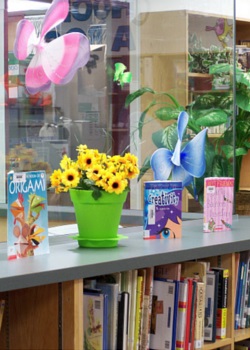
    lit a candle, put a flower in a vase, arranged the fruit in a bowl?
    inhaled deeply, exhaled slowly?

Hope so. Do any one of these and let your day unfold.

It’s the little things….
Posted in Brave Writer Philosophy, One Thing | 3 Comments »

Finding a Rhythm

Finding a rhythm in your homeschool

The Brave Writer Lifestyle may be in danger of becoming a group of words that lose meaning. When I first chose the word “lifestyle” to express the kind of language arts and writing environment that I hope families can create, I did so because I wanted to undercut the negative associations with the word “curriculum.”

“Lifestyle” is a routine or habit of being that relishes good books, writing, poetry, language, talking, movie viewing, and listening. These habits of being will foster better spelling, deeper readings, insight into stories and plots, an appreciation for good writing, an ability to translate one’s thoughts into written expression, a sophisticated vocabulary, interest in languages, (especially one’s own), openness to all kinds of writing genres (including poetry, plays, fiction and non-fiction), and a general love for the language arts.

Because we use the term “lifestyle” so much around here, it might become just the third word in the trio that substitutes for what others might see as a curriculum.

A writing curriculum or a language arts program is geared toward mastering skills. They may, as a by-product, help you to deconstruct difficult grammar, discover a wonderful book or teach helpful writing techniques. Additionally, a program offers structure and a linear step-by-step measurement of movement forward. This is why curricula and programs will never completely fall out of fashion and have their place! But they are not a lifestyle.

Brave Writer offers a different vision. We have certain practices we recommend that have proven beneficial for grammar and spelling, for writing and narrating. But they are simply that: habits or practices. They can be used to advantage or skipped for a time while a child investigates some other aspect of language or writing. You can use programs and curricula to support you in a targeted area of language arts or writing instruction (like an online class, or programs like the Arrow or Boomerang). But these are supports to the lifestyle, not substitutes for it.

A lifestyle implies habit and fluidity, routine and flexibility. You get to decide what is working and what is not.

For those who are “‘tweens” – between curricula and the vision of a lifestyle – let me offer you a single suggestion for how to embrace the lifestyle as you reorient yourselves.

Start with ONE thing.

Finding a rhythm in your homeschoolPick one activity or habit or practice or idea that sounds fun to you and do that first. Do it well. Don’t add to it.

So if you want to read poetry with your kids, go to the library and find a good poetry book. Just get a poetry book. Don’t get sixteen other books to read.

Share the book with your kids. Leave it on the coffee table. Read it at bedtime or with tea or during dinner. Let your kids read and hold it. Mark your favorite poems with bookmarks and reread them. Memorize a poem. Write one each morning on the white board. Write a poem in a notecard and keep it in your pocket all day, then reread it in the morning, in the grocery line and before you make dinner.

Enjoy poetry.

Too often we rush through the ideas on our list of good ideas and then wonder why nothing is taking hold. Stop. Read the ONE book and see how much you can get out of it for a week.

Maybe you’ll illustrate poems, or copy them over, or read them at the dentist’s office, or memorize one to share with visiting relatives. Maybe you’ll want to write a poem yourself. Maybe your kids will. Maybe this book will lead you to another book of poems or to one single poet. Let it do its work. Don’t force it.

The point is that if you make poetry just one of the many things you must do this week to achieve the “Brave Writer Lifestyle,” you may not enjoy the poetry. You might find yourself thinking about how after you read the poetry book, you ought to be copying quotes into copy books. And what about freewriting? And will that subscription to the Arrow turn out to be worth it? Suddenly your mind is off of the poem and on “curriculum planning.”

Don’t fall for that trap.

Slow down. Start with one thing. You can build on one good experience. You’ll find that one positive language arts experience enriches the whole. Perhaps the poem you read will naturally lend itself to a discussion of theme (Gerard Manley Hopkins), or grammar (Lewis Carroll), or word choice (Jack Prelutsky), or even a historical moment that gives context to the poet’s writing (Langston Hughes).

When you have exhausted the poetry book, pick the next enticing idea. (Don’t pick the one you think you should pick – I give you permission to follow your enthusiasm.) Enjoy it. Live it.

Follow these steps:

  1. Prepare for the experience (get the book, buy the ingredients for a recipe for teatime, read ahead in the novel, order the film from Netflix – whatever the activity is).
  2. Set up the experience for success by picking a date and planning to execute it that day. Clear your day of other burdens. Focus.
  3. BE HERE NOW – while you are in the experience, don’t let your mind wander to math or orthodontist appointments or bills. Unplug the phone, turn the ringer off your cell, close the laptop. Enjoy what you are doing and do it fully, without guilt.
  4. Reminisce. When the experience ends, a few days later, talk about it. Remember what was enjoyable. Say it out loud, to your kids, to your friends. Write it up in a blog or email your mother. Be sure to validate the positive experience so that it becomes a memory to treasure and share.

You might notice that these steps work great for teatimes or trips to the art museum. What about something more philosophical like, listening attentively to your children? Start by thinking of all the ways you can be a better listener. Can you take one child out for coffee, another on a walk, swim with one at the Y, see a movie and then chat about it on the way home with yet another?

Do it! It counts. See where it leads.

Can you choose to sit on the couch for a minute today with one child? Might it work to put one child to bed and to lie on that bed for fifteen minutes to cuddle and converse? Do it! Plan it, set it up for success, be fully in the moment and then remember the good that came from it.

You can’t plan time for listening and then fill up your days with lots of busy work. Focus on listening and let that be the frame of reference for everything you do that week.

Allow this year to be the one where you taste-test all the great ideas. Some will stick. Some will bomb. The ones that energize you and your kids will become natural habits because they make you and your kids happy, and you see fruit in their lives.

After many months, you will find that you have a lifestyle all your own.

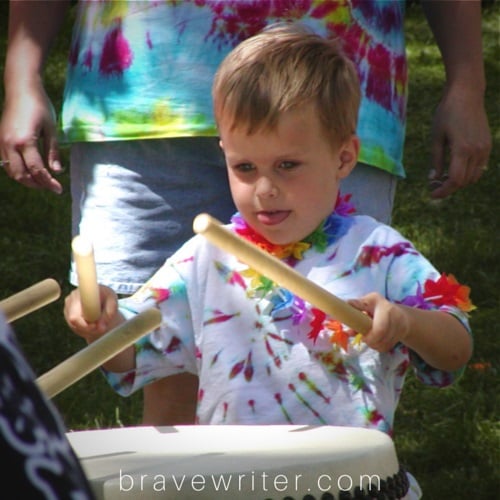
Images: boy drumming by Bev Sykes and library by Enokson (cc cropped, text added)

Posted in Brave Writer Lifestyle, Brave Writer Philosophy, One Thing | 4 Comments »

More email: How to help someone else’s child

Hi Julie,

I know you are super busy but I have a question if you have time.  I have a 7th grade girl who is now in her third year of taking my writing class at our co op using the Brave Writer philosophy.

I feel she is not growing as a writer.  The following is a freewrite that she just turned in this week (they were given three words to include in the freewrite: baby, gym, and computer):

Once thair was a Baby wose big sister loved gymnasticks. So The baby alwase stayed to wach her sister pre form. So one day she desided to Let her baby sister on the balance beam so she puts her sistr on the balance bean a stands her up her sister gose so fast to the other side of the balans beam that she flys all the way to the gymnasticks in struckeders arms and the gymnastics instructer sayed wow you are good at beams so then he talked to the babys mother abought letting the baby on the team. The babys mom sayed yes but on one condition thay don’t make her do anything she dose not wont to do. So the gymnastics in struckder rote her name in the computer and she was afishaly in the team.

Do you have any thoughts?  Am I wrong to expect more by this time?  How do I go about getting more from her?

Thank you for your time,
Kellie

—

Hi Kellie!

Great to know you’re using the Brave Writer philosophy to teach writing in a co-op. Let’s take a look at this freewrite and walk through the steps in Brave Writer to see what can be done with it.

First of all, freewriting means that you’ll see all the ugly spelling, punctuation and grammar. It’s free. That means a kid is focusing exclusively on content. (Right now, there are legions of mothers exhaling as they discover that someone else’s child makes all those mistakes too.) These are fairly gnarly spelling errors, but if you can shift your focus for a moment, you can see that the content isn’t so weak. It’s a little story that has a beginning, middle and end, uses two out of the three words you assigned (I don’t see computer in the piece) and her idea could be developed further for more detail. As her teacher, I’d suggest affirming all of the good things you see.

The next step (since you are probably most disturbed by her mechanics) is to ask her to make as many spelling/punctuation corrections as she can on her first pass. Often, kids can identify their spelling errors even if they can’t correct them. See if she sees what’s wrong before marking up the paper. If she can identify the error, then ask if she can correct it. If she can’t, those words go on a spelling list and can be targeted in copywork and dictation passages that include those words.

She also can benefit from copywork and dictation that target capitalization and apostrophes, for instance. But these are to be taken one at a time. Don’t overwhelm her with too many things to correct.

Finally, as far as getting more from her—the key in Brave Writer is to focus on exactly that: more. Ask her for more. You can ask for more detail about the baby (name, gender, pigtails or short hair, leotard of what color, how many months old?). You can ask for more detail related to the move the baby made on the beam. What was it? Can she describe it so I can see it? Can we paint a word picture for how the instructor caught the baby when the baby flew off the beam? These are the kinds of follow-up comments to make in writing or orally. You might want to chat with this student’s mother about it to see if she can follow through on these kinds of issues/questions.

The goal is to always start right where a child is, not to compare her too much to her peers. This freewrite is creative enough for revision and has the possibility of really growing. Don’t let the punctuation and spelling distract you. Keep those issues separate. If you have to, retype it error free and then read it to see how you could help her grow the content. The goal you need to have is to help her access more vocabulary, detail and insight that she can add to the original.

Hope that helps!

Julie

Posted in Brave Writer Philosophy, Email | 2 Comments »

Email: Reports from the front and a question!


Julie,

I have been reading the Brave Writer Manual (The Writer’s Jungle) and LOVE IT.  I really like the easy approach you give us to teach our kids.  I’m still waiting for the October book to come into my library to start the Arrow program, so I’ll keep you posted on how that goes.

The charter requires everything that the state requires but my rep is also a college Language Arts teacher.  She wants Daniel writing long book reports, essays, and paragraphs when completing school work.  My son, up until Brave Writer “hated” anything that required writing.  He would cringe when constantly reminded that he needed to be able to write an essay for the state tests in April.  Even writing the answers to questions in our history book required my writing the answers he dictated to me and then he would copy them.

Yesterday, we went on a nature walk, in between the rain storms, and collected flowers he wanted to put in a vase and do a writing project on.  We started with using the five senses and listing descriptive words.  When he finished that I asked him to write one sentence (no worries about spelling, grammar, punctuation, etc.) and to my surprise he wrote two very good sentences.  He was so proud reading them to us when his dad came home from work.  When he was done, I congratulated him and let him know that he could be done for the day.  To my surprise he asked if he could write more.  Of course I said yes.

Julie, thank you for this great easy to understand writing program.  We are very blessed to have found you.

Ann

Thanks Ann! It’s always such good news to know that kids discover the power and pride of selecting words to represent their inner experience. You’re doing a great job!

—

Julie,

It’s wonderful to see you up and blogging again. You’re blog has encouraged me greatly these past couple years. I started a blog a couple years ago, because of your encouragement. Writing in it occasionally, my essay like entries reflect upon what I am learning on my journey. Rereading my blog, I notice how much of your philosophy on life (not just writing) has helped me flesh out the things I struggled with through my 19years of home educating. You have also made me realize the importance of example in my life to inspire others. The purpose I have for my blog is to impart to my children as they go through their journey of parenting. Your blog is one of two I come back to, continually. I just want to say thank you for inspiring me to inspire others.  : )

May God shower you with many blessings today!
Diane

Wonderful to hear from you Diane. I’m thrilled that my blog has encouraged you, but even more thrilled to know that you are writing your own! That’s what it’s all about.

—

Hi Julie-

Thanks for sharing at PEACH tonight and for signing your “autograph” on Stefanie’s writing book. 🙂 That will be inspiring for her! I have been using your TWJ (The Writer’s Jungle) electronic since Sept. and we ordered various older electronic Arrows to jive with our TOG readings this year,too.  At any rate, as I told you, it has been going really well. Stef is happier and not as reluctant anymore. She likes the freewriting.   Would you recommend our next step to be just keep doing what we are doing? [buy other Arrows as needed]. I wasn’t sure if doing the Kidswrite Basic would be doing more of the same but with a larger audience and seeing the other kids’ writing with the teacher interaction? Since she is 10, do we just keep going until she gets to middle/high school and use your other essay writing classes, etc? Just wondered your thoughts,

Cindy

Hi Cindy.

You’re doing all the right things. Glad she is growing and relaxing. Your understanding of KWB is accurate. It’s a great place to get feedback, to see other student writing and to ask your in-depth questions about becoming your daughter’s most effective writing coach and ally. If you want an experience that is similar in terms of level, but that uses the tools of TWJ for a different product, I suggest taking a look at the Just So Stories course. It starts on November 2 and gives your daughter a chance to apply her newly found enthusiasm and skills to a specific writing project. This course is not offered again this year and the instructor is our longest-term writing teacher. In other words, she’s fabulous.

In fact, I hope lots of families sign up for JSS as it will close soon. Your kids get to write stories about animals that make use of Rudyard Kipling’s delightful use of language. You’ll love the process and the results.

Posted in Brave Writer Philosophy, BW products, Email, Language Arts, The Writer's Jungle, Young Writers | Comments Off on Email: Reports from the front and a question!

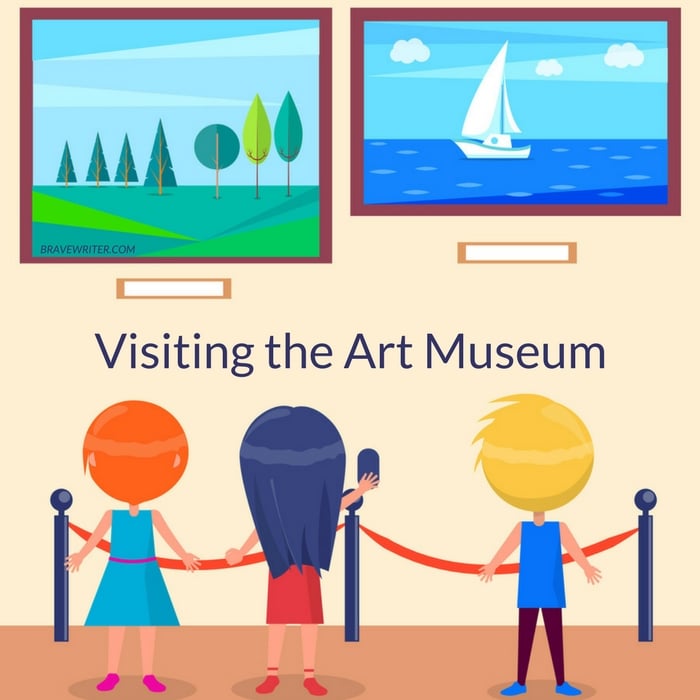
Visiting the Art Museum

Visiting the Art Museum

When we recommend going to art museums, sometimes parents wonder what it’s got to do with writing. Isn’t art its own course of study? Why would Brave Writer specifically promote it?

I promote the enjoyment and study of art because a visual vocabulary is critical to a verbal one. We’re primarily stimulated every day through sight. As we observe the world around us, we form impressions that inform our attitudes, beliefs, preferences and habits. Art uses a visual vocabulary to communicate. We’re awed by the precision of strokes (to an almost photographic accuracy) in some paintings and then moved by the blurry soft edges of impressionism that tend to evoke a mood more than provoke a compliment. We see color manipulated to create atmosphere, we observe other times and eras (habits of dress, style of architecture, expanse of nature). We get to see style (we can compare and contrast artists within one era, and we can compare and contrast artists of different eras).

These encounters are different than nature or TV or flipping through a photo album. Artists are deliberate in ways similar to authors.

  • They select the point of view.
  • They edit the scene in front of them, choosing what to paint and what to exclude.
  • They pull from a palette of colors like authors draw from a lexicon of language.
  • They tell a story through images.
  • They create pathos or joy, indignation or peace.

And all we have to do is stand and look carefully, allow the painting to speak through its images.

For writing, having a rich visual vocabulary is just as important as having a big word-filled one. Words help to express images and images give rise to words. They partner together to create meaning.

A trip to an art museum also offers visuals to go with some of the legendary stories of our collective history. Together, paintings partner with language to create new levels of appreciation.

What follows, then, is a window into how frequent trips to the local Cincinnati Art Museum enhanced our home education.

Be not intimidated! Get the stroller and go. You’ll be glad you did.

2005

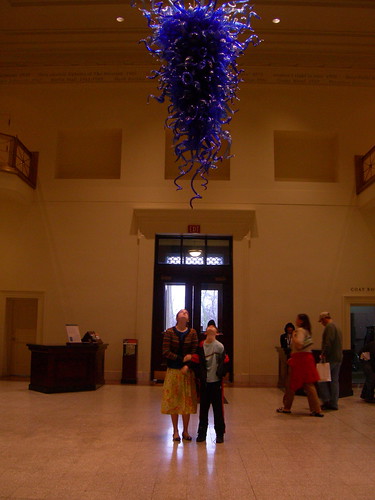
One thing I love about Cincinnati is that the art museum isn’t that far away. We went to it yesterday for the afternoon. We’ve been many, many times. As we walked in the door, Liam exclaimed, “I love that Chihuly chandelier.” Jacob added, “I could look at it every day.”
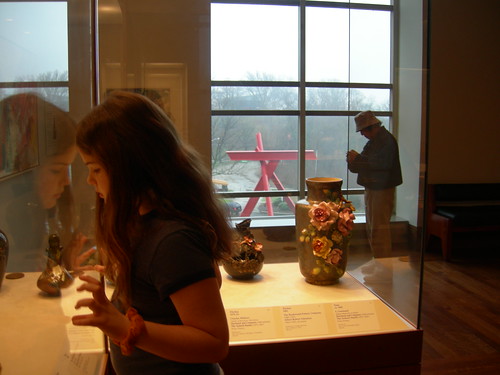
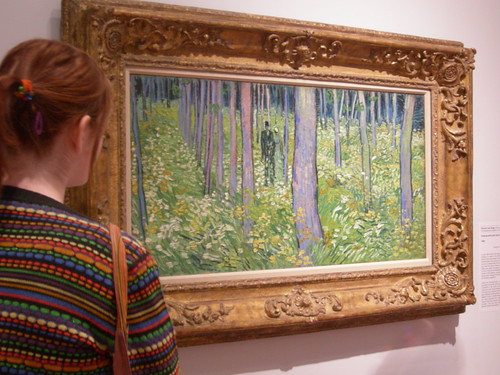
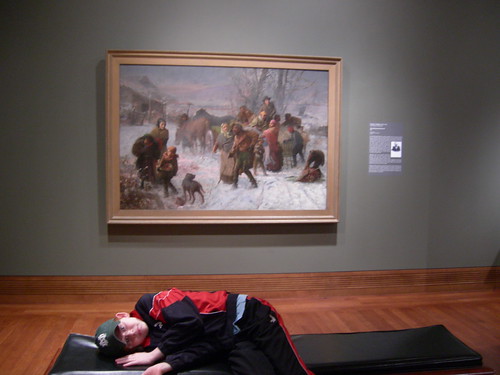
We made our way into the Greek and Egyptian displays and Caitrin noticed that they had rearranged them. She went on to point out which of the vases she liked best compared to last time. Liam wanted to stop and look at each of the hieroglyphs again.

We moved on and went into an exhibit that was put up by Proctor and Gamble – all Cincinnati art. I honestly didn’t recognize the exhibit but the kids did. They started reminiscing about the pieces they had loved the last time we’d been there. We marveled at the quality of the artwork. Later we found an entire exhibit devoted to Frank Duveneck (Cincinnati native) and were thrilled to see all his paintings together. That was new.

We made our way upstairs to see the Monets that are on loan from Paris and were blown away by the size and colors. Caitrin immediately told me the story of why this particular “Bridge at Giverny” was so hard to see close-up – “because Monet lost his eyesight as he got older and he would make paintings that were less and less realistic as a result.” She pointed out how much the bridge showed up if we were at the back of the room compared to up close when we could see each swirl of the brush up close.

Liam reminded me of the “Linnea in Monet’s Garden” book we had read and Jacob remembered the movie we had checked out from the library. We were amazed that the Cathedral at Rouen was so dull close up and so vibrant at a distance. You could see the source of light behind it and it glowed from across the room.

We walked into the modern art exhibit and all agreed again that we don’t like modern art, except that I really like Mark Rothko. Rothko asserts that he isn’t interested in form, line, or color but in creating emotions. He says that he knows he communicates because when people look at his work, many report that they cry. Jacob, who couldn’t remember who Rothko was when I spoke of him last week, was eager to see our Cincinnati Rothko. He didn’t cry. He didn’t understand why anyone would. I didn’t cry either, but I did feel this weird surge in my chest.

Liam wanted to see a real Van Gogh so I took him to the only one in the museum. He remembered it then and commented that, “That guy must really have liked paint. I like his blue.” Caitrin added, “He uses globs of it. It’s nice to see the real painting so we can see the globs up close.” We wished for a Van Gogh exhibit to come to Cincinnati.

Our favorite rooms were closed for renovation. We were sad. So we went to other rooms we frequent less and noticed all the Italians. We discussed the benefits of great art being dispersed throughout the world rather than collected all in one town. We talked about why the Italians artwork was so much more dramatic than the British in the room next door. We shuddered in front of a boyish, rosy-cheeked David holding the recently severed head of a bloody Goliath.

We ended up in front of a painting that showed a woman deranged with a pale face, flowers dripping down her white gown, restrained by a man in a renaissance costume. They stood before a queen in anguish and a king with his face in his hands. Jacob called out, “Mom, this is from Hamlet! That’s Ophelia.” And it was. The man was Laertes, her brother. Apparently this artist had wanted to make a series of Shakespeare paintings to display together in England, but the project failed and the pieces he painted have been bought up by a variety of art connoisseurs. This painting is the first to have been purchased for the Cincinnati Art Museum and its purchase preceded the museum’s construction by about five years.

It was a great afternoon. And it was fun to see that repeated visits yielded so much in my kids.


FREE Online Art Appreciation Workshop

Posted in Appreciating Art, Brave Writer Philosophy | 1 Comment »

« Older Entries
Newer Entries »
  • Search the Blog

  • Julie Bogart
  • Welcome, I’m Julie Bogart.

    I’m a homeschooling alum -17 years, five kids. Now I run Brave Writer, the online writing and language arts program for families. More >>

    IMPORTANT: Please read our Privacy Policy.

  • New to Brave Writer? START HERE

  • FREE Resources

    • 7-Day Writing Blitz
    • Brave Writer Lifestyle Program
    • Brave Writer Sampler: Free Sample Products
    • Freewriting Prompts
    • Podcasts
  • Popular Posts

    • You have time
    • How writing is like sewing
    • Best curriculum for a 6 year old
    • Today's little unspoken homeschool secret
    • Do you like to homeschool?
    • Don't trust the schedule
    • You want to do a good job parenting?
    • If you've got a passel of kids
    • You are not a teacher
    • Natural Stages of Growth in Writing podcasts
  • Blog Topics

    • Brave Learner Home
    • Brave Writer Lifestyle
    • Classes
    • Contests/Giveaways
    • Friday Freewrite
    • High School
    • Homeschool Advice
    • Julie's Life
    • Language Arts
    • Movie Wednesday
    • Natural Stages of Growth
    • One Thing Principle
    • Our Team
    • Parenting
    • Philosophy of Education
    • Podcasts
    • Poetry Teatime
    • Products
    • Reviews
    • Speaking Schedule
    • Students
    • Writing about Writing
    • Young Writers
  • Archives

  • Brave Writer is a participant in the Amazon Services LLC Associates Program, an affiliate advertising program designed to provide a means for sites to earn advertising fees (at no extra cost to you) by advertising and linking to amazon.com

    Content © Brave Writer unless otherwise stated.

What is Brave Writer?

  • Welcome to Brave Writer
  • Why Brave Writer Works
  • About Julie
  • Brave Writer Values
  • Frequently Asked Questions
  • Speaking Schedule

Brave Writer Program

  • Getting Started!
  • Stages of Growth in Writing
  • The Brave Writer Program
  • For Families and Students
  • Online Classes
  • Brave Writer Lifestyle

…and More!

  • Blog
  • Classroom
  • Store
  • Books in Brave Writer Programs
  • Contact Us
  • Customer Service
  • Brave Writer Staff
© 2026 Brave Writer
Privacy Policy
Children's Privacy Policy
Help Center