Pick a character from a book, fairy tale, movie, cartoon and write about why you are like that character. Or you can put yourself in dialog with the character, or start an adventure together, if you prefer.
Archive for February, 2006
Brave Writer and Classical Education
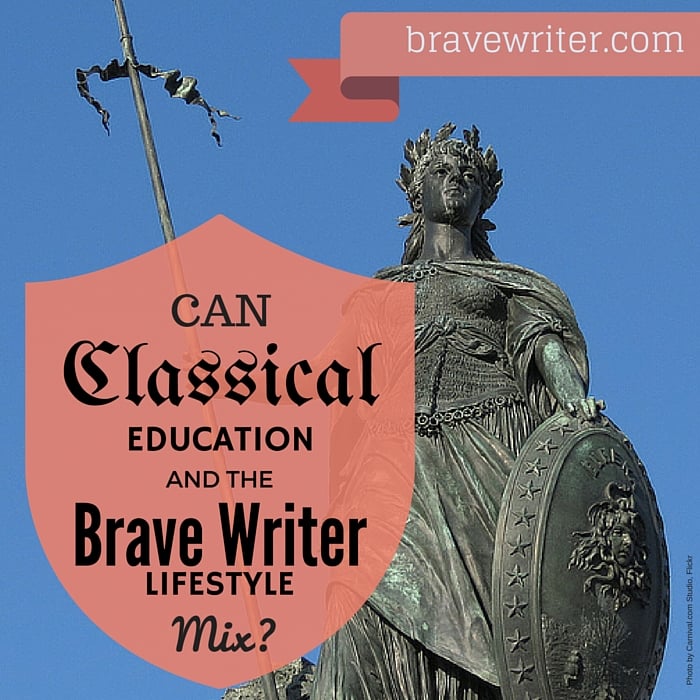
Adults can be drawn to the classical education model. We see what we haven’t learned and are in awe of the opportunity to learn it now, with our kids, hoping they will be the intellectual competents that we fear we are not.
[This post contains Amazon affiliate links. When you click on those links to make purchases,
Brave Writer receives compensation at no extra cost to you. Thank you!]
With the rise of The Well-Trained Mind, homeschoolers are now aware of significant gaps in their own educations. Most of us don’t remember learning the Greek myths, haven’t read The Illiad or The Odyssey, remember very little of our western civ coursework from college, and feel that any expository writing we did in college was more of a lick and a prayer than serious argument.
So we’re attracted to classical homeschooling. There’s so much to love about it!
Love the four year history rotation, love the integration of the sciences into history, love reading classical literature, love the classical argument models, love the immersion in myth and legend and tale and epic poem that is classical education.
Kids deserve to be expanded by
- great literature,
- myth,
- epic poetry,
- legend,
- artwork,
- history,
- scientific discovery,
- the stars,
- mathematics as a language (not just as a workbook),
- Shakespeare,
- theater,
- music,
- dance,
- and languages.
These sources provide rich material for imagination, vocabulary, and inner life. Such inner lives naturally spill over into writing with content and texture.
Each stage of development (grammar, logic, and rhetoric) offers new levels of personal expression and connection to these living source materials. Conversations, drawings, written narrations, transcription of great writing, mini dramas acted out, imitation, and metaphorical thinking (where one connects the past to present experience in a meaningful way) all give the ideas dimension and relevance to the student.

Can classical methods and Brave Writer mix? Yes!
So how does Brave Writer fit into this style of education? I love to say that joy is the best teacher. A happy mother makes a better home educator. The happiness must come from within, not from compliant children. So we begin with you. Begin the adventure of a classical education because you want one, not because your children should have one. You’ll need staying power to carry this course through. Your enjoyment of the lifestyle of classical education must be the fuel in your homeschool engine.
If a classical education model is what excites you, live it first, in front of your children. Read the classics (alone first, or a children’s version aloud). Get some commentaries to help you. You might start with Greek myths (they are so captivating and prevalent, and you will find lots of reinforcement in art and literature).
If you are new to epic poetry, pick out something like Beowulf, narrated by Seamus Heaney on CD and play it over breakfast, a little bit each day. Listen to the story and draw pictures of Grendel. Keep a little lexicon of terms that you define as you discover them. Play with them in sentences over breakfast when your listening is done.
If your kids are writers (9-10 or older), you can use a Friday Freewrite to write what you think will happen next, or to write a new ending, or to think about what Grendel may have felt in those last moments. (For those who don’t know, there is a book called Grendel that was written just for that purpose. You might check that out and compare it to your own speculations.)
You might write a new myth or create a Greek god (what god do you think the Greeks lacked and why?). Reinforce what you are learning not just through rote repetition, but using your imagination to make connections to our time, to our understandings.
Certainly any child who plays online games will make scores of connections since these games are rife with references to the ancient world in particular. Look up the names of characters and discover a pantheon of Egyptian and Phoenician gods that are hidden within the games.
Narration is key to a classical education because the ideas are unfamiliar and the vocabulary is often challenging. So talk over tea and in the car and over dinner. Take your time and keep the experience relevant to kids (don’t rely only on your sense that the material is important to “get them” to do their work). Our family spent two years solid on Ancient Greece, with our major concentration on Greek mythology. My kids know their myths backwards and forwards because they love them, not because they had to learn them.
Eventually this immersion in myths led to a fascination with epic poems, such as Gilgamesh. The results in our home: My daughter wrote her own Greek myth modeled after the ones she loved and my son wrote a screenplay for the story of Gilgamesh. These were not assignments, but spilled out of long term incubation and saturation with the material.
Want more on this theme? Our Writing a Greek Myth class is one of our most popular!

Image by Carnaval.com Studios (cc Modified to add text.)
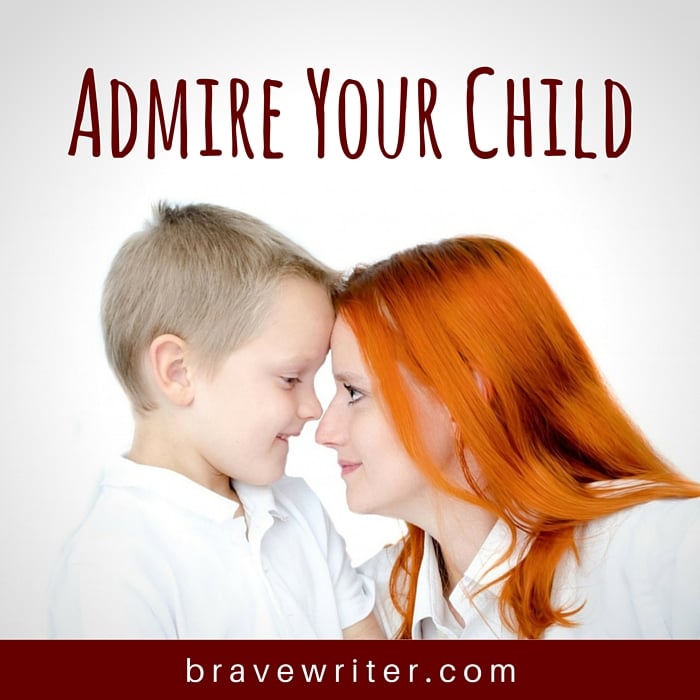
Admire a Child; Inspire a Child
As I was responding to a parent in our The Writer’s Jungle Online class, a comment she made struck me. She wanted to know how to inspire her child to write.
We often get tricked into thinking that finding the right topic or curricula, being creative or imaginative ourselves will lead to inspiration. And many mothers are exhausted, not feeling all that creative ourselves and wonder how we’ll muster inspiration for one, let alone two.
Let me put you at ease. It’s not hard to inspire children. They thrive under a certain condition. The condition is as follows:
Admire your kids.
It’s really that simple.
Notice what they are good at and praise it. If you have a child who is good at yo-yoing, notice. Say so. Today. If your son is a whiz at the remote control and setting the Tivo again for you (since you haven’t bothered to learn how to do it… – yes, that would be me), compliment that son.
If your daughter has stacked up sixteen American Girl catalogs and has the pages flipped down for her favorite pages and then asterisked each outfit she hopes to buy this year, pluck one out of the pile and ask her to take you on a journey of her selections. Yes, this is my nine year old daughter’s favorite pastime.
Ask questions that give your child the opportunity to be an expert. Be genuine. Don’t use leading questions where you hope to turn the conversation to an “educational” topic. Rather, be curious and marvel at how smart your son is, how adept or creative your teen is, how serious and calculating your daughter is.
Admire them for their interests and capacities.
How does this foster good writing? Several ways.
- You are learning to be an appreciative audience.
- You are facilitating the development of vocabulary around a topic of significant interest.
- You are tuning in to your child’s interests and can remember what they are when a writing opportunity comes up. Hey, Liam, want to write about how you learned to do an “around the world” with your yo-yo for Grandma? She’d love to hear.
- Your child learns to trust you. You find the things he is interested in, interesting. The child stops the guesswork of what would please you when you ask him to write and instead, will offer you what pleases him because he knows you will value it.
So find a way to admire your child today. And tomorrow. And the next day. Over time, your child won’t find writing so difficult because she will know that her audience loves to hear what she has to say.

What a day! (Want to work for BW?)
Friday was registration day and we were swamped with registrations.
Kidswrite Basic is full.
Expository Essay is full.
Just So Stories has about six spaces left.
Write for Fun has ten spaces left.
Guided Writing has three spaces left.
Thanks for your enthusiasm for Brave Writer courses. We are adding teachers and hoping to expand out offerings next fall.
To that end, I am seeking new teachers to join the Brave Writer team. If you’d like to teach online writing, please contact me. Here are the qualifications I look for:
- Three years of homeschooling experience
- Published writing (You’ve been paid to write.)
- Friendly, active online presense. I need to see where you post and how you are received online.
If you are looking for a way to combine both your writing skills and your homeschool experience into a part time income, Brave Writer may be for you. Send me an email with your experience and we’ll start a dialog!
Contact me at: Julie’s email
Friday Freewrite: Pets
What kind of pet would you most like to have–monkey, snake, goat–why?