A Brave Writer's Life in Brief - Page 471 of 779 - Thoughts from my home to yours A Brave Writer's Life in Brief
  • Start Here
    • For Families
      Multiple Ages
    • Ages 5-7
      Beginning Writers
    • Ages 8-10
      Emerging Writers
    • Ages 11-12
      Middle School Writers
    • Ages 13-14
      High School Writers
    • Ages 15-18
      College Prep Writers
  • Shop
    • Product Collections
    • Bundles
    • Writing Instruction Manuals
    • Literature & Grammar/Punctuation
    • Composition Formats
    • Literature Singles
    • Homeschool Help
    • Book Shop
  • Online Classes
    • Class Descriptions
    • Class Schedule
    • Classroom
    • How Our Classes Work
    • Our Writing Coaches
    • Classes FAQ
  • Community
    • Brave Learner Home
    • What’s Happening
    • Blog
    • Podcast
    • Calendar
  • Cart
  • My Account
    • My Online Classes
    • My Account
  • My Account
    • My Online Classes
    • My Account
  • Start Here

    If you’re new to Brave Writer, or are looking for the best products for your child or family, choose from below:

    • For Families
      Multiple Ages
    • Ages 5-7
      Beginning Writers
    • Ages 8-10
      Emerging Writers
    • Ages 11-12
      Middle School Writers
    • Ages 13-14
      High School Writers
    • Ages 15-18
      College Prep Writers
  • Shop

    If you’re already familiar with Brave Writer products, go directly to what you’re looking for:

    • Product Collections Browse the full catalog in our shop
    • Bundles Everything you need to get started
    • Writing Instruction Manuals Foundational Writing Programs
    • Literature & Grammar/Punctuation Grammar, Punctuation, Spelling & Literary Devices
    • Composition Formats Writing Assignments for Every Age
    • Literature Singles Individual Literature Handbooks
    • Homeschool Help Homeschooling Tools and Resources
    • Book Shop Books associated with Brave Writer Programs
  • Online Classes
    • Class Descriptions
    • Class Schedule
    • Classroom
    • How Our Classes Work
    • Our Writing Coaches
    • Classes FAQ
  • Community
    • Brave Learner Home
    • What’s Happening
    • Blog
    • Podcast
    • Calendar
  • Search
  • Cart

Search Bravewriter.com

  • Home
  • Blog

A Brave Writer's Life in Brief

Thoughts from my home to yours

Poetry Teatime: Three for tea

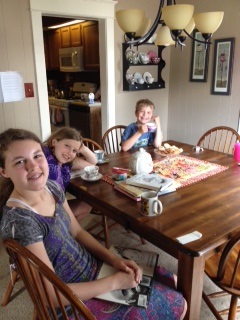
Poetry TeatimeI have 3 kids homeschooling right now– 2 girls ages 13 and 10 and an 8 year old boy.

I have a collection of teacups and everyone loves choosing their cup for the day. My 10 year old likes to plan the treat which has varied from peanut butter and jelly sandwich triangles to freshly baked banana bread. However simple the snack is we always set it out on pretty serving plates.

Our poetry collection at this point is mostly Shel Silverstein and they happily dive in to each choose a poem to share. At first my son was reluctant because it seemed ‘girly’ but he has had a great time and has even helped make up some of the treats.

We have had some great conversations but my favorite thing about poetry teatime is that I feel free to sit down and just enjoy a treat with my children- no guilt.

Tiffany

Image (cc)

Poetry Teatime

Posted in Poetry Teatime | Comments Off on Poetry Teatime: Three for tea


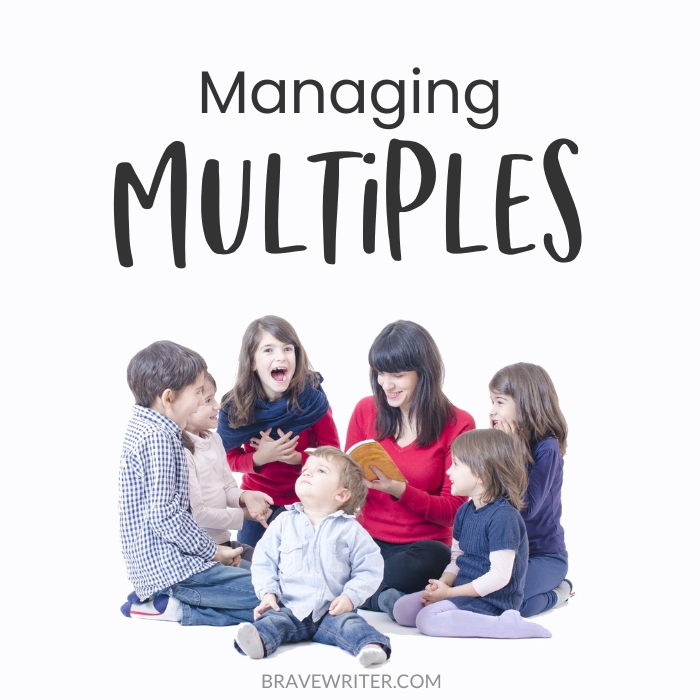
Managing Multiples in Your Homeschool

Brave Writer Managing Multiples

Grade levels are designed for schools, not home. Children similarly aged (not necessarily similarly skilled) are put into bunches and taught by one teacher, using materials designed for that group.

Home educators typically start their journeys with grade level products. They buy the entire slate of materials for Kindergarten or First Grade. As the oldest gets older, younger kids slide into the K or 1st position. By the time the oldest is in 5th grade, there may be three or four kids who are school aged, all with individual sets of products not necessarily coordinated in any meaningful way for you, the teacher of multiples!

The question becomes: “How do I teach all these levels simultaneously?”

It’s a great question! After all, children aren’t sent to be away from the home to a teacher in a separate building, while a parent at home makes meals, shops, and earns an income.

Rather, homeschooling families live in houses, condos, and apartments. They have more going on than an education. They’ve got pregnancies to contend with, toddlers and babies, all the necessities of life from food to laundry to dental appointments, and the pressure to figure out how to educate on the fly (very few home educators have any kind of training whatsoever!).

The secret to success is abandoning grade level.

Focus on subject area, not grade level.

You want all your kids learning about the same stuff together. They will automatically perform at “grade level” or according to their skill set. You can talk about Native American tribes with kids from pre-K to 10th grade. All kinds of materials and books can be gathered and used, together. DVDs, historical fiction, personal accounts from living Native Americans, studying maps, visiting burial grounds or Native American landmarks, making foods, weaving facsimiles of rugs or building replicas of their teepees and dwellings—what of this can’t be done on some level by everyone?

The goal is to create a shared family learning adventure. History and science (even literature) can, to a large extent, be studied collectively as you supply skill appropriate challenges within that context. At least everyone will be on the same page in terms of vocabulary, story, and focus. When you learn this way, students contribute to each other’s educations naturally, in conversation, through sharing their work together.

The 3 R’s (reading, writing, arithmetic) may seem like they are more grade-level bound, but that doesn’t meant you have to stretch yourself thin like a taffy-pull to get them in each day for four or more kids.

Set a time aside for when everyone does copywork. Light candles (one mom literally gives a tealight to each child-they write their name on the candle holder) and tell everyone—this is the time for copywork. You might be amazed that the youngest kids sustain a longer attention span when they are writing at the same time as the older ones. Once a week, kids can pick copywork for each other (knock knock jokes, or riddles, or favorite passages, or quotes from a favorite TV show). A sharing of the burden is possible—perhaps the older kids help the younger ones find passages that they would enjoy. Perhaps the younger ones can offer to decorate the writing of the older kids with stickers or artwork.

Managing Multiples

When you work on writing, suggest a project and have everyone contribute to it (a family letter, a collective report—each person contributing one page). Conversely, each child can work on producing writing for a family topic (subject area). They will select the kind of writing that matches their skill set, but all will focus on writing about artwork or nature or a response to a Shakespeare play.

Math can be done one at a time, if you need to teach specific concepts. But even then—it’s possible to discuss a math concept with the younger ones that the olders already know how to do. The older kids can demonstrate it in action or they might be partners during frisbee-toss skip counting. They can be asked to work with the younger child in secret and then come back to show off to you, the parent.

Reading time ought to be all together, when possible (memories get made here!). Start with the read aloud novel (whole family), followed by silent reading for older kids and reading library picture books for younger ones.

Do Things Together

The idea is to do things together—as much as is possible. When a child needs your undivided attention, pick a time that doesn’t compete with someone else’s similar need. Put your child on the calendar with a date and time—be present. The tendency is to attempt to teach important concepts in the midst of bedlam, and then to wonder why the child isn’t making progress.

If you keep the family together for most of the day, you also build momentum. You won’t be juggling kids who are restlessly waiting for you to help them. There will be productivity happening throughout the morning and into the afternoon. Dinner time will involve talking about the immersion in WW2, rather than each child having a different area of history to discuss and no one to discuss it with!

Home education is about a culture of family learning. Drop your memories of grade level. Focus on shared subject area learning, and group projects when you can.


Brave Learner Home

Posted in Homeschool Advice | 1 Comment »


Friday Freewrite: View from a window

eppnyImage by wonderwoodleyworks (cc)

Quick! Look out the nearest window and describe everything you see. Go!

New to freewriting? Check out our online guide.

Posted in Friday Freewrite | Comments Off on Friday Freewrite: View from a window


The Goal of Education

The Goal of Education

Your job—provide an education.

Your kid’s job—decide what to do with it.

Next year, five years from now, when he turns 18—these are not important today. Today is important.

Today’s task is to be present to today, with your kids. You can’t know how it will all turn out. You can’t decide now, for instance, that you are training your child to be an engineer simply because she’s great at Legos and math. Just because you think your child has a shot at a scholarship via viola doesn’t mean the child ought to play viola.

When we script the future of our children, we miss valuable learning opportunities today. We might focus on ensuring a set of criteria (check boxes of subjects studied) rather than seizing a moment now, right in front of us.

For instance, one mother shared at the Brave Writer retreat about a kestrel nesting box her son and husband built together. The son became so immersed in this project, he learned how to hook up video cameras for live streaming to the Internet and now a birding organization is coming to “band” the family of kestrels that live in it!

Kestrel nest building, live Internet streaming, and banding take real time away from Latin roots or grammar books or the study of ancient Greek political thought. Not only that, just because this son became a mini expert in one aspect of birding doesn’t mean he is destined for ornithology as his career choice.

The experience of caring about kestrels is quite independent of scope and sequence, college entrance requirements, and grades.

Yet it is inextricably bound up in all the elements of learning—reading, study, planning, construction, caring, pondering, mulling things over, making mistakes, correcting mistakes, anticipation, predicting, sharing results, interacting with real organizations that care about the same material (in this case, birds), and the eventual satisfaction of “mastery” or accomplishment. That meta-experience (meta—meaning, the experience as template over the actual activity) of learning is what IS the education. This child is teaching himself how to learn, he’s teaching himself about the power of invested, sustained, self-directed attention in the direction of his interests and innate powers.

What couldn’t this boy do next?

And who’s to say what that will be?

There’s no need to telescope and think that the content is what mattered here. In fact, the opposite is true. What happened in this activity is that the child moved one step closer to knowing that when he wants something, he has all the powers within to make it happen.

THAT’S the goal of education. It is not the result of most traditional educations. It IS the result of many home educations, when we pause to acknowledge and value what is happening in front of our eyes.

That said: my kids never built a single thing we could photograph and frame. It’s difficult sometimes to see what’s being built.

  • Maybe your kids are “building” a social network online.
  • Maybe they are “building” a mastery of their favorite book series having read it 13 times.
  • Maybe they are “building” muscles and skills for soccer.

Maybe they are playing chess or Wii bowling or Settlers of Catan and within each of those games, they are discovering the power of game strategy, calculated risk, the importance of details, the ability to imagine someone else’s perspectives through the possible moves they will make…

Perhaps they use one area of interest as a means to an end in another one (our favorite example: a cookie business to pay for space camp—Jacob did this at ages 11-12). He is not involved in either baking businesses nor space now.

What did he learn? That when he wants something, the power lies within him to find the means to make it happen—as he’s demonstrated through the steady stream of scholarships and opportunities he’s created for himself in his career aim to work in international human rights.

The interest of today is tied to tomorrow’s next step by virtue of the fact that that learning is stored inside a human being. That human being compiles experiences and learning opportunities into the cluster of skills necessary to flourish in the world.

The best way to prepare your child for tomorrow is to care completely about today’s happiness and interests. You do that by smiling, asking good questions, asking for permission to participate, and narrating back to the child the skills you see emerging from the investment being made. For instance, “Your dedication to beating that video game level is impressive. You’ve been steadily focused, willing to try again after repeated defeat, and you kept your cool. Wow.”

Learning is not about getting your child to a preferred future.

Learning is about your child becoming a person
who can choose a future for him or herself.


The Homeschool Alliance

Posted in Brave Writer Philosophy, Homeschool Advice | 5 Comments »


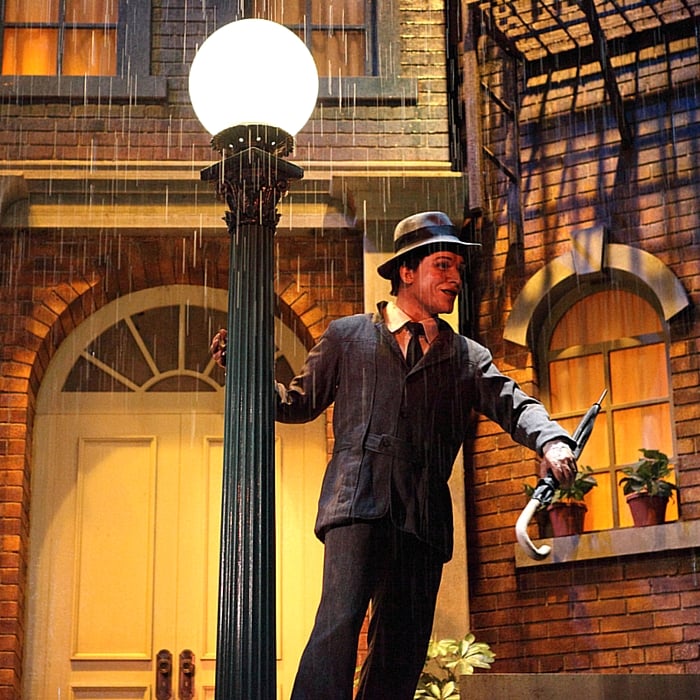
Movie Wednesday: Singin’ in the Rain

Movie Wednesday: Singin in the Rain

by Brave Writer alum, Kyriana Lynch

Singin’ in the Rain, the classic musical starring Gene Kelly, Debbie Reynolds, and Donald O’Connor, was released over sixty years ago in 1952. Since then, it has become a household name as much as “bacon and eggs” (to quote the film).

The trivia about the film is abundant and oh-so-fascinating. Watch—or re-watch—the movie with the family, and discuss the trivia together!

Debbie Reynolds

Debbie Reynolds was only 19 when she began filming this movie, and it was her first major film. Prior to Singin’ in the Rain, she was a gymnast and had no dance training.

Gene Kelly, a notorious perfectionist, criticized Reynolds’ dancing ability repeatedly while filming. One day, after some harsh words, she hid beneath a piano to cry. In a twist of Hollywood fate, she was found hiding by none other than Fred Astaire, who gave her some dancing advice.

During the “Good Morning” dance number, she kept up with Gene Kelly and Donald O’Connor for fourteen hours of dancing, only to be carried off set with bleeding feet. Later, Kelly would say of her, “Debbie was strong as an ox and could work for hours.” However, Reynolds maintained that, “The two hardest things I ever did in my life are childbirth and ‘Singin’ In the Rain’.”

Gene Kelly

Debbie Reynolds wasn’t the only dancer having difficulties in the film. Even Gene Kelly struggled through filming the iconic “Singin’ in the Rain” scene. The scene took seven days to film, with six hours spent in the fake rain each day. Not only was the water mixed with milk to make it show better on camera, but the mixture made Kelly’s suit shrink. Even worse, the whole time while filming Kelly had a cold and a high fever.

Donald O’Connor

Donald O’Connor’s “Make ‘Em Laugh” dance has been described as one of the most complex numbers in cinematic history, and has never been repeated perfectly. After working himself to exhaustion filming the number, O’Connor was forced to rest for several days. Then, he learned that the film had been damaged. O’Connor had to record the entire scene all over again!

Other Trivia from the Movie

While recording the speaking voice for “The Dancing Cavalier,” it was decided that Debbie Reynolds’ speaking voice was not rich enough. Instead, the actress for Lina Lamont, Jean Hagen—who in reality had a beautiful voice—recorded the speaking voice in the scene. So in the film, Lina was dubbing Kathy who was dubbing Lina’s voice!

An initial idea for the ending featured Lina Lamont in a movie called “Jungle Princess,” where she would speak only in grunts. Also, she and Cosmo would have married.

Only two songs were written for the film: “Moses Supposes” and “Make ‘Em Laugh.” The other songs were all taken from previous MGM films. Thus, the screenwriters were given a list of songs and had to connect them into the script for the movie.

Hope you enjoyed learning these trivial tidbits! Do any of them change how you view the movie or the actors and actresses in it? Discuss your reactions with your family!

Need help commenting meaningfully on plot, characterization, make-up and costumes, acting, setting and even film editing? Check out our eleven page guide, Brave Writer Goes to the Movies. Also, tell us about a film you and your kids watched together (along with a pic if you have one) and if we share it on the blog you’ll receive a free copy!

Image by Sam Howzit (cc cropped)

Posted in Wednesday Movies | Comments Off on Movie Wednesday: Singin’ in the Rain


« Older Entries
Newer Entries »
  • Search the Blog

  • Julie Bogart
  • Welcome, I’m Julie Bogart.

    I’m a homeschooling alum -17 years, five kids. Now I run Brave Writer, the online writing and language arts program for families. More >>

    IMPORTANT: Please read our Privacy Policy.

  • New to Brave Writer? START HERE

  • FREE Resources

    • 7-Day Writing Blitz
    • Brave Writer Lifestyle Program
    • Brave Writer Sampler: Free Sample Products
    • Freewriting Prompts
    • Podcasts
  • Popular Posts

    • You have time
    • How writing is like sewing
    • Best curriculum for a 6 year old
    • Today's little unspoken homeschool secret
    • Do you like to homeschool?
    • Don't trust the schedule
    • You want to do a good job parenting?
    • If you've got a passel of kids
    • You are not a teacher
    • Natural Stages of Growth in Writing podcasts
  • Blog Topics

    • Brave Learner Home
    • Brave Writer Lifestyle
    • Classes
    • Contests/Giveaways
    • Friday Freewrite
    • High School
    • Homeschool Advice
    • Julie's Life
    • Language Arts
    • Movie Wednesday
    • Natural Stages of Growth
    • One Thing Principle
    • Our Team
    • Parenting
    • Philosophy of Education
    • Podcasts
    • Poetry Teatime
    • Products
    • Reviews
    • Speaking Schedule
    • Students
    • Writing about Writing
    • Young Writers
  • Archives

  • Brave Writer is a participant in the Amazon Services LLC Associates Program, an affiliate advertising program designed to provide a means for sites to earn advertising fees (at no extra cost to you) by advertising and linking to amazon.com

    Content © Brave Writer unless otherwise stated.

What is Brave Writer?

  • Welcome to Brave Writer
  • Why Brave Writer Works
  • About Julie
  • Brave Writer Values
  • Frequently Asked Questions
  • Speaking Schedule

Brave Writer Program

  • Getting Started!
  • Stages of Growth in Writing
  • The Brave Writer Program
  • For Families and Students
  • Online Classes
  • Brave Writer Lifestyle

…and More!

  • Blog
  • Classroom
  • Store
  • Books in Brave Writer Programs
  • Contact Us
  • Customer Service
  • Brave Writer Staff
© 2026 Brave Writer
Privacy Policy
Children's Privacy Policy
Help Center