A Brave Writer's Life in Brief - Page 453 of 781 - Thoughts from my home to yours A Brave Writer's Life in Brief
  • Start Here
    • For Families
      Multiple Ages
    • Ages 5-7
      Beginning Writers
    • Ages 8-10
      Emerging Writers
    • Ages 11-12
      Middle School Writers
    • Ages 13-14
      High School Writers
    • Ages 15-18
      College Prep Writers
  • Shop
    • Product Collections
    • Bundles
    • Writing Instruction Manuals
    • Literature & Grammar/Punctuation
    • Composition Formats
    • Literature Singles
    • Homeschool Help
    • Book Shop
  • Online Classes
    • Class Descriptions
    • Class Schedule
    • Classroom
    • How Our Classes Work
    • Our Writing Coaches
    • Classes FAQ
  • Community
    • Brave Learner Home
    • What’s Happening
    • Blog
    • Podcast
    • Calendar
  • Cart
  • My Account
    • My Online Classes
    • My Account
  • My Account
    • My Online Classes
    • My Account
  • Start Here

    If you’re new to Brave Writer, or are looking for the best products for your child or family, choose from below:

    • For Families
      Multiple Ages
    • Ages 5-7
      Beginning Writers
    • Ages 8-10
      Emerging Writers
    • Ages 11-12
      Middle School Writers
    • Ages 13-14
      High School Writers
    • Ages 15-18
      College Prep Writers
  • Shop

    If you’re already familiar with Brave Writer products, go directly to what you’re looking for:

    • Product Collections Browse the full catalog in our shop
    • Bundles Everything you need to get started
    • Writing Instruction Manuals Foundational Writing Programs
    • Literature & Grammar/Punctuation Grammar, Punctuation, Spelling & Literary Devices
    • Composition Formats Writing Assignments for Every Age
    • Literature Singles Individual Literature Handbooks
    • Homeschool Help Homeschooling Tools and Resources
    • Book Shop Books associated with Brave Writer Programs
  • Online Classes
    • Class Descriptions
    • Class Schedule
    • Classroom
    • How Our Classes Work
    • Our Writing Coaches
    • Classes FAQ
  • Community
    • Brave Learner Home
    • What’s Happening
    • Blog
    • Podcast
    • Calendar
  • Search
  • Cart

Search Bravewriter.com

  • Home
  • Blog

A Brave Writer's Life in Brief

Thoughts from my home to yours

Poetry Teatime: Unleashing their voices

Poetry Teatime

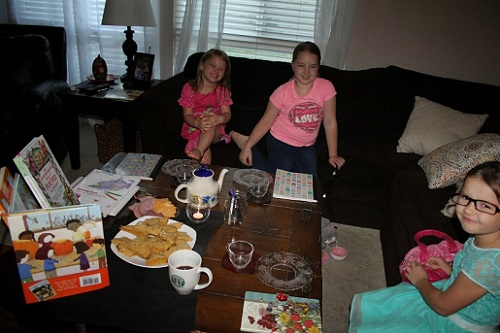
The simple things. This is year two of doing our weekly Friday morning tea time of reading and free writing with also a sweet treat to savor during our time of reflection and sharing. Some of our Fridays, the eager girls come to the table dressed in a role (strollers, baby dolls, pretend glasses) as their props for writing. The creativity of what our Fridays look like are endless fun. These are sacred moments, and despite if our week is a whirlwind (Oh, how that can happen with 4 young ones!) there is great anticipation the night before as they set out their journals and selected books in preparation for our Friday morning. We have collected various pieces of writings of poems and stories together from these cherished Fridays that is “our family book of writings” in the making. There is much value in the words from a page, the creation from the pencil, and a voice. We all have a story to be told. What these children have to say is worth to be heard, and I’m grateful I get to experience their story in the making every Friday. We talk a lot about how their voice and creativity has importance, and with time, craft, and patience, that voice can be unleashed and used for mighty things.

We enjoy making a dramatic drum roll when whoever is up in turn to share what they wrote. We end with lots of applause and encouragement for being brave with sharing their thoughts. Our 4 1/2 year old started referring this year to herself as “a writer.” She sure is, I tell her! She is recognizing that even at her young age, she too, has an important voice to be heard. Her journal is filled with scribbles of pictures and letters that all tell her story. When she sits up so proudly to share during our ritual every Friday morning tea, she looks down to her collage of pictures from her journal. and confidently shares. I record every word from that precious mouth. I re-read aloud what she narrated, and she will often say, “I wrote that!” My oldest now writes freely with limitless creativity, and my kindergartner doesn’t feel restrained since she can’t spell many words yet; she picks up the pencil and intently carries on drawing and sharing her writings. I record and re-read what my preschooler and kindergarten share, and their faces light up with such joy to hear their story being told.

Beautiful thoughts and words start early on. There just needs to be endless opportunities to unleash it. My hope is that my children discover some of their voice on this journey during our Friday mornings of writings.

Kirsten Casper, Brave Writer fan, mom to four children who have voices to be unleashed: 2nd grader, kindergartner, preschooler, & 9 month old)

Image (cc)

Visit our Poetry Teatime website!

Posted in Poetry Teatime | 1 Comment »


Two Ways to Grow Teens

Homeschooling teens

Teens present a challenge to parents who are used to the cozy snuggly younger years of wide-eyed curiosity about lady bugs. Teens can become bored by the wonder of the world around them as they navigate the far-more-interesting-to-them inner world of their thoughts, emotions, and yearnings.

That first teen—how I pity her or him! Parents don’t want to be awakened from the dreamland of their perfect, precious child. They want to prolong innocence and enchantment.

Teens want risk and adventure. They want to prove to themselves that one day, they will in fact be competent adults who live in the world outside the living room walls. They can’t know that they will be successful in that world until they get their hands on it—until they are out in it!

How do we—the anxious parents of these gawky, voice-changing, hair-growing, newly curvy bodies—give them what they need without panic and anxiety?

There are two critical pathways to the expansion of self:

1. Witness
2. Encounter

Witness

One way to grow is to increase your exposure to a world that is different from your familiar one. We adults do that every day by reading the news, or watching television, or listening to radio. We “witness” the events from around the globe via film or satellite, we read interesting discussions about those events, we listen to interviews with people who live in the midst of those events, and we receive stories through movies, memoirs, and novels of people who live very differently from us. This “witness” to the experiences of others expands our worldview and rearranges what we understand as normative or important. We discover our values differently when they are held up next to the values of others (whether those others live down the street or across an ocean).

For teens—they “witness” a larger world in much the same ways, if they are given the chance! They have the Internet—which offers them Twitter, Facebook, bulletin boards for affinity-related discussion, news organizations, blogs like Tumblr, and more. It’s easy to want to limit the use of the Internet, but it’s almost impossible to do so successfully (teens can work around just about any limit you set). It’s even better to create conversation around what they learn there and to be a willing conversation partner for the cognitive growth that is happening at breakneck speed in that space.

They also witness the larger world through novels and films. These two vehicles help teens to absorb the motivations and complexities of being human in unfamiliar (or very familiar!) contexts. They can read, take time off, read more, and process it all safely at home with you.

Witness provides teens with a chance to explore unfamiliar territory at arm’s length. The experience is under their control. They can shut down the computer, they can turn off the television, they can close the book. They are free to sample or deep dive, to agree or disagree without consequence to their life’s situation.

Homeschooling teens

Encounter

Encounter is the more challenging, more impacting way to grow. Encounter is not at arm’s length. Encounter means being overwhelmed (all five senses) with the experience so that you can’t escape it nor package and manage it. For instance, you might “witness” what life is like in Iran by reading a book like Reading Lolita in Tehran. But to encounter life in Tehran, one would have to go and stay there! Travel is one level of encounter (visiting a place for a short stay). An extended stay working in a foreign country is another level of encounter. Moving to live in a foreign country is the most intense form of encounter.

In terms of raising teens, encounter can look a few ways. It is meeting someone who embodies whatever life experience and values are his or hers (that differ from your own). It is befriending someone who comes from a different background. It is visiting the sites where other views take place (for instance, going to a temple for a visit when you are studying about that religion, especially when it is not your religion; another example—visiting a plantation in the South when you grew up in the North hating plantations as representations of slavery).

Encounter is eating the food, hearing/speaking the language, wearing the clothing, adopting the customs.

Encounter is deliberately putting yourself in the uncomfortable position of being with someone different from yourself and allowing that experience to impact you.

We help our teens grow when we give them both opportunities. They love risk and adventure! When you allow them to develop affinities, to explore their curiosities, and to meet/know people who are different from them, you help their brains! They will experience the kind of cognitive growth critical to being critical thinkers and healthy adults!

Cater to their natural inclination to take “thought-risks” and put them in contact with material and people who challenge their assumptions. Celebrate the results (whatever they may be!). Remember: no teen retains the values developed at 14 and 17. Are you today the same person you were at 15? I doubt it.

Everyone adopts positions to try on like shoes when they are teens. So let them adopt away! If you create space for a teen to imagine herself into a viewpoint, she will also have space to move through and out of it too, if she gets more and new information from witnessing or encountering!

It’s an exciting time to parent, if not a little nerve-wracking at times.

Try not to grip too tightly, and enjoy the ride.


Help for high school writers

Posted in Homeschool Advice, Tips for Teen Writers | 1 Comment »


Friday Freewrite: Touch

Friday Freewrite - Touch

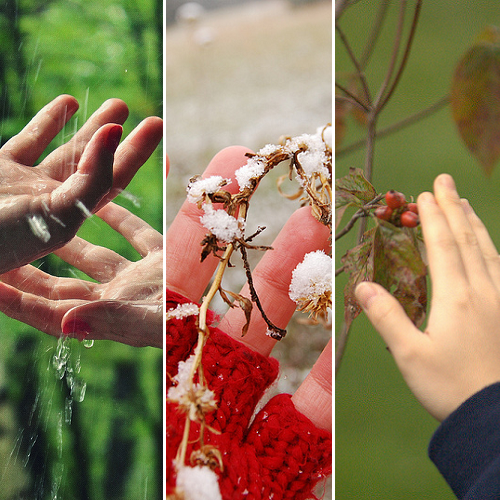
Today’s writing prompt is inspired by Brave Writer’s Keen Observation exercise with a focus on touch:

Choose three items (can be natural or man-made), close your eyes, and explore what each feels like. Record your thoughts then compare and contrast the items. And feel free to use similes: “This one feels like…”

New to freewriting? Check out our online guide.

Images by martinak15, LearningLark, and Graham Milldrum (cc photos are cropped)

Posted in Friday Freewrite | Comments Off on Friday Freewrite: Touch


Winter class schedule is up!

WBWW 95

Registration Opens Mon, Dec. 1, 2014
Noon Eastern (12:00 p.m. EST)

Classes Offered:

Expository Essay
Groovy Grammar
High School Writing Projects
Just So Stories
Kidswrite Basic
Kidswrite Intermediate
Literary Analysis: Rebecca
Middle School Writing Projects
Movie Discussion Clubs: Gutsy Boys and Brave Girls
Playing with Poetry
Photography and Writing
SAT/ACT Essay Prep

Feel free to email Julie or to contact Brave Writer via the online chat option (lower right corner of the home page) if you need help determining which classes would be best for your kids and you.

Click here for more info!

Image by Brave Writer mom, Colleen (cc)

Posted in Online Classes | Comments Off on Winter class schedule is up!


Be More Interested in Thinking than Thoughts

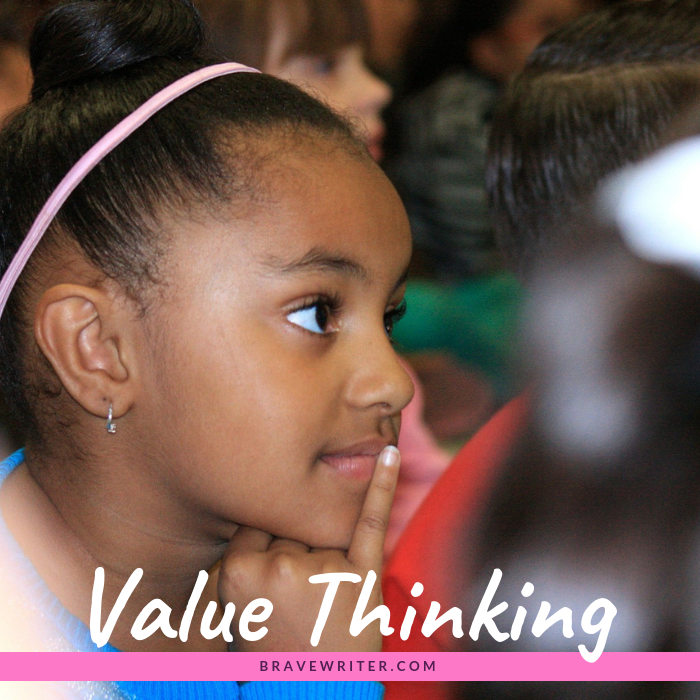
Value Thinking more than Thoughts

When someone shares a strong opinion—even when unsubstantiated by facts and data—it’s easy to feel that it is your obligation to enlighten said person with the “truth” —the truth that has eluded them until they happened upon your smarter, more capable mind.

A child is necessarily younger and less experienced with the world than you are, so their opinions will come from a different (more limited) space. But those conclusions and thoughts are no less logical to the child, no less important, no less “true” in his or her own mind’s eye.

I don’t know anyone who has kept every opinion formed at age ten throughout the rest of life. Kids, teens, young adults, heck OLD adults, routinely revise their notions of what is true, right, and good all the time, as they add experiences, information, and relationships to their lives. Our job as parents isn’t to “safeguard” a particular set of ideas or beliefs (no matter how much we may hope that our kids will adopt a particular set).

Our job is to value cognitive processes that show our kids are learning to reflect on their thinking. We don’t do this to manipulate our kids to adopt our way of thinking. We do it to enhance the powers of thought that our kids are exhibiting.

Example.

When Johannah first became interested in animal rights, she wanted to find a way to make a difference. For her, that meant adopting veganism as her lifestyle. It would have been easy to forbid it (since I had to cook for six other meat-lovers in the family and her choice would be inconvenient) or to combat it with my experiences (I grew up vegetarian and I “knew” that she wouldn’t want to be one forever) or to rebut it with my own set of facts about health.

But what I could see in her commitment wasn’t an opinion about animal rights nearly as much as it was an expression of how she “took in” impacting information and then applied it to her life. She was showing me that when she took something seriously, she would make a corresponding choice to back it with her actions! What an amazing development in a young person—to not just rant about ideas, but to put into practice a highly inconvenient lifestyle choice to back up her convictions!

As a result, our family accommodated this choice. In fact, two more kids chose to become vegans as a result of watching this commitment lived out. We had lots of discussions about how we make commitments and to what causes. It was not easy for my three vegans to understand my choice to not be vegan, for instance. Just my own lifestyle provided them with a chance to learn how to peacefully co-exist with difference—different:

  • experiences,
  • thoughts,
  • choices,
  • facts.

Today, only one of the three is still vegan. They have their new reasons for why they live differently now. These new choices show growth in how they nuance commitments and what they believe. As I suspected, their ideas morphed and grew just like mine have over a lifetime.

When our kids become passionate about a belief, or when they are exploring ideas that may even seem uncomfortable to us, this is a chance to be supportive of the cognitive development happening right before our eyes!

It’s a wonderful thing to see a mind choose to think independently of the family culture—to branch out to find information, ideas, and commitments all their own. It doesn’t mean our kids will even land or stay with these ideas for good. Most of us shift identities and beliefs again and again throughout our lives.

Rather, our children, teens, young adults are doing the hard work of becoming—becoming people who know how to think for themselves, using the resources, experiences, and reasoning skills available at that stage in the journey.

All we have to do is buy soy milk, hummus, and Earth Balance margarine, while listening intently to the passionate plea to end violence against animals.


Raising Critical Thinkers


Brave Learner Home

Posted in Parenting, Raising Critical Thinkers | 2 Comments »


« Older Entries
Newer Entries »
  • Search the Blog

  • Julie Bogart
  • Welcome, I’m Julie Bogart.

    I’m a homeschooling alum -17 years, five kids. Now I run Brave Writer, the online writing and language arts program for families. More >>

    IMPORTANT: Please read our Privacy Policy.

  • New to Brave Writer? START HERE

  • FREE Resources

    • 7-Day Writing Blitz
    • Brave Writer Lifestyle Program
    • Brave Writer Sampler: Free Sample Products
    • Freewriting Prompts
    • Podcasts
  • Popular Posts

    • You have time
    • How writing is like sewing
    • Best curriculum for a 6 year old
    • Today's little unspoken homeschool secret
    • Do you like to homeschool?
    • Don't trust the schedule
    • You want to do a good job parenting?
    • If you've got a passel of kids
    • You are not a teacher
    • Natural Stages of Growth in Writing podcasts
  • Blog Topics

    • Brave Learner Home
    • Brave Writer Lifestyle
    • Classes
    • Contests/Giveaways
    • Friday Freewrite
    • High School
    • Homeschool Advice
    • Julie's Life
    • Language Arts
    • Movie Wednesday
    • Natural Stages of Growth
    • One Thing Principle
    • Our Team
    • Parenting
    • Philosophy of Education
    • Podcasts
    • Poetry Teatime
    • Products
    • Reviews
    • Speaking Schedule
    • Students
    • Writing about Writing
    • Young Writers
  • Archives

  • Brave Writer is a participant in the Amazon Services LLC Associates Program, an affiliate advertising program designed to provide a means for sites to earn advertising fees (at no extra cost to you) by advertising and linking to amazon.com

    Content © Brave Writer unless otherwise stated.

What is Brave Writer?

  • Welcome to Brave Writer
  • Why Brave Writer Works
  • About Julie
  • Brave Writer Values
  • Frequently Asked Questions
  • Speaking Schedule

Brave Writer Program

  • Getting Started!
  • Stages of Growth in Writing
  • The Brave Writer Program
  • For Families and Students
  • Online Classes
  • Brave Writer Lifestyle

…and More!

  • Blog
  • Classroom
  • Store
  • Books in Brave Writer Programs
  • Contact Us
  • Customer Service
  • Brave Writer Staff
© 2026 Brave Writer
Privacy Policy
Children's Privacy Policy
Help Center