
A Brave Writer's Life in Brief - Page 445 of 782 - Thoughts from my home to yours A Brave Writer's Life in Brief
  • Start Here
    • For Families
      Multiple Ages
    • Ages 5-7
      Beginning Writers
    • Ages 8-10
      Emerging Writers
    • Ages 11-12
      Middle School Writers
    • Ages 13-14
      High School Writers
    • Ages 15-18
      College Prep Writers
  • Shop
    • Product Collections
    • Bundles
    • Writing Instruction Manuals
    • Literature & Grammar/Punctuation
    • Composition Formats
    • Literature Singles
    • Homeschool Help
    • Book Shop
  • Online Classes
    • Class Descriptions
    • Class Schedule
    • Classroom
    • How Our Classes Work
    • Our Writing Coaches
    • Classes FAQ
  • Community
    • Brave Learner Home
    • What’s Happening
    • Blog
    • Podcast
    • Calendar
  • Cart
  • My Account
    • My Online Classes
    • My Account
  • My Account
    • My Online Classes
    • My Account
  • Start Here

    If you’re new to Brave Writer, or are looking for the best products for your child or family, choose from below:

    • For Families
      Multiple Ages
    • Ages 5-7
      Beginning Writers
    • Ages 8-10
      Emerging Writers
    • Ages 11-12
      Middle School Writers
    • Ages 13-14
      High School Writers
    • Ages 15-18
      College Prep Writers
  • Shop

    If you’re already familiar with Brave Writer products, go directly to what you’re looking for:

    • Product Collections Browse the full catalog in our shop
    • Bundles Everything you need to get started
    • Writing Instruction Manuals Foundational Writing Programs
    • Literature & Grammar/Punctuation Grammar, Punctuation, Spelling & Literary Devices
    • Composition Formats Writing Assignments for Every Age
    • Literature Singles Individual Literature Handbooks
    • Homeschool Help Homeschooling Tools and Resources
    • Book Shop Books associated with Brave Writer Programs
  • Online Classes
    • Class Descriptions
    • Class Schedule
    • Classroom
    • How Our Classes Work
    • Our Writing Coaches
    • Classes FAQ
  • Community
    • Brave Learner Home
    • What’s Happening
    • Blog
    • Podcast
    • Calendar
  • Search
  • Cart

Search Bravewriter.com

  • Home
  • Blog

A Brave Writer's Life in Brief

Thoughts from my home to yours

What do we talk about AFTER the movie?

What do we talk about AFTER the movie?

Have you ever experienced this? You added a regular movie night to your Brave Writer Lifestyle. You carefully selected a quality film you believed your child would enjoy. The credits have rolled, and the conversation goes something like this:

“What did you think?”
“I liked it.”
“What are your thoughts about the main character?”
“I liked her.”
“Did you have a favorite part?
“I don’t know. Could I play Minecraft now?”

The exchange feels stilted and forced. Instead of a Big Juicy Conversation, your child wants to bolt. Next time, keep the following tips in mind.

7 Ways to Encourage Natural, Lively Film Discussion

1. Lead the way. If you get, “I don’t know,” for an answer then share your reactions. “It made me angry when…” “I had no idea that X would happen…” “Were you as shocked as I was that Y didn’t win?”

2. Be specific. “What did you think?” is so open that some children aren’t able to pin down reasons. Instead try, “What surprised you the most?” and “Could you predict the ending? How did you know?!”

3. Dig Deeper. When your child responds with a general, “I liked it,” you might say, “That’s cool. What did you like about it? The story? The songs? The animation? I liked…”

4. Ask probing questions. “If a psychologist looked at the actions of Z what do you think he or she would say?”

5. Encourage connection. “Do you relate to anyone in the movie, or do any of the characters remind you of someone you know? And, if so, how are they alike?”

6. Seize the moment for retelling. Oral narrations can feel stiff and artificial when asked for. However, if the child is retelling to someone who hasn’t seen the movie, then the retelling springs from a natural place of wanting to share. So let’s say you watched a movie in the afternoon, when the non-homeschooling parent arrives home, ask over dinner, “We watched a great movie today. Who wants to tell Daddy or Mommy about it?”

7. Don’t push it. Sometimes the best conversations happen a day or two later! Not everyone is prepared to discuss a film the moment the credits roll! Wait for the drive to the dentist or while washing dishes. Bring it up in light conversation and through memories of the film and see how it goes them.

The Bottom Line

Even without a discussion, movie viewing is valuable to your kids as a means of teaching them the structure of plot, characterization, setting, mood, theme, and more. Over time, these are all “going in” and you will find that your children will draw on those memories of movie-viewing to help them as they explore literary analysis in high school and beyond.

Image by Personal Creations (cc cropped and text added)

Need help commenting meaningfully on plot, characterization, make-up and costumes, acting, setting and even film editing? Check out our eleven page guide, Brave Writer Goes to the Movies. Also, tell us about a film you and your kids watched together (along with a pic if you have one) and if we share it on the blog you’ll receive a free copy!

Posted in Wednesday Movies | Comments Off on What do we talk about AFTER the movie?


Poetry Teatime: Most delightful yet!

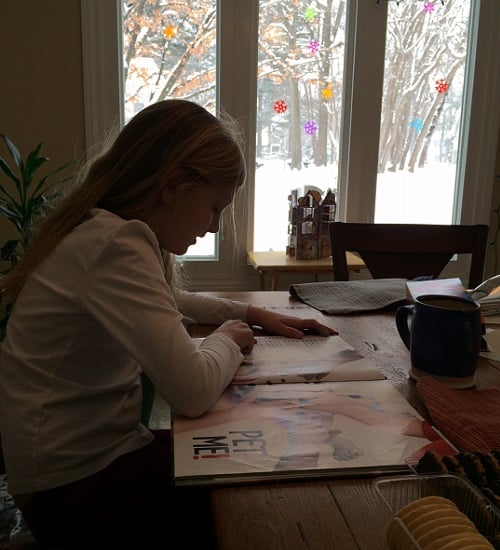
Poetry TeatimeReading the poem “Pet Me!” from Dogs Rule! by Daniel Kirk

Hi Julie!

Although her older brother has been homeschooling since August, my daughter just began homeschooling this week, and the first thing she asked to do was Poetry Tea Time!

Tea Time at our house doesn’t usually involve fine china or crumpets. This week it was mugs of hot cocoa, Girl Scout cookies, and a lingering of the holiday mess. No matter! It was our most delightful tea time yet!

Thank you for an idea that inspires.

Amy

Image (cc)

Poetry Teatime

Posted in Poetry Teatime | Comments Off on Poetry Teatime: Most delightful yet!


Slow Down: You Can Only Do What You Can Do

Brave Writer Slow Down

I’ve had a flurry of phone calls lately. One common thread is that January seduces parents into believing they can fly. There’s something about the start of a new year—the blank slate, the brand new, the no-mistakes-made-yet, the intoxicating elixir of “this year will be different.”

Whatever failed in fall is now up for re-evaluation and redoubling of effort. The urgency to “get something done” for year end evaluations, or to satisfy a skeptical spouse, or to appease your own fantasy of what “should” be happening in your homeschool is surging.

The temptation is great to completely change gears or programs, or to load up on one particular subject area, or to revamp your schedule so that the one neglected child who was happily playing Minecraft all day is now required to sit at the kitchen table for two hours straight every morning (to prove to you that he IS being homeschooled).

My caution: Slow down, Bessie.

You can’t change who you are with the snap of your fingers or all the alarms and whistles of your smart phone. No one new curriculum piece will transform your personal style of being or your natural family rhythm. Worse: if you do the “big overhaul” right now, you may upend all that lovely “settling in” that would naturally happen.

Huge shifts in philosophy or practice midyear feel like whiplash to kids. They sense that the changes mean whatever came before was “not good enough.” (And what if they were reasonably happy doing whatever before? What if they were just getting the hang of the math book or copywork or the system you use to study history?)

It’s hard to commit to an experiment, too. Your children aren’t reading homeschooling discussions and they aren’t necessarily worried about their educations. You worry (that’s your job).

So what should you do if you are dissatisfied with the program or the feel of your homeschool midyear?

Pause. Take notes.

Let yourself consider the good of what IS going on in your homeschool before you assume it is all wrong or messed up.

I remember one year when I thought we weren’t doing enough dictation (I had some fantasy that we’d do it a couple times per week per child). Midyear, I pulled out our notebooks where I collected their work. Page after page of dictation. It wound up being that each child had practiced dictation 2-3 times per month. By January, that meant they had done dictation practice 8-10 times. These dictations, in the shiny clear page protectors, showed remarkable effort and growth. Did they need more dictation than that?

No. The answer turned out to be no.

But the temptation to revamp the schedule was so strong, I almost did it without that backwards glance. It was a fluke that led me to examine the notebooks and to recognize that with my personality and our busy lives, getting to some form of dictation 2-3 times a month was not only pretty good, it was getting the job done!

This is what I want you to consider. It may actually be true that the practices in place are enough and are a true reflection of who you are, already. It’s good to pause, to look through workbooks, to flip through photos, to remind yourself of all the ways you explored learning and the world.

To make an adjustment, follow this plan to help you and your kids make authentic reasonable changes.

Make logistical changes first.

Rather than throw in the towel on dictation, try new tools or a new environment to see if those recast the practice.

  • You might move dictation to a new time of day.
  • Add candles (or brownies!).
  • Use a digital recorder.
  • Maybe let the child do dictation alone in their bedroom.
  • Try typing dictation rather than handwriting.
  • Let the child select her own passage.
  • Have children pair up to do dictation of jokes with each other.
  • Use gel pens and black lined paper.

The point is that sometimes the practice is fine, but the context is tedious or unhelpful.

Change one egregious subject only.

Don’t get swept up into the “change it all” plan. Save that for summer, when you have time to really think through how the new philosophy will work. If the subject getting you down is your awful co-op composition class for 5th grade, drop it. If your daughter despises a workbook, shred it. If the math text is confusing even to you, a full grown adult, replace it. Overhaul the one truly awful component in your homeschool.,

Re-evaluate pace.

Does the child need to work every single math problem if she already understands the concept? Can you skip the odds or a full chapter? Perhaps you’ve been over-doing it on freewriting. Time to take a break and only have experiences, read books, and play with poetry before freewriting again. If you are trapped in Ancient Greece in history (kids are into it and you are sick of it), consider ways to re-hook your interest to accommodate theirs. You don’t HAVE to follow the four year history cycle just because a book tells you to.

Add or take away one regular out of the house trip.

For some families, if you just stayed home one more afternoon or day, you’d find that everything works beautifully. You’d have enough time and space for everything without rushing or hurrying or interrupting the flow. But there are some families who are home so much, the kids are utterly bored of the four walls and need an exit! Add one exciting outing a week (even going to the mall, the park, a coffee shop, the zoo, a friend’s house, the library) to change the vibe of family life, to have something to look forward to!

You can’t fly. You can only do what you do a little better than you are doing it now, until it stops feeling better…and you tweak it again. Be patient, trust the process, and go do something AMAZING that enlivens YOU (take on a big goal like traveling for a weekend away with girlfriends to see the Chicago Art Institute, or running a half marathon, or going to cooking class, or signing up to get your Master’s degree online).

You’re already doing a better job than you realize. I know because I know.


Brave Learner Home

Posted in Brave Writer Philosophy, Homeschool Advice | 1 Comment »


Friday Freewrite: Steering (or not)

Sledding Mary Waters Park

What are the pros and cons to being the one steering (in control) or being the one going along for the ride, and who would you rather be? Explain.

Image by Steven Depolo (cc cropped)

New to freewriting? Check out our online guide.

Posted in Friday Freewrite | Comments Off on Friday Freewrite: Steering (or not)


A tough season

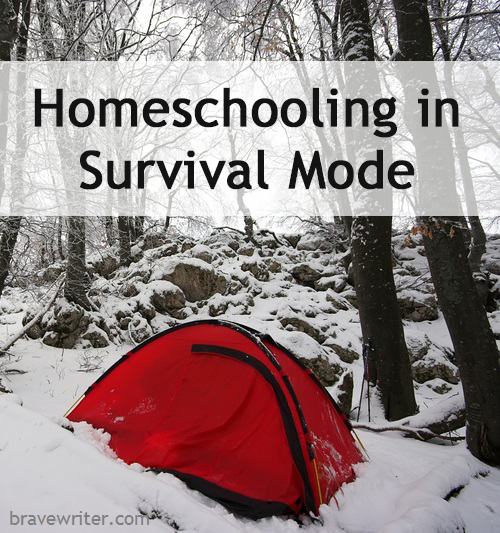
Red tent

An email dialogue with a Brave Writer mom:

Julie,

I feel bad emailing you like this. I know you’re so busy with all of your Brave Writer things and your actual life. I just know that I find so much comfort in your wisdom. I’ve heard you at conferences and chatted with you and I love your book, A Gracious Space. You’re just so encouraging, and your words always make me feel like everything is going to be okay. So right now, when I feel like I want to cry about all of this—kids, homeschooling, mothering, LIFE—I find myself wanting to cry to a complete stranger via email.

Aw. So glad you reached out!

I have four kids—7, 4, 2, and 7 months. My husband works long hours and has a long commute. He travels overseas frequently and our families live on the other side of the country. Basically, I’m on full-fledged duty around the clock, which is fine. I mostly do just fine with making it through the day. But I feel like I’m not giving my kids what they need. For example, my oldest wants to sew ornaments and sell them to make money. She’s a good little sewer, and I want to be able to help her accomplish her goals. But it’s not something she can do entirely on her own (she needs me to thread the needle and fix little knots and other mishaps). That’s no big deal, except that my 4-year-old has things he’s interested in, too. He’s really bright and curious and wants to learn to read, among other things. My 2-year-old is the real trouble. She’s so stinking cute, but she’s a little tornado that doesn’t quit. Ever.

This is a tough, tough season in your life. There are no easy answers because EVERYONE who has children the ages of your kids finds it impossible to come up with any system that actually works. You are in a kind of “happy-survival” mode and must make peace with the fact that the primary way you will overcome this stage is to wait it out (your kids will get older). Two year olds and three year olds have a way of undermining the space because who they are is in this enormous developmental Hurrah! They want what they want and they don’t have the tools yet to do for themselves. So you are all caught in the vortex of the two year old quite legitimately.

She WILL quit eventually but right now it seems like forever.

Confession: I hate reading to my kids. And it’s because when I do, I feel like I’m always yelling over someone (usually the 2-year-old). She wants on my lap, she wants off my lap, back and forth. She doesn’t nap much anymore, and when she does, she ends up staying awake in her room (coming out frequently, of course) until 9:00-10:00 at night, which is a problem on several other levels. The 7-month-old is…well, a baby. She’s super sweet, but she needs a lot from me, too. On top of it all, there’s the house and the laundry and the meals.

Try audio books. They saved my life when I had babies who nursed and hated hearing me read at the same time. You can even ONLY listen in the car when you are driving somewhere and then you don’t even have to read or calm anyone. They will be trapped in the car!

I just feel like there are so many things that I want to do to help my kids grow, but I can’t do any of them, because I’m so busy just keeping our house (barely) functioning. There are so many books I want to read to my older kids, but I only read a teeny tiny fraction of them, because of everything else. We manage to get the absolutely critical things done almost every day (math, copy work, independent reading),

WOW! Good for you. This is exceptional. Be proud of this.

but beyond that, it’s all about survival. My kids love poetry tea time, but we hardly ever do it. We don’t do free writes. We do history sporadically. I long ago decided that lots of outside play and watching Wild Kratts would have to suffice for science.

There you go! Rather than think you “rarely” do freewriting. Think: Yay! We got to freewriting twice this year! Yay! We had one poetry teatime! Yay! We took one field trip! Change your expectations and celebrate your tiny triumphs. Over a childhood, these will grow and repeat and become meaningful in new ways. Right now it seems you will never do any of these big activities with any regularity. But you will… eventually.

What were your days like when your kids were really little? You seem to have done this parenting/homeschooling thing really well—you seem to have enjoyed it, your kids seem to be successful, and you all seem to really like each other, which is what I’m going for over here, so I kind of look to you as my homeschool beacon.

Because they are full grown. I remember so many “squandered” days where all I could do was survive. I have five kids, all two years apart. I was pregnant or nursing for 12 years. Absolutely know your feelings. There were years where we hardly did dictation (for instance). But when I look at the notebooks from those years, we actually got it done 10 times. Ten is a lot! It’s more than I realized at the time, thinking I should have done it every other week for the whole year.

I realized that some years we were more into history than others. That’s just the way the cookie crumbled.

We had weeks where washing diapers and shopping at the store and laundering clothes and cleaning up toys felt like the only things we did. Yet when I looked back I could see that we built with Legos or I helped one learn to knit or I did manage to get to the library or we learned all the words to the songs on the Rafi album or we enjoyed watching Arthur on TV every night before dinner.

Remember that you are also on a learning curve about what works for you. Be good to yourself and trust that all of it will work together to create a vivid happy family life where learning also occurs.

For the older one who needs special help, help her. Keep her up after the baby goes to bed, or get her up extra early before the baby wakes, or promise her the next time the baby naps you’ll help her. You might consider hiring a mother’s helper (since your husband is gone a lot). She could be another homeschool girl or boy who comes for two hours to the house to play with the little ones so you can focus on the older one. This worked for me when I was working freelance as a ghost-writer. I just worked while the helper was downstairs. If they really needed me, I was available. But I didn’t have to supervise so closely.

Thanks for your time,
Adrienne

P.S. Because I feel like a bit of a mooch, emailing you directly for advice, I have to tell you that I am a paying member of the Homeschool Alliance. I don’t go there much, because I don’t have a lot of time, but I aspire to. Anyway, I’ve always thought you were amazing for being so available to so many people, so I’m happy to pay for my access to you. It’s worth it.

You are quite all right writing to me and I’m so glad you are in the Homeschool Alliance. Keep reading there. It will help you! Keep your chin up. You’re doing far more right than you realize.

((((Adrienne))))

Julie

Email is shared with permission

Image © Tetyana Kochneva | Dreamstime.com

Posted in Email, Homeschool Advice | Comments Off on A tough season


« Older Entries
Newer Entries »
  • Search the Blog

  • Julie Bogart
  • Welcome, I’m Julie Bogart.

    I’m a homeschooling alum -17 years, five kids. Now I run Brave Writer, the online writing and language arts program for families. More >>

    IMPORTANT: Please read our Privacy Policy.

  • New to Brave Writer? START HERE

  • FREE Resources

    • 7-Day Writing Blitz
    • Brave Writer Lifestyle Program
    • Brave Writer Sampler: Free Sample Products
    • Freewriting Prompts
    • Podcasts
  • Popular Posts

    • You have time
    • How writing is like sewing
    • Best curriculum for a 6 year old
    • Today's little unspoken homeschool secret
    • Do you like to homeschool?
    • Don't trust the schedule
    • You want to do a good job parenting?
    • If you've got a passel of kids
    • You are not a teacher
    • Natural Stages of Growth in Writing podcasts
  • Blog Topics

    • Brave Learner Home
    • Brave Writer Lifestyle
    • Classes
    • Contests/Giveaways
    • Friday Freewrite
    • High School
    • Homeschool Advice
    • Julie's Life
    • Language Arts
    • Movie Wednesday
    • Natural Stages of Growth
    • One Thing Principle
    • Our Team
    • Parenting
    • Philosophy of Education
    • Podcasts
    • Poetry Teatime
    • Products
    • Reviews
    • Speaking Schedule
    • Students
    • Writing about Writing
    • Young Writers
  • Archives

  • Brave Writer is a participant in the Amazon Services LLC Associates Program, an affiliate advertising program designed to provide a means for sites to earn advertising fees (at no extra cost to you) by advertising and linking to amazon.com

    Content © Brave Writer unless otherwise stated.

What is Brave Writer?

  • Welcome to Brave Writer
  • Why Brave Writer Works
  • About Julie
  • Brave Writer Values
  • Frequently Asked Questions
  • Speaking Schedule

Brave Writer Program

  • Getting Started!
  • Stages of Growth in Writing
  • The Brave Writer Program
  • For Families and Students
  • Online Classes
  • Brave Writer Lifestyle

…and More!

  • Blog
  • Classroom
  • Store
  • Books in Brave Writer Programs
  • Contact Us
  • Customer Service
  • Brave Writer Staff
© 2026 Brave Writer
Privacy Policy
Children's Privacy Policy
Help Center