A Brave Writer's Life in Brief - Page 414 of 783 - Thoughts from my home to yours A Brave Writer's Life in Brief
  • Start Here
    • For Families
      Multiple Ages
    • Ages 5-7
      Beginning Writers
    • Ages 8-10
      Emerging Writers
    • Ages 11-12
      Middle School Writers
    • Ages 13-14
      High School Writers
    • Ages 15-18
      College Prep Writers
  • Shop
    • Product Collections
    • Bundles
    • Writing Instruction Manuals
    • Literature & Grammar/Punctuation
    • Composition Formats
    • Literature Singles
    • Homeschool Help
    • Book Shop
  • Online Classes
    • Class Descriptions
    • Class Schedule
    • Classroom
    • How Our Classes Work
    • Our Writing Coaches
    • Classes FAQ
  • Community
    • Brave Learner Home
    • What’s Happening
    • Blog
    • Podcast
    • Calendar
  • Cart
  • My Account
    • My Online Classes
    • My Account
  • My Account
    • My Online Classes
    • My Account
  • Start Here

    If you’re new to Brave Writer, or are looking for the best products for your child or family, choose from below:

    • For Families
      Multiple Ages
    • Ages 5-7
      Beginning Writers
    • Ages 8-10
      Emerging Writers
    • Ages 11-12
      Middle School Writers
    • Ages 13-14
      High School Writers
    • Ages 15-18
      College Prep Writers
  • Shop

    If you’re already familiar with Brave Writer products, go directly to what you’re looking for:

    • Product Collections Browse the full catalog in our shop
    • Bundles Everything you need to get started
    • Writing Instruction Manuals Foundational Writing Programs
    • Literature & Grammar/Punctuation Grammar, Punctuation, Spelling & Literary Devices
    • Composition Formats Writing Assignments for Every Age
    • Literature Singles Individual Literature Handbooks
    • Homeschool Help Homeschooling Tools and Resources
    • Book Shop Books associated with Brave Writer Programs
  • Online Classes
    • Class Descriptions
    • Class Schedule
    • Classroom
    • How Our Classes Work
    • Our Writing Coaches
    • Classes FAQ
  • Community
    • Brave Learner Home
    • What’s Happening
    • Blog
    • Podcast
    • Calendar
  • Search
  • Cart

Search Bravewriter.com

  • Home
  • Blog

A Brave Writer's Life in Brief

Thoughts from my home to yours

Poetry Teatime: Showing hospitality

Poetry Teatime

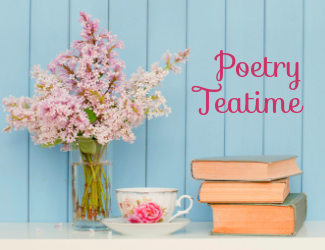
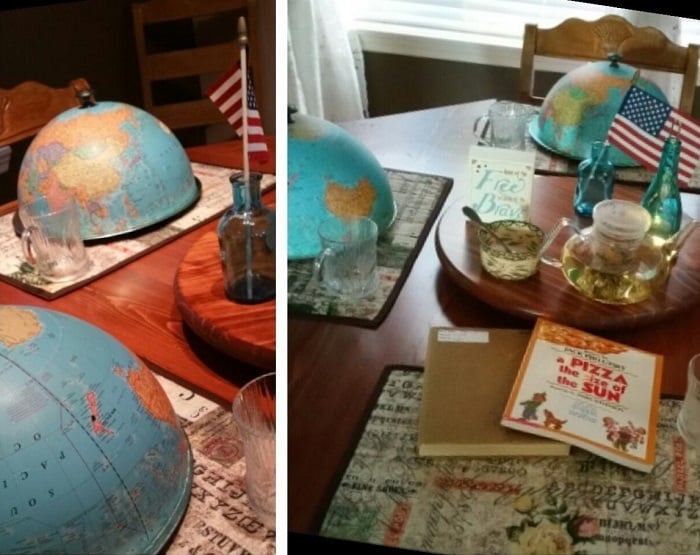
This is our first teatime experience while reading poetry. I made the globe charger covers to surprise them with the special treats underneath. Our theme this year is countries and cultures.

We enjoyed an exotic flowering peach tea with European sweet bread and grapes. My children were amazed to see the tea seed turn into a beautiful peach flower. This was causing so much fun the kids wanted me to keep reading the poems.

I’m always looking for ideas to show hospitality to my children, and this definitely allowed me to go above and beyond while creating memories.

Poetry Teatime

As we wrapped up this teatime my daughter already choose the poetry book for next Tuesday.

Sincerely,
Courtney

Poetry Teatime

Posted in Poetry Teatime | Comments Off on Poetry Teatime: Showing hospitality


Milkshake Apologies!

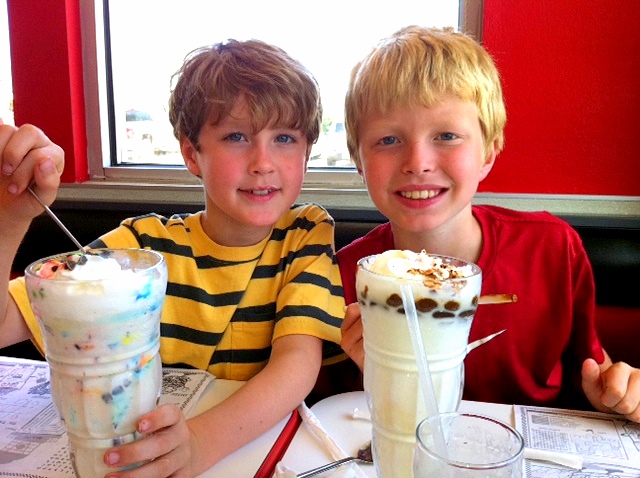
Milkshake apologiesImage by Judge Pera (cc cropped, tinted, text added)

If your year is starting and you’re feeling sheepish—that nagging sense that you and your child are not on the same page—here’s a practice that can help to “reset” the dial between you.

Take your child out for a shake, or a slushie, or something yummy.

Once you are settled, own up to whatever contribution you’ve made to the icky feelings. One mom I spoke with shared how last year she made a list with her daughter of fun things to do in homeschool—and then never did them. She let “school” rob her of her confidence in pursuing things like baking and sewing. Understandably, the daughter’s attitude toward this year’s curricula is hostile.

Maybe you and your kids are at odds over a particular program, practice, or problem in your family. You can’t begin with the fresh feeling of a new school year if there is distance, edge, or irritation between you.

Children can’t put you in “time out,” they can’t take away your technology, they can’t give you a low grade. What they can do is pick at your bad habits, laugh derisively when you make mistakes, or roll their eyes when you express enthusiasm. This is how they hold you accountable—they resist.

Reestablishing connection has to come first—before algebra or study of the ancient Greeks.

Start with your part.

How have you contributed to the alienated feelings between you? Have you ignored your child’s unhappiness? Not followed through on a promise? Shouted or shamed your child into performance?

Maybe you are teaching a curriculum you don’t even like—yet you expect your child to “like” it. Perhaps there’s a level of admission there that needs to happen—”I don’t like this program, yet I’m requiring you to like it. I see the inconsistency in that. I’m sorry.”

Milkshake apologies

Image by Jim Larrison (cc)

Once you share how you see yourself contributing to the negative energy between you, ask your child what else is upsetting. Is there something else you should know?

Create space for them to add to the list of what is not going well. Apologize for that too—even if it feels unfair.

Sip. Take big slurps of your milkshake to help you hold back from being defensive. Listen. Your child can even be flat out wrong—your only task is to leave space for the child to share his or her perspective in that moment.

Next, talk about what will be different this year. Make it concrete, keep it short. Perhaps you are about to switch to one new program. Or maybe you will follow through on the promise to get your child piano lessons (and will do it that day, when you get home).

Go low. Be the one who apologizes first—who creates space for a renewed connection. Make eye contact. Be open.

If your child does the whole, “I don’t know” and “There’s nothing wrong,” that’s okay too. It could be that your child is still figuring out whether or not you will change—will actually do what you are now promising to do. So do it! Start the change cycle.

And see what happens next.

Your tasks? Pay for drinks, apologize, offer to listen, make one or two new plans, follow through.

You can do this!

Brave Writer Lifestyle

Posted in Homeschool Advice | Comments Off on Milkshake Apologies!


Why we don’t use video in Brave Writer online classes

Why we don't use video in Brave Writer online classes

Some people ask why our classes don’t make use of video. It’s a pedagogical choice: reading produces better writers than listening. Not only that, reading requires depth of concentration and attention that enable the reader to internalize what is being read. Listening allows for greater distraction. For instance, have you ever noticed how you can be looking at your child and rearranging the cabinets in your mind at the same time? You appear to be listening, but you’ve “checked out.”

Listening to lectures creates a similar result. You may have an affective moment of “Wow that was wonderful!” but the retention of the particulars is not nearly as complete as if you had read the same material.

“In fact, studies have shown that reading uninterrupted text results in faster completion and better understanding, recall, and learning than those who read text filled with hyperlinks and ads. Those who read a text-only version of a presentation, as compared to one that included video, found the presentation to be more engaging, informative, and entertaining, a finding contrary to conventional wisdom, to be sure. Additionally, contrary to conventional educational wisdom, students who were allowed Internet access during class didn’t recall the lecture nor did they perform as well on a test of the material as those who weren’t ‘wired’ during class. Finally, reading develops reflection, critical thinking, problem solving, and vocabulary better than visual media.” ~Jim Taylor Ph.D., Psychology Today

Some thoughts about technology and learning.

Image by Brave Writer mom Anne


Check out Brave Writer's NEW online class pageCheck out our NEW online class page!

It’s magical! Click on the choices by age or semester or type of student (Family Classes, Parent is Student, Child is Student, and High School) and the page transforms for you!

Brave Writer online classes are uniquely designed with the busy homeschooling parent in mind. Classes last anywhere from three to six weeks. We offer courses that address a specific writing need so that you can take one or more over the course of a school year. We keep the class sessions short so that you may work around your family’s schedule.

LEARN MORE

Posted in Online Classes | Comments Off on Why we don’t use video in Brave Writer online classes


Friday Freewrite: Dress up

Friday Freewrite: Dress up

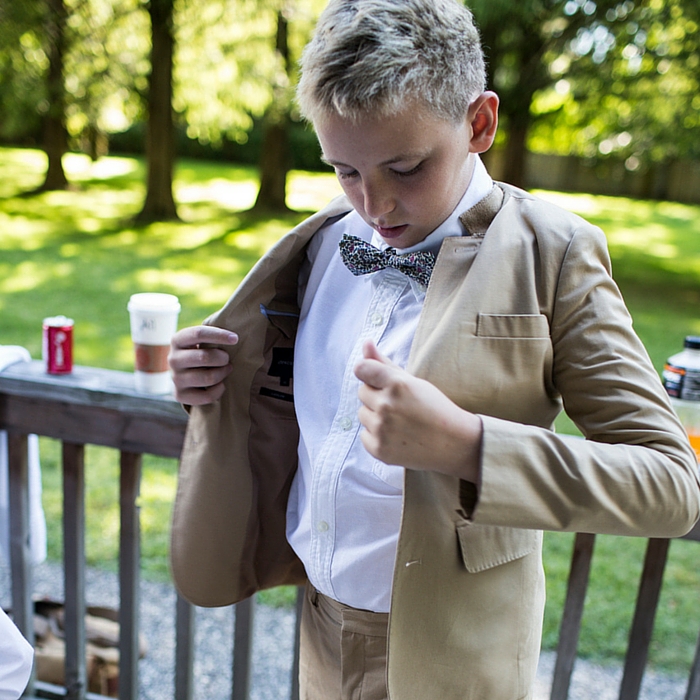
Should kids be made to dress up for an event if they’d rather wear jeans and a t-shirt? Why or why not.

New to freewriting? Check out our online guide.

Image by StarMama (cc cropped)

Posted in Friday Freewrite | Comments Off on Friday Freewrite: Dress up


The Power of Story

Power of story- Jen

We read aloud to our children each day, fulfilling this basic “requirement” that our kids get an education from quality literature often not aware of how deep that education goes just from reading Redwall (again) or The Wind in the Willows. I don’t know if we (as a group) have plumbed the depths of how powerful all that reading is. In fact, I daresay that we mostly have not!

How many of us have associated the pleasure of Trumpet of the Swan with furnishing academic brilliance?

Yet this is precisely what is happening in living rooms strewn with Legos across the country (and globe). Home educators are doing a greater service for their children and the aims of education through the simple practice of immersing themselves in story each day than any other single practice.

You’re providing the education academics DREAM of providing.

Did you know that STORY is the foundation of a quality liberal arts education?

Rudyard Kipling says:

“If history were taught in the form of stories,
it would never be forgotten.”

Story as Education

Narratives, tales, myths, legends, fictions–the ability to see the story
in any subject area is the heart of a sophisticated, multi-faceted education.

Here’s why.

Academics like to talk a lot about the “imagination”–the capacity to imagine oneself into other times and places, cultures and worldviews, value sets and moral dilemmas.


Your child’s academic imagination grows
in direct relation to immersion in story.


Reading aloud, reading fiction, reading poetry, reading biographies, reading non-fiction, reading religious texts: Reading leads to a robust exploration of what it means to be human, sharing a planet.

Story also comes from other sources: film, video games, plays, documentaries, lectures, sermons, artwork, music, and television.

What homeschoolers do better than any other educational tool is plunge their children into the heart of STORY, every day:

narrative,
plot,
characters,
perspectives,
experiences,
moral dilemmas,
enriching cultural detail,
other times, other places, other worlds!

You’re great at it!

As we give our children this gift of STORY from the rocking chair or cuddled on a couch, we create connections in our children’s minds that resurface again and again. Charlotte Mason calls these connections: “The Science of Relations.” In Brave Writer, we call them: “Powerful Associations.”

Modern day stories that make use of ancient mythology are resonant for active readers (Percy Jackson books, Harry Potter, Hunger Games). Historical fiction shows us the world before we arrived and gives us context for our every day experiences (Johnny Tremain, The Master Puppeteer, The Bronze Bow).


Cross-cultural exploration through story shrinks the globe
and creates empathic ties to people who are different from us.


One of my favorite professors (40+ years as a professor, Harvard Ph.D.) said to me last week that what’s missing in too many of today’s in-coming college freshmen is the capacity to imagine richly–with texture, openness, and connection between subjects. Reading and writing in the humanities, in particular, depend on a complex intuitive understanding of the narrative arc:

what creates surprise,
the nature of viewpoint,
power dynamics,
moral right and wrong as they are funneled through lived experiences and confronted by characters/actors through dilemmas,
the underlying mythology of the narrative.

Moral Imagination

One of the core curriculum classes at Xavier University is called “Literature and the Moral Imagination.” The goal of that class is not dissimilar to what you all do every day you read aloud to your children. You are shaping your children’s understanding of morality, intuitively, without lecture. Your kids are forming their values through confronting the moral dilemmas faced by beloved characters!

As I spoke with Professor Dewey, I shared about what we do in Brave Writer. We offer classes that are designed to plunge our children into the juicy soul of STORY.

We not only read Rudyard Kipling’s Just So Stories, we ask our students to write them!

We not only enjoy Greek Myths, we explore them for their structure and ask students to produce their own fictional accounts of Gods and Goddesses they create!

Dr. Dewey was thrilled, saying that he wished all schools did this for children.

We’re not just “creative writing” here at Brave Writer.


Our story writing classes offer your students a pathway to
intellectual excellence and moral development.


Hope you’ll take advantage of them!

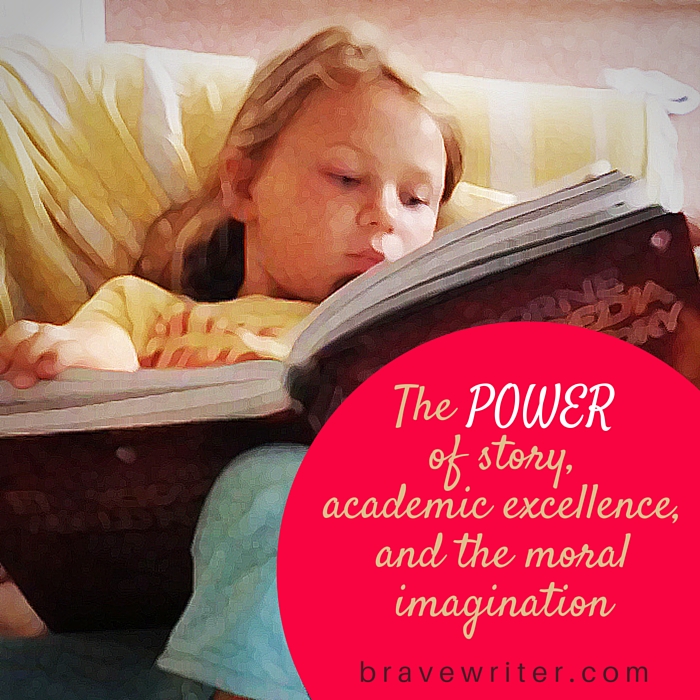
Image of child reading by Brave Writer mom Jen

Posted in Brave Writer Philosophy, Homeschool Advice, Online Classes | Comments Off on The Power of Story


« Older Entries
Newer Entries »
  • Search the Blog

  • Julie Bogart
  • Welcome, I’m Julie Bogart.

    I’m a homeschooling alum -17 years, five kids. Now I run Brave Writer, the online writing and language arts program for families. More >>

    IMPORTANT: Please read our Privacy Policy.

  • New to Brave Writer? START HERE

  • FREE Resources

    • 7-Day Writing Blitz
    • Brave Writer Lifestyle Program
    • Brave Writer Sampler: Free Sample Products
    • Freewriting Prompts
    • Podcasts
  • Popular Posts

    • You have time
    • How writing is like sewing
    • Best curriculum for a 6 year old
    • Today's little unspoken homeschool secret
    • Do you like to homeschool?
    • Don't trust the schedule
    • You want to do a good job parenting?
    • If you've got a passel of kids
    • You are not a teacher
    • Natural Stages of Growth in Writing podcasts
  • Blog Topics

    • Brave Learner Home
    • Brave Writer Lifestyle
    • Classes
    • Contests/Giveaways
    • Friday Freewrite
    • High School
    • Homeschool Advice
    • Julie's Life
    • Language Arts
    • Movie Wednesday
    • Natural Stages of Growth
    • One Thing Principle
    • Our Team
    • Parenting
    • Philosophy of Education
    • Podcasts
    • Poetry Teatime
    • Products
    • Reviews
    • Speaking Schedule
    • Students
    • Writing about Writing
    • Young Writers
  • Archives

  • Brave Writer is a participant in the Amazon Services LLC Associates Program, an affiliate advertising program designed to provide a means for sites to earn advertising fees (at no extra cost to you) by advertising and linking to amazon.com

    Content © Brave Writer unless otherwise stated.

What is Brave Writer?

  • Welcome to Brave Writer
  • Why Brave Writer Works
  • About Julie
  • Brave Writer Values
  • Frequently Asked Questions
  • Speaking Schedule

Brave Writer Program

  • Getting Started!
  • Stages of Growth in Writing
  • The Brave Writer Program
  • For Families and Students
  • Online Classes
  • Brave Writer Lifestyle

…and More!

  • Blog
  • Classroom
  • Store
  • Books in Brave Writer Programs
  • Contact Us
  • Customer Service
  • Brave Writer Staff
© 2026 Brave Writer
Privacy Policy
Children's Privacy Policy
Help Center