Writing about Writing Archives - Page 23 of 27 - A Brave Writer's Life in Brief A Brave Writer's Life in Brief
  • Start Here
    • For Families
      Multiple Ages
    • Ages 5-7
      Beginning Writers
    • Ages 8-10
      Emerging Writers
    • Ages 11-12
      Middle School Writers
    • Ages 13-14
      High School Writers
    • Ages 15-18
      College Prep Writers
  • Shop
    • Product Collections
    • Bundles
    • Writing Instruction Manuals
    • Literature & Grammar/Punctuation
    • Composition Formats
    • Literature Singles
    • Homeschool Help
    • Book Shop
    • Special Offers
  • Online Classes
    • Class Descriptions
    • Class Schedule
    • Classroom
    • How Our Classes Work
    • Our Writing Coaches
    • Classes FAQ
  • Community
    • Brave Learner Home
    • What’s Happening
    • Blog
    • Podcast
    • Calendar
    • Brave Writer Lifestyle
  • Cart
  • My Account
    • My Online Classes
    • My Account
  • My Account
    • My Online Classes
    • My Account
  • Start Here

    If you’re new to Brave Writer, or are looking for the best products for your child or family, choose from below:

    • For Families
      Multiple Ages
    • Ages 5-7
      Beginning Writers
    • Ages 8-10
      Emerging Writers
    • Ages 11-12
      Middle School Writers
    • Ages 13-14
      High School Writers
    • Ages 15-18
      College Prep Writers
  • Shop

    If you’re already familiar with Brave Writer products, go directly to what you’re looking for:

    • Product Collections Browse the full catalog in our shop
    • Bundles Everything you need to get started
    • Writing Instruction Manuals Foundational Writing Programs
    • Literature & Grammar/Punctuation Grammar, Punctuation, Spelling & Literary Devices
    • Composition Formats Writing Assignments for Every Age
    • Literature Singles Individual Literature Handbooks
    • Homeschool Help Homeschooling Tools and Resources
    • Book Shop Books associated with Brave Writer Programs
    • Special Offers
  • Online Classes
    • Class Descriptions
    • Class Schedule
    • Classroom
    • How Our Classes Work
    • Our Writing Coaches
    • Classes FAQ
  • Community
    • Brave Learner Home
    • What’s Happening
    • Blog
    • Podcast
    • Calendar
    • Brave Writer Lifestyle
  • Search
  • Cart

Search Bravewriter.com

  • Home
  • Blog

A Brave Writer's Life in Brief

Thoughts from my home to yours

Archive for the ‘Writing about Writing’ Category

« Older Entries
Newer Entries »

Copywork and Dictation: How Often? (Revisited)

Homework

Julie,

Could you briefly share with us how copywork and dictation look in your home and include the highest grade you’ve had at home? I’ve shared your arrow and boomerang (the concept) with several friends and the common concern is that it doesn’t appear to be enough. Many believe that copywork and dictation should be daily not weekly. I would love your insight on this matter!

Lisa

—

Hi Lisa.

Sure, I can share.

My oldest kids are in college (the oldest two are 21 and 18). I homeschooled both of them through high school, though the second one went part time to our local high school as well. Our third child is a junior in high school and goes full time. He was homeschooled through 9th grade. We have two more kids: 8th and 7th grades – all homeschooled.

Copywork and dictation can be done more frequently than weekly. The Arrow/Boomerang are designed to support the homeschooling parent, not to replace her own good judgment and her skills as a home educator. In fact, when I first designed the Arrow (which came first), I used to always say that the goal was to model how copywork and dictation can be done (how to select passages, how to teach them, how to make them more meaningful). Mothers can learn to do it themselves, if they like.

I included only one passage per week for several reasons:

1) Discouragement: Many mothers set out to do copywork/dictation more than a couple times per week and then when they fail to hit their target, they give up and stop doing it all together. I’ve found that copywork/dictation once per week is way better than not doing it at all while holding the ideal of doing it twice or three times or every day of the week. In fact, I’ve found that once a week adds up to a lot of copywork/dictation if done all year.

2) Length of passage: Some of the passages in the Arrow and particularly the Boomerang are long. They benefit from being broken up into multiple days of work.

3) Personal preference: Kids like to pick their own copywork. Not all copywork has to be selected for them. By offering only one passage per week, your have the freedom of selecting other passages to copy (song lyrics, poetry, passages from a beloved book, refrigerator magnets, a religious text). If I give you more than one per week, you will feel you must impose those passages on your kids to get your money’s worth. But this way, you focus on one passage, really teach it, and then can allow your kids to select the ones that they want.

4) Stress: For reluctant writers, it is a lot to ask them to do handwriting work (in a book, for instance), copywork, dictation, freewriting, and any writing project all in a week. The Arrow and Boomerang allow you to feel that you are covering the material necessary to a good language arts program without putting your child through too much pencil trauma.

Brave Writer is different than other programs. I believe firmly in a parent’s role in the homeschool. We are supports to what you do. We offer products that teach you how to teach. Of course you can do more copywork and dictation if you like. I have a son (14) who copied things every day and did special handwriting therapies for his dysgraphia. Yet two years ago, he could hardly write even one passage a week. I have an 11 year old daughter who doesn’t like the passages I pick who writes in her journal and her Greek notebook every day, even in summer. We talk about grammar over lunch or in the car. She is learning spelling through Facebook status updates!

My older kids credit their years of dictation with their punctuation skills (the ones in college). They feel like they learned mechanics painlessly. My junior in high school has successfully gone straight into Honor’s English without having ever done a formal grammar or spelling program. He’s learned it all through less than once per week dictation over his lifetime.

Pay attention to your kids. Do what you believe nourishes them. Let them tell you what is working and what is not. Kids don’t learn as well when they are numb to the subject matter, when they feel obliged to fulfill your expectations without their buy-in. If once a week copywork/dictation is tolerable (even enjoyable) for you kids, they will learn a lot! There’s no reason to think that more is necessarily better.

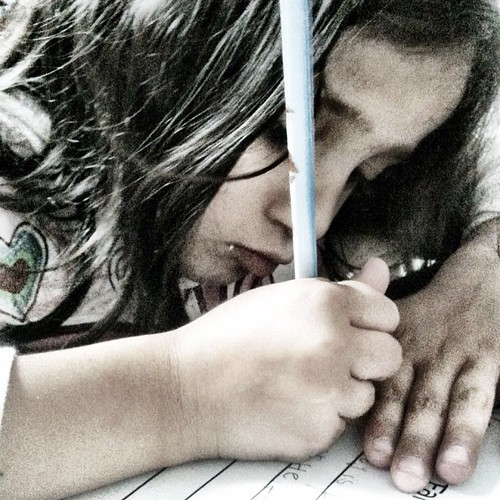
Image by Alastair Vance
Posted in Brave Writer Philosophy, Copywork Quotations, Email, Writing about Writing | 3 Comments »

Moms Who Write

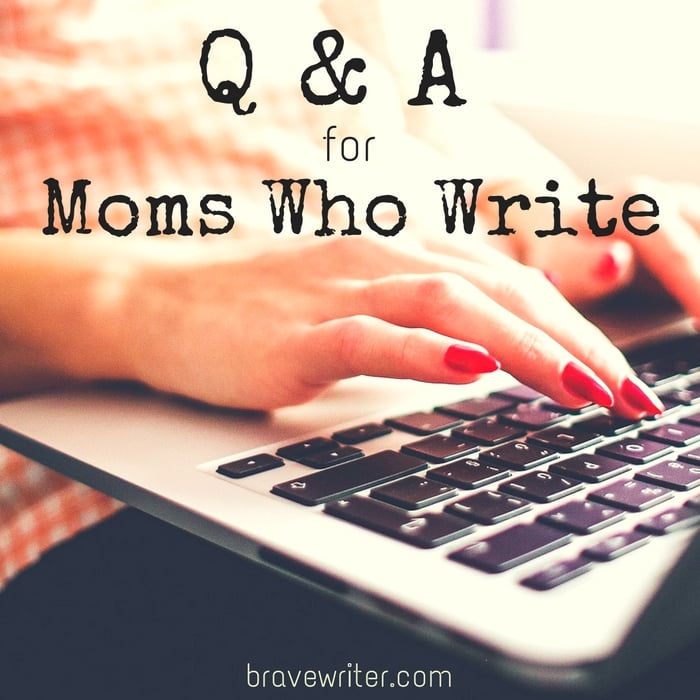
Q & A for Moms Who Write

Do you offer writing classes for moms?

We have. We’ve done them every couple of years in the summer. But it’s possible to work on your writing on your own. One great opportunity is in November: NaNoWriMo (National Novel Writing Month). If you’ve got that romance novel burning in your imagination, or you have the tale of a suspicious murder to unfold, November could be your month to finally tackle it, without intimidation and with the support of a nationwide network. Check it out.

What can you suggest for moms who want to grow as writers?

Write. It seems so redundant to say it, but believe it or not, I need to hear it every day myself. In fact, one of the disadvantages of running a writing business is that I spend more time writing about writing than actually doing it for the sheer joy, satisfaction and creativity of the thing!

  • Step One:
    Make time to write. Read about writing, read good writing, and then go write.
  • Step Two:
    The second step is more difficult. You must find an audience for your writing and you must risk doing it pretty early in your writing development. Why? Because you’ve got to develop this thick, scaly skin that masterfully deflects the darts of critique, all while accepting them into your writing psyche. One of the hardest things to do with your precious writing is to risk sharing it with a dispassionate audience who has the cajones to tell you when your writing is banal, trite, flowery or boring. Seriously, those are the hardest critiques for me.

There’s this habit we fall into that is not good for us: we fall in love with our own words. They float off the page toward us with rainbows and powdered sugar and we can’t believe we, mere humans, thought to write those words – those insightful, magical, melodious words. Then someone points out that there are no powerful verbs, the analogy is flawed and the piece stands up better without your favorite sentence. Suddenly you know you’re a fraud, and will never write well, and what were you thinking when you tried to write?

Yeah, that’s just how it feels for everyone.

So write anyway, take the fiery darts of honest feedback like the tough woman who survived labor and lived to tell about it, and get better at it.

Does it work the same way with non-fiction and article writing?

Yes it does. You gather insights and ideas, put them into lists and then craft those lists into articles to share with others. Start by reading in the exact article-writing genre that interests you. Take notes of insights and novel approaches to familiar topics (mine the areas of your personal expertise: homeschooling, gardening, spirituality, organizing a desk, sharing about the birds and bees with pre-teens, recovering from a c-section). Then begin to flesh out those topics through freewriting alternating with research. You want both your natural voice to come through as well as some sophistication (data to substantiate your intuitive hunches).

To market your work, check out Writer’s Market from the library and page through the magazines that relate to that field. Most likely you won’t sell your first article (or if you do, you will get paid peanuts). But that’s how we all start! So if you want to write, do it and cajole your way into any publication that will have you. Over time, you will develop your resume of published items and that will help you find better paying and bigger magazines for your audience.

More on Awesome Adulting!

Posted in Writing about Writing | 8 Comments »

More about Talking and Writing

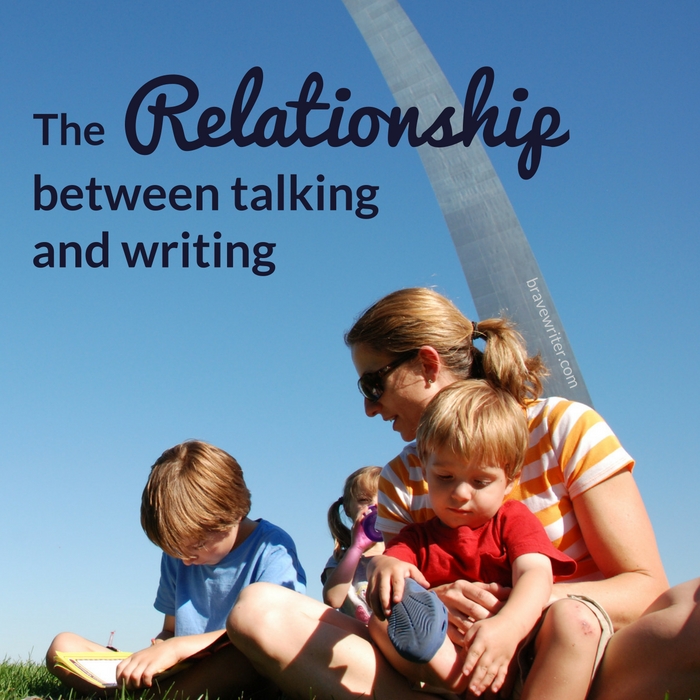
The relationship between talking and writing

A Brave Writer mom writes:

Hi Julie,

Thanks for this post. I am challenged to give my children full attention talk time. I am always DOING something while they are talking. I am not sure what they’d do if I stopped and looked them and in the eye!

I found the post interesting as it relates to me though. I feel that I am better able to express myself through the written word. For me, the opposite of what you’ve described seems to be true. When I have let the words come out through my fingers and onto the page, I am a much more confident talker later on. After writing, I have a better idea of how I feel, what I think, what’s important. In fact, I’d like to see how improved writing could improve my abilities as a conversationalist.

Let’s talk (I mean write!) about this.

When I say that talking helps kids write, I mean it. But I want to acknowledge that:

Writing helps us think better than talking.

It is perfectly natural and right that when you want to figure out what you really think about a topic, writing is more likely to draw it from you than talking or chatting. A good conversation with a supportive listener can have a similar effect, but the truth is, there is something about putting those words down onto a page where you can sit back and reread or observe them that causes you to identify the thread, the thought, the idea in its concrete form more effectively than chatting or talking.

So I want you to know I agree with you. That fact (that writing leads to clarity of thinking) is what has made me a chronic journal-keeper and now blogger for my entire life. It’s what made me love essay writing and research papers. It’s why I tend to take notes when I listen to a great talk or seminar. I recognize that my ideas become more crystallized when I write.

Talking and Writing

So what did I mean, then, that
talking leads to better writing in kids?

Here’s the subtle nuance I want to emphasize. Before a child feels fluent in the mechanics of writing, before a child has had success with writing to the degree that he or she discovers the magic and power of the written word to unveil that next layer of insight, talking is the means by which a person develops a vocabulary of personal value. In other words, talking is the primary mechanism that establishes “writer’s voice.” Conversation, reporting, sharing, narrating all lead to a growing confidence and competence in language – the very stuff that will lead to more satisfying writing, more ease in writing eventually… which will then lead to better thinking.

To nurture that development as your children share, then, you will:

  • listen,
  • reflect back,
  • mirror and support the development of speech.

You’ll notice their flourishes, their senses of humor, their attention to detail, their surprising word choices and your job is to affirm these.

When they go to write, perhaps you will even remind them of that “so funny thing they just said at dinner” to include in the writing. You might jot down their words as they fly out of their mouths for them (and naturally this will happen when you are nursing the baby and making dinner at the same time). If you can “catch your child in the act of thinking” (i.e. talking) and capture the words on paper, you’ve given your child a huge headstart in the writing process. Suddenly that natural voice, those easy to find words are available for writing! Such a relief!

As you support that process, you are actually giving your child a chance to see just how connected the interior life, conversation, and writing really are: which is the strange and magical mix that informs all good writing.

Brave Writer Online Classes

Header image by Brave Writer mom Christa

Posted in Brave Writer Philosophy, Writing about Writing | Comments Off on More about Talking and Writing

« Older Entries
Newer Entries »
  • Search the Blog

  • Julie Bogart
  • Welcome, I’m Julie Bogart.

    I’m a homeschooling alum -17 years, five kids. Now I run Brave Writer, the online writing and language arts program for families. More >>

    IMPORTANT: Please read our Privacy Policy.

  • New to Brave Writer? START HERE

  • FREE Resources

    • 7-Day Writing Blitz
    • Brave Writer Lifestyle Program
    • Brave Writer Sampler: Free Sample Products
    • Freewriting Prompts
    • Podcasts
  • Popular Posts

    • You have time
    • How writing is like sewing
    • Best curriculum for a 6 year old
    • Today's little unspoken homeschool secret
    • Do you like to homeschool?
    • Don't trust the schedule
    • You want to do a good job parenting?
    • If you've got a passel of kids
    • You are not a teacher
    • Natural Stages of Growth in Writing podcasts
  • Blog Topics

    • Brave Learner Home
    • Brave Writer Lifestyle
    • Classes
    • Contests/Giveaways
    • Friday Freewrite
    • High School
    • Homeschool Advice
    • Julie's Life
    • Language Arts
    • Movie Wednesday
    • Natural Stages of Growth
    • One Thing Principle
    • Our Team
    • Parenting
    • Philosophy of Education
    • Podcasts
    • Poetry Teatime
    • Products
    • Reviews
    • Speaking Schedule
    • Students
    • Writing about Writing
    • Young Writers
  • Archives

  • Brave Writer is a participant in the Amazon Services LLC Associates Program, an affiliate advertising program designed to provide a means for sites to earn advertising fees (at no extra cost to you) by advertising and linking to amazon.com

    Content © Brave Writer unless otherwise stated.

What is Brave Writer?

  • Welcome to Brave Writer
  • Why Brave Writer Works
  • About Julie
  • Brave Writer Values
  • Frequently Asked Questions
  • Speaking Schedule

Brave Writer Program

  • Getting Started!
  • Stages of Growth in Writing
  • The Brave Writer Program
  • For Families and Students
  • Online Classes
  • Brave Writer Lifestyle

…and More!

  • Blog
  • Classroom
  • Store
  • Books in Brave Writer Programs
  • Contact Us
  • Customer Service
  • Brave Writer Staff
© 2026 Brave Writer
Privacy Policy
Children's Privacy Policy
Help Center